Wednesday, May 29, 2019

WHAT ARE FLUIDS? - Fluids are substances that can flow or continually deform under an applied shear stress. A shear stress state is where the stress is parallel to the surface of the material. The term fluid therefore includes liquids and gas. Gases are easily compressed whereas liquids are nearly incompressible. A liquid has definite size but a gas expands to fill any closed vessel containing it. Fluids can change their shape readily, so their mechanical behavior cannot be described in terms of mechanics of a rigid body as is the case with solids.

Image result for What are Fluids? images
.............................................................................................
Image result for What are Fluids? imagesFluids
What are Fluids?


A fluid is substance that can flow or continually deforms under an applied shear stress.
A shear stress state is where the stress is parallel to the surface of the material. The term fluid therefore includes liquids and gas.
There are of course differences between liquids and gases.
Gases are easily compressed whereas liquids are nearly incompressible. A liquid has definite size but a gas expands to fill any closed vessel containing it.
However, in discussing the mechanical behavior of fluids we use only the properties of liquids and gases connected with their ability to flow.
Therefore, the same basic laws control the static and dynamic behavior of both liquids and gases.
Unlike solids, fluids can change their shape readily, so their mechanical behavior cannot be described in terms of mechanics of a rigid body as is the case with solids.
There is a difference in the way a force acts on a fluid as opposed to a solid.
A force can be applied to a single point of a solid and be sustained by it; but a force can only be applied to and sustained by a surface of an enclosed fluid.
In a fluid at rest such a force is always directed at right angles to the surface.
A fluid at rest cannot sustain a tangential force; the fluid layers would simply slide over one another when subject to such a force.
It is convenient therefore to describe the force acting on a fluid by specifying the pressure P, which is defined as the magnitude of the normal force per unit surface area.
P= Force/Area
Pressure is a
 scalar quantity.
Fluids display properties such as:
-- not resisting deformation, or resisting it only lightly (viscosity), and
-- the ability to flow (also described as the ability to take on the shape of the container).This also means that all liquids have the property of fluidity.
These properties are typically a function of their inability to support a shear stress in static equilibrium.
Solids can be subjected to shear stresses, and to normal stresses both compressive and tensile.
In contrast, ideal fluids can only be subjected to normal, compressive stress which is called pressure.
Real fluids display viscosity and so are capable of being subjected to low levels of shear stress.
In a solid, shear stress is a function of strain, but in a fluid, shear stress is a function of strain rate.
A consequence of this behavior is Pascal's law which describes the role of pressure in characterizing a fluid's state.
Depending on the relationship between shear stress, and the rate of strain, fluids can be characterized as one of the following:
Newtonian fluids : where stress is directly proportional to rate of strain
Non-Newtonian fluids : where stress is not proportional to rate of strain
Rheology is the science of deformation and flow.
One common factor between solids, liquids, and all materials whose behavior is intermediate between solids and liquid is that if we apply a stress or load on any of them they will deform or strain.

 Image result for What are Fluids? images
Image result for What are Fluids? imagesImage result for What are Fluids? imagesImage result for What are Fluids? images

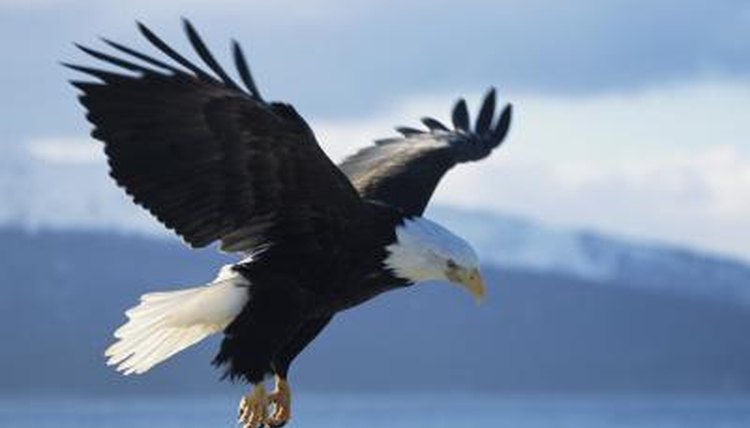
AERODYNAMICS OF THE BALD EAGLE - The bald eagle's body is covered with 7,000 hollow feathers. Interlocking layers of feathers contain insulating air pockets; the bald eagle rearranges his waterproof feathers to space out or draw together the air pockets, regulating body temperature. The bald eagle's wing tips have gaps between the flight feathers. He adjusts his wing slots to sustain his flight pattern and ensure precise movements. During flight he spreads his tail feathers, increasing the surface area; he glides and soars utilizing his tail to increase the effects of updrafts and thermals. The bones' light weight factors into aerodynamics, because weight determines how much lift is necessary to gain altitude relative to volume or displacement -- relative to how much space the bird takes up -- as well as determines maneuverability at speed.


.................................................................................................

AERODYNAMICS OF THE BALD EAGLE
By Karen Mihaylo


The national bird of the United States, the bald eagle is found only in North America.
The aerodynamic bald eagle (Haliaeetus leucocephalus) silently dives from the sky and snatches fish from the water.
He conserves energy by gliding on rising warm air currents called thermals and flies at altitudes up to 10,000 feet.
When you see several eagles riding the thermals as a group, you're viewing a "kettle" of eagles.

The Bald Eagle's Feathers

The bald eagle's body is covered with 7,000 hollow feathers.
Bald eagle feathers are lightweight -- 30 weigh about the same as a penny -- flexible and strong.
Interlocking layers of feathers contain insulating air pockets; the bald eagle rearranges his waterproof feathers to space out or draw together the air pockets, regulating body temperature.
Haliaeetus leucocephalus molts once a year, unlike most birds, who molt several times a year.

The Bald Eagle's Wings

The 8-foot wingspan of an adult bald eagle is a majestic sight.
The bird can reach 35 miles per hour during level flight. Angling his head, wings and tail, he takes maximum advantage of the wind, diving at up to 75 miles per hour with the wind at his back.
The bald eagle's wing tips have gaps between the flight feathers. He adjusts his wing slots to sustain his flight pattern and ensure precise movements.

The Bald Eagle's Tail

The bald eagle moves his tail from side to side, and up and down.
During flight he spreads his tail feathers, increasing the surface area; he glides and soars utilizing his tail to increase the effects of updrafts and thermals.
As the bald eagle dives, swoops or brakes, he steadies himself with his tail.

The Bald Eagle's Skeleton

The bald eagle's bones are hollow and virtually weightless.
An adult eagle weighs between 8 and 16 pounds, the male lighter than the female.
His bones weigh only about a half-pound, or 5 percent to 6 percent of his total body weight.
The eagle's beak, talons and feathers are made of lightweight keratin.
The bones' light weight factors into aerodynamics, because weight determines how much lift is necessary to gain altitude relative to volume or displacement -- relative to how much space the bird takes up -- as well as determines maneuverability at speed.

Flight Training

The juvenile bald eagle reaches adult size when he's 2 months old.
He makes his first flight about a month later but returns to the nest, where his parents will continue to care for him for another four to twelve weeks.
The bald eagle spends the first four to five years of his life in training, learning to hunt, strengthening his flight muscles and perfecting his flying techniques.

Author
Karen Mihaylo has been a writer since 2009. She has been a professional dog groomer since 1982 and is certified in canine massage therapy. Mihaylo holds an associate degree in human services from Delaware Technical and Community College.

ENGINEERING ARCH THEORY - The fundamental feature of arched structures is that horizontal reactions appear even if the structure is subjected to vertical loads only. This phenomenon is known as arch action. As the height or rise of the arch decreases, the outward thrust increases and as a result, maintaining the arch action and preventing the arch from collapsing, internal ties or external bracing must be employed. The efficiency of an arch can be demonstrated by comparing it with a beam of the same span under the same loading conditions.

Image result for images Engineering Arch Theory
................................................................................................
Image result for images Engineering Arch TheoryEngineering Arch Theory
What is engineering arch theory?
StructX


Engineering Arch Theory

Arches employ the principal that when weight is uniformly applied to them the forces resolve into axial compressive stresses and thrust at the base or bearing points instead of into bending moments.

The fundamental feature of arched structures is that horizontal reactions appear even if the structure is subjected to vertical loads only.

This phenomenon is known as arch action.

As the height or rise of the arch decreases, the outward thrust increases and as a result, maintaining the arch action and preventing the arch from collapsing, internal ties or external bracing must be employed.

The efficiency of an arch can be demonstrated by comparing it with a beam of the same span under the same loading conditions.

Fixed arch: statically indeterminate structures to the third degree, the end points require solid restraints. These types of arches are the most ridged but are sensitive to relative settlement at the supports as well as any additional forces created by changes in temperature.

Two-hinged arch: statically indeterminate to the first degree and although are not as rigid as fixed arches, they are somewhat insensitive to relative settlement at the supports.

Three-hinged arch: statically determinate and are not affected by settlement or the additional forces created by temperature changes.

Tied-arch: provides an internal member or tie to resist the outward thrust caused by arch action. A strong tension member connected between the arch springing points reduces the amount of any external bracing requirements.

Parabolic arch: because both the shape of the arch and the shape of the bending moment diagram are parabolic, when the arch is subjected to a uniform load, the bending moment at every section of the arch is theoretically zero. The arch will be under pure axial compression.

Assumptions and Limitations

·  The cross-section of the arch is considered small compared to its length (beam is long and thin)

·  Loads act transverse to the longitudinal axis and pass through the shear centre (any torsion/twist is eliminated).

·  Self weight of the arch has been ignored (this may have to be added).

·  The material of the arch is homogenous and isotropic and has a constant Young's modulus in all directions.

·  The young's modulus is considered to be constant in both compression and tension.

·  The resultant moment of the bending stress is equal to the external moment along the entire length of the beam.

·  The centroidal plane (Neutral surface) is subjected to zero axial stress and does not undergo any change in length.

·  Deflections are assumed to be very small compared to the overall length of the arch.

·  The cross-section remains planar and perpendicular to the longitudinal axis during bending.

·  Any deflection of the arch follows a circular arc with the radius of curvature considered to remain large compared to the dimension of the cross section.

"Good engineers don't need to remember every formula; they just need to know where they can find them."

StructX was created in an effort to provide a comprehensive and freely accessible resource for the structural engineering community - "Good engineers don't need to remember every formula; they just need to know where they can find them". Fundamentally, StructX is an ever adapting source of formulas, data, properties and techniques commonly adopted by structural engineers worldwide.
Image result for images Engineering Arch Theory

Image result for images Engineering Arch TheoryImage result for images Engineering Arch TheoryImage result for images Engineering Arch Theory


Image result for images Engineering Arch TheoryImage result for images Engineering Arch TheoryImage result for images Engineering Arch Theory

Image result for images Engineering Arch TheoryImage result for images Engineering Arch TheoryImage result for images Engineering Arch Theory


Image result for images Engineering Arch TheoryImage result for images Engineering Arch TheoryImage result for images Engineering Arch Theory

Image result for images Engineering Arch TheoryImage result for images Engineering Arch TheoryImage result for images Engineering Arch Theory

Tuesday, May 28, 2019

AIR CONDITIONERS MANUFACTURING - The first step in making an air conditioner is to form the metal and plastic parts. Metal parts are usually sheet stamped to give them the desired shape. If the metal used is steel, it is then galvanized. Once galvanized, the steel is painted or powder coated. Once the exterior parts are made, the air conditioner is ready for assembly. Once the air conditioner has been assembled, the coolant gas is placed in the compressor, condensers and pipes to a pre-determined pressure level. The air conditioner is tested for coolant leaks and the electronics are tested. Then the air conditioner is packaged for transportation to a warehouse and distribution facility.

The Manufacturing Process of Air Conditioners
.........................................................................................

Air Conditioners Manufacturing
The Manufacturing Process of Air Conditioners
By Ma Wen Jie


Making the Parts

Most air conditioners are made from sheet steel or other easily formed metal or plastic.
The first step in making an air conditioner is to form the metal and plastic parts.
Metal parts are usually sheet stamped to give them the desired shape.
Sheet stamping typically trims the metal to the required size. Large, flat plastic pieces are often vacuum formed, while smaller pieces are cast or formed using a number of different techniques, including vacuum forming.
If the metal used is steel, it is then galvanized.
Galvanization is the process of adding a layer of zinc to slow rust and other deterioration.
Once galvanized, the steel is painted or powder coated.
Powder coating is a durable form of paint that is sprayed on dry and then heated to melt and bond to the metal substrate.

Assembly

Once the exterior parts are made, the air conditioner is ready for assembly.
Most condensers, the devices that perform heat transfer functions, are pre-made.
Most compressors, the device that compresses the gas that transfers the heat through the condensers, are also pre-built.
Assembling the air conditioner is a matter of installing the compressor, the inside condenser, which cools the air being blown into the indoor area, the outside condenser, which transmits heat from inside the building to the outside air and and various electronic controls.
The condensers are connected via copper pipes to the compressor, and the electronic controls are connected to an electric motor, which causes the compressor to spin.

Charging and Finishing

Once the air conditioner has been assembled, the coolant gas is placed in the compressor, condensers and pipes to a pre-determined pressure level.
The air conditioner is tested for coolant leaks and the electronics are tested.
If it works well, the cover is screwed in place.
If the air conditioner has controls, as opposed to a remote control, control knobs and sliders are installed.
Then the air conditioner is packaged for transportation to a warehouse and distribution facility.

About the Author
Although he grew up in Latin America, Mr. Ma is a writer based in Denver. He has been writing since 1987 and has written for NPR, AP, Boeing, Ford New Holland, Microsoft, RAHCO International, Umax Data Systems and other manufacturers in Taiwan. He studied creative writing at Mankato State University in Minnesota. He speaks fluent Mandarin Chinese, English and reads Spanish.
 The Manufacturing Process of Air Conditioners

DRONES - Unmanned Aerial Vehicles (UAVs) - During the Spanish-American war of 1898, the U.S. military was able to deploy camera-attached kites to take some of the first aerial surveillance photographs of enemy sites. An even earlier example of a military’s use of unmanned vehicles took place earlier in 1849 when Austrians successfully attacked Venice with balloons packed with explosives. But it wasn’t until around World War I that militaries started to experiment with ways to to integrate a radio-controlled system into various types of unmanned aircraft. The World War II era marked the introduction of drones in combat operations. One particularly devastating weapon was Nazi Germany’s V-1 rocket AKA the Buzz Bomb. After World War II, the U.S. military started repurposing target drones for reconnaissance missions.

UAV Unmanned Aerial Vehicle (drone) attack
..............................................................................................
Drones
Unmanned Aerial Vehicles (UAVs)
The History of Drones

Learn about how unmanned aerial vehicles took over the skies.
by

As fascinating as drones are, they often come with a feeling of uneasiness.
On the one hand, unmanned aerial vehicles (UAVs) have allowed U.S. military forces to turn the tide in numerous overseas conflicts and in the fight against terror without risking the life of a single soldier.
Yet there’s concern that the technology can fall into the wrong hands.
And while they’re also a big hit among hobbyists for being able to provide a wonderful vantage point for capturing breathtaking aerial video footage, some people are understandably worried about privacy issues — being spied on in our backyards.
But keep in mind that UAVs have had a long and established history that dates back centuries.
What’s changed, however, is that the technology has become increasingly sophisticated, lethal and accessible to the masses.
Over time, they’ve been used in various capacities such as an eye-in-the-sky form of surveillance, as an “aerial torpedo” during World War II, and as armed aircraft during the war in Afghanistan.
Here now is a comprehensive history of how drones have changed warfare, for better and for worse.

Tesla’s Vision

The remarkably clairvoyant inventor Nikola Telsa was the first to foresee the coming of militarized unmanned vehicles.
It was one of several futuristic predictions that he made while speculating on the potential uses for a remote control system he was developing at the time.
In the 1898 patent “Method of and Apparatus for Controlling Mechanism of Moving Vessels or Vehicles” (No. 613,809), Telsa described, in a seemingly prophetic tone, the wide range of possibilities for his new radio-control technology:
“The invention which I have described will prove useful in many ways. Vessels or vehicles of any suitable kind may be used, as life, despatch, or pilot boats or the like, or for carrying letters packages, provisions, instruments, objects… but the greatest value of my invention will result from its effect upon warfare and armaments, for by reason of its certain and unlimited destructiveness it will tend to bring about and maintain permanent peace among nations.”
About three months after filing the patent, he gave the world a glimpse of how such a technology might work.
At the annual Electrical Exhibition held at Madison Square Garden, before a stunned audience of attendees, Tesla gave a demonstration in which a control box that transmitted radio signals was used to maneuver a toy boat along a pool of water.
Outside of a handful of inventors who had already been experimenting with the technology, few people had even known about the existence of radio waves. 

Militaries Enlist Unmanned Aircraft 

Armed forces at the time were already beginning to see how remotely-controlled vehicles may be used to gain certain strategic advantages.
For example, during the Spanish-American war of 1898, the U.S. military was able to deploy camera-attached kites to take some of the first aerial surveillance photographs of enemy sites.
An even earlier example of a military’s use of unmanned vehicles took place earlier in 1849 when Austrians successfully attacked Venice with balloons packed with explosives.
But it wasn’t until around World War I that militaries started to experiment with ways to further Tesla’s vision and to integrate a radio-controlled system into various types of unmanned aircraft.
One of the first costly and elaborate efforts was the Hewitt-Sperry Automatic Airplane, a collaboration between the U.S. Navy and inventors Elmer Sperry and Peter Hewitt to develop a radio-controlled airplane that can be used as a pilotless bomber or flying torpedo.

Directive Gyroscopes

Crucial to this objective was perfecting a gyroscope system that could automatically keep the aircraft stabilized.
The auto-pilot system that Hewitt and Sperry eventually came up with featured a gyroscopic stabilizer, a directive gyroscope, a barometer for altitude control, radio-controlled wing and tail parts and a gearing device that measures distance flown.
Theoretically, this would enable the aircraft to fly a pre-set course in which it would either drop a bomb onto the target or simply crash into it.
The proof-of-concept was encouraging enough that the Navy supplied seven Curtiss N-9 seaplanes to be outfitted with the technology and poured an additional $200,000 into the Automatic Airplane’s development.
Ultimately, after several failed launches and wrecked prototypes, the project was scrapped.
However, they were able to pull off one flying bomb launch to show that the concept was at the very least plausible.

The Kettering Bug

While the navy backed Hewitt and Sperry’s Automatic Airplane idea, the U.S. army commissioned another inventor, General Motor’s head of research Charles Kettering, to work on a separate “aerial torpedo” project.
To help get the project off the ground, they also tapped Elmer Sperry to develop the torpedo’s control and guidance system and brought in Orville Wright as a consultant.
That collaboration resulted in the Kettering Bug, a computerized, auto-piloted biplane programmed to carry a bomb directly toward a pre-determined target.  
In 1918, the Kettering bug completed a successful test flight, which quickly prompted the army to place a large order for the production of the unmanned aircraft.
However, the Kettering bug suffered the same fate as the Automatic Airplane and was never used in combat, partly because officials were concerned the system may malfunction before reaching enemy territory.
But looking back, both the automatic airplane and Kettering bug both played significant roles as they are considered to be the forerunners to modern day cruise missiles.

From Target Practice to Spy in the Sky

The post-World War I period saw the British Royal Navy take the early lead in the development of radio-controlled unmanned aircraft, purposing them primarily as “target drones.”
In this capacity, UAVs were programmed to mimic the movements of enemy aircraft during anti-aircraft training, basically serving as target practice and often getting shot down.
One drone that was often used, the radio-controlled version of the de Havilland Tiger Moth airplane called the DH.82B Queen Bee, was thought to be from which the term “drone” derived from. 
That initial head start, however, was relatively short-lived.
In 1919, Reginald Denny, a serviceman of the British Royal Flying Corps, emigrated to the United States and opened a model plane shop that eventually became Radioplane Company, the first large-scale producer of drones.
After having demoed a number of prototypes to the U.S. Army, Denny’s one-of-a-kind business got a huge break in 1940 by procuring a contract for the manufacture of Radioplane OQ-2 drones.
By the end of World War II, the company had supplied the army and navy with fifteen thousand drones.
Besides drones, the Radioplane Company was also known for launching the career of one of the most legendary Hollywood starlets.
In 1945, Denny’s actor friend and later president Ronald Reagan, sent a military photographer named David Conover to capture snapshots of the factory workers assembling Radioplanes for the army’s weekly magazine.
One of the employees he photographed, a young lady named Norma Jean, would later quit her job and work with him on other photoshoots as a model, eventually changing her name to Marilyn Monroe. 

Combat Drones

The World War II era also marked the introduction of drones in combat operations.
In fact, the battle between the Allied and Axis powers ushered in a return to the development of aerial torpedoes, which can now be made to be more precise and destructive.
One particularly devastating weapon was Nazi Germany’s V-1 rocket AKA the Buzz Bomb.
The “flying bomb,” designed for civilian targets in cities, was guided by a gyroscopic autopilot system that helped carry a 2,000-pound warhead upwards of 150 miles.
As the first wartime cruise missile, it led to the deaths of 10,000 civilians and injured around 28,000 more.
After World War II, the U.S. military started repurposing target drones for reconnaissance missions.
The Ryan Firebee I, which demonstrated in 1951 the ability to stay aloft for two hours while reaching an altitude of 60,000 feet, was among of the first unmanned aircraft to undergo such a conversion.
Turning the Ryan Firebee into a reconnaissance platform led to the development of the Model 147 FireFly and Lightning Bug series, both of which were used extensively during the Vietnam war.
During the height of the Cold War, the U.S. military turned its focus toward stealthier spy aircraft. A notable example of this is the Mach 4 Lockheed D-21.

Attack of the Armed Drone

The notion of armed drones (that weren’t guided missiles) being used on the battlefield wasn’t sufficiently considered until around the start of 21st century.
The most suitable candidate, the Predator RQ-1, manufactured by General Atomics, had been tested and put in service since 1994 as a surveillance drone capable of traveling a distance of 400 nautical miles and can stay airborne for 14 hours straight.
More impressively, it can be controlled from thousands of miles away via a satellite link.
On October 7th, 2001, armed with laser-guided Hellfire missiles, a Predator drone launched the first ever combat strike by a remotely piloted aircraft in Kandahar, Afghanistan in an effort to take out Mullah Mohammed Omar, a suspected Taliban leader.
While the mission failed, the event marked the dawn of a new era of militarized drones.
Since then, unmanned combat aerial vehicles (UCAVs) such as the Predator and General Atomics’ larger and more capable MQ-9 Reaper has completed thousands of missions and yet unintentionally has taken the lives of at least 6,000 civilians, according to a report in The Guardian. 
The U.S. President Obama released statistics of drone use in 2016, stating that since 2009, 473 strikes had killed between 2,372 and 2,581 combatants.

Tuan C. Nguyen is a Silicon Valley-based journalist specializing in technology, health, design and innovation. His work has appeared in ABCNews.com, NBCNews.com, FoxNews.com, CBS' SmartPlanet and LiveScience.
https://www.thoughtco.com/history-of-drones-4108018
UAV Unmanned Aerial Vehicle (drone) attack