Showing posts with label Mohs hardness scale. Show all posts

Thursday, September 10, 2020

DIFFERENCE BETWEEN PYRITE AND GOLD - Real gold is a chemical element, a substance no ordinary chemical process — like electrolysis or heating — can break down. Gold's chemical symbol is "Au" (derived from the element's Latin-language name, "aurum"). A fun way to remember this is to say to yourself, "A! U! Give me back my gold!" For maximum entertainment value, use a Brooklyn accent. Pyrite is different. Unlike gold, it's a compound made up of two different elements: iron and sulfur. That's why it's often referred to by the name "iron sulfide." Scientists write out pyrite's chemical formula as "FeS2." You see, iron and sulfur's chemical symbols are, "Fe" and "S," respectively. And each pyrite molecule contains one iron atom along with two sulfur atoms. On the Mohs' scale, which rates the hardness of gems and minerals, gold has a ranking of 2.5 to 3. As elements go, it's rather soft so a gold nugget can easily be scratched with a pocket knife. Pyrite has the advantage here; it's a bit harder and comes in at 6 to 6.5 on the Mohs' scale. Forget knives; you'd need a high-quality metal file to scratch this stuff. Steel hammers are another tool that can give the game away. Hit some pyrite with one of these beauties and it'll send sparks flying. If you're persistent enough, the pyrite will shatter and eventually get reduced to a powder. None of that happens when you strike gold with a hammer: No sparks, no powder.

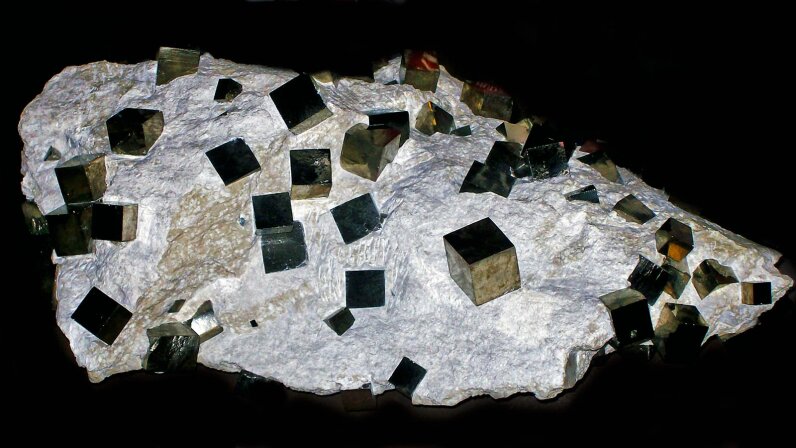
Cubic Pyrite.............................................................................................................................................
gold veinDifference Between Pyrite and Gold
What's the Difference Between Pyrite and Gold?
BY MARK MANCINI


Martin Frobisher thought he'd hit the jackpot.
The year 1576 found this English explorer and legal pirate — he was sanctioned by the crown to plunder enemy treasure ships — seeking the Northwest Passage, the undiscovered Arctic sea route that links the Atlantic and Pacific oceans.
He found something else instead — Labrador, Canada, and what is now Frobisher Bay.
But weeks later he sailed west and reached icy Baffin Island, where he gathered a mineral sample that seemed to be flaked with gold. But it wasn't.
Not according to the Royal Assayer who identified the shiny bits as pyrite, also known as "fool's gold."
Undeterred, Queen Elizabeth's merchants sent Frobisher back to Baffin, where he gathered and shipped 1,400 tons (1,270 metric tons) of ore.
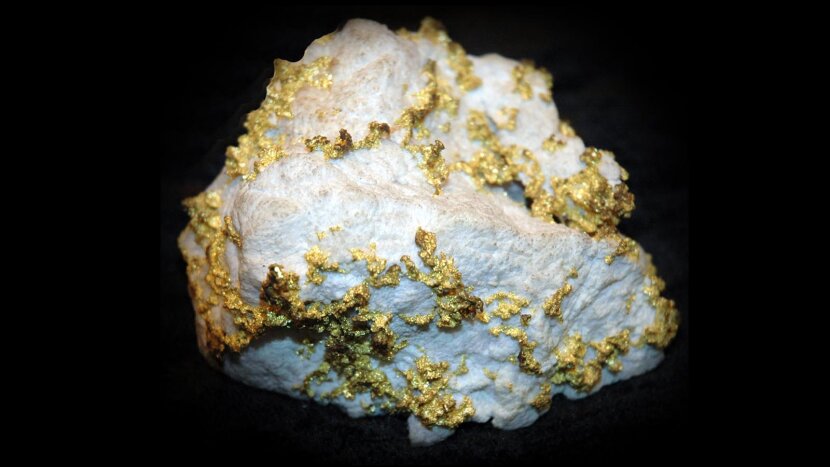
gold vein
A vein of gold is seen here in a hydrothermal sample of quartz taken from an unspecified mine
 at or near Grass Valley in northeast-central California.
You can see how different the gold vein is from the pyrite above.
Most of it was worthless; in a few tested samples, the gold content was only five to 14 parts per billion.
Though he longed to abandon Baffin and go exploring again, Frobisher spent years fruitlessly hunting Arctic treasure. And it was all because of that pyrite.
Elements and Compounds
Captain Christopher Newport could likely sympathize.
As the leader of Jamestown, England's first permanent settlement in North America, he was constantly getting tricked by New World "gold" that turned out to be — you guessed it — pyrite.
So, let's say you're a prospector, or maybe just a bright-eyed field geologist. How do you avoid pyrite's trickery?
Before we get into that, it might be a good idea to explain what pyrite actually is in the first place.
Real gold is a chemical element, a substance no ordinary chemical process — like electrolysis or heating — can break down.
If you've got a classroom periodic table handy, look for gold between platinum and mercury.
Gold's chemical symbol is "Au" (derived from the element's Latin-language name, "aurum").
A fun way to remember this is to say to yourself, "A! U! Give me back my gold!" 
For maximum entertainment value, use a Brooklyn accent.
Pyrite is different. Unlike gold, it's a compound made up of two different elements: iron and sulfur.
That's why it's often referred to by the name "iron sulfide."
Scientists write out pyrite's chemical formula as "FeS2."
You see, iron and sulfur's chemical symbols are, "Fe" and "S," respectively. And each pyrite molecule contains one iron atom along with two sulfur atoms.
Playing Rough
Telling gold and pyrite apart really isn't that difficult if you know what you're doing.
Ever watch the Olympics? Then you'll probably know those world-class athletes love to bite their gold medals in front of the cameras. (Seriously, it happens a lot.)
The practice comes from the old belief that one can bite gold coins to see if they're counterfeit.
Supposedly, nibbling on any coin with a high gold content leaves bite marks behind.
The truth's more complicated, though, but the custom has a basis in fact.
On the Mohs' scale, which rates the hardness of gems and minerals, gold has a ranking of 2.5 to 3. As elements go, it's rather soft so a gold nugget can easily be scratched with a pocket knife.
Pyrite has the advantage here; it's a bit harder and comes in at 6 to 6.5 on the Mohs' scale. Forget knives; you'd need a high-quality metal file to scratch this stuff.
Steel hammers are another tool that can give the game away. Hit some pyrite with one of these beauties and it'll send sparks flying.
If you're persistent enough, the pyrite will shatter and eventually get reduced to a powder.
None of that happens when you strike gold with a hammer: No sparks, no powder.
Instead, you might just end up expanding or flattening the sample. Not only is gold soft, it's malleable to boot.
See How I Glitter
Visually, both materials are yellowish, but gold is less brassy in hue. It also doesn't form cube-shaped crystals, as pyrite often does.
On the contrary, most of the gold encountered in the field takes the form of either flakes or lumpy nuggets.
Gold also will leave a yellow streak behind if it's rubbed against a bit of porcelain or white ceramic tile.
Repeat this same experiment with pyrite and it will leave a darker, greenish-black line.
If you're still in doubt, the nose knows. Although gold is pretty much odorless, pyrite has a faint smell — and it smells like rotten eggs. (Again, it's loaded with sulfur.)
But where things can get confusing is gold and pyrite sometimes turn up in the same deposits.
Remember, Frobisher's ore did contain some genuine gold — albeit a teeny, tiny amount.
If "real" gold keeps eluding you, don't despair.
Fool's gold isn't completely useless. Like we already mentioned, it can be used to produce sparks, and thereby start fires.
That made pyrite a valuable commodity in ancient and prehistoric societies. Indeed, the word "pyrite" itself came from a Greek term for "firestone."
Tomorrow may bring a new appreciation for iron sulfide.
In 2020, scientists at the University of Minnesota used electric voltage and an ionic solution to successfully turn pyrite into a magnetic material.
This breakthrough could lead to low-cost, sulfur-based solar cells down the road — giving fool's gold a bright future in the green energy industry.
NOW THAT'S INTERESTING
He never found the Northwest Passage, but Martin Frobisher was knighted in 1588 for fighting the Spanish Armada

Mark Mancini is a freelance writer currently based in New Jersey. Over the years, he’s covered every subject from classic horror movies to Abe Lincoln's favorite jokes. He is particularly fond of paleontology and has been reporting on new developments in this field since 2013. When Mark's not at his writing desk, you can usually find him on stage somewhere because he loves to get involved with community theater. And if you ever feel like trading puns for a few hours, he's your guy.
Cubic Pyrite

Monday, December 11, 2017

DIAMONDS - Properties & Types - Diamond is the hardest natural material. The Mohs hardness scale, on which diamond is a '10' and corundum (sapphire) is a '9', doesn't adequately attest to this incredible hardness, as diamond is exponentially harder than corundum. It is an exceptional thermal conductor - 4 times better than copper - which gives significance to diamonds being called 'ice'.

Diamonds
Chemistry of Diamond: 
Properties & Types


PROPERTIES OF DIAMONDS

Diamond is the hardest natural material.
The Mohs hardness scale, on which diamond is a '10' and corundum (sapphire) is a '9', doesn't adequately attest to this incredible hardness, as diamond is exponentially harder than corundum.
Diamond is also the least compressible and stiffest substance.
It is an exceptional thermal conductor - 4 times better than copper - which gives significance to diamonds being called 'ice'.
Diamond has an extremely low thermal expansion, is chemically inert with respect to most acids and alkalis, is transparent from the far infrared through the deep ultraviolet, and is one of only a few materials with a negative work function (electron affinity).
One consequence of the negative electron affinity is that diamonds repel water, but readily accept hydrocarbons such as wax or grease.
Diamonds do not conduct electricity well, although some are semiconductors.
Diamonds can burn if subjected to a high temperature in the presence of oxygen.
Diamond has a high specific gravity; it is amazingly dense given the low atomic weight of carbon.
The brilliance and fire of a diamond are due to its high dispersion and high refractive index.
Diamond has the highest reflectance and index of refraction of any transparent substances.
Diamond gemstones are commonly clear or pale blue, but colored diamonds, called 'fancies,’ have been found in all the colors of the rainbow.
Boron, which lends a bluish color, and nitrogen, which adds a yellow cast, are common trace impurities.
Two volcanic rocks that may contain diamonds are kimberlite and lamproite.
Diamond crystals frequently contain inclusions of other minerals, such as garnet or chromite.
Many diamonds fluoresce blue to violet, sometimes strongly enough to be seen in daylight.
Some blue-fluorescing diamonds phosphoresce yellow (glow in the dark in an afterglow reaction).

TYPE OF DIAMONDS

Natural Diamonds
Natural diamonds are classified by the type and quantity of impurities found within them.
·       Type Ia - This is the most common type of natural diamond, containing up to 0.3% nitrogen.
·       Type Ib - Very few natural diamonds are this type (~0.1%), but nearly all synthetic industrial diamonds are. Type Ib diamonds contain up to 500 ppm nitrogen.
·       Type IIa - This type is very rare in nature. Type IIa diamonds contain so little nitrogen that it isn't readily detected using infrared or ultraviolet absorption methods.
·       Type IIb - This type is also very rare in nature. Type IIb diamonds contain so little nitrogen (even lower than type IIa) that the crystal is a p-type semiconductor.
Synthetic Industrial Diamonds
Synthetic industrial diamonds have produced the process of High-Pressure High-Temperature Synthesis (HPHT).
In HPHT synthesis, graphite and a metallic catalyst are placed in a hydraulic press under high temperatures and pressures.
Over the period of a few hours, the graphite converts to diamond. The resulting diamonds are usually a few millimeters in size and too flawed for use as gemstones, but they are extremely useful as edges on cutting tools and drill bits and for being compressed to generate very high pressures.
(Interesting side note: Although used to cut, grind, and polish many materials, diamonds aren't used to machine alloys of iron because the diamond abrades very quickly, due to a high-temperature reaction between iron and carbon.)
Thin Film Diamonds
A process called Chemical Vapor Deposition (CVD) may be used to deposit thin films of polycrystalline diamond.
CVD technology makes it possible to put 'zero-wear' coatings on machine parts, use diamond coatings to draw the heat away from electronic components, fashion windows that are transparent over a broad wavelength range, and take advantage of other properties of diamonds.

ANNE MARIE HELMENSTINE, PH.D.

Anne Helmenstine, Ph.D., is an author and consultant with a broad scientific and medical background.
EXPERIENCE
Anne has taught chemistry, biology, and physics at the high school, college, and graduate level. In her doctoral work, Anne developed ultra-sensitive chemical detection and medical diagnostic tests. She has worked abstracting/indexing diverse scientific literature for the Department of Energy. She presently works as a freelance writer and scientific consultant. She enjoys adapting lab-based science projects so that they can be performed safely at home.
EDUCATION
Dr. Helmenstine has bachelor of arts degrees in physics and mathematics with a minor in chemistry from Hastings College in Nebraska and a doctorate of philosophy in biomedical sciences from the University of Tennessee at Knoxville.
Chemistry is part of everyone's life, from cooking and cleaning to the latest computer chip technology and vaccine development. It doesn't have to be intimidating and it doesn't have to be hard to understand.
You can read more about Anne's current and past work on her Google Profile: Anne Helmenstine. Find Anne's printable periodic tables and science projects at Science Notes.
You may also like:


CLICK HERE:


CLICK HERE:


CLICK HERE:


CLICK HERE:


CLICK HERE:
.

Multi-Media Filter, Highly-Activated Carbon Filter,
Zeolite-Process Water Softener With Brine Tank,
Fiberglass Ballast-Type Pressure Tank
(fully automatic backwash & regeneration)
PURICARE 
INDUSTRIAL 
ENTERPRISES 
Water 
Treatment 

Systems
.
...
...

Aganan, Pavia, Iloilo, Philippines
...

CLICK HERE . . . to view company profile . . .

Ballast-TypePressure Tank
Houston Water Pump with
Mazaki Automatic Pump Controller