Showing posts with label Infrared. Show all posts

Friday, November 27, 2020

RADIO WAVES & CELL PHONE WAVES - The electromagnetic spectrum includes a variety of radio waves, set at specific frequency bands which allow for radio, television, microwave and other types of transmissions across these bands. Each of these frequencies consist of a packet of charged photons which propagate out as waves of different vibrating frequencies expressed in Hertz. The measurement of these frequencies comes from the German physicist, Heinrich Hertz, who first proved the existence of the electromagnetic waves. Radio and cellphone frequency bands can both transmit analog or digital signals. The Electromagnetic Spectrum comprises diverse bands of radiation which vibrate at different frequencies. Each of these particular kinds of radiation are measured in units of hertz cycles per second. In addition to radio waves and microwaves, the EM spectrum also includes infrared radiation, visible light, ultraviolet, X-rays and gamma rays. A radio transmission is electromagnetic radiation that is made up of electrical and magnetic fields perpendicular to one another. They both move as a wave, cycling at a specific frequency. Energy in the wave moves back and forth between the magnetic and electrical fields. A radio signal propagates from its point of transmission in a spherical shape, as with higher-frequency radio waves as a more focused, narrower beam. The radio frequency range begins with the Extremely Low Frequency band at 3 hertz and extends to the Extremely High Frequency band at 300 gigahertz. Cellular phone networks utilize multiple bands of EM spectrum, one of which is called UHF, or ultra-high frequency, sometimes known as microwave.

..........................................................................................................................................................................................................................................................................................................

Radio Waves & Cell Phone Waves

What Is the Difference Between Radio Waves & Cell Phone Waves?

By Peter De Conceicao


The electromagnetic spectrum includes a variety of radio waves, set at specific frequency bands which allow for radio, television, microwave and other types of transmissions across these bands.

Each of these frequencies consist of a packet of charged photons which propagate out as waves of different vibrating frequencies expressed in Hertz.

The measurement of these frequencies comes from the German physicist, Heinrich Hertz, who first proved the existence of the electromagnetic waves theorized by another scientist.

Radio and cellphone frequency bands can both transmit analog or digital signals.

Electromagnetic Spectrum

The Electromagnetic Spectrum comprises diverse bands of radiation which vibrate at different frequencies.

Each of these particular kinds of radiation are measured in units of hertz cycles per second.

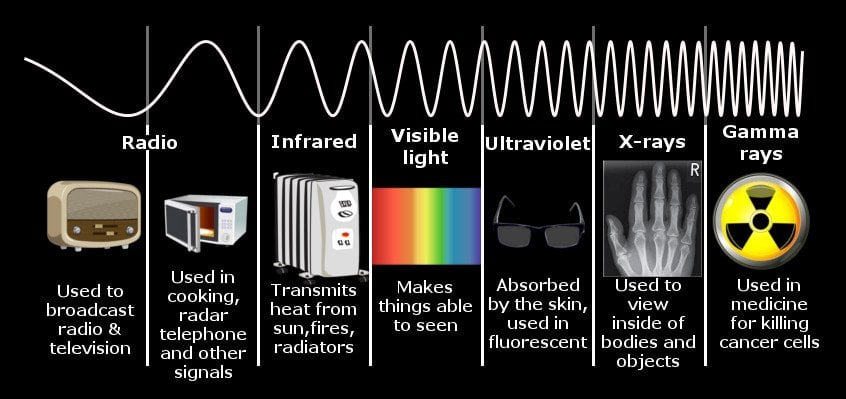
In addition to radio waves and microwaves, the EM spectrum also includes infrared radiation, visible light, ultraviolet, X-rays and gamma rays.

Radio Waves

A radio transmission is electromagnetic radiation that is made up of electrical and magnetic fields perpendicular to one another.

They both move as a wave, cycling at a specific frequency. Energy in the wave moves back and forth between the magnetic and electrical fields.

A radio signal propagates from its point of transmission in a spherical shape, as with higher-frequency radio waves as a more focused, narrower beam.

The radio frequency range begins with the Extremely Low Frequency band at 3 hertz and extends to the Extremely High Frequency band at 300 gigahertz.

The Microwave Band

Cellular phone networks utilize multiple bands of EM spectrum, one of which is called UHF, or ultra-high frequency, sometimes known as microwave.

The frequency range for microwave radiation is between 300 megahertz and 300 gigahertz.

UHF waves are also utilized in radar, microwave ovens and wireless local area networks.

Microwaves on the electromagnetic spectrum can be further divided into different bands, depending on the frequency.

Wave Propagation

Radio and microwave transmissions propagate differently from their point of origin.

Radio waves have a lower frequency and longer wavelength as compared to cell phone waves operating at higher microwave frequencies.

Microwaves can carry a higher amount of information than radio signals, and are transmitted in narrower beams which can be aimed and focused to a greater degree than radio waves.

Cellular Phones

Cellular phone signals are transmitted on two bands, one between 800 to 900 megahertz and the other between 1.8 gigahertz to 1.95 GHz.

Signals from a cellular phone transmit to a base-station, which relays it to the next station or other receivers on its network.

Radio signals between a cellular phone and the network fluctuate in strength depending on the business of the network.

Based in Los Angeles, Peter De Conceicao has been a professional researcher and writer since 2000. He has also worked as a writer for nonprofit educational organizations. Most recently, his work has appeared in Examiner.com as a news analyst and social commentator. He holds a degree in communications from Loyola Marymount University.

https://sciencing.com/difference-waves-cell-phone-waves-6624355.html


You might also like:


How Safe are Cell Phones?

CLICK HERE . . . to view . . . 

https://puricarechronicles.blogspot.com/2017/12/cell-phones-research-indicates-long.html

............................................................................................................................................................................................................................................................................................

 So Glad God Doesn't Require a Smartphone

CLICK HERE . . . to view . . . 

https://puricarechronicles.blogspot.com/2020/11/so-glad-god-doesnt-require-smartphone-i.html

............................................................................................................................................................................................................................................................................................

Dangerous Wavelengths and Frequencies

CLICK HERE . . . to view . . . 

https://puricare.blogspot.com/2019/05/dangerous-wavelengths-and-frequencies.html

............................................................................................................................................................................................................................................................................................

Microwave Radiation

CLICK HERE . . . to view . . . 

https://puricare.blogspot.com/2019/10/microwave-radiation-in-electromagnetic.html

............................................................................................................................................................................................................................................................................................

Phone Towers And Cancer

CLICK HERE . . . to view . . . 

https://puricare.blogspot.com/2019/09/phone-towers-and-cancer-phone-towers.html


Wednesday, December 25, 2019

THE VISIBLE SPECTRUM - Wavelengths and Colors - Light from 400–700 nanometers (nm) is called visible light, or the visible spectrum. Light outside this range may be visible to other organisms but cannot be perceived by the human eye. Colors of light that correspond to narrow wavelength bands (monochromatic light) are the pure spectral colors learned using the ROYGBIV acronym: red, orange, yellow, green, blue, indigo, and violet. Some people can see further into the ultraviolet and infrared ranges than others, so the "visible light" edges of red and violet are not well-defined. Violet light has the shortest wavelength, which means it has the highest frequency and energy. Red has the longest wavelength, the shortest frequency, and the lowest energy. The spectrum was first described with seven colors. The visible spectrum does not encompass all the colors humans perceive because the brain also perceives unsaturated colors and colors that are a mixture of wavelengths. Mixing colors on a palette produces tints and hues not seen as spectral colors.

Graded watercolor wash background in pink tones
.....................................................................................................................................................  
The Visible Spectrum
Light passing through a prismWavelengths and Colors
by Anne Marie Helmenstine, Ph.D. 


Fondo futuristaThe human eye sees color over wavelengths ranging roughly from 400 nanometers (violet) to 700 nanometers (red).
Light from 400–700 nanometers (nm) is called visible light, or the visible spectrum, because humans can see it.
Light outside this range may be visible to other organisms but cannot be perceived by the human eye.
Colors of light that correspond to narrow wavelength bands (monochromatic light) are the pure spectral colors learned using the ROYGBIV acronym: red, orange, yellow, green, blue, indigo, and violet.
Wavelengths of Visible Light
Some people can see further into the ultraviolet and infrared ranges than others, so the "visible light" edges of red and violet are not well-defined.
Also, seeing well into one end of the spectrum doesn't necessarily mean you can see well into the other end of the spectrum.
You can test yourself using a prism and a sheet of paper.
Shine a bright white light through the prism to produce a rainbow on the paper. Mark the edges and compare the size of your rainbow with that of others.
The wavelengths of visible light are:
Violet: 380–450 nm (688–789 THz frequency)
Blue: 450–495 nm
Green: 495–570 nm
Yellow: 570–590 nm
Orange: 590–620 nm
Red: 620–750 nm (400–484 THz frequency)
Violet light has the shortest wavelength, which means it has the highest frequency and energy.
Red has the longest wavelength, the shortest frequency, and the lowest energy.
The Special Case of Indigo
There is no wavelength assigned to indigo. If you want a number, it's around 445 nanometers, but it doesn't appear on most spectra.
There's a reason for this. English mathematician Isaac Newton (1643–1727) coined the word spectrum (Latin for "appearance") in his 1671 book "Opticks."
He divided the spectrum into seven sections — red, orange, yellow, green, blue, indigo, and violet — in keeping with the Greek sophists, to connect the colors to days of the week, musical notes, and the known objects of the solar system.
So, the spectrum was first described with seven colors, but most people, even if they see color well, can't actually distinguish indigo from blue or violet.
The modern spectrum typically omits indigo. In fact, there is evidence Newton's division of the spectrum doesn't even correspond to the colors we define by wavelengths.
For example, Newton's indigo is the modern blue, while his blue corresponds to the color we refer to as cyan. Is your blue the same as my blue? Probably, but it may not be the same as Newton's.
Colors People See That Aren't on the Spectrum
The visible spectrum does not encompass all the colors humans perceive because the brain also perceives unsaturated colors (e.g., pink is an unsaturated form of red) and colors that are a mixture of wavelengths (e.g., magenta).
Mixing colors on a palette produces tints and hues not seen as spectral colors.
Colors Only Animals Can See
Just because humans can't see beyond the visible spectrum doesn't mean animals are similarly restricted.
Bees and other insects can see ultraviolet light, which is commonly reflected by flowers. Birds can see into the ultraviolet range (300–400 nm) and have plumage visible in UV.
Humans see further into the red range than most animals. Bees can see color up to about 590 nm, which is just before orange starts. Birds can see red, but not as far toward the infrared range as humans.
Some people believe the goldfish is the only animal that can see both infrared and ultraviolet light, but this notion is incorrect. Goldfish cannot see infrared light.

Anne Marie Helmenstine, Ph.D.
Introduction
Ph.D. in biomedical sciences from the University of Tennessee at Knoxville - Oak Ridge National Laboratory.
Science educator with experience teaching chemistry, biology, astronomy, and physics at the high school, college, and graduate levels.
ThoughtCo and About Education chemistry expert since 2001.
Widely-published graphic artist, responsible for printable periodic tables and other illustrations used in science.
Experience
Anne Helmenstine, Ph.D. has covered chemistry for ThoughtCo and About Education since 2001, and other sciences since 2013. She taught chemistry, biology, astronomy, and physics at the high school, college, and graduate levels. She has worked as a research scientist and also abstracting and indexing diverse scientific literature for the Department of Energy.
In addition to her work as a science writer, Dr. Helmenstine currently serves as a scientific consultant, specializing in problems requiring an interdisciplinary approach. Previously, she worked as a research scientist and college professor. 
Education
Dr. Helmenstine holds a Ph.D. in biomedical sciences from the University of Tennessee at Knoxville and a B.A. in physics and mathematics with a minor in chemistry from Hastings College. In her doctoral work, Dr. Helmenstine developed ultra-sensitive chemical detection and medical diagnostic tests.
ThoughtCo and Dotdash
ThoughtCo is a premier reference site focusing on expert-created education content. We are one of the top-10 information sites in the world as rated by comScore, a leading Internet measurement company. Every month, more than 13 million readers seek answers to their questions on ThoughtCo.
For more than 20 years, Dotdash brands have been helping people find answers, solve problems, and get inspired. We are one of the top-20 largest content publishers on the Internet according to comScore, and reach more than 30% of the U.S. population monthly. Our brands collectively have won more than 20 industry awards in the last year alone, and recently Dotdash was named Publisher of the Year by Digiday, a leading industry publication.


You might also like:


What A Wonderful World

Anne Murray

CLICK HERE . . . to view complete playlist . . . 

https://puricarechronicles.blogspot.com/2019/03/what-wonderful-world-anne-murray-i-see.html

............................................................................................................................................................................................................................................................................................

The Colors That Make Up White Light

CLICK HERE . . . to view . . . 

https://puricare.blogspot.com/2019/01/the-colors-that-make-up-white-most.html

............................................................................................................................................................................................................................................................................................

What Is Light?

CLICK HERE . . . to view . . . 

https://puricarechronicles.blogspot.com/2020/10/what-is-light-physics-and-bible.html

.......................................................................................................................................................................................................................

The Color Red

CLICK HERE . . . to view . . . 

https://puricarechronicles.blogspot.com/2020/12/the-color-red-use-of-color-red-in.html

............................................................................................................................................................................................................................................................................................

Sun and Rain : A Recipe For Rainbows

CLICK HERE . . . to view . . . 

https://puricare.blogspot.com/2020/07/sun-and-rain-recipe-for-rainbows.html

............................................................................................................................................................................................................................................................................................

What Is An Aura?

CLICK HERE . . . to view . . . 

https://puricare.blogspot.com/2020/09/what-is-aura-many-spiritual-advisers.html

............................................................................................................................................................................................................................................................................................

Colors And Human Behavior

CLICK HERE . . . to view . . . 

https://puricare.blogspot.com/2019/10/how-colors-affect-human-behavior-color.html

............................................................................................................................................................................................................................................................................................

Rainbows In The Bible

CLICK HERE . . . to view . . . 

https://puricarechronicles.blogspot.com/2020/05/rainbows-in-bible-gods-throne-signifies.html

Buckfast honey bees fly near a beehive

Saturday, September 7, 2019

PHONE TOWERS AND CANCER - Phone towers are not the only thing we should be worried about; phones and routers are similar to miniature towers themselves. In fact, not only are they greater in number, but they also lie much closer to us than most cell phone towers do. Microwaves generating non-ionizing radiation are harmless, but concentrated microwaves can penetrate our skin and burn tissues; this is exactly how ovens work! Antennas are generally mounted on top of tall towers or buildings, which causes the power levels of the emitted radiation to dwindle as it descends toward the ground. At ground level, the emission is 1000 times lower than the limits for safe transmission set by the Federal Communication Commission (FCC). In other words, damage is highly unlikely. Second, the signals are not transmitted constantly, but intermittently.

mobile network tower
.................................................................................................................................
Microwave OvenPhone Towers And Cancer
Do Phone Towers Cause Cancer?
Akash Peshin  


Well, the answer isn’t an outright no. One can find some solace in the fact that the evidence for the case hasn’t been conclusive.
Right now, at this very moment, you are drowning in an ocean of electromagnetic radiation. Its waters are a myriad of radiation – radio waves, the sun’s light, infrared and all the rest.
Initially, the world was dominated by the sun’s light and infrared radiation, the harbingers of heat.
Now, however, with the construction of soaring phone towers and the ubiquity of smartphones, radio waves seem to be growing in domination.
The notion of whether phone towers pose a health risk has been speculated for decades.
The presence of towers and cell phones concerned people even at times when mobile devices were a luxury – complex technological equipment that only a few people carried.
The situation today seems to cause even more apprehension – cell phones are as common and necessary as footwear, every household has a router, and to accommodate both of these, radio towers are planted more often than trees.
Ionizing vs Non-ionizing radiation
Any type of fear is largely spurred by uncertainty, which is essentially a lack of information.
In this case, the fear of phone towers seems to be fueled by our lack of understanding of electromagnetic physics.
The seven types of electromagnetic radiation can be categorized into two classes based on their energies: ionizing and non-ionizing radiation
Ionizing radiation represents the high-frequency spectra of electromagnetic radiation, which includes high-frequency ultraviolet rays, X-rays and gamma rays – remnants of a nuclear aftermath.
Prolonged exposure to these emissions can cause cellular mutation, which can lead to various cancers. This is because, as the name suggests, they tend to ionize and destabilize molecules.
These high-frequency waves are so energetic that they interact with matter as if they are individual particles, colliding and kicking matter’s constituents out of their stable structures. 
Exposure to such an energetic radiation disrupts the structure of DNA, a major cause of cancer and other autoimmune diseases.
On the other hand, non-ionizing radiation represents the low-frequency spectra of electromagnetic radiation.
These include radio waves, microwaves, infrared and visible light.
Owing to their low frequencies, these waves travel with very low energies, rendering them non-ionizable — they are unable to knock particles away from stable molecular structures.
The fact that low-frequency waves aren’t energized enough to disrupt DNA molecules implies that the radio waves constantly emanating from phone towers are harmless.
Even so, could constant exposure to them, like an interference pattern, positively add up to threaten us with a fatal health risk?
The fear is most likely to be observed in parents who are apprehensive about radiation affecting the developing brains and bodies of children.
Are these apprehensions justified? Let’s see what the experts have to say.
They are “possibly carcinogenic”
Phone towers are not the only thing we should be worried about; phones and routers are similar to miniature towers themselves.
In fact, not only are they greater in number, but they also lie much closer to us than most cell phone towers do.
Microwaves generating non-ionizing radiation are harmless, but concentrated microwaves can penetrate our skin and burn tissues; this is exactly how ovens work!
So… should we be worried? Well, the answer isn’t an outright no.
One can find some solace in the fact that the evidence for the case hasn’t been conclusive.
This is reflected in the World Health Organization’s (WHO) International Agency for Research on Cancer (IARC), which deems radio transmission “possibly carcinogenic” — towers don’t seem to pose a threat, but we aren’t sure.
However, there are multiple reasons why they might be harmless.
First, antennas are generally mounted on top of tall towers or buildings, which causes the power levels of the emitted radiation to dwindle as it descends toward the ground.
At ground level, the emission is 1000 times lower than the limits for safe transmission set by the Federal Communication Commission (FCC).
In other words, damage is highly unlikely.
Second, the signals are not transmitted constantly, but intermittently.
However, could the radiation affect people who live in the vicinity of these towers, such as people living right below the roof or inhabitants of buildings whose windows face towers mounted on a shorter building directly adjacent to them?
The answer is still “No”. Cement, wood and other obstructions attenuate signals, thereby deterring any copious amounts of potentially harmful radiation.
The power levels are known to be at a maximum right next to the antenna, so access to the places with direct exposure might be limited.
Still, a lack of studies relating to residents living near a glut of towers and their likelihood of cancer hasn’t allowed any definitive conclusion to appear.

Akash Peshin is an Electronic Engineer from the University of Mumbai, India and a science writer at ScienceABC. Enamored with science ever since discovering a picture book about Saturn at the age of 7, he believes that what fundamentally fuels this passion is his curiosity and appetite for wonder.


mobile network tower
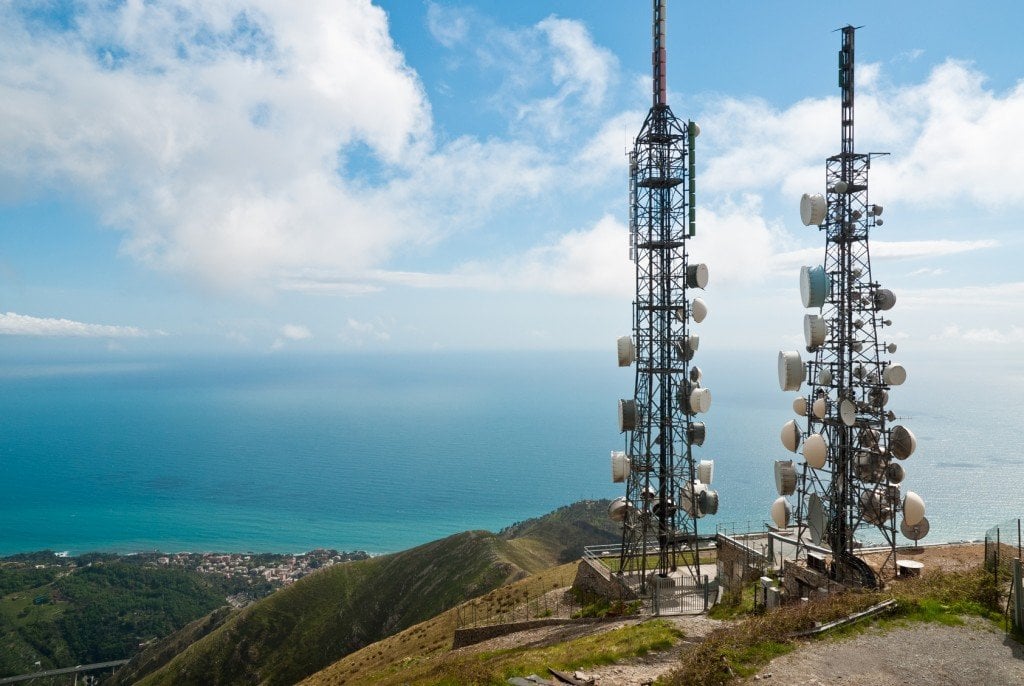
Phone towers on top of a hill.


The electromagnetic spectrum.

mir satellite
Mir, a Russian space station that operated in low Earth orbit from 1986 to 2001, as seen in orbit around Earth in a file picture.


Microwave Oven
A microwave oven. 


Alexander Graham Telephone in New york
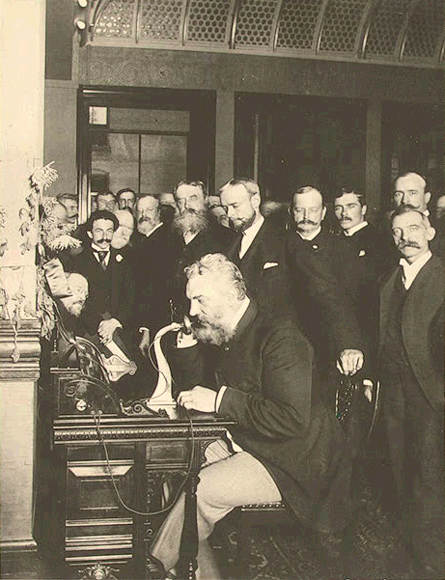
Bell on the telephone in New York (calling Chicago) in 1892. Good ol’ times, huh?