Showing posts with label Insulation Materials. Show all posts

Saturday, September 21, 2019

ASBESTOS IN YOUR HOME - Many compound materials benefit from asbestos because of its taut fiber form. When materials with asbestos are left alone, as manufactured and pressed or mixed together, asbestos can be pretty hard to break down. Using any process or pressure to cut, sand or dig into asbestos-containing parts, however, releases dust shards of fiber particles, launching the asbestos into the air. When the particles are breathed in, they are either subsequently released through exhaling, or they lodge themselves into the organs and air passageways, often causing lung diseases and abnormal, cancerous growths. Mesothelioma, lung cancer and asbestosis are linked to asbestos exposure in the home and workplace.

Mesothelioma, lung cancer and asbestosis are linked to asbestos exposure in the home and workplace. See more hidden home dangers pictures.
......................................................................................................................................................
Asbestos In Your Home
How do you find out if there's asbestos in your home?
BY BRISTER RIENO


People who were old enough to use a hair dryer in the 1970s may remember their first exposure to the fear of asbestos when their dryers were recalled as a health threat [source: CPSC].
Others may have grown up with warnings about staying away from attic insulation or old pipe wrapping in basements, but are these concerns dated now that the world is more aware of the dangers of asbestos exposure?
Asbestos has been a part of the modern built world for more than a century because it is flame resistant, very long lasting and an excellent insulating material.
Many compound materials benefit from asbestos because of its taut fiber form.
When materials with asbestos are left alone, as manufactured and pressed or mixed together, asbestos can be pretty hard to break down.
Using any process or pressure to cut, sand or dig into asbestos-containing parts, however, releases dust shards of fiber particles, launching the asbestos into the air.
When the particles are breathed in, they are either subsequently released through exhaling, or they lodge themselves into the organs and air passageways, often causing lung diseases and abnormal, cancerous growths.
Mesothelioma, lung cancer and asbestosis are linked to asbestos exposure in the home and workplace, though since the late 1970s, bans and regulations have helped lessen the risks [sources: EPACPSC].
Is asbestos just an old concern, or is it a continuing, modern problem? Could there be asbestos in your home?
Maybe for sure, maybe not much and maybe none at all, but it's worth brushing up on the subject.
Air Apparent?
If your home was built in 1980 or later, it isn't likely to have asbestos components, and if it does, they would have to be labeled accordingly.
Homes built before the 1970s likely do have asbestos in their construction materials, which might include the following:
·          insulation: attic and wall insulation in houses built from 1930 through 1950 (and homes with vermiculite insulation up through 1990)
·          heat-proofing surrounds: boards and wall and floor treatments around wood-burning stoves and older furnaces
·          heat and water pipes: exterior wraps and adhesives
·          floor and ceiling tiles: in sheet and drop-tile forms
·          roofing and siding: shingles and sheets with composites of concrete and asphalt
·          wall and ceiling treatments: thick, decorative or soundproofing coatings that resemble popcorn-like grooves or dried foam cottage cheese
·          walls, corners and gaps: joint compounds and patching materials commonly contained asbestos [source: EPA]
These are just some of the most common areas where asbestos products were used, and unfortunately, checking to see if it's in your own home isn't a matter of just eyeing the sources.
Asbestos isn't identifiable by sight alone, and it's odorless and unlabeled if used before bans were instituted.
Only testing at the microscopic level confirms the presence of asbestos, and this should always be left to a trained professional.
If you suspect that your home, whether a rental or owned property, has hidden asbestos or areas of asbestos dust, it's best to leave everything as is -- the EPA even advises against dusting or vacuuming suspect areas [source: EPA].
Most of all don't do anything abrasive to the area that could cause the release of particles if no dust is visible [source: EPA].
Contact an asbestos professional who can test and recommend ways to remove or cover and contain the asbestos materials if found.
Maybe you're fearful that asbestos is hanging out where you live. How worried should you be?
RELIABLE INFO
Many Web sites on asbestos appear to be backed by institutions, medical associations or academic centers but are in fact linked to law firms. While some of the information may be well researched, turning to official sources like the U.S. Environmental Protection Agency, the National Institutes of Health, the Consumer Product Safety Commission and the Occupational Safety & Health Administration will provide less biased data.
Adios Asbestos?
Living with asbestos is a reality for many who reside in older homes, but with containment, covering and sealing -- or encapsulation -- or removal by a professional, the risk of harmful exposure is low [source: EPA].
A joint paper by the Environmental Protection Agency (EPA), Consumer Product Safety Commission (CPSC) and the American Lung Association (ALA) summarizes the health risks as being greatest for those with heavy exposure in factory settings or those involved in demolition work, mining and milling.
Those exposed to small amounts in ordinary life are a lot less likely to develop health problems [sources: CPSCEPA].
In fact, the best thing to do with asbestos material in good condition is to leave it alone [source: CPSC].
Some individuals exposed to asbestos never develop health problems, but as many as 200 people are diagnosed with mesothelioma linked to asbestos in the United States each year [source: EPA].
Lung cancer and asbestosis, which is mostly fatal, is considered a high-exposure outcome for those who breathed in prolonged and significant amounts of asbestos [source: EPA].
And the EPA emphasizes that asbestos-related lung cancer is much lower for the general population and asbestosis is "rarely caused by neighborhood or family exposure" [source: EPA].
Most people in the United States can breathe a sigh of relief that asbestos contact will be minimal if asbestos in their home is left undisturbed or left to the professionals to remove or contain.
ALWAYS ASK AN EXPERT
National, regional and local agencies have ongoing efforts to prevent asbestos-related illnesses and continued exposure.
To find assistance in your area, check the EPA's regional and state asbestos contacts.
Terri BrisenoAnalytic Specialist, Health Informatics
Mesothelioma, lung cancer and asbestosis are linked to asbestos exposure in the home and workplace. See more hidden home dangers pictures.
Mesothelioma, lung cancer and asbestosis are linked to asbestos exposure in the home and workplace.


Thursday, August 15, 2019

CANCER AND INSULATION MATERIALS - A properly insulated home will save money on energy costs by resisting the flow of heat and making your heating and air conditioning work less. Fiberglass insulation, a man-made mineral fiber con¬structed from a variety of materials, such as sand and recycled glass, is the most popular form of insulation in the United States -- more than 90 percent of homes in America are lined with the pink stuff But while many see the benefits of insulating our houses with fiberglass, some are worried fiberglass can cause various health problems -- it's capable of causing immediate skin irritation.

Hidden Home Dangers Image Gallery A worker sprays fiberglass over a spa mold at Sundance Spas. Is insulation like fiberglass dangerous? See more pictures of hidden home dangers.
............................................................................................................................................
A worker pulls fiberglass straight as it is manufactured at a factory in Chengdu, Sichuan Province, China.Cancer And Insulation Materials
Is insulation dangerous?
BY JOHN FULLER


Rummaging around in your friend's newly renovated attic, you notice what looks like a rolled-up blanket in the far corner.
You give it a kick, and the blanket unfurls onto the floor. It's pink, and the material looks a little like cotton candy.
You run your hand over it to see what it feels like, but you soon realize that was a mistake. Before you know it, your hand is red and itchy -- you've just come in contact with fiberglass insulation.
Insulating our homes is one of the most important parts of house construction, and insulation has a big effect on the costs of energy.
Heat naturally flows from a warm space to a cool space, and our homes suffer from this transfer.
In the winter, warm air from the inside will move to the outside and make us cold.
In the summer, hot air moves from the outside to the inside and makes it uncomfortably warm.
We have heating and air conditioning systems to fix these problems, but the more opportunities warm air has to flow out of or into the house, the harder those systems have to work.
As those systems work harder, we use more energy and pay much higher utility bills.
A properly insulated home will save money on energy costs by resisting the flow of heat and making your heating and air conditioning work less.
Fiberglass insulation, a man-made mineral fiber con­structed from a variety of materials, such as sand and recycled glass, is the most popular form of insulation in the United States -- more than 90 percent of homes in America are lined with the pink stuff [source: Spencer and Gulick].
But while many see the benefits of insulating our houses with fiberglass, some are worried fiberglass can cause various health problems -- it's capable of causing immediate skin irritation.
But while some research suggests that inhaling fiberglass particles could cause cancer, but in 2001, the International Agency for Research on Cancer removed glass, rock and slag wool fibers -- common elements of fiberglass insulation -- from its list of substances possibly carcinogenic to humans [sources: NTPIARC].
Fiberglass and Asbestos
If you've ever come in contact with fiberglass, you already know what it can do to your skin. The tiny fibers of glass from insulation wool can irritate your skin and eyes.
If you experience too much contact with fiberglass, it can cause what's called irritant contact dermatitis, or inflammation of the skin.
Breathing in fibers can also increase the difficulty of breathing. Is that the extent of the trouble fiberglass can cause, or are there more serious health effects?
Fiberglass became popular in the United States as another insulating material -- asbestos -- was phased out of use.
Asbestos, unlike fiberglass, is a naturally occurring silicate material found in rocks. Its known use goes back to the ancient Greeks, who admired it for its ability to withstand very high temperatures.
Indeed, asbestos isn't just resistant to heat. It also doesn't evaporate in the air, dissolve in water or react with most chemicals.
All of these properties made it particularly attractive for home construction, and asbestos was the main material used for building insulation for the late 19th century and much of the 20th century.
But as early as the 1930s, the health hazards of asbestos became clear. When asbestos fibers are released into the air, they split into microscopic pieces.
Once breathed in, asbestos fibers will be inhaled deep into the lungs, where they stay for long periods of time.
During that time, the fibers irritate the lungs and any other part of the body they may travel to, disrupting cell division by interfering with chromosome distribution and changing important genetic material.
This increases the chances of developing illnesses such as asbestosis, mesothelioma and other cancers, although symptoms of any such disease typically won't show up for 10 to 40 years.
Asbestos is classified as a known human carcinogen by state, federal and international agencies, and new uses of the material were banned in 1989 by the Environmental Protection Agency.
Still, we frequently see asbestos-related problems, from the evacuation of poorly constructed school buildings to debris created from Hurricane Katrina in New Orleans in 2005.
While asbestos is a natural material and fiberglass is man-made, the two materials are often compared because they're both fibrous.
This quality made fiberglass a good substitute once the health effects of asbestos became apparent. It also has the heat-resistant qualities that made asbestos so desirable for insulation.
It also has some worried that the fibers from fiberglass are just as dangerous as asbestos -- it's sometimes referred to negatively as "man-made asbestos" or the asbestos of the 20th century.
But while early research on rats in the 1970s stated that "fibrous glass of small diameter is a potent carcinogen," more modern research isn’t as sweeping in its findings [source: Montague].
The American Conference of Governmental Industrial Hygienists, on the other hand, claims fiberglass is "Not Classifiable as a Human Carcinogen," meaning there isn't even data to say whether or not it causes cancer in people [source: Yeshiva University].
The U.S. National Toxicology Program issued its 13th Report on Carcinogens in fall of 2014, and while its entry on Certain Glass Wool Fibers (Inhalable) states that they are “reasonably anticipated to be human carcinogens,” it also goes on to say that there is so much variation in production that full assessments must be made on a case-by-case basis [source: NTP].
Fiberglass is generally considered safe when properly installed. Once it's installed, fiberglass rests safely between panels, sheetrock and plaster -- only when it's removed will fibers become airborne.
In the meantime, people are still suggesting alternative ways to insulate homes -- everything including cork, corn cobs, cotton, newspapers and brick are other ways to keep the heat from escaping houses. 

John Fuller earned a bachelor’s degree in English from the University of Georgia, where he also minored in film studies. After a brief stint in film and television production, John began his career at HowStuffWorks as a staff writer, writing about spacewalks, cave dives and everything in between. He eventually switched to a position as editor, which is where you’ll find him now. John also co-hosted the music podcast 'Stuff From the B-Side' with publisher Mark Larson from 2008 to 2009, and he currently contributes to “Stuff From the Future.'
John stands at his desk while he works, which still gets him the occasional funny look from his coworkers. When he’s not editing articles or eating too much free candy from the office, he enjoys reading fiction, searching high and low for cheap (but quality) used vinyl, playing basketball and watching baseball.

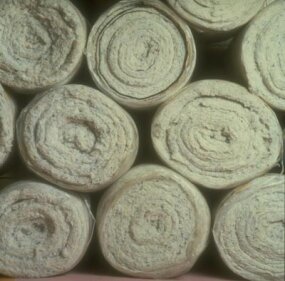
 Rolls of natural cotton and recycled cotton prepared for use as an alternative to fiberglass insulation.

Hidden Home Dangers Image Gallery A worker sprays fiberglass over a spa mold at Sundance Spas. Is insulation like fiberglass dangerous? See more pictures of hidden home dangers.
A worker sprays fiberglass over a spa mold at Sundance Spas. Is insulation like fiberglass dangerous?


A worker pulls fiberglass straight as it is manufactured at a factory in Chengdu, Sichuan Province, China.


Rolls of natural cotton and recycled cotton prepared for use as an alternative to fiberglass insulation.