Showing posts with label Landfills. Show all posts

Sunday, August 16, 2020

ALUMINUM FOIL REUSE AND RECYCLING - Over 75% of all aluminum foil produced in the United States is used for food packaging and much of that ends up the local landfills. This is an unfortunate result of habits formed by a wasteful society and it is up to each of us to change that behavior. Environmentalists have criticized the use of aluminum foil due to the high resource costs associated to the production of the product. Many recycling centers and public recycling programs don’t accept aluminum foil, leaving many scratching their heads as to why. Aluminum foil is 100% recyclable though the catch is that it is often much dirtier than cans. With the sheets of foil often being filled with food waste that can lead to contamination, many recycling center simply won’t accept it. While American households recycle up to 70% of their household aluminum waste, most of that is from cans, leaving thousands of tons of foil sheets for the landfill. We throw away enough foil each year to build a fleet of aircraft and recycling a single aluminum can saves enough energy to power a television for 3 hours. Reuse that aluminum foil to reduce waste. One of the easiest ways to save energy and money is to reuse that old aluminum foil. Instead of balling it up and tossing in the trash, lay it flat and wash it with soap and water. Don’t forget that aluminum foil is also dishwasher safe, so just place it on the top shelf when running a load and you will be left with clean reusable foil sheets.

Can Used Aluminum Foil Be Recycled?” – Citizens for Recycling First
..................................................................................................................................................................
Recycling Center - City of Round RockAluminum Foil
Facts About Aluminum Foil Reuse and Recycling
by Matthew Speer


Turning dirty foil into useful catalysts - News - The Chemical ...Over 75% of all aluminum foil produced in the United States is used for food packaging and much of that ends up the local landfills. 
This is an unfortunate result of habits formed by a wasteful society and it is up to each of us to change that behavior. 
Environmentalists have criticized the use of aluminum foil due to the high resource costs associated to the production of the product. 
There are some simple and cost effective tips you can use to stretch your dollar and aluminum foil farther.
Aluminum Foil Recycling Can Be a Pain
Food, Beverage & Other Container Recycling - City of MinneapolisMany recycling centers and public recycling programs don’t accept aluminum foil, leaving many scratching their heads as to why. 
If you can recycle an aluminum can you should be able to recycle foil as well, right? 
The fact is, aluminum foil is 100% recyclable though the catch is that it is often much dirtier than cans. 
With the sheets of foil often being filled with food waste that can lead to contamination, many recycling center simply won’t accept it. 
Aluminum Foil | City of BoiseWhile American households recycle up to 70% of their household aluminum waste, most of that is from cans, leaving thousands of tons of foil sheets for the landfill. 
According to reports, we throw away enough foil each year to build a fleet of aircraft and recycling a single aluminum can saves enough energy to power a television for 3 hours.
Reuse That Aluminum Foil to Reduce Waste
One of the easiest ways to save energy and money is to reuse that old aluminum foil. 
Instead of balling it up and tossing in the trash, lay it flat and wash it with soap and water. 
Top five aluminium scrap exporting countries in the worldDon’t forget that aluminum foil is also dishwasher safe, so just place it on the top shelf when running a load and you will be left with clean reusable foil sheets. 
You can reuse foil sheets time and again, saving you money from having to purchase new supplies.
A sustainable lifestyle can be a snap with some very simple changes in your lifestyle. 
It is not rocket science, reusing products reduces waste of all kinds, so think before you throw that aluminum away.

Matthew Speer is a Marketing and Advertising Executive that has worked with companies like AOL and U.S. News University Connection. He also has a passion for sustainability and keeping the Earth a beautiful place for our future generations which is why he helped create iSustainableEarth.com. Inspired by his own family and taking strides to go green he strives to live a sustainable lifestyle through research and action.

A Little About iSustainableEarth.com
Founded in October 2011, iSustainableEarth.com delivers useful and innovative information on Sustainable Living and all things “Green” to people just like you.   Our aim is to inform our readers of the latest trends, conservation tips and the steps anyone can take to make the most out of what precious resources we have.  We are committed to providing real solutions for real people helping everyone embrace a sustainable lifestyle.
Learn about iSustainableEarth
For some, sustainable living is just the way it is, skills passed down from family or learned through life experience.  For us, it all started with two leaky toilets and an outrageous water bill.  We learned that something so small can have a devastating effect on the environment and more personally, our wallets.  There had to be a better way and our drive to improve our habits showed us that while going green is easy to say, there was no one place we could go for help.  That is why we started iSustainableEarth.com, bringing together the top resources and minds to make sustainable living real, simple and affordable.
While we embrace the ideas that exist today, let us also challenge the world to live for the ideas of tomorrow.  Together and with one step at a time a difference can be made, let’s take that first step together.
Top five aluminium scrap suppliers in Germany
Aluminum life cycle


Thursday, August 13, 2020

HOW MODERN WASTEWATER TREATMENT CHANGED OUR WORLD - Without wastewater treatment, diseases and infections would ravage our society. Wastewater treatment is often an overlooked necessity of civilization. Without proper sewer systems, wastewater treatment plants, and overall regulation, our cities would be ripe with disease and human waste everywhere. When you flush a toilet, your waste flows through the sewers to a wastewater treatment plant that treats it. Sewer systems are a topic all their own, so we'll mainly focus on how your wastewater goes from one of the dirtiest substances on the planet back into water that's safe for the environment. Some wastewater plants known as full-cycle reuse plants will even take wastewater and treat it all the way back to drinking water, which will then be pumped to city inhabitants. Today's level of engineering and chemistry allow full-cycle reuse plants to output drinking water chemically identical to what's in your tap right now. When wastewater arrives at a treatment facility, it first gets all the large chunks filtered out through a screen, a rather large one. These screens are generally called bar screens, and their main job is to make the sewage more homogenous so it can flow through pumps and pipes in the plant. The waste removed from bar screens is sent off to the landfill, and the slightly less chunky sewage heads to the next step, the grit chamber.

How Modern Wastewater Treatment Changed our World
...............................................................................................................................................................
How Modern Wastewater Treatment Changed our World
How Modern Wastewater Treatment Changed our WorldWithout wastewater treatment, diseases and infections would ravage our society
By Trevor English


Wastewater treatment is often an overlooked necessity of civilization.
Without proper sewer systems, wastewater treatment plants, and overall regulation, our cities would be ripe with disease and human waste everywhere.
Believe it or not, much of the modern wastewater management technology we consider standard in any 21st century home, things like toilets and sewer pipes, are actually relatively new in the grand scheme of history.
The history of wastewater treatment
That's not to say that sewer systems haven't been around for ages.
After all, the ancient Romans had a complex system of sewers at the peak of their empire.
How Modern Wastewater Treatment Changed our World
Roman sewer in Cologne
Rather, the knowledge of how poorly managed wastewater can drastically impact the health of society is relatively new.
The Romans had a centralized sewage management system, although it was fairly rudimentary by today's standards.
Open and closed ditches and pipes would carry away excrement and trash, primarily using rainwater runoff.
The contaminated water would then flow into large concrete tanks that let the sewage settle out before the water was allowed to flow into the nearby rivers.
There was indoor plumbing, and public latrines were also built over the sewers.
In medieval Europe, closed sewers, stone conduits, or ditches were used to drain sewage away from residential areas, often in conjunction with septic tanks, but chamber pots were often dumped directly onto the streets.
Between 1858 and 1859 the Thames in London was chock full of untreated wastewater, which combined with very hot weather to cause what became known as "the Great Stink".
The 17th and 18th centuries saw a rapid expansion in waterworks and pumping systems, but the Industrial Revolution led to even more rapid growth of cities and pollution, which acted as a constant source for the outbreak of deadly diseases like cholera and typhoid.
As cities grew in the 19th century, increasing public health concerns led to the development of municipal sanitation programs and the construction of sewer systems in many cities.
These systems often discharged sewage directly into rivers without treatment, but by the late 19th century, chemical treatments and sedimentation systems were in use in many cities.
The construction of centralized sewage treatment plants began between the late 19th and early 20th centuries.
These systems passed sewage through a combination of physical, biological, and chemical processes to remove pollutants.
Also beginning in the 1900s, new sewage-collection systems were designed to separate storm-water from domestic wastewater, to prevent treatment plants from becoming overloaded during heavy rains.
In the 1910s and 20s, engineers developed more sophisticated systems to treat drinking water before it was supplied to residents in cities.
Stepping back for a moment and examining the timeline here, we can begin to understand just how recent effective wastewater treatment on a grand scale appeared.
Roughly 150 years ago was the first few centralized instances of water treatment for cities. It would take decades for more rigid practices to emerge.
In 1972, the Clean Water Act was passed in the United States. Up until this point, sewage treatment for some cities still relied on chemical treatment and filtration, and the treated sewage was often dumped into rivers and streams.
There was little in the way of pretreatment of industrial wastewater to prevent toxic chemicals from interfering with the biological processes used at sewage treatment plants.
After the passage of the Clean Water Act, cities started a process known as secondary treatment, which removes all the pollutant organic materials from the effluent.
Wastewater with high concentrations of organic materials and nutrients being dumped into rivers was causing algal blooms and the bacteria growth, which created dead zones in rivers.
The secondary treatment essentially eradicates the effluent of microorganisms and organics so that when it's discharged, it has little effect on the surrounding environment.
To think, just 50 years ago many communities in the world were dumping mostly untreated sewage into rivers.
Wastewater treatment processes have really experienced their most rapid growth in the last 30 or so years, now with every planned municipality in the world having some form of a centralized wastewater management system.
It's all at a hefty cost too - on the scale of billions and billions of dollars.
Now, however, we can flush our toilets and shower without really having to worry about what's happening to all that dirty water.
It gets handled by trusty wastewater treatment plant operators before being discharged into local rivers and lakes.
"Oh, and what happens to all the solids from wastewater?" you might wonder.
Well in some cases, wastewater treatment plants will let it dry, package it up and sell it as fertilizer to help supplement the hefty costs of running a treatment plant.
In other cases, some plants will use the sludge to produce methane, which they will then burn for power or sell.
Wastewater treatment today uses science and engineering, though it is still a little bit smelly. We suppose it comes with the territory.
Now that we understand just how recently our knowledge of sanitation when it comes to human waste has emerged, let's take a closer look at exactly how wastewater treatment plants work. 
How modern wastewater treatment works
When you flush a toilet, your waste flows through the sewers to a wastewater treatment plant that treats it.
Sewer systems are a topic all their own, so we'll mainly focus on how your wastewater goes from one of the dirtiest substances on the planet back into water that's safe for the environment, and in theory, safe enough to drink.
Some wastewater plants known as full-cycle reuse plants will even take wastewater and treat it all the way back to drinking water, which will then be pumped to city inhabitants.
This may sound gross, but today's level of engineering and chemistry allow full-cycle reuse plants to output drinking water chemically identical to what's in your tap right now.
Before we dive into the specific process of wastewater treatment, let's put things into a scale.
New York City has an array of 14 wastewater treatment plants that handle 1.3 billion gallons of wastewater per day (4.9 billion liters).
That is enough wastewater to fill the dead sea with sewage in 8 years, just from one large city.
So, society produces a lot of waste. Let's see what happens first when it arrives at a wastewater treatment plant.
How Modern Wastewater Treatment Changed our World
Pre & Primary Treatment
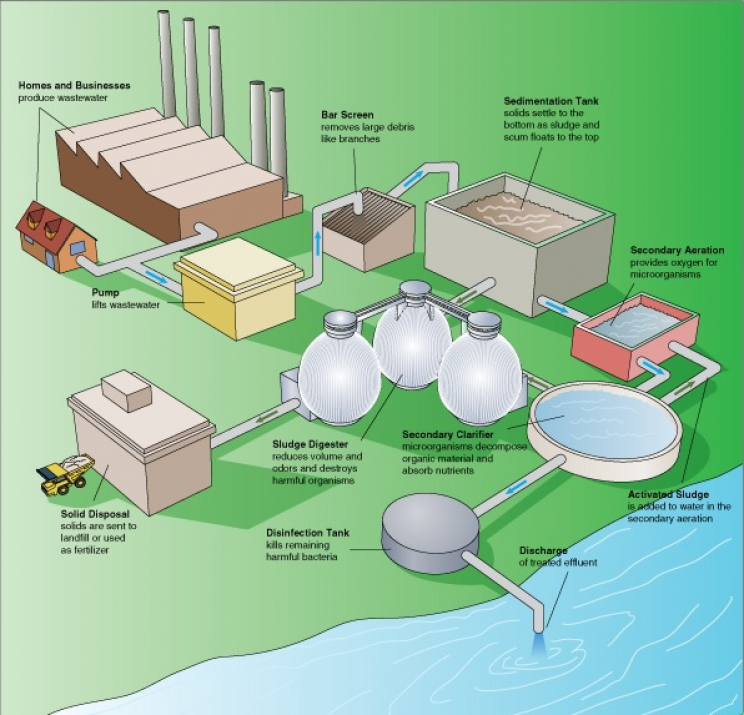
How Modern Wastewater Treatment Changed our WorldWhen wastewater arrives at a treatment facility, it first gets all the large chunks filtered out through a screen, a rather large one.
These screens are generally called bar screens, and their main job is to make the sewage more homogenous so it can flow through pumps and pipes in the plant.
The waste removed from bar screens is sent off to the landfill, and the slightly less chunky sewage heads to the next step, the grit chamber.
Grit chambers are essentially just big pools that you definitely don't want to swim in, they allow the larger particles in the sewage to settle out to the bottom.
These larger particles, things like dirt, sand, and large food particles, are called grit. Again, this process aids in making the sewage more homogenous than when it came in. The grit is also trucked off to landfills.
After the sewage gets pretty homogenized in these first few processes, it moves onto the primary clarifiers.
Primary clarifiers function as giant settling basins that allow particles larger than 10 μm (0.01 mm), referred to as suspended solids, to settle out to the bottom of the basin.
A giant skimming arm also scrapes away fat and grease that rise along the surface of the water.
These primary clarifiers are based on a principle called settling velocity, essentially just the speed at which particles settle.
Engineers make sure that the inflow of the water to the primary clarifier isn't more than the settling velocity of the particles, which ensures that particles still settle out and the sewage keeps on flowing.
Upon leaving the primary clarifiers, the sewage is free of solids bigger than 10 μm and at this point, is mostly contaminated with organic matter.
The sewage then moves on to aeration basins, beginning the secondary treatment processes.
Secondary wastewater treatment
Aeration basins are essentially bubbly hot tubs for sewage.
They bubble up air through the bottom of the sewage, which invigorates the sewage with dissolved oxygen.
How Modern Wastewater Treatment Changed our World
A view of 3 clarifiers
Engineers also pump in activated sludge into aeration basins, which is essentially bacteria and waste from the next round of clarifiers.
This activated sludge raises the oxygen content of the water and the bacteria go on a feeding frenzy, eating up all of the organic matter.
After the aeration basins, the sewage is going to look a lot clearer and it will head onto the secondary clarifiers.
This is the final filtering process, where all the remaining particles settle out.
The stuff that settles out is that activated sludge just mentioned, and a part of it is reused to make the aeration basins run smoothly.
What isn't used is left to dry out before it's disposed of or used as fertilizer.
How Modern Wastewater Treatment Changed our World
By the time the sewage leaves the secondary clarifiers, 85 percent of all organic matter has been removed and it will look fairly clear.
It might also be safe to drink too, but you're probably not going to want to. The final process before discharge is disinfection.
This process kills off all the bacteria still left in the water and makes sure there aren't any diseases being discharged into rivers.
This is typically done through chlorine, ozone, or ultraviolet disinfection (or a combination of these).
Ozone disinfection involves discharging electricity into the water to cause oxygen gas molecules to turn into ozone molecules, which oxidizes the bacteria, causing their cell walls to break, and kills them.
Chlorine treatment kills the bacteria in a similar manner but is a liquid chemical added to the water, and the treatment plant operators will generally remove the chlorine before releasing the effluent so the chlorine doesn't damage the environment.
Lastly, engineers can also use ultraviolet light to scramble the DNA of the bacteria, making it impossible for them to reproduce.
All three of these processes have different pros and cons and are used fairly interchangeably across the world.
In most cases, after disinfection, the water is released into rivers and streams.
In regions where water is scarce, sometimes the treated wastewater will head back for another round of treatment to be made into drinking water.
Chemically, this is very safe and could probably be used in many more places around the world if it wasn't for the stigma surrounding the closed-loop process of turning wastewater back into drinking water.
The entire process takes around 24 to 36 hours for a molecule of water to make it through the treatment plant.
And that's the magic of wastewater treatment. It's an essential process that allows us to live our lives without having to think about our own waste.
Be sure to thank all the wastewater treatment plant operators around you, because they have to deal with what you don't want to, 24/7.

Trevor English
Author
Trevor is a civil engineer (B.S.) by trade and an accomplished writer with a passion for inspiring everyone with new and exciting technologies. He is also a published children’s book author and the producer for the YouTube channel Concerning Reality.

Founded on the core mission of connecting likeminded engineers around the globe, Interesting Engineering is now a leading community with more than 15 million+ minds. Every day we share a new idea, a new thought, an upcoming technology OR an engineering breakthrough that will change the way you think about technology and engineering in today’s world and in the near future. Whether it’s a device that can charge your mobile in seconds or it’s the latest model of Boeing that has launched moments ago, we will bring everything up on your screen to view, to share and to grant you the power to comment. We believe that sharing information is the only way that can enrich and empower humans on this earth and we follow this as our core mission and responsibility. If you have got something that could entice the world, then Interesting Engineering is a perfect platform to show off your work to the outside world.
How Modern Wastewater Treatment Changed our World

Sunday, July 19, 2020

WASTE TO ENERGY - Landfills include a number of materials that are not biodegradable. Municipal solid waste is the official name of garbage. And it can be incredibly useful when it goes to a waste to energy plant. Instead of going to a landfill to do potential harm to the environment, it is used to produce energy. It works like this: the trash gets dumped into a large pit. A huge claw scoops up the trash and it gets incinerated. The heat from the incineration is combined with water to create steam. That steam is used to make turbines spin and the turbines create electricity. While waste to energy plants have a lot of potential, they need to be widely used to be the most effective. A perfect example of this can be seen in Sweden where waste to energy plants are commonplace. Less than 1% of household waste in Sweden ends up in landfills. In contrast, more than half of waste in the United States went into landfills in 2015. Sweden makes it a priority to convert as much trash as possible into energy. And that garbage can make a significant difference. How much energy can four tons of garbage produce? The equivalent of a ton of oil or 1.6 tons of coal, according to a Swedish power plant run by a municipal government company called Tekniska Verken. In Sweden, they recycle about 49% of their trash and about 50% goes to the waste to energy plants. While it isn’t the main source of the country’s energy, it does help to provide warmth in the winter.

The benefits of waste-to-energy technologies
..............................................................................................................................................
Climate explained: seven reasons to be wary of waste-to-energy ...
Waste to Energy

What is Waste to Energy?
by Matthew Speer


Humans create a lot of garbage.
Garbage fills up a lot of landfills. And those landfills can create a lot of environmental issues. What can be done?
In America, it might seem like a major problem.
Especially since landfills include a number of materials that are not biodegradable.
But there is a solution that can reduce waste and even help to create energy.
How Does Waste to Energy Work?
Municipal solid waste is the official name of garbage.
Waste-to-Energy: Sustainability Solution or Ponzi Scheme? | JSTOR ...And it can be incredibly useful when it goes to a waste to energy plant.
Instead of going to a landfill to do potential harm to the environment, it is used to produce energy.
It works like this: the trash gets dumped into a large pit. A huge claw scoops up the trash and it gets incinerated.
The heat from the incineration is combined with water to create steam. That steam is used to make turbines spin and the turbines create electricity.
Sweden: Gold Standard for Waste to Energy Use
While waste to energy plants have a lot of potential, they need to be widely used to be the most effective.
What's the future of waste-to-energy facility in the Philippines?A perfect example of this can be seen in Sweden where waste to energy plants are commonplace.
Less than 1% of household waste in Sweden ends up in landfills. In contrast, more than half of waste in the United States went into landfills in 2015.
Sweden makes it a priority to convert as much trash as possible into energy. And that garbage can make a significant difference.
How much energy can four tons of garbage produce?
The equivalent of a ton of oil or 1.6 tons of coal, according to a Swedish power plant run by a municipal government company called Tekniska Verken.
In Sweden, they recycle about 49% of their trash and about 50% goes to the waste to energy plants.
While it isn’t the main source of the country’s energy, it does help to provide warmth in the winter.
America is Also Working to Reduce Waste
While America may not have the same waste reduction rates as Sweden just yet, there are still many ways that the U.S. is working to reduce waste.
Aside from their own waste to energy plants, the U.S. also offers a number of waste reduction opportunities.
Recycling converts the trash into new materials.
Composting turns waste from organic materials into usable fertilizer that helps plants grow. These are just some of the ways that Americans can make the most of their waste.
There are even ways to make cash with trash.
Recycling programs can help reduce the amount of waste that ends up in landfills and can even pay in some places, depending on local laws.
Anything that helps to reduce waste is a worthy cause. And if it can also help bring in a few extra dollars, that’s even better!

Matthew Speer is a Marketing and Advertising Executive that has worked with companies like AOL and U.S. News University Connection. He also has a passion for sustainability and keeping the Earth a beautiful place for our future generations which is why he helped create iSustainableEarth.com. Inspired by his own family and taking strides to go green he strives to live a sustainable lifestyle through research and action.
http://www.isustainableearth.com/energyefficiency/what-is-waste-to-energy


You might also like:

Landfill
Waste Disposal and Recycling
CLICK HERE . . . to view . . . 
....................................................................................................................
Composting - Salinas Valley Solid Waste Authority (SVSWA)
Composting of Solid Waste, Objectives & Its Steps
CLICK HERE . . . to view . . . 
https://puricare.blogspot.com/2020/05/composting-of-solid-waste-objectives.html
....................................................................................................................
Life in the Payatas Dumpsite of Manila, Philippines
Health Risks Due 
To Solid Waste
CLICK HERE . . . to view . . . 
https://puricare.blogspot.com/2020/05/health-risks-due-to-solid-waste-solid.html
.................................................................................................................... 
United Nations' World Water Day Is Marked In San Francisco
Recycling Different Plastics
CLICK HERE . . . to view . . . 
https://puricare.blogspot.com/2019/01/recycling-different-plastics-different.html  
....................................................................................................................
Image result for benefits of recycling metals images
Benefits of Recycling Metal
CLICK HERE . . . to view . . . 
Waste-to-energy: Green solutions for emerging markets - KPMG Global

Wednesday, June 24, 2020

WASTEWATER TREATMENT - Wastewater treatment is the process of converting wastewater – water that is no longer needed or is no longer suitable for use – into bilge water that can be discharged back into the environment. It may be formed by a number of activities including bathing, washing, using the toilet, and rainwater runoff. Wastewater is full of contaminants including bacteria, chemicals, and other toxins. Its treatment aims at reducing the contaminants to acceptable levels to make the water safe for discharge back into the environment. There are two wastewater treatment plants namely chemical or physical treatment plants, and biological wastewater treatment plants. Biological waste treatment plants use biological matter and bacteria to break down waste matter. Physical waste treatment plants use chemical reactions as well as physical processes to treat wastewater. While Biological treatment systems are ideal for treating wastewater from households and business premises, Physical wastewater treatment plants are mostly used to treat wastewater from industries, factories, and manufacturing firms. Industrial waste is a matter of grave concern as wastewater from industries contain chemicals and other toxins. Treating wastewater should be encouraged. This will save water thereby paving the way towards a healthy and sustainable environment and will also prevent water-borne hazards that put human lives at stake.


..................................................................................................................................................
Wastewater Treatment
What is Wastewater Treatment?


Wastewater treatment is the process of converting wastewater – water that is no longer needed or is no longer suitable for use – into bilge water that can be discharged back into the environment.
It may be formed by a number of activities including bathing, washing, using the toilet, and rainwater runoff.
Wastewater is full of contaminants including bacteria, chemicals, and other toxins.
Its treatment aims at reducing the contaminants to acceptable levels to make the water safe for discharge back into the environment.
Having said that, what exactly is wastewater treatment and how does it work? Well, that is what we are going to learn over the next couple of sections.
Types of Wastewater Treatment Plants
There are two wastewater treatment plants namely chemical or physical treatment plants, and biological wastewater treatment plants.
Biological waste treatment plants use biological matter and bacteria to break down waste matter.
Alternatively, Physical waste treatment plants use chemical reactions as well as physical processes to treat wastewater.
While Biological treatment systems are ideal for treating wastewater from households and business premises, Physical wastewater treatment plants are mostly used to treat wastewater from industries, factories, and manufacturing firms.
Note that Industrial Waste here is a matter of grave concern as most of the wastewater from industries contain chemicals and other toxins that can largely harm the environment.
According to Wikipedia,
“Wastewater treatment is a process used to remove contaminants from wastewater or sewage and convert it into an effluent that can be returned to the water cycle with minimum impact on the environment, or directly reused. The latter is called water reclamation because treated wastewater can be used for other purposes. The treatment process takes place in a wastewater treatment plant (WWTP), often referred to as a Water Resource Recovery Facility (WRRF) or a Sewage Treatment Plant (STP). Pollutants in municipal wastewater (households and small industries) are removed or broken down.”
Step by Step Wastewater Treatment Process
The following is a step by step process of how wastewater is treated:
1. Wastewater Collection
This is the first step in the wastewater treatment process. 
Collection systems are put in place by the municipal administration, homeowners as well as business owners to ensure that all the wastewater is collected and directed to a central point.
Note that the wastewater collected here is primarily the water used in our everyday activities like cooking utensils, taking a bath, doing laundry, and more.
This water is collected and then directed to a treatment plant using underground drainage systems or by exhauster tracks owned and operated by business people.
The transportation of wastewater should however be done under hygienic conditions.
The pipes or tracks should be leak-proof and the people offering the exhausting services should wear protective clothing.
Since the slightest issue in the exhauster track might affect the overall treatment process, businesses manning the process take extra-care to prevent any mishap.
2. Odor Control
At the treatment plant, odor control is important, to say the least.
Wastewater contains a lot of dirty substances that cause a foul smell over time.
To ensure that the surrounding areas are free of the foul smell, odor treatment processes are initiated at the treatment plant.
All odor sources are contained and treated using chemicals to neutralize the foul smell producing elements. It is the first wastewater treatment plant process and it’s very important.
3. Screening
This is the next step in the wastewater treatment process.
Screening involves the removal of large objects for example nappies, cotton buds, plastics, diapers, rags, sanitary items, nappies, face wipes, broken bottles or bottle tops that in one way or another may damage the equipment.
Failure to observe this step results in constant machine and equipment problems.
Specially designed equipment is used to get rid of grit that is usually washed down into the sewer lines by rainwater.
The solid wastes removed from the wastewater are then transported and disposed off in landfills.
4. Primary Treatment
This process involves the separation of macrobiotic solid matter from the wastewater.
Primary treatment is done by pouring the wastewater into big tanks for the solid matter to settle at the surface of the tanks.
The sludge, the solid waste that settles at the surface of the tanks, is removed by large scrappers and is pushed to the center of the cylindrical tanks and later pumped out of the tanks for further treatment.
The remaining water is then pumped for secondary treatment.
5. Secondary Treatment
Also known as the activated sludge process, the secondary treatment stage involves adding seed sludge to the wastewater to ensure that it is broken down further.
Air is first pumped into huge aeration tanks that mix the wastewater with the seed sludge which is basically a small amount of sludge, which fuels the growth of bacteria that uses oxygen and the growth of other small microorganisms that consume the remaining organic matter.
This process leads to the production of large particles that settle down at the bottom of the huge tanks. The wastewater passes through the large tanks for a period of 3-6 hours.
6. Bio-solids handling
The solid matter that settles out after the primary and secondary treatment stages are directed to digesters.
The digesters are heated at room temperature. The solid wastes are then treated for a month where they undergo anaerobic digestion.
During this process, methane gases are produced and there is a formation of nutrient-rich bio-solids that are recycled and de-watered into local firms.
The methane gas formed is usually used as a source of energy at the treatment plants.
It can be used to produce electricity in engines or to simply drive plant equipment. This gas can also be used in boilers to generate heat for digesters.
7. Tertiary treatment
This stage is similar to the one used by drinking water treatment plants which clean raw water for drinking purposes.
The tertiary treatment stage has the ability to remove up to 99 percent of the impurities from the wastewater.
This produces effluent water that is close to drinking water quality.
Unfortunately, this process tends to be a bit expensive as it requires special equipment, well trained and highly skilled equipment operators, chemicals, and steady energy supply.
8. Disinfection
After the primary treatment stage and the secondary treatment process, there are still some diseases causing organisms in the remaining treated wastewater.
To eliminate them, the wastewater must be disinfected for at least 20-25 minutes in tanks that contain a mixture of chlorine and sodium hypochlorite.
The disinfection process is an integral part of the treatment process because it guards the health of the animals and the local people who later use the water for other purposes.
The effluent (treated wastewater) is later released into the environment through the local waterways.
This water may now be used in industries, for irrigation, and to meet a range of other purposes like doing laundry and washing clothes.
9. Sludge Treatment
The sludge that is produced and collected during the primary and secondary treatment processes requires concentration and thickening to enable further processing.
It is put into thickening tanks that allow it to settle down and later separates from the water. This process can take up to 24 hours.
The remaining water is collected and sent back to the huge aeration tanks for further treatment.
The sludge is then treated and sent back into the environment and can be used for agricultural use.
The Benefits of Wastewater Treatment
Wastewater treatment has a number of benefits. For example, wastewater treatment ensures that the environment is kept clean, there is no water pollution.
You probably know at this point, how important it is to prevent water pollution.
After all, it causes countless ailments in both humans and animals. In the worst cases, it might even lead to death.
Treating wastewater minimizes water pollution, thereby keeping us safe and healthy.
We also laud this process because it ingeniously makes use of the most important natural resource; water.
After the treatment, the water can be used for cooling machines in factories and industries.
It will minimize the need of using freshwater, thereby, in a way, saving water.
Treating wastewater also prevents the outbreak of waterborne diseases and most importantly, it ensures that there is adequate water for other purposes like irrigation.
That is why it is extremely important to encourage this process and make it a part of our daily lives.
Finally, one should note that wastewater is but a complex combination of several special chemicals, nutrients, and most importantly, metal particles.
Recovering the metal particles, in particular, can effectively address the community level demands of useful natural resources.
Scientists are constantly employing new methods to enhance the resource recovery process from wastewater, and thanks to them, we can now use treated wastewater for a variety of purposes.
Conclusion
In summary, the wastewater treatment process is one of the most important environmental conservation processes that should be encouraged worldwide.
Most wastewater treatment plants treat wastewater from homes and business places.
Industrial plants, refineries, and manufacturing plants wastewater is usually treated at the onsite facilities.
These facilities are designed to ensure that the wastewater is treated before it can be released to the local environment.
Some of the water is used for cooling the machines within the plants and treated again. They try to ensure that nothing is lost.
It is illegal for disposing untreated wastewater into rivers, lakes, oceans, or into the environment, and if found culpable one can be prosecuted.
Either way, since wastewater is a matter of grave concern, treating it should be encouraged time and again.
This will not just help save water thereby paving the way towards a healthy and sustainable environment, but it will also prevent water-borne hazards that put millions of human lives at stake.

Rinkesh. A true environmentalist by heart ❤️. Founded Conserve Energy Future with the sole motto of providing helpful information related to our rapidly depleting environment. Unless you strongly believe in Elon Musk‘s idea of making Mars as another habitable planet, do remember that there really is no 'Planet B' in this whole universe.