Showing posts with label Seasons. Show all posts

Monday, August 10, 2020

AUTUMN: THE COOLING-OFF SEASON - Sandwiched between blazing summer and chilly winter, autumn is the "cooling off" season. Nighttime arrives earlier, temperatures begin to drop and most vegetative growth decreases. Animals begin to prepare for the dearth of food that generally comes during the winter, gathering supplies or traveling to warmer climates. The cycle of seasons is caused by Earth's tilt on its axis and the planet's orbit around the sun. When the axis points toward the sun, that hemisphere experiences summer. The hemisphere tilted away from the sun experiences winter. After Earth travels a quarter of the way around the sun, the axis is pointed along the planet's path, parallel to the star. From our perspective here on Earth, the sun travels along an imaginary line called the ecliptic, which marks the plane in which the planets orbit the sun. Another imaginary line is the celestial equator, which a projection of Earth's equator into space. For half the year, during summer in the Northern Hemisphere, the sun appears to move along the ecliptic north of the celestial equator. During the other half of the year, it appears to be south of the celestial equator. Because of the way the sun's light refracts in Earth's atmosphere, we can actually see the sun for a few minutes before its disk rises and for a few minutes after it has truly set. Thus, daylight on any given day lasts roughly six or seven minutes longer than it seemingly should.

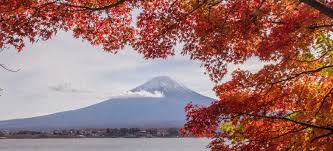
Iconic Views of Mount Fuji: Fuji Kawaguchiko Autumn Leaves ...
8 International Places to Travel to See Breathtaking Fall Leaves
.................................................................................................................................................................
The colorful foliage of autumn. This scenic route showcases
the pumpkin-orange hues of fall foliage.
Autumn: The Cooling-Off Season
By Nola Taylor Redd


Sandwiched between blazing summer and chilly winter, autumn is the "cooling off" season.
Nighttime arrives earlier, temperatures begin to drop and most vegetative growth decreases.
Animals begin to prepare for the dearth of food that generally comes during the winter, gathering supplies or traveling to warmer climates.
In 2015, autumn in the Northern Hemisphere begins at 4:21 a.m. EDT (8:21 a.m. UTC) on Sept. 23, according to the National Oceanic and Atmospheric Administration. It ends at 11:48 p.m. EST on Dec. 21 (4:45 a.m. UTC on Dec. 22).
Seasons explained
The cycle of seasons is caused by Earth's tilt on its axis and the planet's orbit around the sun.
When the axis points toward the sun, that hemisphere experiences summer.
The hemisphere tilted away from the sun experiences winter.
After Earth travels a quarter of the way around the sun, the axis is pointed along the planet's path, parallel to the star.
From our perspective here on Earth, the sun travels along an imaginary line called the ecliptic, which marks the plane in which the planets orbit the sun.
Another imaginary line is the celestial equator, which a projection of Earth's equator into space.
For half the year, during summer in the Northern Hemisphere, the sun appears to move along the ecliptic north of the celestial equator.
During the other half of the year, it appears to be south of the celestial equator.
The exact moment when the sun appears to arrive at the intersection of the ecliptic and the celestial equator is when autumn begins.
At Earth's equator, the sun is directly overhead at noon.
These moments in time are called equinoxes, and the length of daylight and nighttime are approximately the same, according to the National Maritime Museum.
The word "equinox is derived from two Latin words: aequus (equal) and nox (night).
Day and night are not exactly 12 hours each.
Because of the way the sun's light refracts in Earth's atmosphere, we can actually see the sun for a few minutes before its disk rises and for a few minutes after it has truly set.
Thus, daylight on any given day lasts roughly six or seven minutes longer than it seemingly should.
Different definitions of autumn
The autumnal equinox is the beginning of "astronomical autumn," which ends with the start of winter.
In the Northern Hemisphere, that is from around September 22 to about December 22, though it varies from year to year, according to the NOAA. In the Southern Hemisphere, the season runs from about March 20 to June 21.
Weather forecasters and some countries define the season as "meteorological autumn" by the three months in which the weather changes.
In the Northern Hemisphere, this is September, October, and November.
In the Southern Hemisphere, meteorological autumn occurs in March, April, and May.
Falling temperatures
Autumn brings a nip in the air. How much of a change is felt depends on the location of the area on Earth.
Regions near the equator experience fairly constant temperatures throughout the year, while those farther north or south experience greater variations.
This is because the equator gets a consistent amount of sun.
Far northern and southern regions get less sun due to the curvature of the sun, according to the Atmospheric Radiation Measurement (ARM) program.
For the continental United States, temperatures during autumn (September through November) average 53.5 degrees Fahrenheit (11.9 Celsius), according to the NOAA — an 18-degree (10 degrees C) drop from average summer temperatures.
Average autumn temperatures range from a high of 72.7 F (22.6 C) in Florida to a low of 26.7 F (minus 2.9 C) in Alaska.
What's in a name?
Autumn, of course, is also known as fall, primarily in the United States.
Ambivalence over the name of the third season of the year reflects its status as a relatively new concept, according to Natalie Wolchover in a 2012 article for Live Science.
Many cultures only recognized two seasons, such winter and summer or winter and spring.
The period of transition between summer and winter came to be known as "harvest."
"Autumn," a Latin word, first appeared in English in the late 14th century, and gradually gained on "harvest."
In the 17th century, "fall" came into use, almost certainly as a poetic complement to "spring," according to "Folk Taxonomies in Early English" (Fairleigh Dickinson University Press, 2003) by Earl R. Anderson.
Why do leaves change color?
Fall leaves.
In response to chilly temperatures and the changes in daylight, leaves stop producing green-tinted chlorophyll, which allows them to capture sunlight and make energy.
Because chlorophyll is sensitive to the cold, certain weather conditions like early frosts will turn off production more quickly.
Meanwhile, orange and yellow pigments called carotenoids — also found in orange carrots — shine through the leaves' washed out green.
The red color in some leaves comes from anthocyanins, which unlike carotenoids, are only produced in the fall, according to the State University of New York College of Environment.
They also give color to strawberries, red apples, and plums.
But red leaves are also signal of distress.
If you see leaves of a tree turning red early, in late August, the tree is most likely suffering from a fungus or perhaps a ding from a reckless driver.
Autumn in different cultures
Autumn is generally regarded as the end of the growing season. Also known as the harvest season, autumn ushers in a time of celebration for many farming cultures when they gathered in their crops.
"Autumn, or fall, is rich with different festivals which mainly celebrate the return of light, harvest, and, like spring, rebirth through death," Cristina De Rossi, an anthropologist at Barnet and Southgate College in London, told Live Science.
For example, the harvest festival in the United Kingdom is a time when people give thanks for the fruits of the land and collect food to donate to those in need. 
"Harvest celebrations tend to combine giving thanks with prayers for future abundance, to propitiate the god(s) and ensure successful crops," said De Rossi.
Another example of this would be Thanksgiving, which is celebrated in the United States.
The foliage of Hocking Hills is so breathtaking the fall time
that it’s known as Southeastern Ohio’s Scenic Wonderland.
It is a historical commemoration, but it has a spiritual dimension strongly associated with homecoming and giving praise for what has been bestowed upon us, explained De Rossi.
De Rossi also points out these celebrations as further examples of fall's ties with giving thanks and rebirth:
o  The Jewish festival of Sukkot, which commemorates the time spent in exile by giving thanks.
o  Halloween (All Hallows Eve) celebrations on Oct. 31 remind people of the connection with death, the spirits of those who have left this earth, and thus rebirth. 
o  On the following day, Christians, especially Catholics, celebrate All Hallows Day, or All Saints' Day, when people visit their departed and bring flower to their graves. 
o  In Mexico, the living celebrate their ancestors during the Day of the Dead on Nov. 2.
Autumn quotes
The season is often regarded as a melancholy time and has inspired many writers and poets. Here are some quotes about autumn:
"Autumn is a second spring when every leaf is a flower." — Albert Camus
Delicious autumn! My very soul is wedded to it, and if I were a bird I would fly about the earth seeking successive autumns." — George Eliot
"Autumn … the year's last, loveliest smile." — William Cullen Bryant
"Every leaf speaks bliss to me, fluttering from the autumn tree." — Emily Bronte
"Now Autumn's fire burns slowly along the woods and day by day the dead leaves fall and melt." — William Allingham
"Autumn in New York, why does it seem so inviting?" — Vernon Duke
"Summer ends, and autumn comes, and he who would have it otherwise would have high tide always and a full moon every night." — Hal Borland
"I saw old Autumn in the misty morn stand shadowless like silence, listening to silence." — Thomas Hood
"Autumn is the mellower season, and what we lose in flowers we more than gain in fruits." — Samuel Butler
"Autumn is as joyful and sweet as an untimely end." — Remy de Gourmont
Additional reporting by Alina Bradford, Live Science Contributor, and Tim Sharp, Reference Editor.

Nola Taylor Redd 
Live Science Contributor
Nola Taylor Redd is a contributing writer for Live Science and Space.com. She combines her degrees in English and Astrophysics to write about science, with an emphasis on all things space-related.
https://www.livescience.com/24476-autumn.html



You might also like:


30 Beautiful Spring-Inspired Baby Names For Girls
The 4 Seasons of Life You Should Know
CLICK HERE . . . to view . . . 
Autumn Leaves - Things To Do | Visit Hiroshima
Autumn leaves (koyo) in Japan

Tuesday, April 7, 2020

THE REASONS FOR THE SEASONS - Our year is divided up into four seasons: summer, fall, winter, spring. Unless someone lives at the equator, each season delivers different weather patterns. Generally, it's warmer in spring and summer, and cooler in autumn and winter. Ask most people why it is cold in the winter and warm in the summer and they'll likely say that Earth must be closer to the Sun in the summer and farther away in the winter. This seems to make common sense. After all, as someone gets close to a fire, they feel more heat. So why wouldn't closeness to the Sun cause the warm summer season? While this is an interesting observation, it actually leads to the wrong conclusion. Here's why: Earth is farthest from the Sun in July each year and closest in December, so the "closeness" reason is wrong. Also, when it is summer in the northern hemisphere, winter is happening in the southern hemisphere, and vice versa. If the reason for the seasons was solely due to our proximity to the Sun, then it should be warm in both the northern and southern hemispheres at the same time of year. That doesn't happen. It's really the tilt that is the main reason we have seasons. But there is another factor to consider.

Different season
..........................................................................................................................................................
Carefree girl in field of flowersThe Reasons for the Seasons
summer-sunset swimIf the reason for the seasons was solely due to our proximity to the Sun, then it should be warm in both the northern and southern hemispheres at the same time of year - that doesn't happen - it's really the tilt that is the main reason we have seasons
By John P. Millis, Ph.D


The change of seasons is one of those phenomena that people take for granted. They know it happens in most places, but don't always stop to think about why we have seasons.
The answer lies in the realm of astronomy and planetary science.
earth and its seasonsThe biggest reason for the seasons is that Earth's axis is tilted relative to its orbital plane.
Think of the orbital plane of the solar system as a flat plate. Most of the planets orbit around the Sun on the "surface" of the plate.
Rather than having their north and south poles point directly perpendicular to the plate, most planets have their poles at a slant. This is particularly true of Earth, whose poles are tilted 23.5 degrees.
Earth may have a tilt because of a large impact on our planet's history that likely caused the creation of our Moon.
One idea of the Moon's formation.
The best theory about the formation of the Moon says that the infant Earth
and a Mars-sized body called Theia collided early in the history of the solar system.
The remnants were blasted to space and eventually coalesced to form the Moon. 
During that event, infant Earth was smacked pretty heavily by a Mars-sized impactor. That caused it to tip over on its side for a while until the system settled down.
.
Eventually, the Moon formed and Earth's tilt settled to the 23.5 degrees it is today. It means that during part of the year, half of the planet is tilted away from the Sun, while the other half is tilted toward it.
Both hemispheres still get sunlight, but one gets it more directly when it's tilted toward the Sun in summer, while the other gets it less directly during winter (when it is tilted away).
This diagram shows Earth's axial tilt and how it affects the hemispheres
that are tilted toward the Sun through different parts of the year. 
When the northern hemisphere is tilted toward the Sun, people in that part of the world experience summer. At the same time, the southern hemisphere gets less light, so winter occurs there.
The solstices and equinoxes are used mostly in calendars to mark the beginning and end of seasons but are not themselves related to the causes of the seasons.
Seasonal Changes
Our year is divided up into four seasons: summer, fall, winter, spring. Unless someone lives at the equator, each season delivers different weather patterns.
Generally, it's warmer in spring and summer, and cooler in autumn and winter.
Ask most people why it is cold in the winter and warm in the summer and they'll likely say that Earth must be closer to the Sun in the summer and farther away in the winter.
This seems to make common sense. After all, as someone gets close to a fire, they feel more heat. So why wouldn't closeness to the Sun cause the warm summer season?
While this is an interesting observation, it actually leads to the wrong conclusion.
Here's why: Earth is farthest from the Sun in July each year and closest in December, so the "closeness" reason is wrong.
Also, when it is summer in the northern hemisphere, winter is happening in the southern hemisphere, and vice versa.
If the reason for the seasons was solely due to our proximity to the Sun, then it should be warm in both the northern and southern hemispheres at the same time of year.
That doesn't happen. It's really the tilt that is the main reason we have seasons. But there is another factor to consider.
the jovian worlds of jupiter, saturn, uranus, and neptune
All planets have an axial tilt, including the gas giants. The Uranus tilt is so severe it "rolls" around the Sun on it side.
It's Hotter at High Noon Too
Earth's tilt also means that the Sun will appear to rise and set in different parts of the sky during different times of the year.
In the summertime the Sun peaks almost directly overhead, and generally speaking will be above the horizon (i.e. there will be daylight) during more of the day.
This means that the Sun will have more time to heat the surface of the Earth in the summer, making it even warmer. In the winter, there's less time to heat the surface, and things are a bit chillier.
Observers can generally see this change of apparent sky positions quite easily.
Over the course of a year, it's fairly easy to note the position of the Sun in the sky. In the summertime, it will be higher up and rise and set at different positions than it does in the wintertime.
It's a great project for anyone to try, and all they need is a rough drawing or picture of the local horizon to the east and west.
Observers can glance out at the sunrise or sunset each day, and mark the positions of sunrise and sunset each day to get the full idea.
Back to Proximity
So, does it matter how close Earth is to the Sun? Well, yes, in a sense, it does, just not the way people expect.
Earth's orbit around the Sun is only slightly elliptical. The difference between its closest point to the Sun and the most distant is a little more than three percent.
That isn't enough to cause huge temperature swings. It translates to a difference of a few degrees Celsius on average.
The temperature difference between summer and winter is a lot more than that. So, closeness doesn't make as much of a difference as the amount of sunlight the planet receives.
That's why just simply assuming that Earth is closer during one part of the year than another is wrong. The reasons for our seasons are easy to understand with a good mental image of our planet's tilt and its orbit around the Sun.
Key Takeaways
Earth's axial tilt plays a large role in creating seasons on our planet.
The hemisphere (north or south) tilted toward the Sun receives more heat during that time.
Closeness to the Sun is NOT a reason for the seasons.
John P. Millis, Ph.D
Professor of Physics and Astronomy
Education
Ph.D., Physics and Astronomy, Purdue University
B.S., Physics, Purdue University
Introduction
Associate Professor of Physics, Anderson University
Chairman, Department of Physical Sciences and Engineering, Anderson University
Conducts astronomical research at the VERITAS observatory
Experience
John P. Millis, Ph.D., is a former writer for ThoughtCo, where he contributed articles on space and astronomy for three years. He has taught physics and astronomy at the college level since 2001 and is currently the chair of the Department of Physical Sciences and Engineering at Anderson University in Indiana. He teaches a wide variety of courses while maintaining an active research program in high energy astrophysics.
Dr. Millis's research focuses on pulsars, pulsar wind nebulae, and supernova remnants. Using the VERITAS gamma-ray observatory in southern Arizona, he studies the very high energy radiation from these dynamic sources to extract information about their formation and emission mechanisms. In 2010, he co-founded a small consulting business, Aurum Consulting, LLC, assisting with biological testing, chemical formulations, and product development.
Education
Dr. Millis received a Ph.D. in physics and astronomy and a B.S. in physics with a mathematics minor from Purdue University.
ThoughtCo and Dotdash
ThoughtCo is a premier reference site focusing on expert-created education content. We are one of the top-10 information sites in the world as rated by comScore, a leading Internet measurement company. Every month, more than 13 million readers seek answers to their questions on ThoughtCo.
For more than 20 years, Dotdash brands have been helping people find answers, solve problems, and get inspired. We are one of the top-20 largest content publishers on the Internet according to comScore, and reach more than 30% of the U.S. population monthly. Our brands collectively have won more than 20 industry awards in the last year alone, and recently Dotdash was named Publisher of the Year by Digiday, a leading industry publication.

Night sky and the Milky Way in Botswana the Southern Hemisphere

Monday, April 29, 2019

LEAVES CHANGE COLORS IN THE FALL - Leaf abscission (the technical term for the dropping of leaves) begins with the degradation of chlorophyll. As the green fades, yellow and orange pigments known as carotenoids are revealed in the leaves of many species. In other plants, pigments called anthocyanins accumulate in the leaves at this time, giving them shades of red and purple. Some of the most beautiful fall foliage features both types of pigments, often with one color giving way to the next as the season progresses.

..........................................................................................................................................................................................................................................................................................................
...................................................................................................
Why Do Leaves Change Colors in the Fall?
.

As the green fades, yellow and orange pigments known as carotenoids are revealed in the leaves of many species. In other plants, pigments called anthocyanins accumulate in the leaves at this time, giving them shades of red and purple. Some of the most beautiful fall foliage features both types of pigments, often with one color giving way to the next as the season progresses.

WRITTEN BY:  Melissa Petruzzello 


In many places around the world, autumn is marked by the slow, beautiful change of green foliage to vibrant reds, oranges, yellows, and purples. 

Green leaves appear green because of the presence of the pigment chlorophyll, which is key to photosynthesis. 

In temperate regions, cold winters pose a risk to the leaves of broadleaf trees and other perennials, and so these plants drop their leaves in a controlled fashion to reduce injuries and conserve energy. 

This event is usually triggered by the declining day length and falling temperatures of autumn. 

Leaf abscission (the technical term for the dropping of leaves) begins with the degradation of chlorophyll. 

As the green fades, yellow and orange pigments known as carotenoids are revealed in the leaves of many species. 

In other plants, pigments called anthocyanins accumulate in the leaves at this time, giving them shades of red and purple. 

Some of the most beautiful fall foliage features both types of pigments, often with one color giving way to the next as the season progresses.

Eventually all the leaves are dropped, and the plant goes dormant for the long winter months.


BIOGRAPHY
Melissa Petruzzello began working at Britannica in 2013 and is Assistant Editor of Plant and Environmental Science. She has her M.S. in Plant Biology and Conservation from Northwestern University (2011) and a B.S. in Biological Science from Biola University (2008).
https://www.britannica.com/story/why-do-leaves-change-colors-in-the-fall


You might also like:


Autumn 
Leaves

Nat King Cole

CLICK HERE . . . to view complete playlist . . . 

https://puricarechronicles.blogspot.com/2018/06/autumn-leaves-nat-king-cole-falling.html

,,,,..........................................................................................................................................................................................................................................

Autumn: The Cooling-Off Season

CLICK HERE . . . to view . . . 

https://puricare.blogspot.com/2020/08/autumn-cooling-off-season-sandwiched.html

,,,,..........................................................................................................................................................................................................................................

Changing Seasons

CLICK HERE . . . to view . . . 

https://puricarechronicles.blogspot.com/2020/05/changing-seasons-childlike-faith-does.html

,,,,..........................................................................................................................................................................................................................................

Finding Beauty in Your Winter Season

CLICK HERE . . . to view . . . 

https://puricarechronicles.blogspot.com/2020/03/finding-beauty-in-your-winter-season.html

,,,,..........................................................................................................................................................................................................................................

Seasonal Affective Disorder (SAD)

CLICK HERE . . . to view . . . 

https://puricare.blogspot.com/2020/02/seasonal-affective-disorder-sad-why-do.html