Showing posts with label Platinum. Show all posts

Tuesday, December 8, 2020

HOW TO MAKE AQUA REGIA ACID SOLUTION - Aqua regia is an extremely corrosive mixture of nitric and hydrochloric acid, used as an etchant, for some analytical chemistry procedures, and to refine gold. Aqua regia dissolves gold, platinum, and palladium, but not the other noble metals. Here's what you need to know to prepare aqua regia and use it safely. Aqua regia is a corrosive acid mixture made by combining nitric acid and hydrochloric acid. The usual ratio of acids is 3 parts hydrochloric acid to 1 part nitric acid. When mixing the acids, it is important to add the nitric acid to the hydrochloric acid and not the other way around. Aqua regia is used to dissolve gold, platinum, and palladium. The acid mixture is unstable, so it is usually prepared in small amounts and used immediately. Aqua regia preparation involves mixing strong acids. The reaction produces heat and evolves poisonous vapors. Make and use aqua regia solution inside a fume hood, with the sash down as much as is practical to contain the vapors and protect against injury in case of splashing or glassware breakage. Prepare the minimum volume needed for your application. Make sure your glassware is clean. In particular, you don't want any organic contaminants because they can produce a vigorous or violent reaction. Avoid using any glassware that may be contaminated with a chemical containing a C-H bond.

.........................................................................................................................................................................................................................................................................................................

How to Make Aqua Regia Acid Solution

By Anne Marie Helmenstine, Ph.D.


Aqua regia is an extremely corrosive mixture of nitric and hydrochloric acid, used as an etchant, for some analytical chemistry procedures, and to refine gold.

Aqua regia dissolves gold, platinum, and palladium, but not the other noble metals.

Here's what you need to know to prepare aqua regia and use it safely.​​

Fast Facts: Aqua Regia

Aqua regia is a corrosive acid mixture made by combining nitric acid and hydrochloric acid.

The usual ratio of acids is 3 parts hydrochloric acid to 1 part nitric acid.

When mixing the acids, it is important to add the nitric acid to the hydrochloric acid and not the other way around.

Aqua regia is used to dissolve gold, platinum, and palladium.

The acid mixture is unstable, so it is usually prepared in small amounts and used immediately.

Reaction to Make Aqua Regia

Here is what happens when nitric acid and hydrochloric acid are mixed:

HNO3 (aq) + 3HCl (aq) → NOCl (g) + 2H2O (l) + Cl2 (g)

Over time, nitrosyl chloride (NOCl) will decompose into chlorine gas and nitric oxide (NO).

Nitric acid auto-oxidizes into nitrogen dioxide (NO2):

2NOCl (g) → 2NO (g) + Cl2 (g)

2NO (g) + O2 (g) → 2NO2(g)

Nitric acid (HNO3), hydrochloric acid (HCl), and aqua regia are strong acids.

Chlorine (Cl2), nitric oxide (NO), and nitrogen dioxide (NO2) are toxic.

Aqua Regia Safety

Aqua regia preparation involves mixing strong acids.

The reaction produces heat and evolves poisonous vapors, so it's important to follow safety protocols when making and using this solution:

Make and use aqua regia solution inside a fume hood, with the sash down as much as is practical to contain the vapors and protect against injury in case of splashing or glassware breakage.

Prepare the minimum volume needed for your application.

Make sure your glassware is clean. In particular, you don't want any organic contaminants because they can produce a vigorous or violent reaction.

Avoid using any glassware that may be contaminated with a chemical containing a C-H bond.

Do not use the finished solution on any material containing an organic.

Wear safety goggles.

Wear a lab coat.

Wear gloves.

If you get drops of any of the strong acids on your skin, wipe them off immediately and rinse with lots of water.

If you spill acid on clothing, remove it immediately.

In the case of inhalation, move immediately to fresh air.

Use the eyewash and seek emergency medical attention in case of eye contact.

In the case of ingestion, rinse the mouth with water and do not induce vomiting.

Neutralize any spills with sodium bicarbonate or similar compound.

Remember, it's best to neutralize a strong acid with a weak base and not a strong base.

Prepare Aqua Regia Solution

The usual molar ratio between concentrated hydrochloric acid and concentrated nitric acid is HCl:HNO3 of 3:1.

Keep in mind, concentrated HCl is about 35%, while concentrated HNO3 is about 65%, so the volume ratio is usually 4 parts concentrated hydrochloric acid to 1 part concentrated nitric acid.

A typical total final volume for most applications is only 10 milliliters. It's unusual to mix up a large volume of aqua regia.

Add the nitric acid to the hydrochloric acid. Do not add hydrochloric to nitric!

The resulting solution with be a fuming red or yellow liquid.

It will smell strongly of chlorine (although your fume hood should protect you from this).

Dispose of leftover aqua regia by pouring it over a large amount of ice.

This mixture may be neutralized with a saturated sodium bicarbonate solution or 10% sodium hydroxide.

The neutralized solution may then be safely poured down the drain. The exception is used solution that contains heavy metals.

A heavy metal-contaminated solution needs to be disposed of according to your local regulations.

Once you have prepared aqua regia, it should be used when it's fresh. Keep the solution in a cool location.

Do not store the solution for an extended length of time because it becomes unstable.

Never store stoppered aqua regia because pressure build-up could break the container.

Another potent acid solution is called "chemical piranha."

If aqua regia isn't suitable for your needs, piranha solution may be what you need.


Anne Marie Helmenstine, Ph.D.

Chemistry Expert

Education

Ph.D., Biomedical Sciences, University of Tennessee at Knoxville

B.A., Physics and Mathematics, Hastings College

Introduction

Ph.D. in biomedical sciences from the University of Tennessee at Knoxville - Oak Ridge National Laboratory.

Science educator with experience teaching chemistry, biology, astronomy, and physics at the high school, college, and graduate levels.

ThoughtCo and About Education chemistry expert since 2001.

Widely-published graphic artist, responsible for printable periodic tables and other illustrations used in science.

Experience

Anne Helmenstine, Ph.D. has covered chemistry for ThoughtCo and About Education since 2001, and other sciences since 2013. She taught chemistry, biology, astronomy, and physics at the high school, college, and graduate levels. She has worked as a research scientist and also abstracting and indexing diverse scientific literature for the Department of Energy.

In addition to her work as a science writer, Dr. Helmenstine currently serves as a scientific consultant, specializing in problems requiring an interdisciplinary approach. Previously, she worked as a research scientist and college professor.

Education

Dr. Helmenstine holds a Ph.D. in biomedical sciences from the University of Tennessee at Knoxville and a B.A. in physics and mathematics with a minor in chemistry from Hastings College. In her doctoral work, Dr. Helmenstine developed ultra-sensitive chemical detection and medical diagnostic tests.

ThoughtCo and Dotdash

ThoughtCo is a premier reference site focusing on expert-created education content. We are one of the top-10 information sites in the world as rated by comScore, a leading Internet measurement company. Every month, more than 13 million readers seek answers to their questions on ThoughtCo.

For more than 20 years, Dotdash brands have been helping people find answers, solve problems, and get inspired. We are one of the top-20 largest content publishers on the Internet according to comScore, and reach more than 30% of the U.S. population monthly. Our brands collectively have won more than 20 industry awards in the last year alone, and recently Dotdash was named Publisher of the Year by Digiday, a leading industry publication.

https://www.thoughtco.com/making-aqua-regia-acid-solution-603641

Friday, May 8, 2020

PLATINUM - Platinum is a naturally occurring chemical element that is actually about 30 times rarer than gold. It's the least common of all the popular precious metals. In appearance, platinum is silvery-white and shiny. Because it looks so similar to white gold, the distinction can be confusing to the untrained eye. White gold is actually yellow gold that was mixed with other metals and then plated with rhodium to appear more white — a white mask that will unveil a yellow tinge over time. Platinum, on the other hand, will maintain its naturally white color. If you look closely at a piece of well-loved platinum jewelry, you'll notice a satiny finish on the surface that developed over time. This change in texture is known as 'patina. Many platinum aficionados actually desire this change in appearance. Platinum is also more durable than gold, which is one of the reasons it is often the metal of choice for engagement rings, (gold prongs are more likely to break than their platinum counterparts.) Nowadays, platinum is more likely to be mined as ore from deep underground. Workers blast rock into small pieces and transport it to the surface for further processing. Platinum also may be found as a byproduct of processing other metals like nickel and copper. Most platinum is derived from a mineral called cooperite, also known as platinum sulfide. Platinum is even found in outer space. Platinum has also been discovered in heavy concentrations in meteorites.

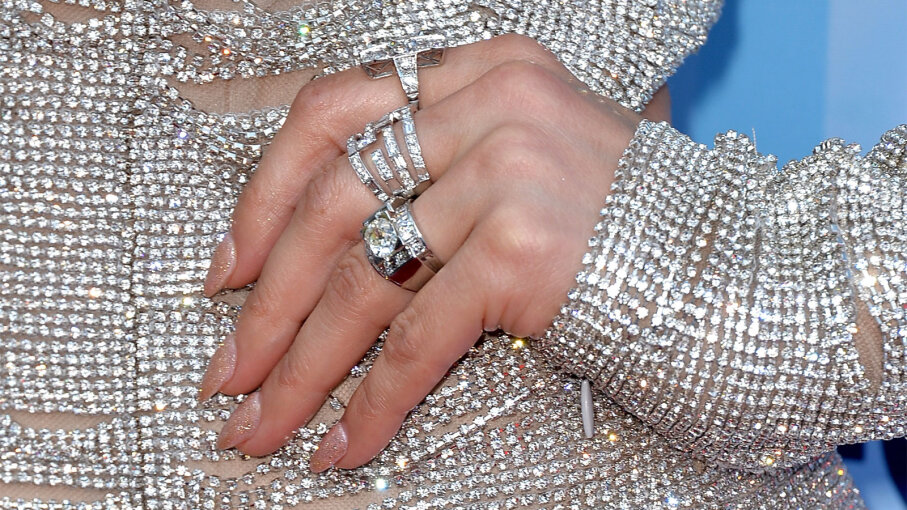
jennifer lopez, platinum rings
Jennifer Lopez (and her platinum rings) attend Fox's "American Idol" XIII Finale at Nokia Theatre L.A. on May 21, 2014 in Los Angeles.
.................................................................................................................................................................
Platinum
What’s So Special About Platinum?
BY ALIA HOYT 


If phrases like "platinum status" and "going platinum" are to be believed, the precious metal is the best and baddest in all the land.
But how elite is it actually, particularly when compared with its best frenemy, gold?
Platinum Vs. Gold
Platinum is a naturally occurring chemical element that is actually about 30 times rarer than gold, according to Jenny Luker, president of Platinum Guild International USA (PGI), a marketing organization for the platinum jewelry industry.
"If all the platinum ever mined were melted and poured into an Olympic-sized pool, the platinum would barely reach your ankles. Gold, however, would fill three pools," she explains via email.
In fact, it's the least common of all the popular precious metals.
In appearance, platinum is silvery-white and shiny.
Because it looks so similar to white gold, the distinction can be confusing to the untrained eye.
"White gold is actually yellow gold that was mixed with other metals and then plated with rhodium to appear more white — a white mask that will unveil a yellow tinge over time," Luker says.
"Platinum, on the other hand, will maintain its naturally white color."
That's not to say that it won't change at all, however. 
"If you look closely at a piece of well-loved platinum jewelry, you'll notice a satiny finish on the surface that developed over time. This change in texture is known as 'patina,'" Luker explains.
Many platinum aficionados actually desire this change in appearance.
Platinum is also more durable than gold, which is one of the reasons it is often the metal of choice for engagement rings, (gold prongs are more likely to break than their platinum counterparts.)
Unfortunately, all of these attributes have given platinum a traditionally heftier price tag than gold, although Luker notes that the current price difference is minimal. 
"Right now, the price per ounce of platinum is actually lower than gold. However, because platinum jewelry is more pure (typically 95 percent platinum versus 58.5 percent gold in 14 kt. gold jewelry) and more dense than gold, it will still cost a bit more than a similar gold ring," she notes.
(On July 9, 2019, the price of platinum was $816.60 per ounce. Gold was $1,397.68 per ounce.)
How Platinum Is Mined
Platinum is mined mainly in South Africa, but also found in Russia and Zimbabwe.
The metal is formed when minerals are eroded from their original spot and then carried by water somewhere else (this is called stream bed mining or alluvial mining).
Workers sift through the sand or mud looking for gold, diamonds or platinum.
Nowadays, platinum is more likely to be mined as ore from deep underground. Workers blast rock into small pieces and transport it to the surface for further processing.
Platinum also may be found as a byproduct of processing other metals like nickel and copper.
Most platinum is derived from a mineral called cooperite, also known as platinum sulfide.
Platinum is even found in outer space. "Platinum has also been discovered in heavy concentrations in meteorites — first reported in F. G. Hawley's research papers, published in 1939," Luker says.
Although platinum's strength and beauty have made it a jewelry favorite since the ancient Egyptians and Mayans, jewelry-making is hardly its only useful application.
About half of platinum's demand is actually for use in catalytic converters for transportation vehicles like buses, cars and trucks, in large part because it's adept at converting harmful engine emissions into less damaging waste.
Platinum is also used as a catalyst to make chemicals like silicone, nitric acid and benzene.
In fact, the six platinum group metals (iridium, palladium, platinum, rhodium, ruthenium and osmium) are all known for their impressive catalytic skills (meaning these metals increase the rate of chemical reaction between substances without changing their physical properties.)
In the healthcare field, platinum compounds are a component of some chemotherapy drugs, and are also used in pacemakers and even dental fillings.
The electronics industry has various applications for platinum, too — for instance, computer hard disks.
From a defense standpoint, platinum has been long valued for its strength, which goes far beyond simple scratch resistance.
The metal holds up well under high temperatures, boasts stable electrical properties and is highly resistant to chemical attacks.
For example, coating jet engine blades with platinum-based products protects them where temperatures can reach 2,000 degrees C (3,632 degrees F).
"Platinum was an important strategic defense metal used during World War II and was not allowed for jewelry application at that time," Luker says.
Even today, platinum is so important to economic and defense efforts that it was listed as one of the 35 minerals "deemed critical to U.S. national security and the economy."
With a resume like that, it appears that platinum's reputation and price tag are well-deserved, indeed. 
NOW THAT'S MISGUIDED
Ironically, Spaniards who discovered platinum in Colombia were less than impressed, tossing it by the wayside as an impurity in the coveted silver they were mining.
So disdainful of the metal were they that they dubbed it "platina," which means "little silver." From this term, we get the English word "platinum."
Alia Hoyt
CONTRIBUTING WRITER
Alia is an Atlanta-based freelance writer who has contributed content to HowStuffWorks for going on a decade now, with a specialty in health writing. She’s also been published by TLC, Animal Planet, and a number of corporate clients. She holds a bachelor’s degree in journalism from the University of Georgia (Go Dawgs!), and might someday get around to setting up a professional website. Until then, check her out on LinkedIn.
She and her husband are proud parents to three handsome, too-smart-for-their-own-good boys. Alia is a passably not terrible tennis player, lover of all things dance and music, brownie-obsessed, avid reader and off-key car singer. Her two favorite types of people are those who have a healthy sense of humor and those who actually read articles in their entirety before posting comments.

jennifer lopez, platinum rings