Showing posts with label Wind direction. Show all posts

Tuesday, January 12, 2021

MEASURING THE WIND - How can we measure the wind? - Wind speed is measured with an anemometer. The faster the anemometer is spinning, the stronger the wind. You do not need an anemometer to estimate the wind speed. You can use a verbal scale, called the Beaufort scale, which describes the effect of the wind on everyday things like trees. Wind direction is measured with a wind vane. You can estimate the wind direction by yourself just by using your face as a "sensor." Face into the wind, and then record the direction you are facing, relative to north. The wind blows because air pressure is higher in one place than in another place. The air moves from areas of higher pressure to areas of lower pressure. Objects like buildings, trees, and hills affect the direction of the wind near the surface. To get the best idea of the wind direction, try to stand far away from such objects. A park or a playing field is the best place to observe the wind. Wind speed is measured with an anemometer. Most anemometers have four horizontal shafts arranged like the spokes of a wheel. The end of each shaft is cup-shaped. The wind pushes the concave side of the cup more than the convex side, so the anemometer spins in the wind. The faster the anemometer is spinning, the stronger the wind. You do not need an anemometer to estimate the wind speed. You can use a verbal scale, called the Beaufort scale, which describes the effect of the wind on everyday things like trees. Wind direction is measured with a wind vane.

..........................................................................................................................................................................................................................................................................................................................................

Measuring the Wind

How can we measure the wind?

.

Wind speed is measured with an anemometer. The faster the anemometer is spinning, the stronger the wind. You do not need an anemometer to estimate the wind speed. You can use a verbal scale, called the Beaufort scale, which describes the effect of the wind on everyday things like trees. Wind direction is measured with a wind vane. You can estimate the wind direction by yourself just by using your face as a "sensor." Face into the wind, and then record the direction you are facing, relative to north.

The American Geosciences Institute


The wind blows because air pressure is higher in one place than in another place.

The air moves from areas of higher pressure to areas of lower pressure.

Objects like buildings, trees, and hills affect the direction of the wind near the surface.

To get the best idea of the wind direction, try to stand far away from such objects.

A park or a playing field is the best place to observe the wind.

Wind speed is measured with an anemometer.

Most anemometers have four horizontal shafts arranged like the spokes of a wheel.

The end of each shaft is cup-shaped. The wind pushes the concave side of the cup more than the convex side, so the anemometer spins in the wind.

The faster the anemometer is spinning, the stronger the wind.

You do not need an anemometer to estimate the wind speed.

You can use a verbal scale, called the Beaufort scale, which describes the effect of the wind on everyday things like trees.

Wind direction is measured with a wind vane.

One end of the vane has a small, heavy object, and the other end has a flat object with a large area.

The wind pushes the flat object more than the small, heavy objects, so the vane swings around to be parallel to the wind.

You can estimate the wind direction by yourself just by using your face as a "sensor."

Face into the wind, and then record the direction you are facing, relative to north.

The American Geosciences Institute

AGI was founded in 1948, under a directive of the National Academy of Sciences, as a network of associations representing geoscientists with a diverse array of skills and knowledge of our planet. The Institute provides information services to geoscientists, serves as a voice of shared interests in our profession, plays a major role in strengthening geoscience education, and strives to increase public awareness of the vital role the geosciences play in society’s use of resources, resilience to natural hazards, and the health of the environment.

AGI is a not-for-profit 501(c)(3) organization dedicated to serving the geoscience community and addressing the needs of society. AGI headquarters are in Alexandria, Virginia.

AGI's Mission:

The American Geosciences Institute represents and serves the geoscience community by providing collaborative leadership and information to connect Earth, science, and people.

https://www.americangeosciences.org/education/k5geosource/content/weather/how-can-we-measure-the-wind


You might also like:


Wind Turbulence

CLICK HERE . . . to view . . . 

https://puricare.blogspot.com/2019/11/wind-turbulence-turbulence-is.html

..........................................................................................................................................................................................................................................................................................

Aircraft Winglets

CLICK HERE . . . to view . . . 

https://puricare.blogspot.com/2019/11/aircraft-winglets-significant-source-of.html

..........................................................................................................................................................................................................................................................................................

Wind Turbines

CLICK HERE . . . to view . . . 

https://puricare.blogspot.com/2019/11/wind-turbines-why-do-wind-turbines-have.html

..........................................................................................................................................................................................................................................................................................

Taking Authority Over the Wind and Waves in Your Life

CLICK HERE . . . to view . . . 

https://puricarechronicles.blogspot.com/2019/11/taking-authority-over-wind-and-waves-in.html

..........................................................................................................................................................................................................................................................................................

The Aeolian Harp

Music of the Storm 

CLICK HERE . . . to view . . . 

https://puricarechronicles.blogspot.com/2019/06/the-aeolian-harp-music-of-storm-aeolian.html

..........................................................................................................................................................................................................................................................................................

Atmospheric Pressure

CLICK HERE . . . to view . . . 

https://puricare.blogspot.com/2019/10/atmospheric-pressure-air-consists-of.html

..........................................................................................................................................................................................................................................................................................

Gauge Pressure And Absolute Pressure

CLICK HERE . . . to view . . . 

https://puricare.blogspot.com/2019/09/gauge-pressure-and-absolute-pressure.html

Friday, January 31, 2020

NATURAL METHODS TO KEEP HOUSES COOL - Just imagine how miserable it would have been for folks in the scorching summer when their only option would be to vigorously wave a paper fan with their hands. People found plenty of natural methods to keep their houses cooler than the temperature outside. They identified ways to create a balance with the local environment. They employed methods of passive cooling to design houses in a way that is in accordance with the climate, enabling them to lower the temperature inside the house. Climate is most important in deciding how a building should be constructed. This must be done by taking into account the movement of the sun and wind on the site. The information that this provides determines the location of the rooms in the houses, so placing rooms in the opposite direction of the sun’s path would make the room naturally cooler than the others. Wind direction also plays an important role, as the flow of natural wind in a room would help keep it ventilated and cooler.

Pont du Gard three-tiered aqueduct was built in Roman times on the river Gardon. Provence summer day. - Image(cge2010)S
................................................................................................................................................................
Adalaj, Gujrat, India- November 16,2010 The beautiful Step well of Adalaj ( Adalaj or Rudabai stepwell or baoli ) Near Ahmadabad - Image( Abhijeet Khedgikar)s
Natural Methods To Keep Houses Cool

How Did Houses Cool Before ‘Air Conditioning’ Became A Thing?
Vishal Thakur  


Before the advent of artificial air conditioning, people used many different ways to cool their houses.
Some of these techniques included designing houses with respect to the surrounding environment, using evaporative cooling, wind-catchers, etc.
Summers can become an unbearable mess sometimes.
Rising temperatures in the afternoon, sun beating down on top of your head, roads filled with traffic and pollution… it all feels like a bad and very sweaty drag.
Fortunately, we now have the option of cushioning ourselves in an enclosed room with the temperature turned way down on the AC unit, effectively detaching ourselves from the heatwave going on outside.
This, of course, wasn’t always an option. The first air conditioning systems were powered back in 1902, meaning that artificial cooling is a relatively new phenomenon.
Just imagine how miserable it would have been for folks in the scorching summer when their only option would be to vigorously wave a paper fan with their hands.
Fortunately, they had more options then handheld fans, as people found plenty of natural methods to keep their houses cooler than the temperature outside.
They employed methods of passive cooling to design houses in a way that is in accordance with the climate, enabling them to lower the temperature inside the house.
Let’s look at some of the ways people naturally cooled their homes.
Ways in which houses were cooled naturally
Without modern technology, people relied heavily on the way houses were built in accordance with the local climate to maximize heat dissipation and thermal insulation.
Many buildings constructed today completely disregard this, as it is easy to simply build a box and slap electric air conditioning on the side.
In the past, people did not have this option, so they had to learn techniques to make houses as site-friendly and aligned with the climate as possible, making it completely natural.
These tricks were used to make their houses cooler:
House layout based on the climate of the site
As stated before, the climate of a site is one of the most important aspects of deciding how a building should be constructed.
This must be done by taking into account the movement of the sun and wind on the site.
The information that this provides determines the location of the rooms in the houses, so placing rooms in the opposite direction of the sun’s path would make the room naturally cooler than the others.
Wind direction also plays an important role, as the flow of natural wind in a room would help keep it ventilated and cooler.
Some very interesting examples include Indian step wells, which were dug underground in the shape of stairs.
The level underneath has water and as is away from sunlight, making it much cooler than the rooms above.
Shading of the house
Well-designed exterior shading of the house cuts off the harsh sunlight coming in during the afternoon.
This reduces the heat gain on the exterior surfaces of the house (windows and blank walls) and also ensures ambient temperatures in semi-open and outdoor areas of the house.
Initially, this shading was done with trees, but as techniques evolved, the shading could be achieved by an opaque slab running through the house (seen above modern windows), extended balconies, and perforated wooden shades called pergolas.
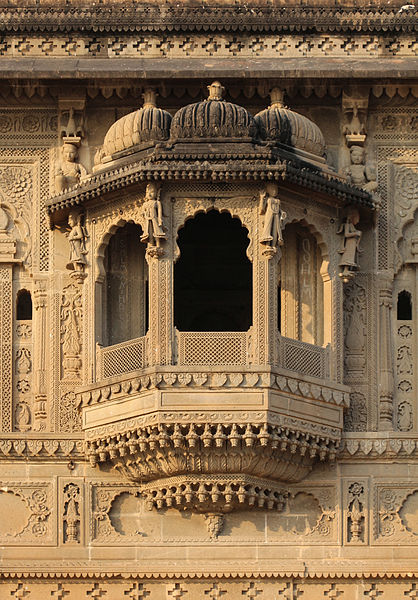
Examples of this are seen in Mughal architecture with jharokhas, which provide a separation of space, reducing the temperature of the room inside.
Thermal insulation
The thickness of the walls and the roof of the house plays an important role in transferring heat from the exterior to the interior.
Many materials are used to insulate this transfer, making the interior rooms much cooler.
These materials are stacked between the walls; some of the common ones are wool, cellulose fiber and glass fiber.
Thermal insulation boards are drilled on the back of the roof to avoid heat transfer.
Earth walls help a lot in insulating the houses, as it is a cooler material; adding splashes to the walls makes the incoming air cool and pleasant.
Natural Ventilation
Keeping windows facing the direction of the wind helps cool down rooms with the breeze.
Having two windows on two opposite walls or having a courtyard on one side helps this even further, as there is a constant flow of wind in the room, giving no time for the hot air to linger.
Innovative window-making techniques also help get rid of warm air. As warm air moves higher than cooler air, small vents were placed on the windows for its elimination, thus making the room cooler.
Black openings are also placed on the roof for the suctioning of warm air, with a wind tunnel on the ground to cool the incoming air.
Windcatcher
In use for thousands of years, a windcatcher is a small tower with an opening on the top.
The tower ‘catches’ the wind flowing above and forces it to enter the houses, thus cooling the interior. This is the simplest type of windcatcher.
Another type is used with a qanat, which is the opposite of the one described above. A qanat is an underground tunnel with a water body for the warm air to cool down.
The air then flows into the room and goes out of the opening on top of the tower, thus completing the ventilation cycle.
Evaporative Cooling
Our bodies cool through evaporation. As we exert energy and perspire (sweat), the evaporation cools our body down.
This same principle is used in making a room cooler through evaporation. Wet khas-mats hung on a window on a windy day will make the room cooler inside.
This method is so effective, in fact, that modern coolers use the same principles to operate.
The earliest example of this is the Egyptians using wet reeds on their windows to cool down their rooms.
Aqueducts
Romans gave us many engineering marvels and aqueducts are one of them.
Aqueducts are an underground network linked to a water supply and used to connect clear sources of water to community spaces and individual houses.
They were also used to take heat away from houses by pumping into the walls.
However, this was just for the elite, as it was an expensive system to develop and use.
These aqueducts were also used to fill Roman fountains, which were used to cool down the common public.
Conclusion
We’ve come a long way, from sprinkling water on our walls to installing electric air conditioners without a second thought.
People have always found ingenious ways to get some relief in the heat and identified ways to create a balance with the local environment.
As artificial air conditioning is not very environmentally friendly, we can still use some of these clever approaches when designing new buildings to reduce the need for artificial cooling!

Vishal is an Architect and a design aficionado. He likes making trippy patterns in his computer. Fascinated by technology’s role in humanity’s evolution, he is constantly thinking about how the future of our species would turn out – sometimes at the peril of what’s currently going on around him.
Cattail and reed plant isolated on white background. Wild grass - Image(Artiste2d3d)s


Adalaj, Gujrat, India- November 16,2010 The beautiful Step well of Adalaj ( Adalaj or Rudabai stepwell or baoli ) Near Ahmadabad - Image( Abhijeet Khedgikar)s
Stepwells make the room on the lower floors cooler. 
Maheshwar Fort
Jarokha’s help shade rooms from the penetrating sunlight. 
Plastic (mansard) or skylight window on attic with environmentally friendly and energy efficient thermal insulation rockwool. - Image(brizmaker)S
Thermal insulation on roofs to reduce heat gain. 

Earthship-ventilation-cooling-tube-schematic copy
Earth walls with openings for airflow
Edificios en Yazd, Irán
Windcatcher
Windcatcher with qanat 


Cattail and reed plant isolated on white background. Wild grass - Image(Artiste2d3d)s
Egyptians used wet reeds for evaporative cooling 
Pont du Gard three-tiered aqueduct was built in Roman times on the river Gardon. Provence summer day. - Image(cge2010)S
Three-tier aqueduct