Showing posts with label Respirators. Show all posts

Saturday, August 8, 2020

RESPIRATORS AND CLEAN AIR - How Do Respirators Allow You To Breathe Clean Air In A Contaminated Environment - A respirator is a device you can use to protect yourself from inhaling harmful or even poisonous substances. Any device that can do that could be theoretically referred to as a respirator. Respirators come in different shapes and sizes and are appropriate for different settings. You don’t want to use a gas mask designed for stopping dust in a place filled with harmful gases, because it would be absolutely useless and would potentially put your life in danger. Activated charcoal is another very common choice for filters in respirators, as each particle or granule of carbon offers a large surface area where pollutant particles can get trapped and adsorbed. Such filters are quite effective at filtering out acidic gases, such as chlorine, and particles like sediment and volatile organic compounds. Activated carbon filtering is even used in cigarette filters! The other and relatively more sophisticated way of being able to breathe in a contaminated setting is by using a respirator whose filters contain a substance that could react with the ‘bad’ chemical and neutralize it. For instance, a respirator with calcium oxide will bind with carbon dioxide present in the air and turn it into a different product. This way, all the harmful carbon dioxide will be removed and the user will be able to breathe in the contaminated environment.

Self-Contained Breathing Apparatus
................................................................................................................................................................
Polish MUA gas maskRespirators And Clean Air
How Do Respirators Allow You To Breathe Clean Air In A Contaminated Environment  
By Ashish


Have you watched the popular American TV show Breaking Bad?
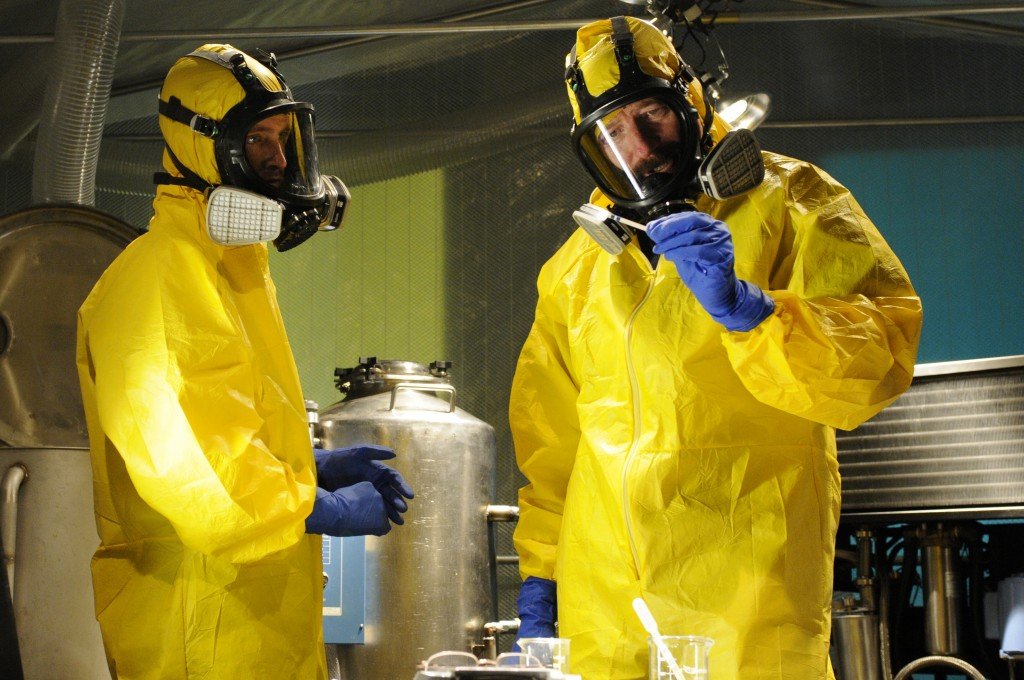
The lead characters of the show are often shown working in chemistry labs, wearing respirators that basically cover their entire face.
walter-white-yellow-hazmat-meth-cook-suit
The lead characters of the show Breaking Bad always wore respirators while working in their lab.
There are many movies and TV shows that depict people donning respirators before entering a “contaminated” area.
In fact, respirators are not so uncommon, even in real life: firefighters wear a special type of respirator when entering sites that still have a lot of smoke and soot.
Chemists wear them in the laboratory and even elite security forces wear respirators before going into the “target area”, if they are expecting chemical threats.
I must admit, the first time I saw people putting on respirators in a contaminated environment, I couldn’t figure out how those little mask-like items worked.
I mean, I understood that the respirators could cover their nose and face and protect them from external injuries, but they still had to breathe in the same contaminated environment, right?
As in, the air they breathed still contained those impurities and harmful gases, so how did the respirators protect them from all that harmful smoke?
It’s very simply, actually, but first things first…
What is a respirator?
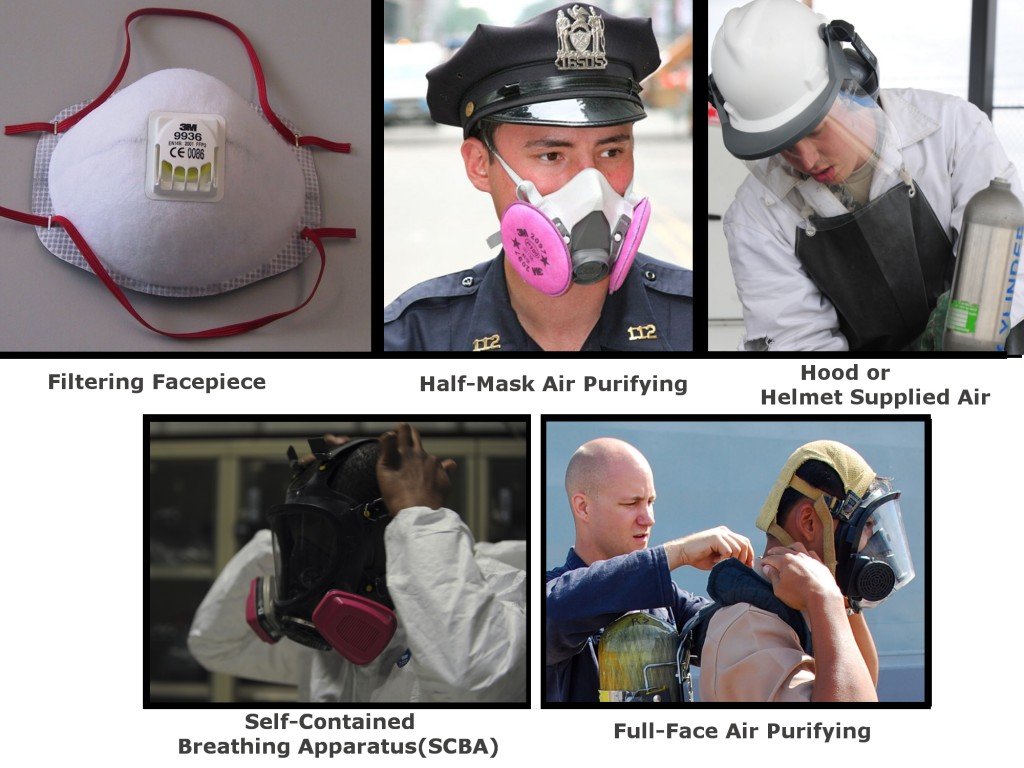
Different kinds of respirators.
A respirator is a device you can use to protect yourself from inhaling harmful or even poisonous substances (e.g., dangerous gases that contain ‘bad’ chemicals). Any device that can do that could be theoretically referred to as a respirator.
Respirators come in different shapes and sizes and are appropriate for different settings.
The second part of that sentence is the really important part.
You don’t want to use a gas mask designed for stopping dust in a place filled with harmful gases, because it would be absolutely useless and would potentially put your life in danger.
How do respirators work?
There are two ways to make contaminated air breathable:
1) physically filtering the air, and
2) reacting the contaminated air with a substance that removes or neutralizes the harmful chemicals within it.
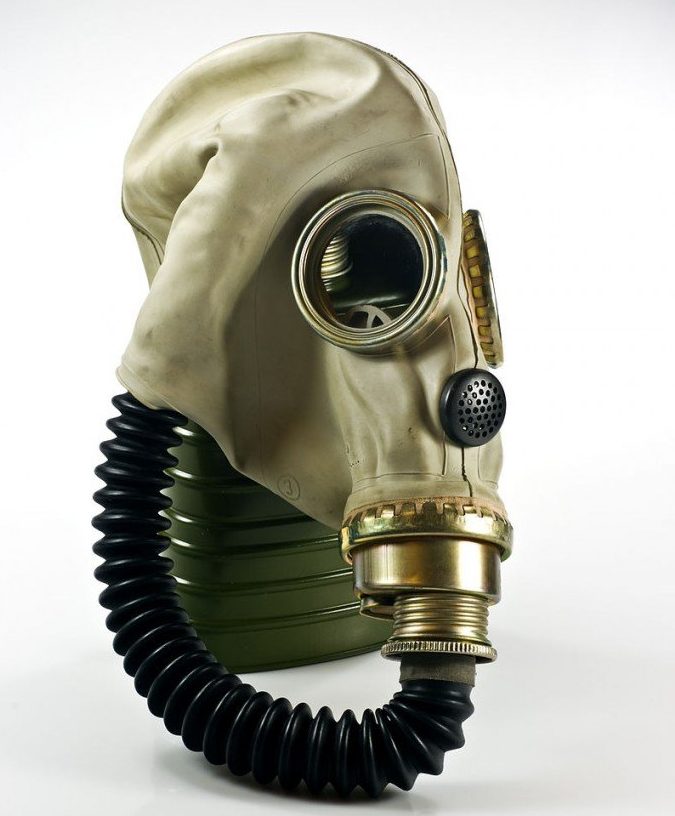
Polish MUA gas mask
A Polish MUA Gas Mask. Used from the 1970’s to the 1980’s
and was replaced by the Polish MP-4 gas mask.
There’s also a third way, wherein you could carry your own oxygen supply when entering a contaminated zone, but we’re only going to discuss techniques to filter air using respirators.
Consider dusty air, for example.
The gas mask that would be required to breathe in such a setting would contain a paper filter that could physically prevent dust particles from entering through the mask (to gain access to the nose or mouth of the wearer).
Self-Contained Breathing Apparatus
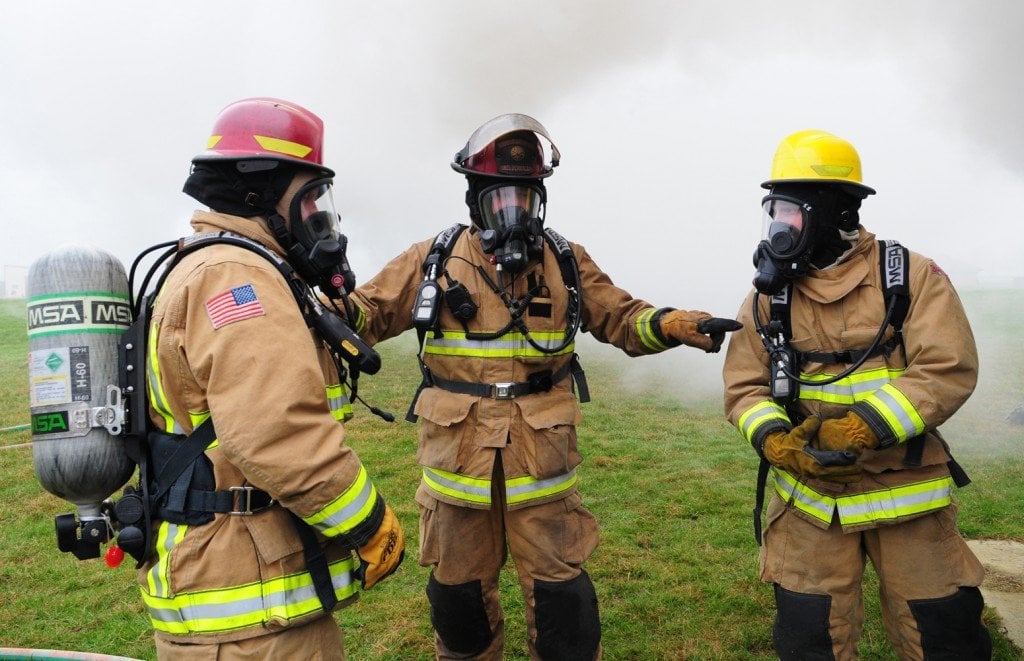
Self-Contained Breathing Apparatus. These types of respirators —
called a Self-Contained Breathing Apparatus (SCBA) — are usually worn by firefighters
on a mission. Such respirators use their own air tank to supply clean air,
so the wearer doesn’t have to worry about filters at all. 
Paper filters have very small holes that let only oxygen pass through and block all unwanted particles (e.g., dust, smoke, soot particles etc.).
It’s important to note that such a basic mask will be absolutely useless in the presence of toxic gases.
Activated charcoal is another very common choice for filters in respirators, as each particle or granule of carbon offers a large surface area where pollutant particles can get trapped and adsorbed.
Imagine filtering rocks out of sand… if you have a filter with pores that are big enough to let sand pass through, but are small enough to block rocks, filtering the rocks out of the sand would be easy, right?
That’s exactly what these types of filters do — they let oxygen molecules pass through and block bigger pollutant particles.
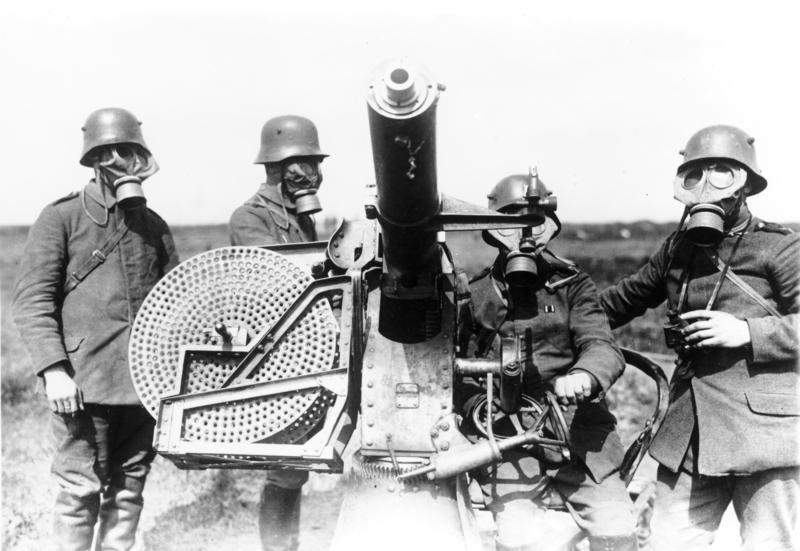
, How Do Respirators Allow You To Breathe Clean Air In A Contaminated Environment?, Science ABC, Science ABC
German soldiers with gas masks, 1915.
In the rudimentary gas masks used in the first world war, it was found
that wood charcoal was a good absorbent of poison gases.
Such filters are quite effective at filtering out acidic gases, such as chlorine, and particles like sediment and volatile organic compounds. Activated carbon filtering is even used in cigarette filters!
The other and relatively more sophisticated way of being able to breathe in a contaminated setting is by using a respirator whose filters contain a substance that could react with the ‘bad’ chemical (present in the contaminated air) and neutralize it.
For instance, a respirator with calcium oxide will bind with carbon dioxide (i.e., the pollutant) present in the air and turn it into a different product.
This way, all the harmful carbon dioxide will be removed and the user will be able to breathe in the contaminated environment.
Then again, this sort of respirator would be absolutely useless against chlorine or mustard gas.
That’s why it’s VERY IMPORTANT to check what kind of contamination setting a particular respirator will be effective in, as entering a ‘bad air’ zone wearing the wrong kind of respirator is tantamount to not wearing one at all!

Ashish is a Science graduate (Bachelor of Science) from Punjabi University (India). He spends a lot of time watching movies, and an awful lot more time discussing them. He likes Harry Potter and the Avengers, and obsesses over how thoroughly Science dictates every aspect of life… in this universe, at least.

ScienceABC.com was launched with the sole objective of finding and sharing fun and interesting science facts. We believe that Science is a fascinating and valuable area of study for people of all ages, and we’re not alone! This website is curated by a team of professionals who are passionate about Science. Our greatest hope is that the fun we have curating this content is the same for everyone who reads it.

walter-white-yellow-hazmat-meth-cook-suit

Thursday, October 19, 2017

GAS MASKS - Modern chemical warfare began on April 22, 1915, when German soldiers first used chlorine gas to attack the French in Ypres. But long before 1915, miners, firemen and underwater divers all had a need for helmets that could provide breathable air. Early prototypes for gas masks were developed to meet those needs.

Gas Masks
The History of Gas Masks 
The gas mask was an evolutionary invention and involved many inventors
by Mary Bellis


Inventions that aid and protect the ability to breath in the presence of gas, smoke or other poisonous fumes were being made before the first use of modern chemical weapons.
Modern chemical warfare began on April 22, 1915, when German soldiers first used chlorine gas to attack the French in Ypres.
But long before 1915, miners, firemen and underwater divers all had a need for helmets that could provide breathable air.
Early prototypes for gas masks were developed to meet those needs.

EARLY FIRE FIGHTING AND DIVING MASKS

In 1823, brothers John and Charles Deane patented a smoke protecting apparatus for firemen that was later modified for underwater divers.
In 1819, Augustus Siebe marketed an early diving suit. Siebe's suit included a helmet in which air was pumped via a tube to the helmet and spent air escaped from another tube.
The inventor founded Siebe, Gorman and Co to develop and manufacture respirators for a variety of purposes and was later instrumental in developing defense respirators.
In 1849, Lewis P. Haslett patented an "Inhaler or Lung Protector," the first U.S. patent (#6529) issued for an air purifying respirator.
Haslett's device filtered dust from the air.
In 1854, Scottish chemist John Stenhouse invented a simple mask that used charcoal to filter noxious gasses.
In 1860, Frenchmen, Benoit Rouquayrol and Auguste Denayrouse invented the Résevoir-Régulateur, which was intended for use in rescuing miners in flooded mines.
The Résevoir-Régulateur could be used underwater. The device was made up of a nose clip and a mouthpiece attached to an air tank that the rescue worker carried on his back.
In 1871, British physicist John Tyndall invented a fireman's respirator that filtered air against smoke and gas.
In 1874, British inventor Samuel Barton patented a device that "permitted respiration in places where the atmosphere is charged with noxious gasses, or vapors, smoke, or other impurities," according to U.S. patent #148868.

GARRETT MORGAN

American Garrett Morgan patented the Morgan safety hood and smoke protector in 1914.
Two years later, Morgan made national news when his gas mask was used to rescue 32 men trapped during an explosion in an underground tunnel 250 feet beneath Lake Erie.
The publicity led to the sale of the safety hood to firehouses across the United States.
Some historians cite the Morgan design as the basis for early U.S. army gas masks used during WWI.
Early air filters include simple devices such as a soaked handkerchief held over the nose and mouth.
Those devices evolved into various hoods worn over the head and soaked with protective chemicals.
Goggles for the eyes and later filters drums were added.

CARBON MONOXIDE RESPIRATOR

The British built a carbon monoxide respirator for use during WW1 in 1915, before the first use of chemical gas weapons.
It was then discovered that unexploded enemy shells gave off high enough levels of carbon monoxide to kill soldiers in the trenches, foxholes and other contained environments.
This is similar to the dangers of the exhaust from a car with its engine turned on in an enclosed garage.

CLUNY MACPHERSON

Canadian Cluny Macpherson designed a fabric "smoke helmet" with a single exhaling tube that came with chemical sorbents to defeat the airborne chlorine used in the gas attacks.
Macpherson's designs were used and modified by allied forces and are considered the first to be used to protect against chemical weapons.

BRITISH SMALL BOX RESPIRATOR

In 1916, the Germans added larger air filter drums containing gas neutralizing chemicals to their respirators.
The allies soon added filter drums to their respirators as well.
One of the most notable gas masks used during WWI was the British Small Box Respirator or SBR designed in 1916.
The SBR was probably the most reliable and heavily used gas masks used during WWI.
RELATED POSTS:


CLICK HERE . . .


CLICK HERE . . .


CLICK HERE . . .


CLICK HERE . . .


CLICK HERE . . .


CLICK HERE . . .


CLICK HERE . . .
.
Multi-Media Filter, Highly-Activated Carbon Filter,
Zeolite-Process Water Softener With Brine Tank,
Fiberglass Ballast-Type Pressure Tank
(fully automatic backwash & regeneration)
.
PURICARE 
INDUSTRIAL 
ENTERPRISES 
Water 
Treatment 
Systems
.
...

Aganan, Pavia, Iloilo, Philippines
...

CLICK HERE . . . to view company profile . . .
Reverse Osmosis with Steel Tank 
& Cartridge Pre-Filters

Submersible Pumps

Tachmina Solenoid-Driven
Chemical Metering Pump
- ensures regulated dosing
of chlorine into water system
without human intervention