Showing posts with label Mediums. Show all posts

Friday, July 24, 2020

ECTOPLASM - Ectoplasm emerged as a nifty way for mediums to "show" people that those spirits really did exist and could physically manifest. Usually, this ectoplasm would kind of ooze from the body -- the mouth, an ear or any other orifice you could imagine. This ectoplasm sometimes looked like gauzy, cloth-like material or mysteriously took the form of faces of the spirit that was being invited to talk. Some of the most famous "physical" mediums were later found to be cutting out pictures from newspapers and using the cover of darkness to "manifest" the stuff - For a long time, ectoplasm was absolutely something mysterious. In a séance, a medium supposedly communicates a spirit. During the 19th and early 20th centuries, séances were a popular fad. People were quite into the idea that souls or spirits were floating around us. Ectoplasm emerged as a nifty way for mediums to "show" people that those spirits really did exist and could physically manifest. Usually, this ectoplasm would kind of ooze from the body -- the mouth, an ear or any other orifice you could imagine. This ectoplasm sometimes looked like gauzy, cloth-like material or mysteriously took the form of faces of the spirit that was being invited to talk. Others would just swallow some cloth or paper and spit it up for effect. A kind of gross trick, but not really from another dimension, after all. It's pretty easy to find lots of photographic "evidence" of the kind of spooky ectoplasm

Real Ectoplasm Ghost video - YouTube
..............................................................................................................................................

Ectoplasm
Ectoplasm

What is ectoplasm?
.
A strange visage appears on a piece of cloth next to the head of medium Marthe Beraud (aka Eva C) during a seance, circa 1910. Ectoplasm got its start in such seances.
A strange visage appears on a piece of cloth next to the head of medium Marthe Beraud
 (aka Eva C) during a seance, circa 1910. Ectoplasm got its start in such seances.
Ectoplasm emerged as a nifty way for mediums to "show" people that those spirits really did exist and could physically manifest. Usually, this ectoplasm would kind of ooze from the body -- the mouth, an ear or any other orifice you could imagine. This ectoplasm sometimes looked like gauzy, cloth-like material or mysteriously took the form of faces of the spirit that was being invited to talk. Some of the most famous "physical" mediums were later found to be cutting out pictures from newspapers and using the cover of darkness to "manifest" the stuff
BY KATE KERSHNER


To most of us, the definition of ectoplasm is "a slime in 'Ghostbusters.'"
To a more select group of people, it is the outer layer of cytoplasm that helps make up an amoeba.
And to an even smaller subset of the population, ectoplasm is a substance that secretes off spirits -- or their earthbound medium -- and might just help that medium produce spooky, otherworldly feats for awed witnesses.
Ectoplasm photographyNow. Guess which explanation for ectoplasm is actually rooted in reality?
It doesn't exactly take a biologist to figure out that we should probably go for the amoeba one, as it does sound vaguely familiar -- in that high school science class kind of way. Also, ghosts aren't real.
But don't tell that to the small, yet vocal, part of our audience who chose the latter definition.
Because for a long time, ectoplasm was absolutely something mysterious but not altogether insane -- if you were hanging out at séances, that is.
In a séance, a medium supposedly communicates (or helps others communicate with) a spirit.
During the 19th and early 20th centuries, séances were a popular fad. People were quite into the idea that souls or spirits were floating around us, waiting to be nudged with a question.
Ectoplasm emerged as a nifty way for mediums to "show" people that those spirits really did exist and could physically manifest.
Usually, this ectoplasm would kind of ooze from the body -- the mouth, an ear or (let's just be polite) any other orifice you could imagine.
This ectoplasm sometimes looked like gauzy, cloth-like material or mysteriously took the form of faces of the spirit that was being invited to talk.
Is Ectoplasm Real? Ectoplasm and ScienceOr perhaps not so mysteriously, considering that some of the most famous "physical" mediums were later found to be cutting out pictures from newspapers and using the cover of darkness (ectoplasm would supposedly disappear in light, you see) to "manifest" the stuff.
Still others would just swallow some cloth or paper and spit it up for effect. A kind of gross trick, but not really from another dimension, after all.
It's pretty easy to find lots of photographic "evidence" of the kind of spooky ectoplasm mediums were into.
And it probably isn't a huge surprise that people took these pictures as proof; in the burgeoning days of photography, it was easy to assume that white splotches on a badly rendered picture were ghosts or that the carefully staged pictures were candid.
Lesson being, for those asking you for a definition of ectoplasm at a party, you can really judge what kinds of people they are by which definition they cleave to.

Kate Kershner, Contributing Writer
Kate Kershner has a degree in creative writing from Western Washington University.
Spirit Photography Ectoplasm - What Is Ectoplasm? | Parapsychology

Monday, March 23, 2020

PSYCHOKINESIS - Mind Over Matter - Some people link psychokinesis to the spiritual world, suggesting for example that some reports of ghosts — such as poltergeists — are not manifestations of the undead at all, but instead the unconscious releases of a person's psychic anger or angst - The word psychokinesis is derived from the Greek words for "mind" and "motion" and is also called PK or telekinesis. Though many Americans believe in psychic ability, about 15 percent of us, scientific evidence for its existence remains elusive. If people could move everyday objects with nothing more than their thoughts, this should be quite easy to demonstrate. The idea is that if the ability exists, its force is obviously very weak. Therefore, the less physical energy that would have to be exerted on an object to physically move it, the more obvious the effect should be. The idea of people being able to move objects through mind power alone has intrigued people for centuries, though only in the late 1800s was it seen as an ability that might be scientifically demonstrated. This occurred during the heyday of the early religion Spiritualism, when psychic mediums claimed to contact the dead during séances, and objects would suddenly and mysteriously move, float, or fly by themselves across the darkened room, seemingly untouched by human hands.

Mind Over Matter - Science AliveScience Alive
Postponed* Mind over Matter | Tilburg University
............................................................................................................................................................
Psychokinesis
telekinesis
Facts About Mind Over Matter
.
Telekinesis, Psychokinesis - CrystalinksSome people even link psychokinesis to the spiritual world, suggesting for example that some reports of ghosts — such as poltergeists — are not manifestations of the undead at all, but instead the unconscious releases of a person's psychic anger or angst
By Benjamin Radford - Live Science Contributor 


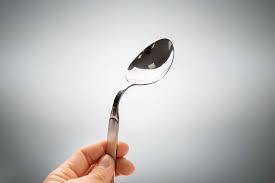
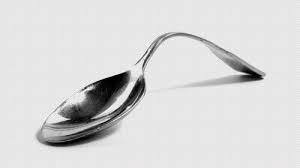
Scientific evidence for the psychic ability to move objects or bend spoons remains elusive.
"Who here is psychic? Raise my hand!"
That's an old joke, but there are several claimed types of psychic powers, including precognition (knowing the future) and telepathy (describing things at a remote location).

telekinesisBut for sheer impressiveness it's hard to beat psychokinesis, the ability to move objects through mind power.
The word is derived from the Greek words for "mind" and "motion" and is also called PK or telekinesis.
Fictional psychokinetics are easy to find: The popular X-Men comic and film franchise includes the character Jean Grey, whose powers include extrasensory perception and psychokinesis.
The 2009 movie "Push" is about a group of young Americans with various psychic abilities who team up and use their paranormal powers against a shadowy U.S. government agency.
Though many Americans believe in psychic ability (about 15 percent of us, according to a 2005 Baylor Religion Survey), scientific evidence for its existence remains elusive.
Some people even link psychokinesis to the spiritual world, suggesting for example that some reports of ghosts — such as poltergeists — are not manifestations of the undead at all, but instead the unconscious releases of a person's psychic anger or angst.
If people could move everyday objects with nothing more than their thoughts, this should be quite easy to demonstrate: Who wouldn't like their latte delivered by a psychic barista from across the counter, floating it right to your hand with a mere gesture?
This doesn't happen, of course. Instead researchers have focused on what they term "micro-PK," or the manipulation of very small objects.
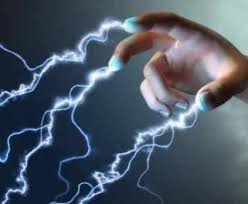
Psychokinesis..! — SteemitThe idea is that if the ability exists, its force is obviously very weak. Therefore, the less physical energy that would have to be exerted on an object to physically move it, the more obvious the effect should be.
For this reason, laboratory experiments often focus on rather mundane feats such as trying to make dice land on a certain number at an above-chance rate, or influencing a computerized random number generator.
Because of this change in methodologies, psychokinesis experiments rely more heavily on complex statistical analyses; the issue was not whether a person could bend a spoon or knock a glass over with their minds, for example, but whether they could make a coin come up heads significantly above 50 percent of the time over the course of 1,000 trials.
Spiritualism and mediums
The idea of people being able to move objects through mind power alone has intrigued people for centuries, though only in the late 1800s was it seen as an ability that might be scientifically demonstrated.
This occurred during the heyday of the early religion Spiritualism, when psychic mediums claimed to contact the dead during séances, and objects would suddenly and mysteriously move, float, or fly by themselves across the darkened room, seemingly untouched by human hands.
Though many people were convinced — including, ironically, Sir Arthur Conan Doyle, the creator of Sherlock Holmes — it was all a hoax.
Fraudulent psychics resorted to trickery, using everything from hidden wires to black-clad accomplices to make objects appear to move untouched.
As the public slowly grew wise to the faked psychokinesis, the phenomenon faded from view.
It was revived again in the 1930s and 1940s, when a researcher at Duke University named J.B. Rhine became interested in the idea that people could affect the outcome of random events using their minds.
Rhine began with tests of dice rolls, asking subjects to influence the outcome through the power of their minds.
Though his results were mixed and the effects were small, they were enough to convince him that there was something mysterious going on.
Telekinesis: Facts About Mind Over Matter | Live Science
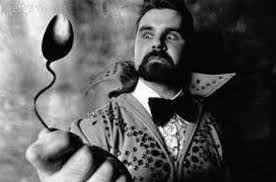
Uri Geller, shown speaking at a press event in Moscow in 2009,
made millions in the 1970s by claiming he could bend spoons with his mind. 
Unfortunately for Rhine, other researchers failed to duplicate his findings, and many errors were found in his methods.
In the 1970s, Uri Geller became the world's best-known psychic and made millions traveling the world demonstrating his claimed psychokinetic abilities, including starting broken watches and bending spoons.
Though he denied using magic tricks, many skeptical researchers observed that all of Geller's amazing feats could be — and have been — duplicated by magicians.
Public interest in psychokinesis returned in the 1980s.
One person nationally known for claimed psychokinetic ability, James Hydrick, tried to demonstrate his powers on the television show "That's My Line" in 1981, following several successful television appearances.
He claimed to move small objects, such as a pencil or the pages of a telephone book, with his mind.
Host Bob Barker consulted with skeptic James Randi, who suspected that Hydrick was merely discreetly blowing on the pages to make them move.
To prevent this method of trickery Randi placed styrofoam bits around the open book, as the lightweight pieces would clearly be disturbed if the pages were moving because of Hydrick's breath instead of his mind.
After many awkward minutes in front of Barker, Randi, a panel of judges, and the live studio audience, a flustered Hydrick finally said that his powers weren't cooperating.
Hydrick later admitted that his psychokinetic powers had been faked, and marveled at how easy it had been to fool the public.
Frauds and fakery
Telekinesis: 5 Cases – K.O. JewelThe history of psychokinesisis a history of frauds and fakery, both proven and suspected.
Even many researchers admit that the data fall far short of scientific standards of proof; researcher Russell Targ, in his book "The Reality of ESP" (2012, Quest Books) acknowledges that "the evidence for laboratory psychokinesis is quite weak."
Recent advances in virtual reality technology may, however, be the next best thing.
In 2017, a company called Neurable announced plans to develop psychokinesis — or at least a virtual reality form of it — for a game called Awakening.
Using a combination of eye movement tracking technology and electroencephalogram (EEG) sensors in a headset, the game allows a player to move and manipulate objects in a virtual world merely by looking and thinking.
After an initial calibration process that takes several minutes, the players can select and move computer-generated images.
Perhaps one day technology will allow us to actually move objects with our thoughts, but until then we must be satisfied with the power depicted in fiction and fantasy.

Benjamin Radford
Live Science Contributor
Benjamin Radford is the Bad Science columnist for Live Science. He covers pseudoscience, psychology, urban legends and the science behind "unexplained" or mysterious phenomenon. Ben has a master's degree in education and a bachelor's degree in psychology. He is deputy editor of Skeptical Inquirer science magazine and has written, edited or contributed to more than 20 books, including "Scientific Paranormal Investigation: How to Solve Unexplained Mysteries," "Tracking the Chupacabra: The Vampire Beast in Fact, Fiction, and Folklore" and “Investigating Ghosts: The Scientific Search for Spirits,” out in fall 2017. His website is www.BenjaminRadford.com.


Psychokinesis - Home | FacebookPsi ball psychokinesis - Egely WheelTelekinesis vs Psychokinesis | Astrology Psychic ReadingUri Geller - Alchetron, The Free Social EncyclopediaUri Geller's Strike!' Board Game, 1986Psychokinesis - Bending Spoons with My Mind - My Experience ...
Mind Over Matter Psychological | Psychotherapist, Counsellor ...Mind Over Matter - The BoxAre ESP and Psychokinesis Really Possible? | PCMag

Thursday, June 6, 2019

EXORCISM - Facts and Fiction About Demonic Possession - While most people enjoy a scary movie, belief in the literal reality of demons and of the efficacy of exorcism can have deadly consequences - Most religions claim that humans can be possessed by demonic spirits, and offer exorcisms to remedy this threat. The idea that invading spirits are inherently evil is largely a Judeo-Christian concept; many religions and belief systems accept possession by both beneficent and malevolent entities for short periods of time as uncommon — and not especially alarming — aspects of spiritual life. Spiritualism, a religion that flourished across America in the 1800s and is still practiced in a few places today, teaches that death is an illusion and that spirits can possess humans. New Agers have also long embraced a form of possession called channeling, in which spirits of the dead are said to inhabit a medium's body and communicate through them. There are countless exorcism-inspired films, including "The Last Exorcism," "The Exorcism of Emily Rose," "The Devil Inside" and "The Rite" — wildly varying in quality, originality, and scariness. The greatest cultural influence, of course, came from the classic "The Exorcist."

CaptainHowdy
............................................................................................................................................................
To the extent that exorcisms "work," it is due to the power of suggestion 
and psychology: If you believe you're possessed 
(and that an exorcism will cure you), then it just might.

Exorcism
Facts and Fiction About Demonic Possession
BROTHERTEDD.COM
While most people enjoy a scary movie, belief in the literal reality of demons and of the efficacy of exorcism can have deadly consequences
By Benjamin Radford
Live Science Contributor


The belief that demons exist and can possess people is of course the stuff of fiction and horror films — but it is also one of the most widely-held religious beliefs in the world.
The ExorcistMost religions claim that humans can be possessed by demonic spirits (the Bible, for example, recounts six instances of Jesus casting out demons), and offer exorcisms to remedy this threat.

.
The idea that invading spirits are inherently evil is largely a Judeo-Christian concept; many religions and belief systems accept possession by both beneficent and malevolent entities for short periods of time as uncommon — and not especially alarming — aspects of spiritual life.
Spiritualism, a religion that flourished across America in the 1800s and is still practiced in a few places today, teaches that death is an illusion and that spirits can possess humans.
New Agers have also long embraced a form of possession called channeling, in which spirits of the dead are said to inhabit a medium's body and communicate through them.
Hundreds of books, and even some symphonies, have been allegedly composed by spirits.
.
Fictional exorcisms
Hollywood, of course, has been eager to capitalize on the public's continued fascination with exorcism and demonic possession with films often dubbed "based on a true story."
There are countless exorcism-inspired films, including "The Last Exorcism," "The Exorcism of Emily Rose," "The Devil Inside" and "The Rite" — wildly varying in quality, originality, and scariness.
The greatest cultural influence, of course, came from the classic "The Exorcist."
In the weeks after the film came out in 1974, a Boston Catholic center received daily requests for exorcisms. The script was written by William Peter Blatty, adapted from his best-selling 1971 novel of the same name.
Blatty described the inspiration for the film as a Washington Post article he’d read in 1949 about a Maryland boy who had been exorcised.
Blatty believed (or claimed to believe) it was an accurate account, though later research revealed the story had been sensationalized was far from credible.
Michael Cuneo, in his book "American Exorcism: Expelling Demons in the Land of Plenty," credits Blatty and "The Exorcist" with much of the modern-day interest in exorcism.
As for historical accuracy, though, Cuneo characterizes Blatty's work as a massive structure of fantasy resting on a flimsy foundation of one priest's diary.
There really was a boy who underwent an exorcism, but virtually all of the gory and sensational details appearing in the book and film were wildly exaggerated or completely made up.
Real exorcisms
While many Americans think of real exorcisms as relics of the Dark Ages, exorcisms continue to be performed, often on people who are emotionally and mentally disturbed.
Whether those undergoing the exorcism are truly possessed by spirits or demons is another matter entirely.
Exorcisms are done on people of strong religious faith. To the extent that exorcisms "work," it is due to the power of suggestion and psychology: If you believe you're possessed (and that an exorcism will cure you), then it just might.
The word exorcism derives from the Greek word for oath, "exousia."
As religious studies scholar James R. Lewis explains in his book "Satanism Today: An Encyclopedia of Religion, Folklore, and Popular Culture," "To exorcise thus means something along the lines of placing the possessing spirit under oath — invoking a higher authority to compel the spirit — rather than an actual 'casting out.'"
This becomes clear when the demonic entity is commanded to leave the person, not by the authority of a priest but instead, for example, "in the name of the Father, and the Son, and of the Holy Spirit."
The Vatican first issued official guidelines on exorcism in 1614, and revised them in 1999.
According to the U.S. Conference of Catholic Bishops, signs of demonic possession include superhuman strength, aversion to holy water, and the ability to speak in unknown languages.
Other potential signs of demonic possession include spitting, cursing, and "excessive masturbation."
Along with a handful of Vatican-sanctioned exorcists, there are hundreds of self-styled exorcists around the world.
After attending 50 exorcisms during research for his book, Michael Cuneo states that he never saw anything supernatural or unexplainable: No levitation or spinning heads or demonic scratch marks suddenly appearing on anyone's faces, but many emotionally troubled people on both sides of the ritual.
While most people enjoy a scary movie, belief in the literal reality of demons and of the efficacy of exorcism can have deadly consequences.
In 2003, an autistic 8-year-old boy in Milwaukee, Wis., was killed during an exorcism by church members who blamed an invading demon for his disability; in 2005 a young nun in Romania died at the hands of a priest during an exorcism after being bound to a cross, gagged, and left for days without food or water in an effort to expel demons.
And on Christmas Day 2010 in London, England, a 14-year-old boy named Kristy Bamu was beaten and drowned to death by relatives trying to exorcise an evil spirit from the boy.

Benjamin Radford is deputy editor of Skeptical Inquirer science magazine and author of six books including "Scientific Paranormal Investigation: How to Solve Unexplained Mysteries." His website is www.BenjaminRadford.com.
Benjamin Radford is the Bad Science columnist for Live Science. He covers pseudoscience, psychology, urban legends and the science behind "unexplained" or mysterious phenomenon. Ben has a master's degree in education and a bachelor's degree in psychology. He is deputy editor of Skeptical Inquirer science magazine and has written, edited or contributed to more than 20 books, including "Scientific Paranormal Investigation: How to Solve Unexplained Mysteries," "Tracking the Chupacabra: The Vampire Beast in Fact, Fiction, and Folklore" and “Investigating Ghosts: The Scientific Search for Spirits,” out in fall 2017. His website is www.BenjaminRadford.com.