Showing posts with label Essential oils. Show all posts

Saturday, October 24, 2020

SENSITIVE TO FRAGRANCE? - You're not alone – but the science is still out - A survey of people in the US, Australia, UK and Sweden last year reported that as many as 1 in 3 people have 'fragrance sensitivity'. The study found adverse effects were most often caused by fragrance in products worn by others, in cleaning products, and in air fresheners or deodorisers. The smell of scented laundry products can make some people feel sick. Top of the list of adverse effects were respiratory problems (difficulty breathing, coughing, shortness of breath), mucosal symptoms (e.g. watery or red eyes, nasal congestion, sneezing), migraine headaches, skin problems (e.g. rashes, hives, red skin, tingling skin, dermatitis), and asthma attacks. Nine per cent of people found the effects of fragrance 'disabling', causing them to lose workdays or even jobs. Products like air fresheners and cleaning materials have also been linked to a more serious condition called Multiple Chemical Sensitivity. The science is not in yet, says molecular pharmacologist and toxicologist Ian Musgrave of the University of Adelaide. We know that components of fragrances can, in some people, cause contact dermatitis — a condition that makes skin red or inflamed. And there have also been a number of studies that have found that perfume triggers migraines and asthma attacks. But differences in methodologies make it hard to compare findings on the proportion of people affected.

.........................................................................................................................................................................................................................................................................................................

Sensitive to 

fragrance?

Could one persons pleasure be another person's poison?

You're not alone – but the science is still out

By Anna Salleh

ABC Science


Jacqueline Wilkes can't stand the smell of air fresheners, perfume, aftershave and scented laundry powder.

"I find these fragrances highly offensive," she says.

"They make me feel headachy, sick in the stomach and breathless."

Unfortunately, Jacqueline is not the only person in her family with a sensitivity to fragrance. 

Jacqueline and mother Nancy Wilkes are both sensitive to fragrance.

Her mum Nancy has a lung disease and is on oxygen therapy. Her reactions to scented products are even worse than Jacqueline's.

"If she comes in contact with people wearing these fragrances, or products with fragrance in them she can be severely ill," says Jacqueline.

Nancy chokes up, becomes weak and dizzy and gets headaches and sore muscles.

Anxiety about encountering smells keeps Nancy at home a lot, Jacqueline says.

"She's really cut down on her socialising. It's quite isolating for her."

Even the health professionals Nancy sees wear cologne, or use air fresheners and toilet deodorisers.

And because fragrances are naturally volatile, they get around.

At home Nancy can be affected not just by scents on visitors, but by wafts of deodorant or laundry powder used by the neighbours.

One in three affected by fragrance?

A survey of people in the US, Australia, UK and Sweden last year reported that as many as 1 in 3 people have 'fragrance sensitivity'. 

The smell of scented laundry products can make some people feel sick.

The study, by Anne Steinemann from the University of Melbourne, found adverse effects were most often caused by fragrance in products worn by others, in cleaning products, and in air fresheners or deodorisers.

Top of the list of adverse effects were respiratory problems (difficulty breathing, coughing, shortness of breath), mucosal symptoms (e.g. watery or red eyes, nasal congestion, sneezing), migraine headaches, skin problems (e.g. rashes, hives, red skin, tingling skin, dermatitis), and asthma attacks.

And Dr Steinemann found that 9 per cent of people found the effects of fragrance 'disabling', causing them to lose workdays or even jobs.

Products like air fresheners and cleaning materials have also been linked to a more serious condition called Multiple Chemical Sensitivity.

What does the science say?

The science is not in yet, says molecular pharmacologist and toxicologist Ian Musgrave of the University of Adelaide. 

We know that components of fragrances can, in some people, cause contact dermatitis — a condition that makes skin red or inflamed.

And there have also been a number of studies that have found that perfume triggers migraines and asthma attacks.

But differences in methodologies make it hard to compare findings on the proportion of people affected, says Professor Musgrave.

"Steinemann's results are plausible, although they may be overestimated."

And the difficulty is not just in comparing research, but also attributing causality.

That's because most studies are — like Dr Steinemann's — based on self-reports by people, who may be mistaken about the cause of their symptoms.

Dr Musgrave says two other studies that have deliberately exposed people to fragrance under controlled experimental conditions suggest there is no link between fragrance and respiratory problems, although these were small studies.

Could something else be involved?

Other experts have suggested there are neurological and even psychological factors playing a role.

Perhaps people come to associate fragrances used to mask other environmental agents that trigger adverse effects, like mould or cigarette smoke, with the reaction, says Dr Musgrave.

It might make things smell clean but maybe it's masking
other triggers of asthma and migraine?

"They could then become anxious or triggered by the fragrance even when the mould or cigarette smoke is not present."

Dr Musgrave says it's not clear whether the conditions reported in the study by Dr Steinemann were caused by fragrance itself or other possible triggers in the environment.

"Nonetheless, this issue is important to community groups and even if it is not fragrance itself, but other factors (such as triggers concealed by fragrance) more research is needed to ensure that health issues are not being missed," he says

It's also a controversial one, with the idea that perfumes poses health hazards listed among the 2011 Top Ten Unfounded Health Scares by a website supported by the hygiene and cosmetics industry. 

So, what can you do if you're affected by fragrances?

Although the science is not yet conclusive, Jacqueline and her mum are not taking any chances.

"There's no doubt in our minds that fragrance is the culprit," says Jacqueline.

She's not convinced we know the full impact of fragrances on health, so she tries to avoid them altogether.

One way to do this is to use unscented products only, which means avoiding those labelled as containing 'parfum' or 'fragrance'

Even these seemingly-innocent incense sticks may insence some.

Another way is to use simple products like bicarb soda and vinegar.

If fragrance use by others is the issue, having a conversation with them is a good starting point.

However, this can be tricky, as Jacqueline and Nancy found when they complained about fragrant oil sticks used in a physiotherapist's practice.

They were told to go elsewhere!

If you are in the workplace and you can't solve your problem by talking to colleagues, you could ask your boss to deal with it as an occupational health and safety issue.

This could mean putting some distance between you and someone who is wearing a strong scent, or changing the chemicals used in places like bathrooms.

Some countries even advise workplaces on how to have a "scent-free policy" — although Dr Musgrave says this may not solve the problem if the scent is covering up some other environmental trigger.

Natural versus synthetic scents?

Jacqueline says she focuses on avoiding products containing synthetic fragrance and petrochemicals.

But since the exact ingredients of individual fragrances are not required to be on the label, consumers are a bit in the dark.

So, Jacqueline avoids anything labelled 'parfum' or 'fragrance' and opts instead for essential oils like eucalyptus, lavender and peppermint, which she and her mum find aren't a problem for them.

But it is worth noting essential oils can have their own risks.

Anna Salleh is a journalist with the ABC's Science Unit. As well as producing online content, she produces radio output for programs such as Science Friction, All in the Mind, the Science Show, Earshot and The Health Report. Anna has also worked as a TV researcher and producer on Australian Story, Quantum, The Investigators and Insight (SBS TV), and produced articles for Nature News, New Scientist, Australasian Science Magazine, Griffith Review, the Medical Observer, the Sydney Morning Herald, the Canberra Times and Choice Magazine. She has degrees in science and journalism, a PhD in science and technology studies and has a special interest in the intersection between science and society. Anna has also taught journalism at university, contributed to the development of science journalism courses, and to a number of books. She also sings, plays – and produces radio documentaries about - Brazilian jazz.

https://www.abc.net.au/news/science/2020-03-14/fragrance-sensitivity-science/12030608


You might also like:


Perfume Poisoning

CLICK HERE . . . to view . . . 

https://puricare.blogspot.com/2020/04/perfume-poisoning-how-to-know-if-your.html

.....................................................................................................................................................

Science Of Scent

CLICK HERE . . . to view . . . 

https://puricare.blogspot.com/2020/07/science-of-scent-how-perfumes-work.html

 ....................................................................................................................................................

Essential Oils

CLICK HERE . . . to view . . . 

https://puricare.blogspot.com/2019/12/essential-oils-poisonous-when-misused.html

.....................................................................................................................................................

Perfumes And Essential Oils

CLICK HERE . . . to view . . . 

https://puricarechronicles.blogspot.com/2018/06/perfumes-and-essential-oils-ancient.html

.......................................................................................................................

Perfume In The Bible

CLICK HERE . . . to view . . . 

https://puricarechronicles.blogspot.com/2020/03/perfume-in-bible-ointment-and-perfume.html

Saturday, January 18, 2020

LEMONGRASS AND CANCER - The Unbelievable Anti-Cancer Effects of Lemongrass Essential Oil - Researchers found that lemongrass not only stopped cervical cancer cells (as well as several other types of cancer cells) from spreading, but it also initiated cancer cell apoptosis, also known as programmed cell death. All the results suggest lemongrass oil and citral emulsion could be considered as potent candidates for anticancer agents. Lemongrass oil shows great promise in laboratory studies for its potential anticancer benefits. Where lemongrass really seems to shine, particularly in light of the growing cancer epidemic, is in its ability to destroy cancer cells. Lemongrass essential oil is effective in targeting at least 12 different human cancer cell lines. Animal trials showed that direct injection of lemongrass essential oil inhibited cancer tumors in a dose-dependent way, meaning the higher the dose of the oil, the better the outcome.


...............................................................................................................................................................
Lemongrass And Cancer
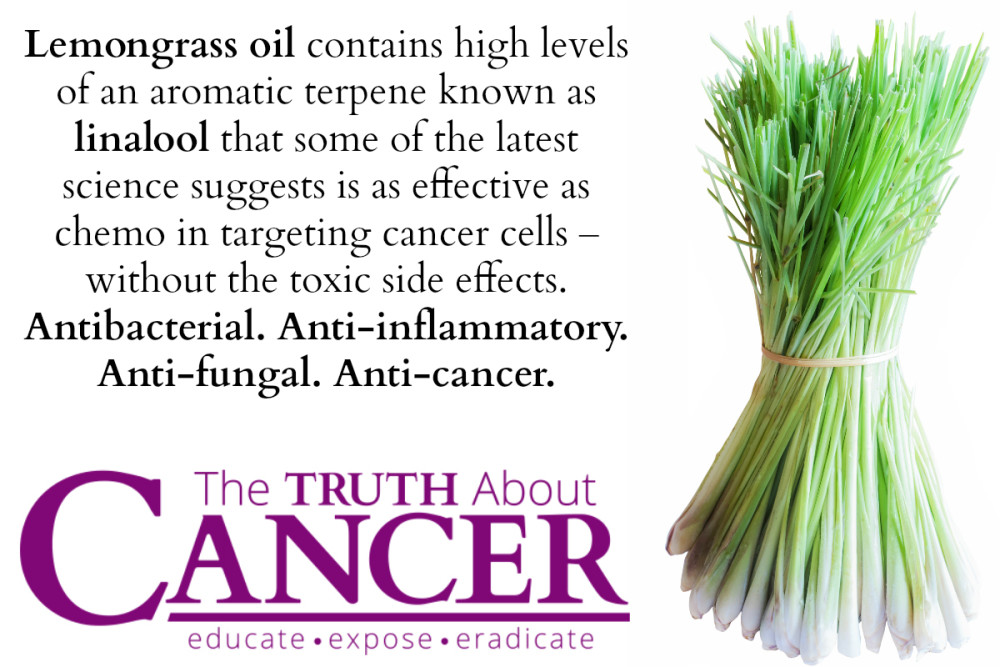
TTAC - Lemongrass GraphicThe Unbelievable Anti-Cancer Effects of Lemongrass Essential Oil
By Ty Bollinger


Studies show that a particular essential oil may provide a solid defense against various cancers.
Lemongrass essential oil, which contains high levels of an aromatic terpene known as linalool, has been used traditionally in tropical countries in the treatment of various health conditions.
What’s even more exciting is that some of the latest in vitro and in vivo animal studies suggest that it could be at least as effective as chemotherapy in targeting cancer cells – without the harmful toxic effects of chemotherapy.
Long prized for its aroma-therapeutic qualities, Cymbopogon citratus (lemongrass or lemon grass) is loaded with key nutrient compounds that present powerful antibacterial, anti-fungal, anti-inflammatory, and anticancer potential.
A 2011 study published in the Journal of Advanced Pharmaceutical Technology & Research outlines the dozens of unique phytoconstituents present in lemongrass, including a diverse array of terpenes, ketones, esters, flavonoids, and phenolic compounds.
The Long List of Health Benefits of Lemongrass Essential Oil
The paper also highlights the many scientifically-confirmed benefits of lemongrass which are that it:
·         Destroys harmful pathogens
·         Promotes healthy stools
·         Inhibits damaging fungi
·         Reduces inflammation
·         Protects against DNA damage
·         Guards against malaria
·         Neutralizes damaging free radicals
·         Helps to balance cholesterol levels
·         Modulates healthy sleep patterns
·         And so much more
According to the report authors…
“Studies indicate that Cymbopogon citratus (a variety of lemongrass) possesses various pharmacological activities such as anti-amoebic, antibacterial, antidiarrheal, antifilarial, antifungal and anti-inflammatory properties.
“Various other effects such as antimalarial, antimutagenicity, antimycobacterial, antioxidants, hypoglycemic, and neurobehavioral have also been studied.”
Could Lemongrass Really Fight More Than a Dozen Different Types of Cancer?
Where lemongrass really seems to shine, particularly in light of the growing cancer epidemic, is in its ability to destroy cancer cells.
A 2009 study published in the journal Chemico-Biological Interactions revealed that lemongrass essential oil is effective in targeting at least 12 different human cancer cell lines. 
Animal trials showed that direct injection of lemongrass essential oil inhibited cancer tumors in a dose-dependent way, meaning the higher the dose of the oil, the better the outcome.
When administered at a dosage of 200 milligrams per kilogram (mg/kg) concentration, lemongrass essential oil was shown to inhibit both ascitic (in the fluid of the abdominal cavity) and solid tumors of Ehrlich Ascites (a type of tumor cell line) by 97.34 percent and 57.83 percent, respectively.
For Sarcoma-180 tumor cells, the same dosage resulted in ascitic and solid tumor inhibition of 94.07 percent and 36.97 percent, respectively. As stated by the researchers:
“Our results indicate that the oil has a promising anticancer activity and causes loss in tumor cell viability by activating the apoptotic process as identified by electron microscopy.”
Can Lemongrass Essential Oil Stop the Spread of Cervical Cancer?
A more recent in vitro study published in the journal Pharmacognosy Communications in 2013 reveals that lemongrass was also effective against cervical cancer.
Researchers found that lemongrass not only stopped cervical cancer cells (as well as several other types of cancer cells) from spreading, but it also initiated cancer cell apoptosis, also known as programmed cell death.
“All the results suggest lemongrass oil and citral emulsion could be considered as potent candidates for anticancer agents,” the authors concluded.
Uses of Lemongrass Essential Oil
As we’ve seen, lemongrass oil shows great promise in laboratory studies for its potential anticancer benefits.
However, there are also several additional benefits of lemongrass essential oil.
Let’s take a look now at some incredible lemongrass essential oil uses that can enhance your health and your overall lifestyle.
Here are some popular ways to incorporate the various lemongrass oil uses into your diet and daily life to reap all of the many potential health benefits:
·      Use lemongrass oil as a fresh citrus seasoning. You may choose to incorporate it in a Malaysian, Cambodian, Vietnamese, or Thai dish
·      Make lemongrass tea
·      Make a natural air freshener by mixing it with other oils like lavender essential oil and peppermint for a fresh scent
·      Add it to shampoos, conditioners, and soaps and harness its antiseptic and astringent qualities
·      Use it as mosquito repellant
·      Put in a diffuser to improve your sleep and reduce your anxiety
·      Dilute it and apply it to sore muscles and massage to relax them
·      Use it to detox your digestive tract and liver
·      Women can use it to relieve menstrual cramps
·      Use it to soothe a headache
Where to Buy Lemongrass Oil
You can easily find lemongrass oil in many different places.
When using essential oils for health purposes, always look for the highest quality oil available that has does not contain fillers.
In cases where it’s difficult to find lemongrass oil, lemon zest or lemon essential oil can serve as an effective lemongrass substitute. Or you may choose to make your own lemongrass oil.
How to Make Lemongrass Essential Oil
If you have access to organic lemongrass, some people prefer to make their own lemongrass essential oil. This can ensure it is as fresh and potent as possible by taking it directly from the stalks of the lemongrass plant.
Here are some basic instructions on how to make lemongrass oil:
1.    Crush two lemongrass stalks
2.    Place them in a jar and cover them with a quality carrier oil, seal the lid, and put the jar in a sunny place
3.    Strain the oil with cheesecloth
4.    Repeat the process with additional stalks until you reach your desired potency
5.    Store oil in a dark glass jar
Article Summary
Lemongrass is loaded with key nutrient compounds that present powerful antibacterial, anti-fungal, anti-inflammatory, and anticancer potential.
Benefits include:
·         Destroys harmful pathogens
·         Promotes healthy stools
·         Inhibits damaging fungi
·         Reduces inflammation
·         Protects against DNA damage
·         Guards against malaria
·         Neutralizes damaging free radicals
·         Helps to balance cholesterol levels
·         Modulates healthy sleep patterns
A 2009 study found that lemongrass essential oil is effective in targeting at least 12 different human cancer cell lines.
2013 research showed that lemongrass was also effective against cervical cancer.
Ways to use lemongrass:
·         Lemongrass oil as a fresh citrus seasoning
·         Lemongrass tea
·         Natural air freshener
·         Add it to shampoos, conditioners, and soaps
·         Mosquito repellant
·         Diffuse to improve sleep and reduce anxiety
·         Apply to sore muscles
·         Detox your digestive tract and liver
·         Menstrual cramps
·         Headaches

Ty Bollinger is a happily married husband, the father of four wonderful children, devoted Christian, best-selling author, medical researcher, talk radio host, health freedom advocate, former competitive bodybuilder and also a certified public accountant. After losing several family members to cancer (including his mother and father), Ty refused to accept the notion that chemotherapy, radiation, and surgery were the most effective treatments available for cancer patients. He began a quest to learn all he possibly could about alternative cancer treatments and the medical industry. Ty has now made it his life mission to share the most remarkable discovery he made on his quest: the vast majority of all diseases (including cancer) can be easily prevented and even cured without drugs or surgery. Ty speaks frequently to health groups, at seminars, expos, conferences, churches, and is a regular guest on multiple radio shows and writes for numerous magazines and websites. Speaking from personal experience and extensive research, Ty has touched the hearts and changed the lives of thousands of people around the world.