Showing posts with label Jet stream. Show all posts

Friday, November 29, 2019

WIND TURBULENCE - Turbulence is essentially just a "rough patch" caused by wind, thunderstorms, the jet stream, proximity to mountains, and other factors. For travelers it's an unpredictable foe, like a sudden pothole in the road or summer storm, but it's so common. There are varying degrees (and types) of turbulence caused by any number of factors: think upward and downward currents from thunderclouds, thermal currents, or clear air turbulence from rapidly changing wind speed or direction. In many cases, pilots know of turbulent conditions ahead and can turn on the seatbelt sign as the plane approaches it. Pilots are also aided by pre-flight weather reports, cockpit radar, and reports from other planes in the area. Most turbulence-related injuries are due to clear air turbulence.


...........................................................................................................................................................
Wind Turbulence
What Causes Turbulence?
11 Things You Need to Know
by BARBARA PETERSON


Reports of critical, turbulence-related injuries are enough to whip travelers into a panic, but don't cancel your next flight just yet.
We spoke to a number of pilots and aviation experts to get the facts about what causes turbulence — and how you can handle it.
Despite the discomfort — and fear — it induces, turbulence is essentially just a "rough patch" caused by wind, thunderstorms, the jet stream, proximity to mountains, and other factors.
For travelers it's an unpredictable foe, like a sudden pothole in the road or summer storm, but it's so common we try (very) hard to tell ourselves "This, too, shall pass."
Still, stories like this always make us cringe:
In February, three passengers on a Delta flight were sent to the hospital after turbulence forced an emergency landing in Nevada, reports NBC.
In June 2018, a Qantas plane "nosedived" because of turbulence from another plane. And then there's this charming video of a descending plane being "banged to its limits."
Sure, it's terrifying stuff — but don't cancel your next flight just yet. We spoke to a number of pilots and aviation experts to get the facts about turbulence-related injuries and what's really happening when your plane is tossing violently.
(Spoiler alert: It doesn't mean the plane's about to crash.)
1. Generally, turbulence is quite harmless.
    Turbulence is relatively common and usually harmless, but that doesn't stop it from being any less uncomfortable mid-air, and mid-moment. There are varying degrees (and types) of turbulence caused by any number of factors: think upward and downward currents from thunderclouds, thermal currents, or clear air turbulence from rapidly changing wind speed or direction. (More on that later.)
2. Turbulence-related injuries do happen—but rarely.
    The Federal Aviation Administration says approximately 58 fliers are injured by turbulence each year.
    Two-thirds of that number are flight attendants or passengers not wearing seat belts when the bumps hit, which means that about 20 passengers — out of the 800 million who fly each year in the United States — are injured due to turbulence. And that usually happens at or above 30,000 feet.
3. Pilots know when it's going to happen.
    In many cases, pilots know of turbulent conditions ahead and can turn on the seatbelt sign as the plane approaches it. Pilots are also aided by pre-flight weather reports, cockpit radar, and reports from other planes in the area.
4. Clear air turbulence, however, is a different story.
     Clear air turbulence is the most dangerous kind, as it occurs in cloudless skies with perfect visibility — so oncoming turbulence cannot be picked up by weather radar.
.
    This leaves little to no time for the flight crew to warn passengers to return to their seats and buckle up. Unsurprisingly, most turbulence-related injuries are due to clear air turbulence.
5. Clear air turbulence is on the rise.
     According to scientists, the amount of extreme clear air turbulence affecting flights could more than double by the middle of the century due to global warming. So brace yourself for more bumpy flights.
6. Turbulence won't cause your plane to crash.
    Though it might feel like it, no matter how severe the turbulence is, the actual safety of the aircraft is rarely in question.
    “Planes are engineered to take a remarkable amount of punishment,” points out Patrick Smith, the writer behind Ask the Pilot and author of the recent book Cockpit Confidential.
7. Pilots are trained to deal with it.
    To prevent turbulence, pilots carefully study the weather patterns, plan ahead, and choose the best route before every flight. When turbulence is unavoidable, the good ones, like Sully Sullenberger, know how to placate anxious passengers.
8. The seatbelt sign is worth obeying. Really.
    Due to the rise of clear air turbulence, the only sure-fire way of preventing turbulence-related injuries is to keep your seatbelt fastened whenever the sign is illuminated. Simple but effective.
9. Car seats work for airplanes, too.
    Lap children are the most vulnerable to turbulence-related injuries: Violent motion could make the kid fly out of your arms.
    In fact, an infant girl a United flight was dislodged from her parent’s lap by the violent shaking of the aircraft — and landed on another passenger several rows away (the baby was surprisingly unharmed).
    The National Transportation Safety Board has long called for requirements that infants be strapped into an airline-approved car seat.
10. We might soon be able to avoid turbulence altogether.
    Airlines are testing technology that can help airplanes avoid turbulence altogether, by using ultraviolet lasers to send pulses into the air ahead.
11. But in the meantime, there are a few tricks to try.
    As Cynthia Drescher recently reported for Traveler, the best way to ride out air turbulence might be to bring on the bouncing: "I bounce in my seat without connection to the structure of the plane, or items fixed to it, and the more abrupt jolts of turbulence seem less severe," writes Drescher.
     Another solution, from Captain Ron Nielsen, a pilot and 40-year veteran of the airline industry who teaches fear of flying classes, is to disrupt your thinking: "Put a pen in the opposite hand than what you normally use, and write your name,” he said.
     "It first causes [the passenger] to focus extra-hard on what she's doing, because she doesn't normally write with her other hand. And the second thing is, it's actually crossing over her motor function in her brain, using the other side of her brain from what she would normally do.”
BARBARA PETERSON is a writer specializing in aviation, travel and consumer issues and is author of Blue Streak: Inside JetBlue, the Upstart that Rocked an Industry.Barbara Peterson has worked as a journalist covering aviation, travel and consumer issues for more than twenty years. In addition to reporting on air travel for Conde Nast Traveler, she has contributed articles to The New York Times, Newsweek/Daily Beast, Wall Street Journal, The Guardian and Consumer Reports. She has authored or co-authored three books, the most recent of which is Blue Streak: Inside JetBlue, the Upstart that Rocked an Industry. She is the winner of the Lowell Thomas Award for Investigative Reporting and the Gene DuBois Award for Excellence in Travel and Aviation Reporting.https://www.cntraveler.com/stories/2014-02-19/united-airlines-mid-air-scare-prevent-turbulence-related-injuries

Monday, September 2, 2019

AIRSPEED VS. GROUND SPEED - Ground speed is how fast an airplane is traveling, relative to a fixed point on the ground. If there's a strong wind pushing an aircraft, that's reflected in the ground speed. Airspeed, in contrast, is how fast an airplane is really flying strictly under its own power, which is calculated by subtracting the wind speed from the ground speed. Airspeed doesn't just affect airplanes. It also affects our vehicles on the ground. A car's airspeed on the highway is what really determines its fuel efficiency, rather than ground speed or the speedometer reading.

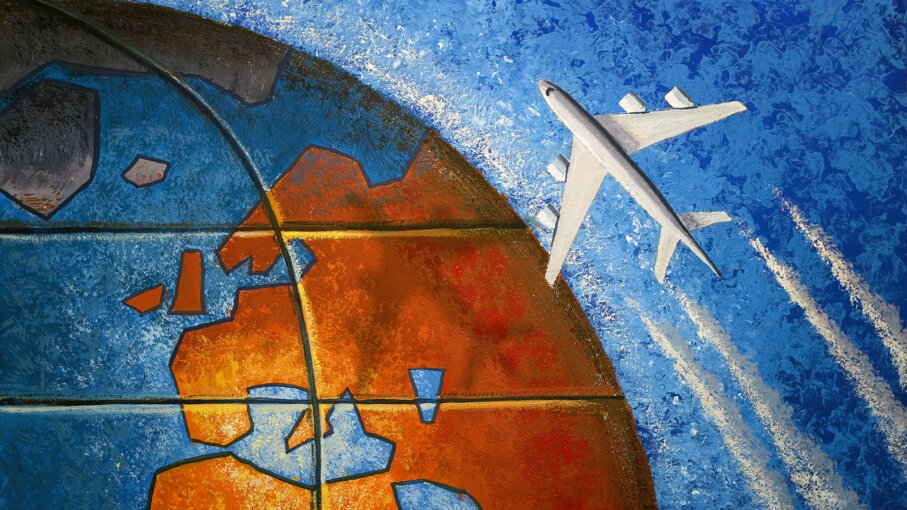
airplane graphic
.............................................................................................................................................
Airspeed Vs. Ground Speed
What's the Difference Between Airspeed and Ground Speed?
BY PATRICK J. KIGER


Back in February 2019, a Virgin Atlantic Boeing 787 jet flying over Pennsylvania in route from Los Angeles to London reached what might seem like an amazing speed of 801 miles per hour (1,289 kilometers per hour), according to CBS News.
But the speed record wasn't because that Virgin Atlantic aircraft itself was exceptionally fast.
Like a sprinter running with the wind at his back, the aircraft benefited from an exceptionally fast jet stream, a high-speed wind moving at 231 miles per hour (371.7 kilometers per hour). It was the fastest jet stream in more than 60 years.
As this explainer on the NASA website details, ground speed is how fast an airplane is traveling, relative to a fixed point on the ground.
Think of it this way: Ground speed is how fast an airplane's shadow would move across the land. If there's a strong wind pushing an aircraft, that's reflected in the ground speed.
Airspeed, in contrast, is how fast an airplane is really flying strictly under its own power, which is calculated by subtracting the wind speed from the ground speed. 
On a perfectly still day, the airspeed is equal to the ground speed. But if the wind is blowing in the same direction that the aircraft is moving, the airspeed will be less than the ground speed.
Airspeed doesn't just affect airplanes. It also affects our vehicles on the ground.
As this study published in 2013 in the International Journal of Energy and Environmental Engineering describes, a car's airspeed on the highway is what really determines its fuel efficiency, rather than ground speed or the speedometer reading.
NOW THAT'S INTERESTING
As NASA points out, a kite has a ground speed of 0 miles per hour, because you're holding it on the end of a string. But since it moves in the air, it has an airspeed that's equal to the speed of the wind.

Patrick J. Kiger has written for HowStuffWorks since 2008 covering a wide array of topics, from history and politics to pop culture and technology. He worked as a newspaper reporter for the Pittsburgh Press, and the Orange County Register in California, where he covered one of the biggest serial murder cases in U.S. history, and also as a staff writer at Baltimore Magazine. As a freelancer, Patrick has written for print publications such as GQ, Mother Jones and the Los Angeles Times, and on the web for National Geographic Channel, Discovery News, Science Channel and Fast Company, among others. In recent years, he's become increasingly interested in how technological advances are altering urban life and the design of cities, and has written extensively on that subject for Urban Land magazine. In his spare time, Patrick is a longtime martial arts student and a fan of crime fiction, punk rock and classic Hollywood films.
airplane graphic

Saturday, May 5, 2018

THE JET STREAM - Weather Systems And Jet Streams - Named for their similarity to fast moving jets of water, jet streams are bands of strong winds in the upper levels of the atmosphere. Jet streams form at the boundaries of contrasting air masses. When warm and cold air meet, the difference in their air pressures as a result of their temperature differences (recall that warm air is less dense, and cold air, more dense) causes air to flow from higher pressure (the warm air mass) to lower pressure (the cold air mass), thereby creating high winds.


 .
Weather Systems And Jet Streams
The Jet Stream: What It Is and How It Affects Our Weather
by Tiffany Means 


You've probably heard the words "jet stream" many times while watching weather forecasts on TV.
That's because the jet stream and its location is key to forecasting where weather systems will travel.
Without it, there would be nothing to help "steer" our daily weather from location to location.

Rivers of Rapidly Moving Air

Named for their similarity to fast moving jets of water, jet streams are bands of strong winds in the upper levels of the atmosphere.
Jet streams form at the boundaries of contrasting air masses.
When warm and cold air meet, the difference in their air pressures as a result of their temperature differences (recall that warm air is less dense, and cold air, more dense) causes air to flow from higher pressure (the warm air mass) to lower pressure (the cold air mass), thereby creating high winds.
Because the differences in temperature, and therefore, pressure, are very large, so too is the strength of the resulting winds.

Jet Stream Location, Speed, Direction

Jet streams "live" at the tropopause (about 6 to 9 miles off the ground) and are several thousand miles long.
Jet stream winds range in speed from 120 to 250 mph, but can reach more than 275 mph.
Oftentimes, the jet houses pockets of winds that move faster than the surrounding jet stream winds.
These "jet streaks" play an important role in precipitation and storm formation.
(If a jet streak is visually divided into fourths, like a pie, its left front and right rear quadrants are the most favorable for precipitation and storm development. If a weak low pressure area passes through either of these locations, it will quickly strengthen into a dangerous storm.)
Jet winds blow from west to east, but also meander north to south in a wave-shaped pattern.
These waves and large ripples (known as planetary, or Rossby waves) form U-shaped troughs of low pressure that allow cold air to spill southwards, and upside-down U-shaped ridges of high pressure that bring warm air northwards.  

Discovered by Weather Balloons

One of the first names associated with the jet stream is Wasaburo Oishi.
A Japanese meteorologist, Oishi discovered the jet stream in the 1920s while using weather balloons to track upper level winds near Mount Fuji.
However, his work went unnoticed outside of Japan.
In 1933, knowledge of the jet stream increased when American aviator Wiley Post began exploring long-distance, high-altitude flight.
Despite these discoveries, the term "jet stream" was not coined until 1939 by German meteorologist Heinrich Seilkopf.

Meet the Polar and Subtropical Jets

While we typically talk about the jet stream as if there was only one, there are actually two: a polar jet stream and a subtropical jet stream.
The Northern Hemisphere and the Southern Hemisphere each have both a polar and a subtropical branch of the jet.
·        The Polar Jet: In North America, the polar jet is more commonly known as "the jet" or the "mid-latitude jet" (so-called because it occurs over the mid-latitudes).
·        The Subtropical Jet: The subtropical jet is named for its existence at 30°N and 30°S latitude—a climate zone known as the subtropics. It forms at the boundary temperature difference between air at mid-latitudes and warmer air near the equator. Unlike the polar jet, the subtropical jet is only present in the wintertime—the only time of year when temperature contrasts in the subtropics are strong enough to form jet winds.
The subtropical jet is generally weaker than the polar jet. It is most pronounced over the western Pacific.

Jet Position Changes With the Seasons

Jet streams change position, location, and strength depending on the season.
In the winter, areas in the Northern Hemisphere may get colder than normal periods as the jet stream dips "lower" bringing cold air in from the polar regions.
Although the height of the jet stream is typically 20,000 feet or more, the influences on weather patterns can be substantial as well.
High wind speeds can drive and direct storms creating devastating droughts and floods. A shift in the jet stream is a suspect in the causes of the Dust Bowl.
In spring, the polar jet starts to journey north from its winter position along the lower third of the U.S., back to its "permanent" home at 50-60°N latitude (over Canada).
As the jet gradually lifts northward, highs and lows are "steered" along its path and across the regions where it's currently positioned.
Why does the jet stream move? Well, jet streams "follow" the Sun, Earth's primary source of heat energy.
Recall that in spring in the Northern Hemisphere, the Sun's vertical rays go from striking the Tropic of Capricorn (23.5° south latitude) to striking more northerly latitudes (until it reaches the Tropic of Cancer, 23.5° north latitude, on the summer solstice).
As these northerly latitudes warm, the jet stream, which occurs near boundaries of cold and warm air masses, must also shift northward to remain at the opposing edge of warm and cool air.

Locating Jets on Weather Maps

On surface maps: Many news and media that broadcast weather forecasts show the jet stream as a moving band of arrows across the U.S., but the jet stream isn't a standard feature of surface analysis maps.
Here's an easy way to eyeball the jet position: since it steers high and low pressure systems, simply note where these are located and draw a continuous curved line in-between them, taking care to arch your line over highs and underneath lows.
On upper level maps: The jet stream "lives" at heights of 30,000 to 40,000 feet above Earth's surface. At these altitudes, atmospheric pressure equals around 200 to 300 mb; this is why the 200 and 300 mb level upper air charts are typically used for jet stream forecasting.
When looking at other upper level maps, the jet position can be guessed by noting where pressure or wind contours are spaced close together.

Tiffany Means is a meteorologist, science writer, and avid cloud watcher/photographer.
Experience
Tiffany has been finding beauty skyward and sharing it with others since the age of 5. By twelve, she knew she wanted to pursue weather professionally—thanks in part to the release of the blockbuster film Twister. Since those days, Tiffany has interned with the domestic and international weather departments at CNN, written monthly climate reports for NOAA’s National Centers for Environmental Prediction, and participated in a number of science outreach events (such as the Science Olympiad Competition). She has personally experienced such weather greats as the Blizzard of 1993, and the floods of Hurricane Francis (2004) and Ivan (2004).
Education
Tiffany holds a bachelor’s degree in Atmospheric Science with a concentration in weather forecasting from the University of North Carolina at Asheville.
Tiffany is a proud member of the American Meteorological Society (AMS).
Tiffany Means
"Weather affects us all. We check it on a daily basis, and talk about it with complete strangers...but it is so much more than 5-day forecasts and small talk! Through my enthusiasm for and expertise in the weather sciences, I hope to spark your curiosity about our atmosphere, create an awareness that will keep you weather ready and safe, and strengthen your environmental responsibility to our atmosphere, water, and earth."
Contact Tiffany: Tiffany can be reached at aboutweatherexpert@gmail.com with questions, comments, reprint requests, or suggestions. You can also connect with her via the social links below.
https://www.thoughtco.com/jet-stream-and-weather-3444495

Multi-Media Filter, Highly-Activated Carbon Filter,
Zeolite-Process Water Softener With Brine Tank,
Fiberglass Ballast-Type Pressure Tank
(fully automatic backwash & regeneration)
.
PURICARE 
INDUSTRIAL 
ENTERPRISES 
Water 
Treatment 
Systems
.
...

Aganan, Pavia, Iloilo, Philippines
...

CLICK HERE . . . to view company profile . . .
Reverse Osmosis with Steel Tank 
& Cartridge Pre-Filters

Submersible Pumps

Tachmina Solenoid-Driven
Chemical Metering Pump
- ensures regulated dosing
of chlorine into water system
without human intervention