Showing posts with label Barometric pressure. Show all posts

Monday, March 8, 2021

BAROMETRIC PRESSURE - Barometric pressure is the weight of the overlying air pressing down on the earth. It is also known as air pressure. Low barometric pressure means the overlying air is rising, whereas high pressure means the overlying air is sinking. Barometric pressure has important effects on water chemistry and weather conditions. It affects the amount of gas that can dissolve in water. More gas, such as oxygen, can dissolve in water under higher pressure when compared to lower air pressure. For instance, more oxygen is dissolved in water at sea level than at high altitudes. The pressure of the overlying air forces more gas into solution. As the overlying pressure decreases, gas is released from solution. A common example of this is when someone opens a carbonated beverage. High barometric pressure supports sunny, clear, and favorable weather conditions, but lower levels promotes rainy and cloudy weather conditions. This atmospheric parameter has been used for hundreds of years to forecast weather conditions. Differences in barometric pressure over large inland lakes can produce seiches, which affect water levels in the lake and adjoining estuaries. Millibars are a more direct measure of barometric pressure and are the units used in SWMP. Traditionally, a barometer was used for measuring barometric pressure. SWMP uses a more modern and accurate device called a capacitative pressure sensor.

.................................................................................................................................................................................................................................................................................................................................................................................

Barometric Pressure

What is Barometric Pressure?

By Fondriest Staff


Barometric pressure is the weight of the overlying air pressing down on the earth.

It is also known as air pressure.

Low barometric pressure means the overlying air is rising, whereas high pressure means the overlying air is sinking.

Why is Barometric Pressure Important?

Barometric pressure has important effects on water chemistry and weather conditions. 

It affects the amount of gas that can dissolve in water. More gas, such as oxygen, can dissolve in water under higher pressure when compared to lower air pressure.

For instance, more oxygen is dissolved in water at sea level than at high altitudes.

The pressure of the overlying air forces more gas into solution.

As the overlying pressure decreases, gas is released from solution. A common example of this is when someone opens a carbonated beverage.

High barometric pressure supports sunny, clear, and favorable weather conditions, but lower levels promotes rainy and cloudy weather conditions.

This atmospheric parameter has been used for hundreds of years to forecast weather conditions.

Differences in barometric pressure over large inland lakes can produce seiches, which affect water levels in the lake and adjoining estuaries.

How is Barometric Pressure measured?

Barometric pressure is typically reported in inches of mercury or in millibars. 1 inch of mercury equals about 33.9 millibars,

Inches of mercury is the traditional way of reporting air pressure. Greater air pressure pushes a column of mercury higher in a barometer.

Millibars are a more direct measure of barometric pressure and are the units used in SWMP.

Barometric Pressure Technology

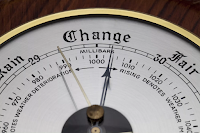
Traditionally, a barometer was used for measuring barometric pressure.

SWMP uses a more modern and accurate device called a capacitative pressure sensor.

The barometer was first devised in 1644. It consists of a glass tube that is closed at one end and open at the other.

The tube sits vertically, with the open end sitting in a pool of mercury.

Changes in pressure will change the level of mercury in the tube.

Increased air pressure pushes the mercury higher into the tube, whereas decreased air pressure allows the mercury in the tube to drop.

https://www.fondriest.com/news/barometricpressure.htm


You might also like:


High or Low Reading in Barometric Pressure

CLICK HERE . . . to view . . . 

https://puricare.blogspot.com/2020/02/high-or-low-reading-in-barometric.html

.............................................................................................................................................................................................................................................................................................
The Basics of Air Pressure

CLICK HERE . . . to view . . . 

https://puricare.blogspot.com/2018/11/air-pressure-air-has-mass-because-it-is.html

............................................................................................................................................................................................................................................................................................

https://puricare.blogspot.com/2021/01/weather-and-arthritis-pain-does-weather.html

https://puricare.blogspot.com/2020/10/weather-signs-of-incoming-storm-how-to.html

https://puricare.blogspot.com/2019/09/gauge-pressure-and-absolute-pressure.html

https://puricarechronicles.blogspot.com/2019/11/when-pressure-is-on-lord-is-listening.html


https://puricarechronicles.blogspot.com/2019/11/anxious-no-more-as-believer-you-have.html


Wednesday, January 13, 2021

WEATHER AND ARTHRITIS PAIN - Does weather affect arthritis pain? - Medical myths die hard. Maybe that’s because there’s no agreement on whether a common belief is indeed a myth. For example, there’s the longstanding belief that weather affects arthritis pain. Many of my patients notice a clear connection; some are so convinced of the link, they believe they can predict the weather better than the TV meteorologists. And maybe that’s true. But that’s not what the science says. A recent study finds no connection between rainy weather and symptoms of back or joint pain. This conclusion was based on a staggering amount of data: more than 11 million medical visits occurring on more than two million rainy days and nine million dry days. Not only was there no clear pattern linking rainy days and more aches and pains, but there were slightly more visits on dry days. Still not convinced? That’s understandable. Maybe it’s not rain or shine that matters — maybe it’s barometric pressure, changes in weather, or humidity that matters most. Or maybe the study missed some key information, such as when symptoms began or got worse — after all, it can take days or even weeks after symptoms begin to see a doctor. What does past research say about weather and arthritis pain? The question of whether there’s a link between weather and aches and pains has been studied extensively. While a definitive answer is nearly impossible to provide — because it’s hard to “prove a negative” (prove that something doesn’t exist) — researchers have been unable to make a strong case for a strong connection. For example, a 2014 study in Australia found no link between back pain and rain, temperature, humidity, or air pressure.

.........................................................................................................................................................................................................................................................................................................................................................

Weather and Arthritis Pain

Does weather affect arthritis pain?

Robert H. Shmerling, MD

Senior Faculty Editor, Harvard Health Publishing


Medical myths die hard. Maybe that’s because there’s no agreement on whether a common belief is indeed a myth.

For example, there’s the longstanding belief that weather affects arthritis pain.

Many of my patients notice a clear connection; some are so convinced of the link, they believe they can predict the weather better than the TV meteorologists. And maybe that’s true.

But that’s not what the science says.

A recent study finds no connection between rainy weather and symptoms of back or joint pain. This conclusion was based on a staggering amount of data: more than 11 million medical visits occurring on more than two million rainy days and nine million dry days.

Not only was there no clear pattern linking rainy days and more aches and pains, but there were slightly more visits on dry days.

Still not convinced? That’s understandable.

Maybe it’s not rain or shine that matters — maybe it’s barometric pressure, changes in weather, or humidity that matters most.

Or maybe the study missed some key information, such as when symptoms began or got worse — after all, it can take days or even weeks after symptoms begin to see a doctor.

What does past research say about weather and arthritis pain?

The question of whether there’s a link between weather and aches and pains has been studied extensively.

While a definitive answer is nearly impossible to provide — because it’s hard to “prove a negative” (prove that something doesn’t exist) — researchers have been unable to make a strong case for a strong connection.

For example, a 2014 study in Australia found no link between back pain and rain, temperature, humidity, or air pressure.

This study collected data regarding features of the weather at the time of first symptoms, and compared it to the weather a week and a month before.

But, an earlier study found that among 200 patients followed for three months, knee pain increased modestly when temperature fell or barometric pressure rose.

Does research matter when you have personal experience?

That’s a fair question. And it’s something I’ve even heard in TV commercials about headache medicines: “I don’t care about the research. I just know what works for me.”

But it’s worth remembering that humans have a remarkable tendency to remember when two things occur or change together (such as wet, gloomy weather and joint pain), but remember less when things do not occur together.

That rainy day when you felt no better or worse is unlikely to be so notable that you remember it.

If you rely solely on memory rather than on more rigorous, data-based evidence, it’s easy to conclude a link exists where, in fact, none does.

In conclusion…

It’s true: medical myths die hard.

In fact, some seem immortal. One could argue that’s as it should be.

After all, yesterday’s medical myth is only one discovery away from becoming tomorrow’s medical fact.

Still, when the evidence is compelling, I think we’d be better off letting go of what’s been disproven, give more credence to evidence than folklore, and keep an open mind — just in case the evidence changes.

When my patients tell me they can predict the weather by how their joints feel, I believe them.

It’s hard to discount it when so many people notice a connection. They could represent an exception to what the studies show.

But I also believe the science. Until I see evidence that’s even more compelling, I remain a skeptic about the weather/arthritis connection.

Robert H. Shmerling, MD

Senior Faculty Editor, Harvard Health Publishing

Robert H. Shmerling, MD, is the former clinical chief of the division of rheumatology at Beth Israel Deaconess Medical Center (BIDMC) and an associate professor of medicine at Harvard Medical School in Boston. He served for more than two decades as the Robinson Firm Chief in the teaching program of the BIDMC internal medicine residency. As a practicing rheumatologist for over 30 years, Dr. Shmerling engaged in a mix of patient care, teaching, and research. His practice included challenging patients, both in the clinic and the inpatient consultation service. His research interests center on diagnostic studies in patients with musculoskeletal symptoms, rheumatic, and autoimmune diseases. He has published research regarding infectious arthritis and how well diagnostic tests perform in patients with suspected rheumatic disease. Having retired from patient care in 2019, Dr. Shmerling now works as a Senior Faculty Editor for Harvard Health Publishing.

https://www.health.harvard.edu/blog/does-weather-affect-arthritis-pain-2019011715789


You might also like:


Injuries Hurt More In Cold Weather

CLICK HERE . . . to view . . . 

https://puricare.blogspot.com/2019/06/injuries-hurt-more-in-cold-weather-in.html

.........................................................................................................................................................................................................................................................................................

Old Injuries And Joint Aches 

CLICK HERE . . . to view . . . 

https://puricare.blogspot.com/2017/05/old-injuries-and-joint-aches-why-do-old.html

Sunday, May 28, 2017

OLD INJURIES AND JOINT ACHES - Why Do Old Injuries And Arthritis Joints Ache At The Start Of The Rainy Season? A drop in the barometric pressure before a storm causes the atmosphere to push less against the body, which allows the tissues around the joints to expand. These expanded tissues may then put excess pressure on the joints, resulting in painful sensation or ache in that particular joint.


.
Old Injuries And 
Joint Aches

Why Do Old Injuries And Arthritis Joints Ache At The Start Of The Rainy Season?

Achish  
You have probably heard the adults in your house, especially your grandparents, complain about the pain of old injuries in certain parts of their body in select climate conditions.
Although people may complain of aggravation from old wounds in practically all climatic conditions, it’s most commonly observed before the onset of rainy seasons.
In fact, the grandfather of a friend of mine can predict the imminent arrival of rain when a particular part of his knee begins to ache. Strangely enough, he is often correct in his rain predictions!
Why do fractured bones hurt so much in certain weather conditions? Is there any real connection between joint pain and weather conditions, or is it purely psychological?
Short answer: Yes, there seems to be a direct relation between joint pains and changes in weather conditions, especially prior to the start of the rainy season.
Although there doesn’t exist a concrete, undebatable theory of how it happens, there are a few hypotheses that blame the fluctuations in barometric pressure for the flaring up of joints.

Pain in bone joints and old injuries due to changes in weather

You may have heard arthritis patients complain about how their affected body parts get tensed and flared when the sky turns cloudy or the air becomes too humid.
Arthritis patients often complain about weather-related bone aches. 
Even in your own case, you may have observed that certain old injury spots start to ache in particular kinds of weather.
As mentioned earlier, the correlation between pain in the joints and weather seems to be so strong that people often predict weather conditions … correctly!
It cannot be denied that there is a definite connection here, and justifying that connection is one very popular hypothesis.

Changes in barometric pressure and joint aches

Barometric pressure is the force exerted by the atmosphere at a given point. It is measured by a device
Barometric pressure is commonly known as the 
atmospheric pressure, and its magnitude at a given 
point is measured with the help of a barometer.
 called a barometer.
In simple words, barometric pressure is the weight of the air that surrounds and pushes down on us. Its magnitude varies with humidity and altitude.
A gradual increase in the barometric pressure is usually seen as a sign of improving weather, while a dip in the barometric pressure may reflect imminent inclement weather.
The barometer “falls” (i.e., there is a drop in the barometric pressure) before the onset of rains or in stormy weather conditions.
During times of stormy weather, the 

barometric pressure tends to be lower. 
A drop in the barometric pressure before a storm causes the atmosphere to push less against the body, which allows the tissues around the joints to expand.
These expanded tissues may then put excess pressure on the joints, resulting in painful sensation or ache in that particular joint.
(Note: this is just a hypothesis as to how dipping barometric pressure can cause joint pains and is not experimentally proven as of now.)
Although changes in the barometric pressure are considered to be the key weather-related variable behind joint pain, there are other factors too, like humidity and temperature, that can cause your bone joints to flare up as well.
Notwithstanding the fact that the relation between weather and joint pain has been under scientific scrutiny since the early 20th century, unfortunately, we haven’t been able to find definitive evidence suggesting that there is a consistent effect from weather conditions on one’s health.
There are several reasons behind this: first, the swelling and discomforting sensation associated with changing weather occurs at too small of a scale to be objectively detected and measured by researchers.
Therefore, they have to count on people’s subjective descriptions of their pain, which cannot be relied upon completely to derive 100% accurate conclusions.
What makes things even more difficult is that people respond differently to the same set of environmental conditions.
While many people complain about their bone joints when the barometric pressure drops, there are plenty of folks who experience pain when the pressure rises.
In other words, there are a lot of mixed and even contradictory responses to the same set of weather conditions, which exacerbates the debate further.
Furthermore, it’s not as if barometric pressure is the only variable in question here; we don’t know for sure which combination of weather conditions is the most discomforting.
Overall, we don’t know the exact reason why changing weather causes joint inflammation, but we do know that it’s experienced by many people, especially arthritis patients.
On a lighter note, people seem to predict changes in weather very accurately based on that!
You might also like:
.
.
Water And Arthritis
CLICK HERE . . .
.

Water And Gout
CLICK HERE . . .
Multi-Media Filter, Highly-Activated Carbon Filter,
Zeolite-Process Water Softener With Brine Tank,
Fiberglass Ballast-Type Pressure Tank
(fully automatic backwash & regeneration)
.
PURICARE 
INDUSTRIAL 
ENTERPRISES 
Water 
Treatment 
Systems
.
...
Aganan, Pavia, Iloilo, Philippines
...

CLICK HERE . . . to view company profile . . .
Reverse Osmosis with Steel Tank 
& Cartridge Pre-Filters

Submersible Pumps

Tachmina Solenoid-Driven
Chemical Metering Pump
- ensures regulated dosing
of chlorine into water system
without human intervention