Showing posts with label Diamonds. Show all posts

Sunday, November 1, 2020

THE MANY FACETS OF A DIAMOND – While the number of facets for most shapes of diamonds is the same, how those facets are cut and where they are cut makes all the difference. Symmetry is everything in diamonds. Before the brilliant cut, diamond facets were almost always step facets, and the actual cut of those facets were far from perfection. However, today’s diamonds are cut with precision and designed with mathematical acuity for optimum fire and certain brilliance. The magic of a diamond lies in the little cuts within the stone. These intricate etchings — called facets — act like prisms to refract light, bouncing the beams throughout the stone to create those flashes and sparkles that make diamonds so stunning. Each facet is cut perfectly and precisely and the art of the cut can increase the value of the diamond considerably. How many facets does a diamond have? The answer depends on the shape of the diamond… and the perfection of the cut. However, as a guideline, the brilliant cut that was created and mastered by Marcel Tolkowsky boasts 58 facets (including the culet!). This is considered the gold standard for all diamonds. According to Diamond Cutter’s International’s foremost diamond expert, Fred Cuellar (aka “The Diamond Guy”), round brilliant, marquise, oval, cushion, heart, pear and emerald shaped diamonds all feature 58 facets. There are, however, shapes that do not conform to the 58 facet brilliant cut.

..........................................................................................................................................................................................................................................................................................................

How Many Facets Does a Diamond Have?

brilliance.com


The magic of a diamond lies in the little cuts within the stone.

These intricate etchings — called facets — act like prisms to refract light, bouncing the beams throughout the stone to create those flashes and sparkles that make diamonds so stunning.

Each facet is cut perfectly and precisely and the art of the cut can increase the value of the diamond considerably.

How Many Facets Does a Diamond Have?

The answer depends on the shape of the diamond… and the perfection of the cut.

However, as a guideline, the brilliant cut that was created and mastered by Marcel Tolkowsky boasts 58 facets (including the culet!).

This is considered the gold standard for all diamonds.

According to Diamond Cutter’s International’s foremost diamond expert, Fred Cuellar (aka “The Diamond Guy”), round brilliant, marquise, oval, cushion, heart, pear and emerald shaped diamonds all feature 58 facets.

There are, however, shapes that do not conform to the 58 facet brilliant cut.

Princess Cut Diamonds

Princess cut diamonds can have as few as 50 facets, but the number can be modified to increase the diamond’s sparkle.


While some princess diamonds are cut with more facets (up to 144!), you’re more likely to find a princess diamond in the lower facet range, around that “gold standard” 58 facets.

As such, the princess cut diamond may be a little less fiery than a modern round brilliant, but there’s a trade-off: the princess cut hides inclusions masterfully, which allows buyers a little more flexibility if they need to price down for clarity.

However, color imperfections will become more noticeable in this shape’s square dimensions. Opt for near colorless when choosing the princess shape.

Asscher Cut Diamonds

The beautiful vintage Asscher cut diamond includes 57 facets in its cut.

However, these cuts are not the brilliant kite-like prisms.

The Asscher (and the Emerald) are cut with step facets.

These unique facet cuts resemble a staircase within the stone.

Step facets create a sleek and sophisticated design but do not project the fiery, dancing light so often displayed by the brilliant cuts.

Radiant Cut Diamonds

Boasting the most facets of any diamond shape, the radiant lights a fire with 70 facets.

The radiant has the dimensions of an emerald cut diamond with the spark of a round brilliant cut.

Radiant diamonds are the best mix of subdued sophistication and sparkling celebration.

Trillion Cut Diamonds

Most often used as a side stone, there are 50 facets in a trillion-shaped diamond.

This cut isn’t as deep as other shapes and shallow depth can take away from the shape’s brilliance.

However, the equilateral shape is a unique design for buyers looking to go beyond the confines of circles, squares, or pears!

This less-brilliant but striking shape is also well-suited to be featured in three-stone engagement rings, as accent stones framing a center diamond.

Ashoka Cut Diamonds

Most buyers have never heard of the Ashoka cut.

Only the most flawless diamonds can be cut into this unique design, which makes the Ashoka rare… and expensive.

The cut was created by William Goldberg and features 62 facets.

Reese Witherspoon’s engagement ring from her husband, Jim Toth, is an Ashoka solitaire.

While the number of facets for most shapes of diamonds is the same, how those facets are cut and where they are cut makes all the difference.

Symmetry is everything in diamonds. Before the brilliant cut, diamond facets were almost always step facets, and the actual cut of those facets were far from perfection.

However, today’s diamonds are cut with precision and designed with mathematical acuity for optimum fire and certain brilliance.


Over the past three decades, we've built a reputation as a leading diamond & engagement ring retailer. As you shop for the perfect item, we’ll guide you through the process with honest advice ensuring that your choice reflects your style and budget.

https://www.brilliance.com/diamonds/how-many-facets-does-a-diamond-have


You might also like:


An Exquisite Diamond

CLICK HERE . . . to view . . . 

https://puricarechronicles.blogspot.com/2020/11/an-exquisite-diamond-paul-wrote-to.html


Sunday, September 2, 2018

LAB-GROWN DIAMONDS - Lab-grown diamonds have been produced since the 1950s. Nearly all of the earliest lab-grown diamonds were put to industrial uses such as making abrasive granules for cutting, drilling, and polishing tools. One of the main incentives for developing methods of producing man-made diamonds was the fact that abrasive tool industries were starting to consume more diamond than could easily be supplied by mining. Just like the natural diamonds that form deep within the Earth, lab-grown diamonds are a crystalline form of carbon with a cubic (isometric) crystal structure. Today, several companies are creating commercial quantities of beautiful lab-grown diamonds with spectacular clarity and color. Now, several percent of the diamonds entering the gem and jewelry marketplace are laboratory-grown.

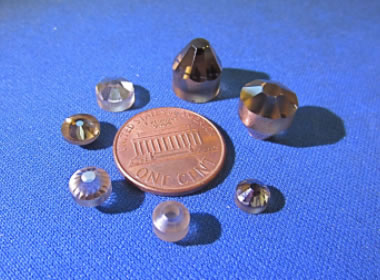
synthetic diamond anvils
Diamond Anvils manufactured from synthetic diamond are used in high-pressure testing and experiments. These anvils were manufactured from CVD diamond. Their bases measure between 5 and 10 millimeters in diameter and their culets between 1.5 and 3 millimeters.
...............................................................................................................................................................
Lab-Grown Diamonds
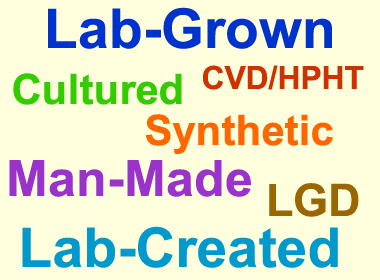
Names for lab-grown diamonds
Names for Lab-Grown Diamonds: These are some of the names
that people use to refer to lab-grown diamonds: Cultured, CVD/HPHT
(Chemical Vapor Deposition / High-Pressure High-Temperature), 
Synthetic, Man-Made, LGD (Lab-Grown Diamond), 
and Lab-Created, among others.

Also known as lab-created diamonds, man-made diamonds, synthetic diamonds
Author: Hobart M. King, Ph.D., GIA Graduate Gemologist


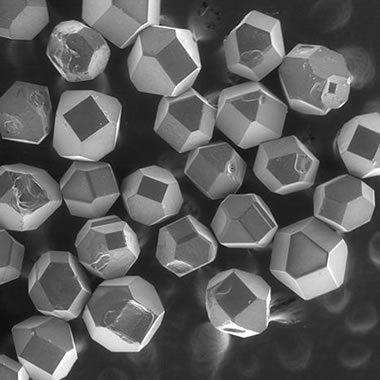
synthetic diamonds
Synthetic Diamonds grown in the High-Temperature Materials Laboratory 
of the Moscow Steel and Alloys Institute.

What Are Lab-Grown Diamonds?
Lab-grown diamonds are diamonds that have been made by people.
Just like the natural diamonds that form deep within the Earth, lab-grown diamonds are a crystalline form of carbon with a cubic (isometric) crystal structure.
Lab-grown diamonds have chemical, physical, and gemological properties that are the same as natural diamonds.
However, the manufacturing processes used to produce lab-grown diamonds give them subtle features that trained gemologists and specialized instruments can use to separate lab-grown diamonds from natural diamonds.
An ability to distinguish natural diamonds from lab-grown diamonds is very important.
In the gem and jewelry industry, many people have a strong preference for natural diamonds. They prefer them because they are made by nature and also because of their rarity.
As a result, natural diamonds sell for a higher price than lab-grown diamonds. However, many people will gladly buy a lab-grown diamond because they can be purchased at a significant cost savings.
A Brief History of Lab-Grown Diamonds
Lab-grown diamonds have been produced since the 1950s. Nearly all of the earliest lab-grown diamonds were put to industrial uses such as making abrasive granules for cutting, drilling, and polishing tools.
One of the main incentives for developing methods of producing man-made diamonds was the fact that abrasive tool industries were starting to consume more diamond than could easily be supplied by mining.
The young diamond-growing industry had the potential to produce an unlimited and reliable supply of diamond abrasives if the cost of production was contained.
This challenge was quickly achieved. Today diamond abrasive granules are produced in hundreds of factories in many parts of the world at a cost of under $1 per carat.
Within a few decades, lab-grown diamonds were being made pure enough and large enough that they could be used in a variety of high-tech applications.
Lab-grown diamonds were being used as heat sinks in advanced computers; wear-resistant coatings on tools and bearings; high-durability windows; tiny anvils for high pressure experiments; specialized lenses; speaker domes; and much more.
During the 1990s a small number of gem-quality diamonds were being produced in laboratories, but very few entered the marketplace.
These diamonds were costly to produce, and manufacturers needed to reduce costs and improve quality to be competitive in the diamond jewelry market.
By 2010, the quality of lab-grown diamonds had improved significantly. A small but increasing number of lab-grown diamonds began entering the gem and jewelry market.
Today, several companies are creating commercial quantities of beautiful lab-grown diamonds with spectacular clarity and color.
Now, several percent of the diamonds entering the gem and jewelry marketplace are laboratory-grown.
Separating Natural and Lab-Grown from Imitation
An ability to positively identify natural diamonds, lab-grown diamonds, and the many imitation materials is essential today for several reasons.
First, significant price differences exist between these materials.
Second, diamond customers are cautious and want to know exactly what they are buying.
And, third, the reputation of every business that sells diamonds is at risk.
Diamond merchants who do not monitor and confirm the identity of inventory coming into their business expose themselves to the risk of financial loss, civil liability and a loss of reputation.
Misidentified merchandise and fraud can enter the supply chain at any level.
Fortunately, both lab-grown and natural diamonds are distinctly different from the many diamond imitations such as cubic zirconia and synthetic moissanite.
These imitations differ from lab-grown diamonds and natural diamonds in many ways. They have a completely different chemical composition and a variety of different physical properties.
Competent gemologists can easily recognize the imitations.
Most jewelry professionals, with training and practice, can separate imitations from natural and synthetic diamonds with a simple testing device that can be purchased for less than $200.
Differences Between Lab-Grown and Natural
Contrary to some marketing messages, lab-grown diamonds and natural diamonds are not identical in every way.
Lab-grown diamonds are produced at Earth’s surface by two different processes: HPHT (high pressure high temperature) and CVD (chemical vapor deposition).
Diamond crystals grown in these manufacturing processes inherit characteristics of the manufacturing process that can be used to tell them apart. These characteristics can also be used to separate them from natural diamonds.
Some lab-grown diamonds can be separated from natural diamonds by a trained gemologist using standard tools.
Using a gemological microscope, the gemologist can sometimes identify inclusions or other features that are unique to HPHT-grown diamonds, CVD diamonds or natural diamonds.
Using a microscope that enables observations using ultraviolet light can reveal growth patterns unique to these different types of diamonds, but most gemologists do not have this equipment.
Even if the gemologist had that equipment, and the necessary training, many diamonds would not be identified with certainty. Thus, more sophisticated tools are needed.
Fortunately, several companies have invented portable screening devices that can separate natural diamonds from lab-grown diamonds.
These devices correctly identify about 98% of natural diamonds and refer all other stones (lab-created diamonds, imitation materials, and the remaining 2% of natural diamonds) for additional testing.
The cost of these screening devices starts at about $4000.
More sophisticated devices that successfully separate natural, lab-grown, and imitation stones from one another can be purchased, but the cost for these starts at about $20,000, which is quite costly for many small businesses.
To buy and sell with safety and confidence, a business must invest in the knowledge of its staff and obtain the necessary equipment.
Appropriate Names for Diamonds
A wide variety of names have been used for diamonds that have been made by people.
In the early days, the names "synthetic diamonds" and "man-made diamonds" were most often used.
Synthetic diamonds was the more scientific name and the name used among technical people. Man-made diamonds was a name used by the general public.
Up until recently the name "lab created" was used much more often than "lab grown".
In December of 2013 the number of people using the name "lab created diamonds" as a Google search query was rivaling the use of "man made diamonds", which was the dominant search query for these materials at that time.
In February of 2017 "lab created diamonds" became the clearly dominant query. (You can see this history for yourself in the graphic above.)
Then a major shift hit the language of Google search queries. In June of 2018, "lab grown diamonds" shot up to the leading position.
This date is coincident with the first appearance of heavy online advertising for the Lightbox diamond brand of De Beers.
Their ads and their website clearly used the name "lab-grown diamonds." Their product launch most likely changed the language being used by people searching Google.
It also caused a major increase in the number of people who queried Google for information about diamonds made by people.

Hobart M. King is the owner and publisher of Geology.com. He is a geologist with over 40 years of experience, has a Ph.D. in geology, and is a GIA graduate gemologist. Much of his work has focused on coal geology, industrial minerals, gemology, geologic hazards, and geoscience education.
He has authored many of the internet’s most popular articles about rocksminerals and gems. He writes most of the content published on Geology.com and compiles its daily news. His writing is read by over a million people each month, making him one of the world’s most widely read geologists.
Hobart M. King, Ph.D., GIA GG
Dr. King earned a Ph.D. and an M.S. in geology from West Virginia University; a B.S. in geology from California University of Pennsylvania; and, a Graduate Gemologist Diploma from the Gemological Institute of America. He is a registered professional geologist in the Commonwealth of Pennsylvania.
He has worked as a geologist in a variety of settings since 1975.
https://geology.com/diamond/lab-grown-diamonds/
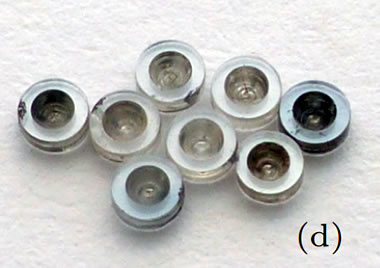
diamond lenses
Diamond Lenses: A photograph of concave parabolic diamond x-ray lenses. Diamond lenses for focusing x-ray beams have been in use since the late 1990s. The lenses in this photo are about 1 millimeter across. 

Monday, December 11, 2017

DIAMONDS - Properties & Types - Diamond is the hardest natural material. The Mohs hardness scale, on which diamond is a '10' and corundum (sapphire) is a '9', doesn't adequately attest to this incredible hardness, as diamond is exponentially harder than corundum. It is an exceptional thermal conductor - 4 times better than copper - which gives significance to diamonds being called 'ice'.

Diamonds
Chemistry of Diamond: 
Properties & Types


PROPERTIES OF DIAMONDS

Diamond is the hardest natural material.
The Mohs hardness scale, on which diamond is a '10' and corundum (sapphire) is a '9', doesn't adequately attest to this incredible hardness, as diamond is exponentially harder than corundum.
Diamond is also the least compressible and stiffest substance.
It is an exceptional thermal conductor - 4 times better than copper - which gives significance to diamonds being called 'ice'.
Diamond has an extremely low thermal expansion, is chemically inert with respect to most acids and alkalis, is transparent from the far infrared through the deep ultraviolet, and is one of only a few materials with a negative work function (electron affinity).
One consequence of the negative electron affinity is that diamonds repel water, but readily accept hydrocarbons such as wax or grease.
Diamonds do not conduct electricity well, although some are semiconductors.
Diamonds can burn if subjected to a high temperature in the presence of oxygen.
Diamond has a high specific gravity; it is amazingly dense given the low atomic weight of carbon.
The brilliance and fire of a diamond are due to its high dispersion and high refractive index.
Diamond has the highest reflectance and index of refraction of any transparent substances.
Diamond gemstones are commonly clear or pale blue, but colored diamonds, called 'fancies,’ have been found in all the colors of the rainbow.
Boron, which lends a bluish color, and nitrogen, which adds a yellow cast, are common trace impurities.
Two volcanic rocks that may contain diamonds are kimberlite and lamproite.
Diamond crystals frequently contain inclusions of other minerals, such as garnet or chromite.
Many diamonds fluoresce blue to violet, sometimes strongly enough to be seen in daylight.
Some blue-fluorescing diamonds phosphoresce yellow (glow in the dark in an afterglow reaction).

TYPE OF DIAMONDS

Natural Diamonds
Natural diamonds are classified by the type and quantity of impurities found within them.
·       Type Ia - This is the most common type of natural diamond, containing up to 0.3% nitrogen.
·       Type Ib - Very few natural diamonds are this type (~0.1%), but nearly all synthetic industrial diamonds are. Type Ib diamonds contain up to 500 ppm nitrogen.
·       Type IIa - This type is very rare in nature. Type IIa diamonds contain so little nitrogen that it isn't readily detected using infrared or ultraviolet absorption methods.
·       Type IIb - This type is also very rare in nature. Type IIb diamonds contain so little nitrogen (even lower than type IIa) that the crystal is a p-type semiconductor.
Synthetic Industrial Diamonds
Synthetic industrial diamonds have produced the process of High-Pressure High-Temperature Synthesis (HPHT).
In HPHT synthesis, graphite and a metallic catalyst are placed in a hydraulic press under high temperatures and pressures.
Over the period of a few hours, the graphite converts to diamond. The resulting diamonds are usually a few millimeters in size and too flawed for use as gemstones, but they are extremely useful as edges on cutting tools and drill bits and for being compressed to generate very high pressures.
(Interesting side note: Although used to cut, grind, and polish many materials, diamonds aren't used to machine alloys of iron because the diamond abrades very quickly, due to a high-temperature reaction between iron and carbon.)
Thin Film Diamonds
A process called Chemical Vapor Deposition (CVD) may be used to deposit thin films of polycrystalline diamond.
CVD technology makes it possible to put 'zero-wear' coatings on machine parts, use diamond coatings to draw the heat away from electronic components, fashion windows that are transparent over a broad wavelength range, and take advantage of other properties of diamonds.

ANNE MARIE HELMENSTINE, PH.D.

Anne Helmenstine, Ph.D., is an author and consultant with a broad scientific and medical background.
EXPERIENCE
Anne has taught chemistry, biology, and physics at the high school, college, and graduate level. In her doctoral work, Anne developed ultra-sensitive chemical detection and medical diagnostic tests. She has worked abstracting/indexing diverse scientific literature for the Department of Energy. She presently works as a freelance writer and scientific consultant. She enjoys adapting lab-based science projects so that they can be performed safely at home.
EDUCATION
Dr. Helmenstine has bachelor of arts degrees in physics and mathematics with a minor in chemistry from Hastings College in Nebraska and a doctorate of philosophy in biomedical sciences from the University of Tennessee at Knoxville.
Chemistry is part of everyone's life, from cooking and cleaning to the latest computer chip technology and vaccine development. It doesn't have to be intimidating and it doesn't have to be hard to understand.
You can read more about Anne's current and past work on her Google Profile: Anne Helmenstine. Find Anne's printable periodic tables and science projects at Science Notes.
You may also like:


CLICK HERE:


CLICK HERE:


CLICK HERE:


CLICK HERE:


CLICK HERE:
.

Multi-Media Filter, Highly-Activated Carbon Filter,
Zeolite-Process Water Softener With Brine Tank,
Fiberglass Ballast-Type Pressure Tank
(fully automatic backwash & regeneration)
PURICARE 
INDUSTRIAL 
ENTERPRISES 
Water 
Treatment 

Systems
.
...
...

Aganan, Pavia, Iloilo, Philippines
...

CLICK HERE . . . to view company profile . . .

Ballast-TypePressure Tank
Houston Water Pump with
Mazaki Automatic Pump Controller