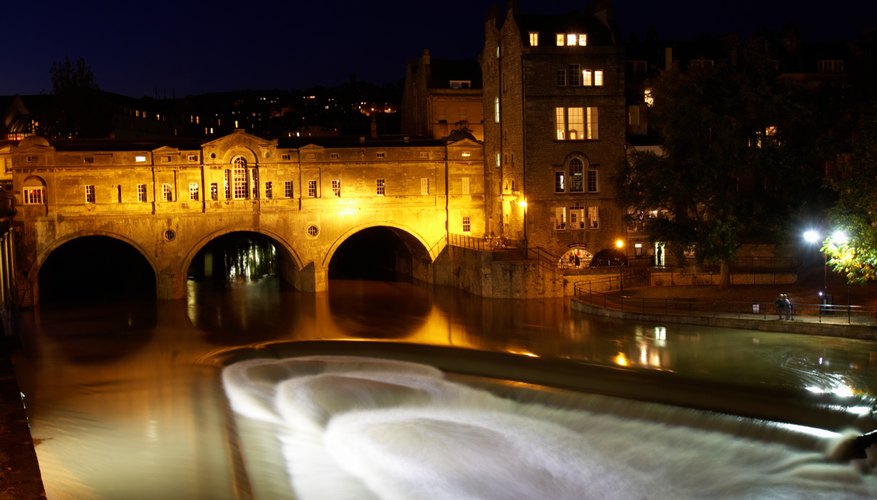
Showing posts with label Bridges. Show all posts

Tuesday, January 12, 2021

SUSPENSION BRIDGES & CABLE-STAYED BRIDGES - What Is the Difference Between a Suspension Bridge & a Cable-Stayed Bridge? - Because many large U.S. cities are located or near lakes, rivers and other waterways, bridges are an indispensable part of our nation’s transportation system. Bridge designers constantly evaluate the optimal bridge design for longer and wider bridges, and their evaluations regularly include comparisons of suspension-bridge technology and cable-stayed technology. The suspension bridge requires two cables strung across high towers on each side of the area to be bridged. The roadway is then hung on vertical suspenders attached to these suspension cables. The support towers support the weight of the suspension cable, which in turn supports the weight of the vertical suspenders and the bridge traffic. Cable-stayed bridges look a lot like suspension bridges, but their support cables tie directly to the support towers. The cantilever construction allows them to be constructed from the inside out. The cable-stayed bridge differs from a suspension bridge in that multiple towers can be easily used to extend the length of the bridge when practical. A final choice of which bridge to build depends on the bridge’ desired function, cost restrictions and engineering data. Suspension bridges appear to have the advantage over cable-stayed bridges for long spans. As the span length increases, the height of the tower increases in a cable-stayed bridge without multiple towers.

...................................................................................................................................................................................................................................................................................................................................................

Suspension Bridges & Cable-Stayed Bridges

What Is the Difference Between a Suspension Bridge & a Cable-Stayed Bridge?

By Ronald Bell


Because many large U.S. cities are located or near lakes, rivers and other waterways, bridges are an indispensable part of our nation’s transportation system.

Bridge designers constantly evaluate the optimal bridge design for longer and wider bridges, and their evaluations regularly include comparisons of suspension-bridge technology and cable-stayed technology.

Suspension Bridge

The suspension bridge, patented in 1808 by James Finley, is an American design. Finley’s first suspension bridge spanned Jacobs Creek, near Pittsburgh, Pennsylvania.

The suspension bridge requires two cables strung across high towers on each side of the area to be bridged.

The roadway is then hung on vertical suspenders attached to these suspension cables.

The support towers support the weight of the suspension cable, which in turn supports the weight of the vertical suspenders and the bridge traffic.

Cable-Stayed Bridge

Cable-stayed bridges look a lot like suspension bridges, but their support cables tie directly to the support towers.

The cantilever construction allows them to be constructed from the inside out.

The cable-stayed bridge differs from a suspension bridge in that multiple towers can be easily used to extend the length of the bridge when practical.

General Comparisons

A final choice of which bridge to build depends on the bridge’ desired function, cost restrictions and engineering data.

Suspension bridges appear to have the advantage over cable-stayed bridges for long spans.

As the span length increases, the height of the tower increases in a cable-stayed bridge without multiple towers.

Cable-stayed bridges allow the construction of the individual segments of the bridge at remote locations.

The suspension bridge requires the building of suspension cables across the entire span before the deck installation begins.

Geological Considerations

The cable-stayed bridge has the advantage of not requiring massive anchorages at the ends of the cables.

Suspension bridges require anchorages strong enough for the tension or, angular pulling, on the suspension cables.

Solid rock or a large mass of stable concrete is the preferred geological base for an anchorage.

These massive anchorages carry the entire weight of the bridge, and their weight must exceed the combined weight of the bridge and the vehicular load.

Today and Tomorrow

One of the newest large suspension bridges in the U.S. spans a part of the Tacoma Narrows; a bridge that self-destructed in 1940. The new bridge is the fifth-longest suspension bridge in the U.S.

Cable-stayed designs dominate most other large bridge projects.

A newly proposed cable-stayed bridge called the John James Audubon Bridge would include a 2.44-mile stretch of the Mississippi river.

If completed, it will be the longest of its kind in North America.

HomeSteady is the ultimate guide for all your household needs. We’re all looking to save, so why not build, fix or create household items that can easily add up over time – everything from removing the most stubborn grease stain to making chemical-free cleaning supplies.

We're here to provide you with all the tricks of the trade so you can save on everyday expenses, while channeling your creativity. Whether you're painting an upcycled chair, building a herringbone headboard or cleaning a red wine stain, Homesteady will be your helping hand.

https://homesteady.com/13366058/what-is-the-difference-between-a-suspension-bridge-a-cable-stayed-bridge


You might also like:


Bridges And Geometry

CLICK HERE . . . to view . . . 

https://puricare.blogspot.com/2019/05/bridges-and-geometry-geometric-design.html

.........................................................................................................................................................................................................................................................................................

Types of Bridges

CLICK HERE . . . to view . . . 

https://puricare.blogspot.com/2020/02/types-of-bridges-typical-bridge-designs.html

.........................................................................................................................................................................................................................................................................................

 Suspension Bridges

CLICK HERE . . . to view . . . 

https://puricare.blogspot.com/2019/11/suspension-bridges-this-category-of.html

.........................................................................................................................................................................................................................................................................................

Roman Engineering Tricks

CLICK HERE . . . to view . . . 

https://puricare.blogspot.com/2018/09/roman-engineering-tricks-romes.html

.........................................................................................................................................................................................................................................................................................

Soldiers Marching In Step On A Bridge

CLICK HERE . . . to view . . . 

https://puricare.blogspot.com/2020/09/soldiers-marching-in-step-on-bridge-why.html

.........................................................................................................................................................................................................................................................................................

Bridge Over Troubled Water

Simon & Garfunkel

CLICK HERE . . . to view complete playlist . . . 

https://puricarechronicles.blogspot.com/2019/08/bridge-over-troubled-water-simon.html

Sunday, May 19, 2019

MATHEMATICS AND CIVIL ENGINEERING - Civil engineers use trigonometry often when surveying a structure. Surveying deals with land elevations as well as the various angles of structures. Physics takes on a huge roll in a civil engineer’s job - equations are applied to all angles of an engineering problem to make sure the structure being created is going to function the way it must. When a bridge is being designed, physics is used to figure out how large the supporting piers should be, as well as how thick the steel columns of bridge need to be, and how many of them should be installed. Physics equations typically use algebra, calculus, and trigonometry.

Image result for Mathematics And Civil Engineering images
.....................................................................................................
Mathematics And Civil Engineering
Image result for Mathematics And Civil Engineering imagesHow Is Math Used in Civil Engineering?
By Benjamin Skinner


A civil engineer uses nearly every form of math at one point in time to do her job.
Algebra is used on a daily basis, and many engineers will have to deal with differential equations, statistics, and calculus occasionally.
A good portion of a civil engineer's time is not spent doing math, but when the time comes civil engineers have to be very comfortable with all the forms of math, especially those that deal with physics.
Civil engineers have to use math equations that are derived from chemistry on a daily basis.
Chemistry's equations are used to measure the strength of materials, and engineers must use these equations to select the right material for a project.
Civil engineers use trigonometry often when surveying a structure. Surveying deals with land elevations as well as the various angles of structures.
Physics takes on a huge roll in a civil engineer’s job.
Physics equations are applied to all angles of an engineering problem to make sure the structure being created is going to function the way it must.
When a bridge is being designed, physics is used to figure out how large the supporting piers should be, as well as how thick the steel columns of bridge need to be, and how many of them should be installed.
Physics equations typically use algebra, calculus, and trigonometry.
Basic math skills such as accounting and statistics must be utilized during the planning phase of any project.
Figuring out the financial side of a project is an important part of a civil engineer’s job and he must figure out how much a project is going to cost its investors.

About the Author
Located in New York State, Benjamin Skinner has been writing technology and health articles since 2008. He has worked with large companies such as Women’s Forum and Great Leap Studios. Skinner has more than six years of experience in the construction industry and understands the inner workings of buildings. He holds a Bachelor of Arts in English literature from Syracuse University.

Sunday, May 12, 2019

BRIDGES AND GEOMETRY - Geometric design is important in bridge design. roperly used, geometric figures can create extremely strong bridges. Though some bridges may use more geometric concepts than others, all bridge designs evenly distribute weight for proper bearing. Truss bridges rely heavily on triangles. Used properly, triangles evenly distribute weight throughout the bridge. Instead of pushing straight down, the weight of an arch bridge is carried outward along the curve of the arch to the supports at each end. Connector plates are used to help strengthen connecting points on bridges. Symmetry is important in bridge design because the entire length of the bridge must be able to bear weight. An asymmetrical bridge can cause the bridge to collapse.

Arches are used for this particular bridge design.
.................................................................................................
Bridges And Geometry
Geometric Concepts Found in Bridges
By Jennifer Elrod


Different bridge designs can be found throughout the world. You can find truss, arch, cable, beam, suspension and cantilever bridges in different areas.
The type of bridge used largely depends on the distance it must cover and the amount of load it must bear.
Geometric design is important in bridge design. Properly used, geometric figures can create extremely strong bridges.
Though some bridges may use more geometric concepts than others, all bridge designs evenly distribute weight for proper bearing.

Triangles

Truss bridges rely heavily on triangles. Used properly, triangles evenly distribute weight throughout the bridge.
Triangles are used on the sides and sometimes even the top of the bridge.
The top of a truss bridge may have an "x" design, where four triangles create enough support to bear a great deal of weight.
Students can use simple wooden craft sticks to create a truss bridge strong enough for the teacher to stand on.
A well-designed bridge is less about the materials and more about the design.

Arches

Arches are used to create arch bridges.
According to PBS.org, "Arch bridges are one of the oldest types of bridges and have great natural strength. Instead of pushing straight down, the weight of an arch bridge is carried outward along the curve of the arch to the supports at each end."
It may be a one-arch bridge, or there may be several arches side by side to create the support needed.

Connector Plates

Connector plates are used to help strengthen connecting points on bridges.
A connector plate is most commonly shaped as either a square or a triangle. They are made of steel and bolted onto intersecting points on a bridge.
The shape of the plate adds strength to these areas of the bridge. When pressure is added to the point of intersecting, the connector plate distributes the pressure.
There are different-sized plates and most have a galvanized coating to help prevent rust corrosion.

Symmetry

Symmetry is a geometric concept that is used in bridge design. Symmetry is where one half of a figure is the mirror image of its other half.
Symmetry is important in bridge design because the entire length of the bridge must be able to bear weight. An asymmetrical bridge can cause the bridge to collapse.
Each arch on an arch bridge must be symmetrical. The triangles on a truss bridge must be symmetrical. Even the spacing on cable and suspension bridges must be even and symmetrical.

About the Author
I'm an experienced teacher with a degree in Multidisciplinary Studies-Human Learning. I've worked with various grade levels at different educational facilities. My expertise includes: lesson planning, curriculum development, child development, educational practices and parent involvement.
Arches are used for this particular bridge design.