.
Aerodynamics And
Air Resistance
 How
Aerodynamics Work
BY PATRICK E. GEORGE
It's unpleasant to think about,
but imagine what would happen if you drove your car into a brick wall at 65
miles per hour (104.6 kilometers per hour).
Metal
would twist and tear. Glass would shatter. Airbags would burst forth
to protect you.
But
even with all the advancements in safety we have on our modern automobiles,
this would likely be a tough accident to walk away from.
A
car simply isn't designed to go through a brick wall.
But
there is another type of "wall" that cars are designed to move
through, and have been for a long time -- the wall of air that pushes against a
vehicle at high speeds.
Most
of us don't think of air or wind as a wall.
At
low speeds and on days when it's not very windy outside, it's hard to notice
the way air interacts with our vehicles.
But
at high speeds, and on exceptionally windy days, air resistance (the
forces acted upon a moving object by the air -- also defined as drag)
has a tremendous effect on the way a car accelerates, handles and achieves
fuel mileage.
This
where the science of aerodynamics comes into play. Aerodynamics is
the study of forces and the resulting motion of objects through the air [source: NASA].
For
several decades, cars have been designed with aerodynamics in mind, and
carmakers have come up with a variety of innovations that make cutting through
that "wall" of air easier and less of an impact on daily driving.
Essentially,
having a car designed with airflow in mind means it has less difficulty
accelerating and can achieve better fuel economy numbers because the engine doesn't
have to work nearly as hard to push the car through the wall of air.
Engineers
have developed several ways of doing this.
For
instance, more rounded designs and shapes on the exterior of the vehicle are
crafted to channel air in a way so that it flows around the car with the least
resistance possible.
Some
high-performance cars even have parts that move air smoothly across the
underside of the car.
Many
also include a spoiler -- also known as a rear wing --
to keep the air from lifting the car's wheels and making it unstable at high
speeds.
Although,
as you'll read later, most of the spoilers that you see on cars are simply for
decoration more than anything else.
In
this article, we'll look at the physics of aerodynamics and air resistance, the
history of how cars have been designed with these factors in mind and how with
the trend toward "greener" cars, aerodynamics is now more important
than ever.
The
Science of Aerodynamics
Before we look at how aerodynamics is applied to
automobiles, here's a little physics refresher course so that you can
understand the basic idea.
As
an object moves through the atmosphere, it displaces the air that surrounds it.
The object is also subjected to gravity and drag.
Drag is generated when a solid object moves through a
fluid medium such as water or air. Drag increases with velocity -- the
faster the object travels, the more drag it experiences.
We
measure an object's motion using the factors described in Newton’s laws. These
include mass, velocity, weight, external force, and acceleration.
Drag
has a direct effect on acceleration.
The
acceleration (a) of an object is its weight (W) minus drag (D) divided by its
mass (m).
Remember,
weight is an object's mass times the force of gravity acting on it. Your weight
would change on the moon because of lesser gravity, but your mass stays the
same. To put it more simply:
a = (W - D) / m
As
an object accelerates, its velocity and drag increase, eventually to the point
where drag becomes equal to weight -- in which case no further acceleration can
occur.
Let's
say our object in this equation is a car. This means that as the car travels
faster and faster, more and more air pushes against it, limiting how much more
it can accelerate and restricting it to a certain speed.
How
does all of this apply to car design? Well, it's useful for figuring out an
important number -- drag coefficient.
This
is one of the primary factors that determine how easily an object moves through
the air.
The
drag coefficient (Cd) is equal to the drag (D), divided by the quantity of the
density (r), times half the velocity (V) squared times the area (A). To make
that more readable:
Cd = D / (A * .5 * r * V^2)
So
realistically, how much drag coefficient does a car designer aim for if they're
crafting a car with aerodynamic intent?
The Coefficient
of Drag
We've just learned that the coefficient of drag (Cd)
is a figure that measures the force of air resistance on an object, such as a
car.
Now,
imagine the force of air pushing against the car as it moves down the road.
At
70 miles per hour (112.7 kilometers per hour), there's four times more force
working against the car than at 35 miles per hour (56.3 kilometers per hour) [source: Elliott-Sink].
The
aerodynamic abilities of a car are measured using the vehicle's coefficient of
drag.
Essentially,
the lower the Cd, the more aerodynamic a car is, and the easier it can move
through the wall of air pushing against it.
Let's
look at a few Cd numbers. Remember the boxy old Volvo cars of the 1970s
and '80s? An old Volvo 960 sedan achieves a Cd of .36.
The
newer Volvos are much more sleek and curvy, and an S80 sedan achieves a Cd of
.28 [source: Elliott-Sink].
This
proves something that you may have been able to guess already -- smoother, more
streamlined shapes are more aerodynamic than boxy ones. Why is that exactly?
Let's
look at the most aerodynamic thing in nature -- a teardrop.
The
teardrop is smooth and round on all sides and tapers off at the top. Air flows
around it smoothly as it falls to the ground.
It's
the same with cars -- smooth, rounded surfaces allow the air to flow in a
stream over the vehicle, reducing the "push" of air against the body.
Today,
most cars achieve a Cd of about .30.
SUVs,
which tend to be more boxy than cars because they're larger, accommodate more
people, and often need bigger grilles to help cool the engine down, have a Cd
of anywhere from .30 to .40 or more.
Pickup
trucks -- a purposefully boxy design -- typically get around .40 [source: Siuru].
Many
have questioned the "unique" looks of the Toyota Prius hybrid, but it
has an extremely aerodynamic shape for a good reason.
Among
other efficient characteristics, its Cd of .26 helps it achieve very high
mileage.
In
fact, reducing the Cd of a car by just 0.01 can result in a 0.2 miles per
gallon (.09 kilometers per liter) increase in fuel economy [source: Siuru].
History of
Aerodynamic Car Design
While scientists have more or less been aware of what
it takes to create aerodynamic shapes for a long time, it took a while for
those principles to be applied to automobile design.
There
was nothing aerodynamic about the earliest cars.
Take
a look at Ford's seminal Model T -- it looks more like a horse
carriage minus the horses -- a very boxy design, indeed.
Many
of these early cars didn't need to worry about aerodynamics because they were
relatively slow.
However,
some racing cars of the early 1900s incorporated tapering and aerodynamic
features to one degree or another.
In
1921, German inventor Edmund Rumpler created the Rumpler-Tropfenauto, which
translates into "tear-drop car."
Based
on the most aerodynamic shape in nature, the teardrop, it had a Cd of just .27,
but its unique looks never caught on with the public. Only about 100 were made [source: Price].
On
the American side, one of the biggest leaps ahead in aerodynamic design came in
the 1930s with the Chrysler Airflow.
Inspired
by birds in flight, the Airflow was one of the first cars designed with
aerodynamics in mind.
Though
it used some unique construction techniques and had a nearly 50-50-weight
distribution (equal weight distribution between the front and rear axles for
improved handling), a Great Depression-weary public never fell in love with its
unconventional looks, and the car was considered a flop.
Still,
its streamlined design was far ahead of its time.
As
the 1950s and '60s came about, some of the biggest advancements in automobile
aerodynamics came from racing.
Originally,
engineers experimented with different designs, knowing that streamlined shapes
could help their cars go faster and handle better at high speeds.
That
eventually evolved into a very precise science of crafting the most aerodynamic
race car possible.
Front
and rear spoilers, shovel-shaped noses, and aero kits became more and more
common to keep air flowing over the top of the car and to create necessary
downforce on the front and rear wheels [source: Formula 1 Network].
On
the consumer side, companies like Lotus, Citroën and Porsche developed some
very streamlined designs, but these were mostly applied to high-performance
sports cars and not everyday vehicles for the common driver.
That
began to change in the 1980s with the Audi 100, a passenger sedan with a
then-unheard-of Cd of .30.
Today,
nearly all cars are designed with aerodynamics in mind in some way [source: Edgar].
What
helped that change to occur? The answer: The wind tunnel.
Measuring Drag
Using Wind Tunnels
To measure the
aerodynamic effectiveness of a car in real time, engineers have borrowed a tool
from the aircraft industry -- the wind tunnel.
In
essence, a wind tunnel is a massive tube with fans that produce airflow over an
object inside. This can be a car, an airplane, or anything else that engineers
need to measure for air resistance.
From
a room behind the tunnel, engineers study the way the air interacts with the
object, the way the air currents flow over the various surfaces.
The
car or plane inside never moves, but the fans create wind at different speeds
to simulate real-world conditions.
Sometimes
a real car won't even be used -- designers often rely on exact scale models of
their vehicles to measure wind resistance.
As
wind moves over the car in the tunnel, computers are used to calculate the drag
coefficient (Cd).
Wind
tunnels are really nothing new. They've been around since the late 1800s to
measure airflow over many early aircraft attempts. Even the Wright Brothes had
one.
After
World War II, racecar engineers seeking an edge over the competition began to
use them to gauge the effectiveness of their cars' aerodynamic equipment.
That
technology later made its way to passenger cars and trucks.
However,
in recent years, the big, multi-million-dollar wind tunnels are being used less
and less.
Computer
simulations are starting to replace wind tunnels as the best way to measure the
aerodynamics of a car or aircraft.
In
many cases, wind tunnels are mostly just called upon to make sure the computer
simulations are accurate [source: Day].
Many
think that adding a spoiler on the back of a car is a great way to make it more
aerodynamic. In the next section, we'll examine different types of aerodynamic
add-ons to vehicles, and examine their roles in performance and providing
better fuel mileage.
Aerodynamic
Add-ons
There's more to aerodynamics than just drag -- there
are other factors called lift and downforce, too.
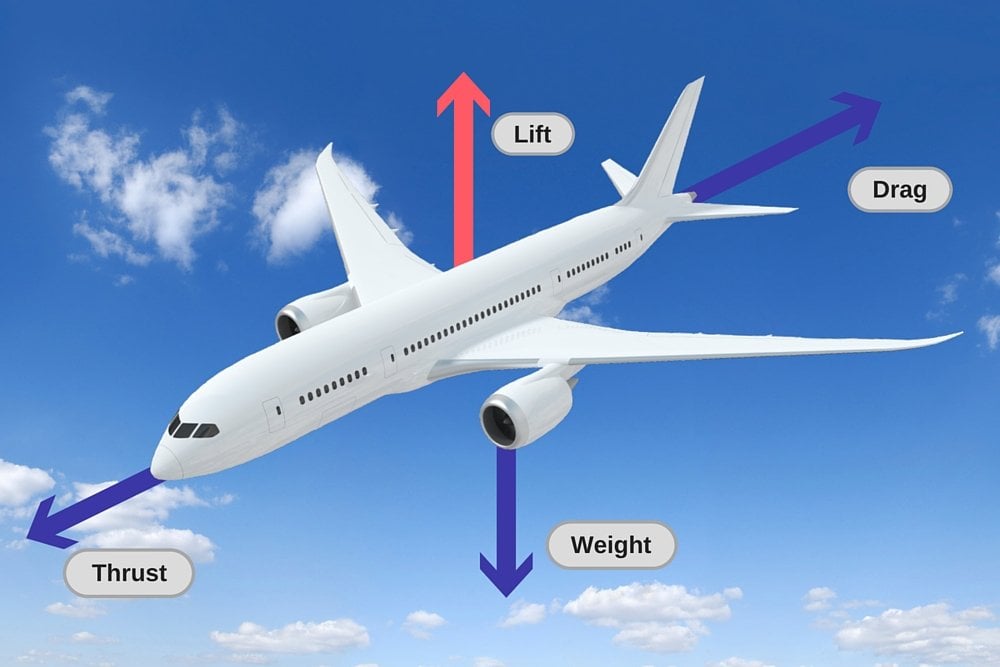
Lift is the force that opposes the weight of an
object and raises it into the air and keeps it there.
Downforce is the opposite of lift -- the force that
presses an object in the direction of the ground [source: NASA].
You
may think that the drag coefficient on a Formula One racecar would be very
low -- a super-aerodynamic car is faster, right?
Not
in this case. A typical F1 car has a Cd of about .70.
Why
is this type of racecar able to drive at speeds of more than 200 miles an hour
(321.9 kilometers per hour), yet not as aerodynamic as you might have guessed?
That's
because Formula One cars are built to generate as much downforce as possible.
At
the speeds they're traveling, and with their extremely light weight, these cars
actually begin to experience lift at some speeds -- physics forces them to take
off like an airplane.
Obviously,
cars aren't intended to fly through the air, and if a car goes airborne it
could mean a devastating crash.
For
this reason, downforce must be maximized to keep the car on the ground at high
speeds, and this means a high Cd is required.
Formula
One cars achieve this by using wings or spoilers mounted onto the front and
rear of the vehicle.
These
wings channel the flow into currents of air that press the car to the ground --
better known as downforce.
This
maximizes cornering speed, but it has to be carefully balanced with lift to
also allow the car the appropriate amount of straight-line speed [source: Smith].
Lots
of production cars include aerodynamic add-ons to generate downforce.
While
the Nissan GT-R supercar has been somewhat criticized in the automotive press
for its looks, the entire body is designed to channel air over the car and back
through the oval-shaped rear spoiler, generating plenty of downforce.
Ferrari’s
599 GTB Fiorano has flying buttress B-pillars designed to channel air to
the rear as well -- these help to reduce drag [source: Classic Driver].
But
you see plenty of spoilers and wings on everyday cars, like Honda and Toyota
sedans.
Do
those really add an aerodynamic benefit to a car? In some cases, it can add a
little high-speed stability.
For
example, the original Audi TT didn't have a spoiler on its rear decklid, but
Audi added one after its rounded body was found to create too much lift and may
have been a factor in a few wrecks [source: Edgar].
In
most cases, however, bolting a big spoiler on the back of an ordinary car isn't
going to aid in performance, speed, or handling a whole lot -- if at all.
In
some cases, it could even create more understeer, or reluctance to corner.
However,
if you think that giant spoiler looks great on the trunk of your Honda Civic,
don't let anyone tell you otherwise.



 How Do Fighter Jets Fly Upside Down?