Showing posts with label Mathematics. Show all posts

Monday, August 17, 2020

CHEMICAL ENGINEERING - Chemical engineering sits at the nexus between science and technology. It's one of the major engineering disciplines. Chemical engineering is applied chemistry. It is the branch of engineering concerned with the design, construction, and operation of machines and plants that perform chemical reactions to solve practical problems or make useful products. It starts in the lab, much like science, yet progresses through the design and implementation of a full-scale process, its maintenance, and methods of testing and improving it. Chemical engineers use math, physics, and economics to solve technical problems. Chemical engineers apply knowledge of chemistry in addition to other engineering disciplines. Chemical engineers sometimes are called 'universal engineers' because their scientific and technical mastery is so broad. You could consider a chemical engineer to be a type of engineer who knows a lot of science. Another perspective is that a chemical engineer is a practical chemist. Some chemical engineers make designs and invent new processes. Some construct instruments and facilities. Some plan and operate facilities. Chemical engineers also make chemicals. Chemical engineers have helped develop atomic science, polymers, paper, dyes, drugs, plastics, fertilizers, foods, petrochemicals, pretty much everything you can imagine. They devise ways to make products from raw materials and ways to convert one material into another useful form.

An engineer by a chemical plant
...................................................................................................................................................................
Chemical Engineering
What Is Chemical Engineering?
By Anne Marie Helmenstine, Ph.D.


Chemical engineering sits at the nexus between science and technology. It's one of the major engineering disciplines.
Take a look at what exactly chemical engineering is, what chemical engineers do, and how to become a chemical engineer.
What Is Chemical Engineering?
Chemical engineering is applied chemistry. It is the branch of engineering concerned with the design, construction, and operation of machines and plants that perform chemical reactions to solve practical problems or make useful products.
It starts in the lab, much like science, yet progresses through the design and implementation of a full-scale process, its maintenance, and methods of testing and improving it.
What Is a Chemical Engineer?
Like all engineers, chemical engineers use math, physics, and economics to solve technical problems.
The difference between chemical engineers and other types of engineers is that they apply knowledge of chemistry in addition to other engineering disciplines.
Chemical engineers sometimes are called 'universal engineers' because their scientific and technical mastery is so broad.
You could consider a chemical engineer to be a type of engineer who knows a lot of science.
Another perspective is that a chemical engineer is a practical chemist.
What Do Chemical Engineers Do?
Some chemical engineers make designs and invent new processes.
Some construct instruments and facilities. Some plan and operate facilities.
Chemical engineers also make chemicals.
Chemical engineers have helped develop atomic science, polymers, paper, dyes, drugs, plastics, fertilizers, foods, petrochemicals, pretty much everything you can imagine.
They devise ways to make products from raw materials and ways to convert one material into another useful form.
Chemical engineers can make processes more cost-effective or more environmentally friendly or more efficient.
Chemical engineers also teach, work with the law, write, create new companies, and perform research.
As you can see, a chemical engineer can find a niche in any scientific or engineering field.
While the engineer often works in a plant or lab, she's also found in the boardroom, office, classroom, and out at field locations.
Chemical engineers are in high demand, so they typically command higher salaries than chemists or other types of engineers.
What Skills Does a Chemical Engineer Need?
Chemical engineers work in teams, so an engineer needs to be able to work and communicate with others.
Chemical engineers study mathematics, energy and mass transfer, thermodynamics, fluid mechanics, separation technology, matter and energy balances, and other topics of engineering, plus they study chemical reaction kinetics, process design, and reactor design.
A chemical engineer needs to be analytical and meticulous.
Someone who is great at chemistry and math and loves solving problems would enjoy the discipline.
Typically, chemical engineering progresses to a masters degree because there's so much to learn.
More About Chemical Engineering
If you'd like to learn more about chemical engineering, start with reasons to study it.
View the chemical engineer job profile and learn how much money an engineer makes. There's also a handy list of types of jobs in chemical engineering.

Anne Marie Helmenstine, Ph.D.
Chemistry Expert
Education
Ph.D., Biomedical Sciences, University of Tennessee at Knoxville
B.A., Physics and Mathematics, Hastings College
Introduction
Ph.D. in biomedical sciences from the University of Tennessee at Knoxville - Oak Ridge National Laboratory.
Science educator with experience teaching chemistry, biology, astronomy, and physics at the high school, college, and graduate levels.
ThoughtCo and About Education chemistry expert since 2001.
Widely-published graphic artist, responsible for printable periodic tables and other illustrations used in science.
Experience
Anne Helmenstine, Ph.D. has covered chemistry for ThoughtCo and About Education since 2001, and other sciences since 2013. She taught chemistry, biology, astronomy, and physics at the high school, college, and graduate levels. She has worked as a research scientist and also abstracting and indexing diverse scientific literature for the Department of Energy.
In addition to her work as a science writer, Dr. Helmenstine currently serves as a scientific consultant, specializing in problems requiring an interdisciplinary approach. Previously, she worked as a research scientist and college professor. 
Education
Dr. Helmenstine holds a Ph.D. in biomedical sciences from the University of Tennessee at Knoxville and a B.A. in physics and mathematics with a minor in chemistry from Hastings College. In her doctoral work, Dr. Helmenstine developed ultra-sensitive chemical detection and medical diagnostic tests.
ThoughtCo and Dotdash
ThoughtCo is a premier reference site focusing on expert-created education content. We are one of the top-10 information sites in the world as rated by comScore, a leading Internet measurement company. Every month, more than 13 million readers seek answers to their questions on ThoughtCo.
For more than 20 years, Dotdash brands have been helping people find answers, solve problems, and get inspired. We are one of the top-20 largest content publishers on the Internet according to comScore, and reach more than 30% of the U.S. population monthly. Our brands collectively have won more than 20 industry awards in the last year alone, and recently Dotdash was named Publisher of the Year by Digiday, a leading industry publication.
..An engineer by a chemical plant

Sunday, October 13, 2019

OPPOSITE OF INFINITY - Infinity has baffled humanity since antiquity. One must realize that infinity is not a concrete number, but rather an idea; it exists only in abstraction. Infinity cannot be a concrete number, say, x, because we can, by the logic of addition, add 1 to x and create a new infinity. We can then add another 1 to create a larger infinity. We can, in fact, add infinity to infinity to create perhaps the infinity of all infinities, but then we can add to this infinity another 1 and … you know the drill. The microscopic realm isn’t any different. The opposite of infinity is called infinitesimal, and its nature is equally bizarre.

An Infinite Reflection Turns Green
////////////////////////////////////////////////////////////////////////////////////////////////////////////////////////////////////////
Opposite Of Infinity
Triangle area of circle
Infinite triangles right angle triangle and calculation

What Is The Opposite Of Infinity?
Akash Peshin  


No, the answer isn’t zero. Infinity is the largest number there is, so the opposite of infinity would be the smallest number there is.
Zero would mean nothing, so what we’re looking for is a number just greater than zero.
However, as we’ll find out, determining this number isn’t as simple as pointing to the number 1.
Infinities are weird
Infinity has baffled humanity since antiquity. One must realize that infinity is not a concrete number, but rather an idea; it exists only in abstraction.
Infinity cannot be a concrete number, say, x, because we can, by the logic of addition, add 1 to x and create a new infinity. We can then add another 1 to create a larger infinity.
We can, in fact, add infinity to infinity to create perhaps the infinity of all infinities, but then we can add to this infinity another 1 and … you know the drill.
The microscopic realm isn’t any different. The opposite of infinity is called infinitesimal, and its nature is equally bizarre.
Unlike whole numbers, real numbers aren’t rigid. Their splintered nature allows us to find and create infinite numbers between any two numbers.
A number can be combined as many times as it can be divided. There could be a hundred numbers between 0 and 1, from 0.01-0.99, or even millions, one just has to add zeroes after the decimal point — divide it increasingly to create new numbers. So, while 0.00000000000000001 seems infinitesimal, one can just divide it by 10 to create a new infinitesimal — 0.000000000000000001.
So, infinitesimal, like infinity, exists only in abstraction, yet its uncertain nature is very disconcerting not just for mathematicians, but also physicists.
Infinitesimal Errors
Mathematics is the language we use to express our ideas in physics, so an inconsistency in math translates to an inconsistency in physics, in our knowledge of nature – of reality.
The inconsistency arises from our uncertainty of the value of infinitesimal, which has been used to derive many crucial formulae.
In fact, an entire branch of mathematics is based on infinitesimal, without which, progress in physics would have been sluggish.
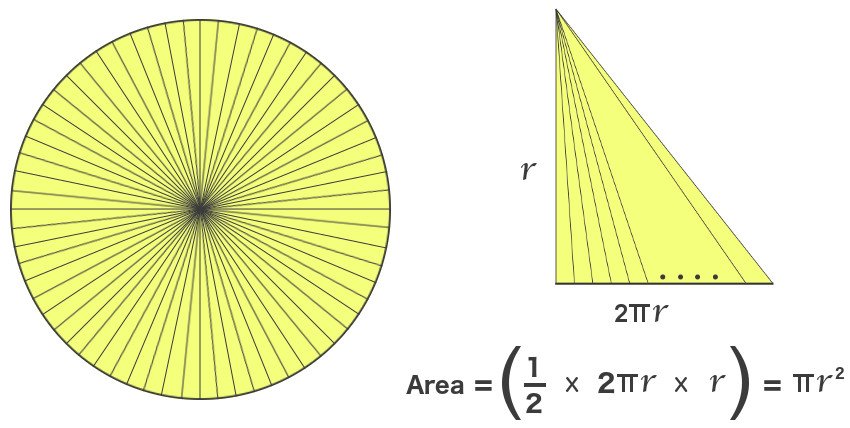
One formula I can think of is the area of a circle. Kepler calculated the area of a circle by dividing it into triangles.
The area of the circle, therefore, would be the sum of areas of each triangle.
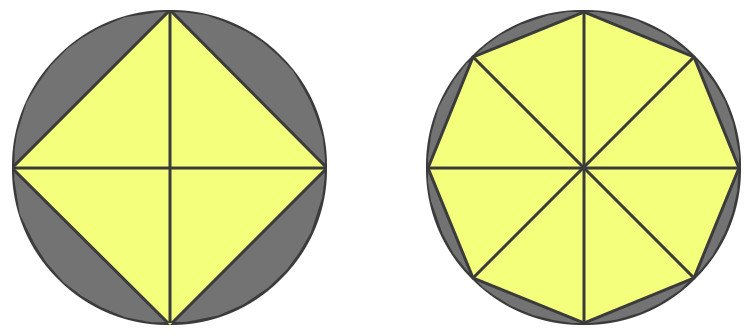
A circle can be divided into four triangles with two diameters, however, the sides of these triangles do not approximate the curves properly, excluding some space, so the area calculated is erroneous.
To reduce this error, we can draw more diameters to create more triangles of shorter sides. However, the error is reduced in this way, but it is still finite.
So, we further divide the circle into more and more triangles until there is no space left excluded. However, to eliminate this error entirely, we must divide it into an infinite number of triangles.
Now, because a line can be interpreted as part of a huge circle, we can say that our circle is composed of infinite lines, which are approximated by the infinitesimal bases of our infinite triangles.
One may notice that the sequence of triangles is reminiscent of a Chinese fan. All the triangles occupy an equal area, but we can convert the fan into a large right-angled triangle by distributing or stretching this area.
Their perimeters have changed, but the total area remains the same. The height of this triangle, with the summit being the circle’s center, is the length of the fan — the radius of our circle, and the base, the circle’s circumference.
The area is ½ times base times height, which is ½ times r times 2πr, or πr².
This is, of course, the correct answer, but the outcome is still erroneous.
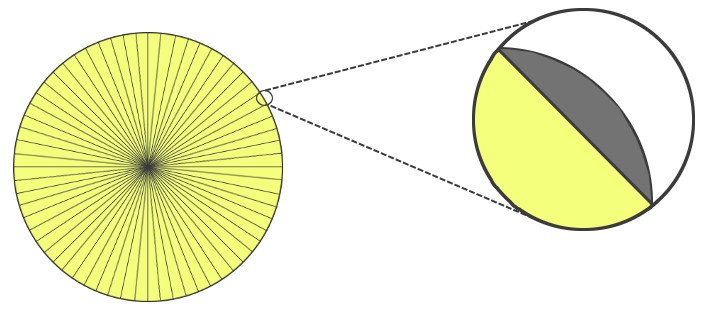
The bases must be truly infinitesimal, so even though Kepler draws really, really, really thin triangles, we know that he could have drawn more.

The moment he stops drawing triangles, he leaves behind spaces, albeit really, really, really small ones, but still, finite.
The curves are then inadequately approximated and the calculation of the area of the circle is slightly erroneous.
While this might make a mathematician uncomfortable, the majority “ignore” such differences for, as we have seen, the results procured aren’t incorrect.
Calculus, either invented or discovered by Leibniz and Newton independently, was also founded on infinitesimals.
That branch of mathematics is concerned with change, with curves.
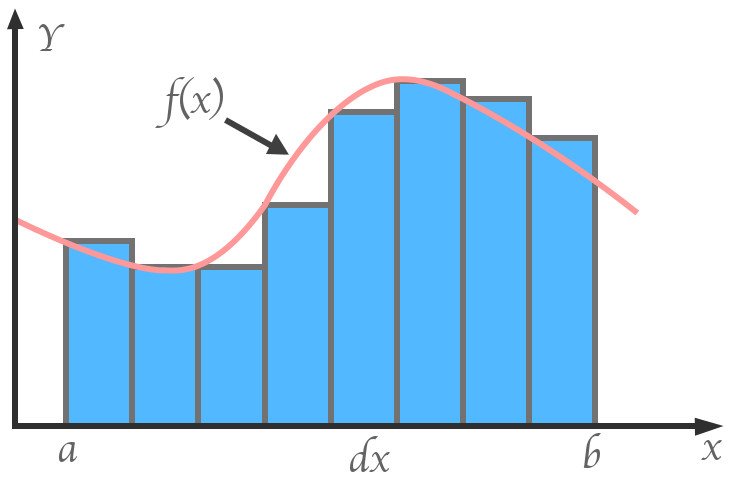
For instance, when we integrate a function, we essentially calculate the area under the curve it draws.
However, like calculating the area of a circle, we calculate it by approximating the curve with infinitesimally thin rectangles. The thinner the rectangles, the smaller the error.
The area of one rectangle is the product of its length — the value on the Y-axis at that point on the curve and its breadth – the infinitesimal unit we call ‘dx’.
We calculate the area of each rectangle and sum them to determine the area under the curve.
This is very useful in physics; for instance, the area under the velocity curve of a body gives the value of its displacement, but then shouldn’t the outcome be erroneous, just like the area of the circle was?
This ineradicable, insoluble problem bothered mathematicians for two centuries following the advent of calculus until the concept of limits was refined.
Limits were implicit in Newton and Leibniz’s work, but they were modified and redefined later in the early 1800s.
The new ideas were mathematically rigorous and consistent. The details are beyond the scope of this article, but limits allowed mathematicians to finally get rid of infinitesimals for good.
What we still haven’t gotten rid of is the absurdity that is infinity.

Akash Peshin is an Electronic Engineer from the University of Mumbai, India and a science writer at ScienceABC. Enamored with science ever since discovering a picture book about Saturn at the age of 7, he believes that what fundamentally fuels this passion is his curiosity and appetite for wonder.
Area of circle

An Infinite Reflection Turns Green
Infinity
Curve area diagramArea of circle border zoom

Thursday, October 3, 2019

THE PYTHAGOREAN THEOREM - The name makes it sound like something akin to advanced particle physics, but it's actually a fairly simple, straightforward way to calculate the length of the third side of a right triangle if you know the lengths of the other two sides. The equation that derives from the Pythagorean Theorem is familiar to many: a2 + b2 = c2. The Pythagorean Theorem holds that, in a right triangle, the square of the hypotenuse is equal to the sum of the squares of the other two sides. It will help you to know how to calculate square roots, and you can also use basic algebra to figure out any missing side of a right triangle as long as you know two of its measurements.


............................................................................................................................................
The Pythagorean Theorem
What Is the Pythagorean Theorem?
Wonderopolis


There are certain things you learn in school that you use on an everyday basis.
Some of these things include reading, writing, spelling, and basic mathematics, such as addition, subtraction, multiplication, and division.
Then there are other things that you learn in school that you probably don't use every single day.
How often do you need to know when World War I started?
Does knowing the details of the process of photosynthesis come in handy every day?
How about all those esoteric mathematical concepts and formulas?
Will algebra ever be useful in real life? Actually, you might be surprised how often you end up using algebra and other mathematical concepts without even realizing it.
Let's take a look at one of those formulas you may have learned about in school: the Pythagorean Theorem.
The name makes it sound like something akin to advanced particle physics, but it's actually a fairly simple, straightforward way to calculate the length of the third side of a right triangle if you know the lengths of the other two sides.
The equation that derives from the Pythagorean Theorem is familiar to many: a2 + b2 = c2.
In this equation, c represents the longest side (known as the hypotenuse) of a right triangle.
Reminder: a right triangle is a triangle that has one 90˚ angle.
The letters a and b represent the other two sides.
Stated another way, the Pythagorean Theorem holds that, in a right triangle, the square of the hypotenuse is equal to the sum of the squares of the other two sides.
So, if side a measures 3 and side b measures 4, you can calculate that side c will measure 5 (32 + 42 = 52 or 9 + 16 = 25).
It will help you to know how to calculate square roots, and you can also use basic algebra to figure out any missing side of a right triangle as long as you know two of its measurements.
The Pythagorean Theorem is credited to Pythagoras, who was a Greek philosopher and mathematician that lived in the 5th century B.C.
However, historians have discovered that other ancient civilizations knew about the basic mathematics of the Pythagorean Theorem thousands of years earlier.
For example, new studies show that the ancient pillars of Stonehenge may have been placed very precisely using the geometry of the Pythagorean Theorem.
Although no one knows who built Stonehenge, historians believe it was constructed over 2,000 years before Pythagoras was born.
Does the Pythagorean Theorem have any usefulness in real life? You bet it does!
First, it's often used as the basis for more complicated mathematics, including calculating areas, volumes, and perimeters of all sorts of geometric shapes.
On a day to day basis, you might find yourself using the Pythagorean Theorem in certain types of jobs and tasks.
These might include architecture, construction, navigation, and surveying.
Basically, any time you build something and you need to use square angles or know how long one side of a triangle needs to be, you'll be using the Pythagorean Theorem!
·  Follow the link to learn how to use shoes to create triangles that you can then measure to confirm the Pythagorean Theorem. Have fun confirming what mathematicians have known for centuries!
·  Are you a sports fan? Check out The Pythagorean Theorem and Baseball online. Can you solve the puzzle? Apply what you've learned about the Pythagorean Theorem. You can click for a hint if you need one.
·  We don't condone breaking and entering, but sometimes you might find yourself locked out of the house and need to borrow a ladder to climb to a second story window to get in. Use the information in The Pythagorean Theorem and Ladders to solve a simple puzzle. Isn't it cool how you can figure out how long the ladder needs to be?

Wonderopolis was created by the National Center for Families Learning (NCFL) in 2010, and it has become one of the most popular education sites today. 
The National Center for Families Learning (NCFL) works to eradicate poverty through education solutions for families. Over our 29-year history, we have changed the lives of millions of families across the country by providing innovative programs, strategies, and resources that support learning, literacy, and family engagement in education. Engaging multiple generations together has been a fundamental and distinguishing aspect of our work, because we know this holistic approach creates a stronger impact and greater success for families. For more information, please visit familieslearning.org.

Sunday, May 19, 2019

MATHEMATICS AND CIVIL ENGINEERING - Civil engineers use trigonometry often when surveying a structure. Surveying deals with land elevations as well as the various angles of structures. Physics takes on a huge roll in a civil engineer’s job - equations are applied to all angles of an engineering problem to make sure the structure being created is going to function the way it must. When a bridge is being designed, physics is used to figure out how large the supporting piers should be, as well as how thick the steel columns of bridge need to be, and how many of them should be installed. Physics equations typically use algebra, calculus, and trigonometry.

Image result for Mathematics And Civil Engineering images
.....................................................................................................
Mathematics And Civil Engineering
Image result for Mathematics And Civil Engineering imagesHow Is Math Used in Civil Engineering?
By Benjamin Skinner


A civil engineer uses nearly every form of math at one point in time to do her job.
Algebra is used on a daily basis, and many engineers will have to deal with differential equations, statistics, and calculus occasionally.
A good portion of a civil engineer's time is not spent doing math, but when the time comes civil engineers have to be very comfortable with all the forms of math, especially those that deal with physics.
Civil engineers have to use math equations that are derived from chemistry on a daily basis.
Chemistry's equations are used to measure the strength of materials, and engineers must use these equations to select the right material for a project.
Civil engineers use trigonometry often when surveying a structure. Surveying deals with land elevations as well as the various angles of structures.
Physics takes on a huge roll in a civil engineer’s job.
Physics equations are applied to all angles of an engineering problem to make sure the structure being created is going to function the way it must.
When a bridge is being designed, physics is used to figure out how large the supporting piers should be, as well as how thick the steel columns of bridge need to be, and how many of them should be installed.
Physics equations typically use algebra, calculus, and trigonometry.
Basic math skills such as accounting and statistics must be utilized during the planning phase of any project.
Figuring out the financial side of a project is an important part of a civil engineer’s job and he must figure out how much a project is going to cost its investors.

About the Author
Located in New York State, Benjamin Skinner has been writing technology and health articles since 2008. He has worked with large companies such as Women’s Forum and Great Leap Studios. Skinner has more than six years of experience in the construction industry and understands the inner workings of buildings. He holds a Bachelor of Arts in English literature from Syracuse University.

Friday, June 15, 2018

THE STUDY OF CALCULUS - Before calculus was invented, all math was static: It could only help calculate objects that were perfectly still. But, the universe is constantly moving and changing. No objects - from the stars in space to subatomic particles or cells in the body - are always at rest. Indeed, just about everything in the universe is constantly moving. Calculus helped to determine how particles, stars, and matter, actually move and change in real time.


 .
Calculus
An Introduction to the Study of Calculus
The branch of mathematics studies rates of change

Calculus is the study of rates of change.
The principals behind calculus date back centuries to the ancient Greeks, as well as to ancient China, India and even medieval Europe.
Before calculus was invented, all math was static: It could only help calculate objects that were perfectly still.
But, the universe is constantly moving and changing. No objects - from the stars in space to subatomic particles or cells in the body - are always at rest.
Indeed, just about everything in the universe is constantly moving. Calculus helped to determine how particles, stars, and matter, actually move and change in real time.

History

Calculus was developed in the latter half of the 17th century by two mathematicians, Gottfried Leibniz and Isaac Newton.
Newton first developed calculus and applied it directly to the understanding of physical systems.
Independently, Leibniz developed the notations used in calculus.
Put simply, while basic math uses operations such as plus, minus, times, and division (+, -, x, and ÷), calculus uses operations that employ functions and integrals to calculate rates of change.
The Story of Mathematics explains the importance of Newton's fundamental theorem of the calculus:
"Unlike the static geometry of the Greeks, calculus allowed mathematicians and engineers to make sense of the motion and dynamic change in the changing world around us, such as the orbits of planets, the motion of fluids, etc."
Using calculus, scientists, astronomers, physicists, mathematicians, and chemists could now chart the orbit of the planets and stars, as well as the path of electrons and protons at the atomic level.
Economists to this day use calculus to determine the price elasticity of demand.

Two Types of Calculus

There are two main branches of calculus: differential and integral calculus.
Differential calculus determines the rate of change of a quantity, while integral calculus finds the quantity where the rate of change is known.
Differential calculus examines the rates of change of slopes and curves, while integral calculus determines the areas of those curves.

Practical Applications

Calculus has many practical applications in real life, as the website, teachnology explains:
"Among the physical concepts that use concepts of calculus include motion, electricity, heat, light, harmonics, acoustics, astronomy, and dynamics. In fact, even advanced physics concepts including electromagnetism and Einstein's theory of relativity use calculus."
Calculus is also used to calculate the rates of radioactive decay in chemistry, and even to predict birth and death rates, the science website notes.
Economists use calculus to predict supply, demand, and maximum potential profits. Supply and demand are, after all, essentially charted on a curve - and an ever-changing curve at that.
Economists refer to this ever-changing curve as "elastic," and the actions of the curve as "elasticity."
To calculate an exact measure of elasticity at a particular point on a supply or demand curve, you need to think about infinitesimally small changes in price and, as a result, incorporate mathematical derivatives into your elasticity formulas.
Calculus allows you to determine specific points on that ever-changing supply-and-demand curve.