Showing posts with label Rainmaking. Show all posts

Saturday, May 30, 2020

CLOUD SEEDING - Humans can now control the weather, including ‘making it rain’ literally – through a process called cloud seeding. It basically is the enhancement of natural precipitation. The process makes water vapor into clouds, turning into precipitation and into rain that would otherwise not fall on earth. It is the most widely used technique in the modification of weather. Cloud seeding, rainmaking, or man-made precipitation enhancement is a way to artificially modify the weather by spreading clouds with small particles, to make it snow or rain. Cloud seeding is all about manipulating the clouds so that it rains. Clouds consist of water droplets or ice crystals. They form when water vapor in the atmosphere cools and later condenses around a particle of dust or salt. These dust or ice particles, also known as condensation nuclei, facilitate the formation of raindrops or snowflakes. Without the condensation nuclei, rainfall cannot form and, therefore, precipitation does not occur. Cloud seeding artificially adds condensation nuclei to the atmosphere, significantly improving the ability of a cloud to produce rain or snow. With the added condensation nuclei, cloud seeding provides a base for snowflakes or raindrops to form. After cloud seeding, precipitation in the form of rain or snow will fall from the clouds back to earth. The intent or goal of cloud seeding is to increase the rain or snow precipitation, suppress hail, reduce lightning, or even dissipate the fog.


................................................................................................................................................
Cloud Seeding

How Does Cloud Seeding Work?
Rinkesh


The weather has been, for Millenia, a natural phenomenon that could not be altered by human activity.
For instance, no one could manipulate the atmosphere so that it rains. However, in the last several years, human intelligence and technology have changed that.
Humans can now control the weather, including ‘making it rain’ literally – through a process called cloud seeding.
It basically is the enhancement of natural precipitation.
The process makes water vapor into clouds, turning into precipitation and into rain that would otherwise not fall on earth.
It is the most widely used technique in the modification of weather.
The following is an in-depth analysis of cloud seeding, how it works, and its potential negative effects.
What is Cloud Seeding?
Cloud seeding, rainmaking, or man-made precipitation enhancement is a way to artificially modify the weather by spreading clouds with small particles, to make it snow or rain.
In other words, cloud seeding is all about manipulating the clouds so that it rains. Clouds consist of water droplets or ice crystals.
They form when water vapor in the atmosphere cools and later condenses around a particle of dust or salt.
These dust or ice particles, also known as condensation nuclei, facilitate the formation of raindrops or snowflakes.
Without the condensation nuclei, rainfall cannot form and, therefore, precipitation does not occur.
Cloud seeding artificially adds condensation nuclei to the atmosphere, significantly improving the ability of a cloud to produce rain or snow.
With the added condensation nuclei, cloud seeding provides a base for snowflakes or raindrops to form.
It, therefore, follows that after cloud seeding, precipitation in the form of rain or snow will fall from the clouds back to earth.
The intent or goal of cloud seeding is to increase the rain or snow precipitation, suppress hail, reduce lightning, or even dissipate the fog.
It is an efficient tool, especially in arid areas of the world, where rainfall is minimal under ordinary circumstances.
Cloud seeding has been practiced by a number of countries including India, the United Arab Emirates, the United States, China, and the United Kingdom.
China has used the technology dependently in dry areas of the country.
The UAE has used the technology since the 1990s, including in 2015 when they pumped about $5 million into their Research Program for Rain Enhancement Science.
The US has employed the technology since the 1950s, especially in the Rocky Mountains, Sierra Nevada, and other mountainous and dry areas.
During the 2008 Beijing Summer Olympics and during the wedding of the Duke and Duchess of Cambridge, the technology was used to prevent rain.
How Does Cloud Seeding Work?
The enhancement of rainmaking or precipitation was first done in 1946 when Vincent Schaefer and Bernard Vonnegu, American scientists at General Electric, were successful in seeding a cloud with dry ice.
They climbed onto a small plane and seeded a cloud with dry ice floating above Schenectady, New York. They then watched as the snow fell from the base of the ice.
After that experiment, Schaefer became referred to as the ‘Snow Man’. According to Guo (2018), three methods can make cloud seeding work:
1.    Spraying water into warm clouds
2.    Dropping ice into cold clouds
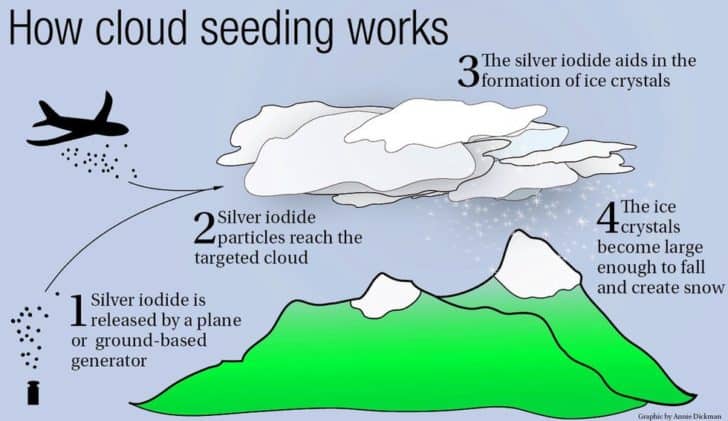
3.    Spraying silver iodide or similar crystals into a cold cloud, either from the ground or over the cloud from an airplane
Regardless, the types of clouds play a vital role in ensuring the process is successful.
Large droplets are required if rain is expected to form, meaning maritime clouds are a better source of rain than continental clouds.
The temperature of the cloud is also important.
For instance, cumulus and stratiform clouds, whose temperature is below -7°C, would be accompanied by precipitation within 25 minutes.
Types of Cloud Seeding
1. Static Cloud seeding
This first of three methods work when a chemical compound is spread onto the clouds.
It is the most commonly used method and involves the spraying of particles of salt, like silver iodide and chloride onto clouds.
Silver iodide (AgI) exists in the environment naturally and is not harmful to humans or wildlife.
To do so, a special aircraft, rocket, or other dispersion device is used.
The salt particles act as a condensation nucleus, drawing water vapor within the cloud towards them.
Moisture will then latch onto them, condensing into water droplets. Subsequently, raindrops form, leading to rainfall.
2. Dynamic Cloud Seeding
This second type of seeding works by boosting the vertical air currents, encouraging more water to pass through the clouds.
It, therefore, translates to more rain.
For it to work, about 100 times more ice crystals are required as compared to the static cloud seeding method.
It is a more complex method as it relies on a sequence of events working properly.
Scientists within the atmospheric science departments as well as other researchers have broken the dynamic cloud seeding method into eleven separate stages.
If one of the stages fails or its outcome is unexpected, the entire process is ruined.
It also makes the technique less dependent as compared to the static cloud seeding method.
3. Hygroscopic Cloud Seeding
This last type utilizes the dispersal of salts through flares or explosives onto the lower parts of a cloud.
The salt will become bigger and water will join it.
It is a relatively new method that has been described as ‘promising.’ It, however, requires more research.
Negative Effects of Cloud Seeding
1. The process is not 100% effective
Despite the process being touted as highly successful in creating rain, it has raised concerns as to its actual effectiveness.
The main question that arises is, would rain have come in a certain place even without the need for the seeding?
Cloud seeding becomes irrelevant if it would have rained regardless of it being used.
It becomes difficult to ascertain if fluctuations in the level of rainfall, occurring during cloud seeding times, are produced by seeding or could have occurred naturally.
2. The process is very expensive
It is an innovative way of creating rainfall, especially in arid areas. However, it is an expensive process.
In China, for instance, the country uses between $60 and $90 million every year on such weather modification projects.
Between 1995 and 2003, the country used $266 million for the same causes.
As already mentioned, the UAE spent about $5 million in 2015 for its Research Program for Rain Enhancement Science.
Such monies could be used to fund other projects, given that it will inevitably rain.
Also, if the aim is to bring rain to areas severely affected by climate change, wouldn’t it be easier to tackle global warming and climate change, as it would bring a long-lasting solution?
3. The truth about silver iodide is that it may potentially contain dangerous substances
Despite silver iodide being termed as safe for the environment, there remain concerns about exposure to the same, especially with regards to soil contamination.
Silver iodide has been known to result in incapacitation and possible residual injuries to humans and other animals, especially after chronic exposure.
The toxicity of silver and its compounds in the environment might be low, but they are negative effects nonetheless.
4. Cloud seeding is not the end solution; it may actually worsen global warming and climate change
It has been argued that cloud seeding is just a way of sweeping the effects of pollution and climate change under the rug.
Using cloud seeding to bring rainfall does not negate the fact that climate change exists and the process does nothing to fix the initial problem, which is global warming and climate change.
Since the process is expensive, it would be easier to fix the bigger problem and enjoy the long-term benefits of a better climate.
5. The results might be damaging – more or less rain!
The end results of cloud seeding are either having no rain, like during the 2008 Beijing Olympics or having more rain, especially in dry areas.
However, sometimes, the results have been damaging.
In 1974, a hurricane on the US East Coast was seeded using dry ice.
The hurricane did not hit the area but moved to the west in Georgia. It caused severe damage, leading to General Electric Corporation being sued.
Operation Cumulus was as well an alleged to be series of secret scientific experiments being conducted in the UK between August 4th and 15th What followed were flash floods in Devon village in Lynmouth, England, killing 35 people.
6. Cloud seeding can be used for destructive purposes
According to Brown (2018), only 56 countries practiced cloud seeding activities in 2016.
This means the possibility of more powerful countries using the process to attack other countries.
For instance, the US used cloud seeding to cause a monsoon in Ho Chi Minh, Vietnam, during the Vietnam War, as a tactic against the Vietnamese soldiers.

Rinkesh. A true environmentalist by heart ❤️. Founded Conserve Energy Future with the sole motto of providing helpful information related to our rapidly depleting environment. Unless you strongly believe in Elon Musk‘s idea of making Mars as another habitable planet, do remember that there really is no 'Planet B' in this whole universe.

Sunday, August 11, 2019

CLOUD SEEDING - Can China control the weather? - With a population of more than 1.3 billion, China requires vast amounts of water. The government practices cloud seeding to try to produce rain for farmers, stave off drought, clear away air pollution and smog, fill water basins and, of course, produce a picture-perfect opening Olympic ceremony. Northern China, where Beijing is located, doesn't receive much rain -- its rainfall levels are 35 percent below the world average, and some of its water supplies are significantly polluted. The area relies heavily on cloud seeding. Cloud seeding also has been used to cool Beijing on hot days.

Staff members from Beijing's Xiangshan Weather Modification Practice Base stand next to a two-pipe cannon used for rain reduction and cloud dispersion.
.........................................................................................................................................................
 Controlling The Weather
Downpours didn't snuff out the torch during the opening ceremony of Beijing's 2008 Olympic Games. Was it a matter of good luck or even better science? See more ­weather pictures.Can China control the weather?
BY JACOB SILVERMAN & ROBERT LAMB


In the­ lead-up to the 2008 Summer Olympics, the People's Republic of China garnered a lot of press for all its housecleaning efforts.
The country made strides toward cleaning up pollution, revamping public transportation and generally tidying up the city of Beijing.
After all, the event promised to be the biggest party of the year, with the entire world invited to tune in.
Authorities deterred potential party crashers by making it harder to visit the city and, yes, even requiring the visiting Luchadores to carry permits for their trademark Mexican wrestling masks.
If you've ever thrown a party, you too may have fretted over every detail concerning the evening.
Will the guests think you're cheap if you don't use the good china? Will your kids be on their best behavior, or should you banish them to their rooms?
Chinese officials faced similar worries heading into the summer games, only they took their micro planning to unheard of levels.
See, the Aug. 8 opening ceremony happened to fall during a traditionally wet season for Beijing. To avoid any crimp in their plans, they decided to shoot down any cloud that looked as though it might try to enter the city uninvited.
That may sound extreme, but Chinese authorities didn't become such meteorological control freaks overnight. Chinese research into weather control dates back to 1958.
Forty years later, the government-run Weather Modification Program launches thousands of specially designed rockets and artillery shells into the sky every year in an attempt to manipulate weather conditions.
Run by the Weather Modification Department, a division of the Chinese Academy of Meteorological Sciences, the program employs and trains 32,000 to 35,000 people across China, some of them farmers, who are paid to handle anti-aircraft guns and rocket launchers [source: Aiyar].
These heavy-duty weapons launch pellets containin­g silver iodide into clouds. Silver iodide is thought to concentrate moisture and cause rain, a process known as cloud seeding.
China has invested heavily in this technology, using more than 12,000 anti-aircraft guns and rocket launchers in addition to about 30 planes [source: Aiyar].
With a population of more than 1.3 billion, China requires vast amounts of water.
The government practices cloud seeding to try to produce rain for farmers, stave off drought, clear away air pollution and smog, fill water basins and, of course, produce a picture-perfect opening Olympic ceremony.
Were Chinese authorities successful in keeping their atmospheric gatecrashers at bay? And how does cloud seeding actually work? Read on to find out.
Cloud Seeding Methods
The Beijing Weather Modification Office spent a lot of time researching how to prevent rain in the city during the Aug. 8 opening ceremony of the 2008 Summer Olympics.
The government even guaranteed clear skies for the event -- a promise it managed to deliver on. The feat only took the launch of 1,104 rain dispersal rockets from 21 sites in the city to pull off [source: O'Neill].
Even in areas with very low humidity, there's at least some water in the sky and clouds.
A rainstorm happens after moisture collects around naturally occurring particles in the air, causing the air to reach a level of saturation at which point it can no longer hold in that moisture.
Cloud seeding essentially helps that process along, providing additional "nuclei" around which water condenses.
These nuclei can be salts, calcium chloride, dry ice or silver iodide, which the Chinese use. Silver iodide is effective because its form is similar to ice crystals. Calcium chloride is often used in warm or tropical areas.
Northern China, where Beijing is located, doesn't receive much rain -- its rainfall levels are 35 percent below the world average, and some of its water supplies are significantly polluted.
The area relies heavily on cloud seeding. Zhiang Qiang, who runs the Beijing Weather Modification Office, told the Asia Times that water levels in Beijing's water basins have increased up to 13 percent due to cloud seeding [source: Aiyar].
Cloud seeding also has been used to cool Beijing on hot days.
There are three cloud seeding methods: static, dynamic and hygroscopic.
·       Static cloud seeding involves spreading a chemical like silver iodide into clouds. The silver iodide provides a crystal around which moisture can condense. The moisture is already present in the clouds, but silver iodide essentially makes rain clouds more effective at dispensing their water.
·       Dynamic cloud seeding aims to boost vertical air currents, which encourages more water to pass through the clouds, translating into more rain [source: Cotton].
Up to 100 times more ice crystals are used in dynamic cloud seeding than in the static method. The process is considered more complex than static clouding seeding because it depends on a sequence of events working properly.
Dr. William R. Cotton, a professor of atmospheric science at Colorado State University, and other researchers break down dynamic cloud seeding into 11 separate stages.
An unexpected outcome in one stage could ruin the entire process, making the technique less dependable than static cloud seeding.
       Hygroscopic cloud seeding disperses salts through flares or explosives in the lower portions of clouds. The salts grow in size as water joins with them. In his report on cloud seeding, Cotton says that hygroscopic cloud seeding holds much promise, but requires further research.
China has a reputation for launching ambitious projects, from the Great Wall in ancient times­ to the highest railroad in the world, connecting Qinghai to Tibet.
But is the investment in cloud seeding worth it, and can the government really make it rain whenever it sees the need?
Cloud Seeding Critics and Converts
Chinese athletes won 51 gold medals in the 2008 summer games -- the most of any participating nation [source: NBC].
The Beijing Weather Modification Office celebrated another key victory: the opening ceremony's defeat of its dreaded adversary, the storm cloud.
The ceremony went by without a drop, the temperature never rose above 83 degrees Fahrenheit (29 degrees Celsius) and most of the day passed with no more than a few scattered clouds. Impressed? Well, not everybody's sold on cloud seeding.
The United States began weather control research in 1946. Currently, some states use cloud-seeding programs in an attempt to increase precipitation levels or prevent crop-damaging hail.
An eight-year experiment in Texas and Oklahoma, conducted over 5,000 square miles (12,950 square kilometers), showed that cloud seeding increased rainfall, cloud height, length of storms and the area in which rain fell [source: Eckhardt].
Even so, enthusiasm for cloud seeding in the U.S. has dried up since the early 1970s, when federal funding was about $19 million a year [source: Cotton, Engber].
Now states have to kick in the dough if they want to try ruling the skies.
Internationally, Russia, Israel, Thailand, South Africa and Caribbean nations have all tried their hand at cloud seeding, with mixed results.
Australian scientists­ conducted numerous experiments, discovering that static seeding didn't appear to be effective over Australia's plains but was very effective over Tasmania.
Despite some successful tests, cloud seeding still has many problems. The fundamental concern is: Does it work?
It may be a chicken-and-egg conundrum -- would it have rained in a given area without the use of cloud seeding, and would it have rained less?
Cloud seeding also depends heavily on environmental conditions like temperature and cloud composition.
In 2003, the United States National Academy of Sciences declared that 30 years of studies had not produced "­convincing" evidence that weather modification works [source: Associated Press].
On the other hand, the American Meteorological Society claims that some studies on cloud seeding show a 10 percent increase in rain volume [source: Eckhardt].
Cloud seeding is quite expensive, though potentially cheaper than other projects, like diverting rivers, building new canals or improving irrigation systems.
Then again, the allure of cloud seeding may redirect attention and funding from other projects that could be more promising.
Then there are questions about altering weather. Are some areas taking moisture out of the air that would have fallen as rain in another region?
And if regions are experiencing drought due to climate change, isn't effort better spent tackling the causes of global warming?
Despite reassurances from cloud-seeding companies, concerns also remain about expo­sure to silver iodide toxicity and soil contamination.
Other safety issues are more transparent. In China, wayward munitions have damaged property and even killed one person in May 2006.
The Chinese government contends that it has improved training, licensing and safety practices. In the end, cloud seeding has strong supporters, but it remains controversial.
Scientists may not be sure if cloud seeding actually works, but despite the skepticism, China is moving forward.
The nation spends $60 to $90 million a year on weather modification, in addition to the $266 million spent from 1995 to 2003 [source: Things Asian].
The government plans to produce 1.7 trillion cubic feet (50 billion cubic meters) of rain a year through the practice [source: Aiyar].
Is cloud seeding just a way of sweeping pollution and climate change under the rug and playing God to ensure you don't have to schedule a rain date? Or is it merely a matter of tweaking weather to your advantage?
However you look at it, it's not likely to go away any time soon. In fact, scientists have already proposed building fleets of massive, unmanned ships to seed clouds over Earth's oceans to provide a cooling counter to carbon dioxide-induced global warming [source: Cartlidge].
If cloud seeding is ultimately a way to "fake it" when guests come to visit or crops need a sprinkle, do we really want a world where we have to manually adjust the planet's atmosphere just to stave off environmental disaster?

About Robert Lamb
As a child, Robert Lamb dreamed of becoming a mad scientist when he grew up. As this profession proved to be largely fictional, however, he swallowed his heartbreak and turned his attention to the written word instead. He earned his bachelor's degree in creative writing from the University of Tennessee in Knoxville, which launched him on a career path through high school English classrooms, small-town newsrooms and finally into the offices of HowStuffWorks.
As a senior writer and podcaster for Stuff to Blow Your Mind, Robert now spends his days sifting through all the scientific wonders that make the world so mad and amazing. He currently lives in Atlanta with his lovely wife and their beautiful one-eyed cat. When he's not researching the apocalypse or the miracle we call a space toilet, he enjoys listening to electronic music, painting the odd miniature and writing fiction.


Staff members from Beijing's Xiangshan Weather Modification Practice Base stand next to a two-pipe cannon used for rain reduction and cloud dispersion.

Staff members from Beijing's Xiangshan Weather Modification Practice Base stand next to a two-pipe cannon used for rain reduction and cloud dispersion.
A staff member from Beijing's Xiangshan Weather Modification Practice Base equips a two-pipe cannon used for rain reduction and cloud dispersion with projectiles.

Downpours didn't snuff out the torch during the opening ceremony of Beijing's 2008 Olympic Games. Was it a matter of good luck or even better science? See more ­weather pictures.
Downpours didn't snuff out the torch during the opening ceremony of Beijing's 2008 Olympic Games. Was it a matter of good luck or even better science?