Showing posts with label Piezoelectricity. Show all posts

Friday, December 18, 2020

PIEZOELECTRIC EFFECT - Piezoelectricity was discovered by two French scientists’ brothers, Jacques and Pierre Curie, in 1880. They found out about piezoelectricity after first realizing that pressure applied to quartz or even some certain crystals creates an electrical charge in that certain material. They later referred to that strange and scientific phenomenon as the piezoelectric effect. The Curie brothers soon discovered the inverse piezoelectric effect. It was after they verified that when an electric field was enforced onto crystal leads, it led to the malformation or disorder to the crystal lead — now called the inverse piezoelectric effect. The term piezoelectricity comes from the Greek word piezo meaning to squeeze or press. Amber also happened to be a source of electrical charge. Many electronic devices today use piezoelectricity. For example, when you use some type of voice-recognition software, or even Siri on your smartphone, the microphone that you’re speaking into is probably using piezoelectricity. That piezo crystal turns the sound energy in your voice, and changes it into electrical signals for your computer or your phone to interpret. That all becomes possible with piezoelectricity. The creation of various more-advanced technologies can be traced to discovery of piezoelectricity. For example, the powerful sonar “sonobuoy” small sensitive microphones, and the ceramic audio tone transducer, were made possible by piezoelectricity. Today we’re seeing the development of ever-more piezoelectric materials and devices. Compressing a piezoelectric material produces electricity. The piezoelectric effect occurs through compression of a piezoelectric material.

..........................................................................................................................................................................................................................................................................................................

Piezoelectric Effect

What is the Piezoelectric Effect?

This basics-of-design-type of article traces the beginnings of piezoelectricity, and how different materials have advanced its effect on today's electronics.

Carmen Emily Yang

Electronic Design


Piezoelectricity was discovered by two French scientists’ brothers, Jacques and Pierre Curie, in 1880.

They found out about piezoelectricity after first realizing that pressure applied to quartz or even some certain crystals creates an electrical charge in that certain material.

They later referred to that strange and scientific phenomenon as the piezoelectric effect. 

The Curie brothers soon discovered the inverse piezoelectric effect.

It was after they verified that when an electric field was enforced onto crystal leads, it led to the malformation or disorder to the crystal lead — now called the inverse piezoelectric effect.

The term piezoelectricity comes from the Greek word piezo meaning to squeeze or press.

Interestingly, electric in Greek means amber. Amber also happened to be a source of electrical charge.

Many electronic devices today use piezoelectricity.

For example, when you use some type of voice-recognition software, or even Siri on your smartphone, the microphone that you’re speaking into is probably using piezoelectricity.

That piezo crystal turns the sound energy in your voice, and changes it into electrical signals for your computer or your phone to interpret. That all becomes possible with piezoelectricity.

The creation of various more-advanced technologies can be traced to discovery of piezoelectricity.

For example, the powerful sonar “sonobuoy” small sensitive microphones, and the ceramic audio tone transducer, were made possible by piezoelectricity.

Today we’re seeing the development of ever-more piezoelectric materials and devices.

Direct Piezoelectric Effect 

As stated, compressing a piezoelectric material produces electricity (piezoelectricity). Figure 1 explains the concept.

1. The piezoelectric effect occurs through compression of a piezoelectric material.

Piezoceramic material — non-conductive piezoelectric ceramic or crystal — is placed between the two metal plates.

For piezoelectricity to be generated, it needs that material to be compressed or squeezed. Mechanical stress applied to piezoelectric ceramic material generates electricity.

As shown in Fig. 1, there’s a voltage potential across the material. The two metal plates sandwich the piezo crystal.

The metal plates collect the charges, which creates/produces voltage (lightning bolt symbol), i.e., piezoelectricity.

In this way, the piezoelectric effect acts like a miniature battery, because it produces electricity. This is the direct piezoelectric effect.

Devices that use the direct piezoelectric effect include microphones, pressure sensors, hydrophones, and many other sensing types of devices. 

Inverse Piezoelectric Effect

The piezoelectric effect can be reversed, which is referred to as the inverse piezoelectric effect.

This is created by applying electrical voltage to make a piezoelectric crystal shrink or expand  (Fig. 2).

The inverse piezoelectric effect converts electrical energy to mechanical energy.

2. Reversal of the piezoelectric effect, called the inverse piezoelectric effect, is when voltage is applied to shrink or expand a piezoelectric crystal.

Using the inverse piezoelectric effect can help develop devices that generate and produce acoustic sound waves.

Examples of piezoelectric acoustic devices are speakers (commonly found in handheld devices) or buzzers.

The advantage of having such speakers is that they are very thin, which makes them useful in a range of phones.

Even medical ultrasound and sonar transducers use reverse piezoelectric effect. Non-acoustic inverse piezoelectric devices include motors and actuators.

Piezoelectric Materials

Piezoelectric materials are materials that can produce electricity due to mechanical stress, such as compression. These materials can also deform when voltage (electricity) is applied.

All piezoelectric materials are non-conductive in order for the piezoelectric effect to occur and work. They can be separated into two groups: crystals and ceramics.

Some examples of piezoelectric materials are PZT (also known as lead zirconate titanate), barium titanate, and lithium niobate.

These man-made materials have a more pronounced effect (better material to use) than quartz and other natural piezoelectric materials.

Compare PZT to quartz. PZT can produce more voltage for the same amount of applied mechanical stress.

Conversely, applying voltage to PZT instead of quartz provides more movement. Quartz, a well-known piezoelectric material, is also the first known piezoelectric material.

PZT is created and produced (under high temperatures) with two chemical elements — lead and zirconium — and combined with a chemical compound called titanate.

PZT’s chemical formula is (Pb[Zr(x)Ti(1-x)]O3).

It is commonly used to produce ultrasounds transducers, ceramic capacitors, and other sensors and actuators.

It also evinces a special range of different properties. In 1952, PZT was manufactured by Tokyo Institute of Technology.

Barium titanate is a ferroelectric ceramic material with piezoelectric properties.

For that reason, barium titanate has been used as a piezoelectric material longer than most others. Its chemical formula is BaTiO3.

Barium titanate was discovered in 1941 during World War II.

Lithium niobate is a compound that combines oxygen, lithium, and niobium. Its chemical formula is LiNbO3.

Also a ferroelectric ceramic material it’s just like barium titanate in that it has piezoelectric properties, too.

Piezoelectric Devices

Sonar

Sonar, which arrived in the 1900s, was invented by Lewis Nixon. He initially developed sonar to help detect icebergs. Interest in sonar rose during World War I, though, to help locate submarines underwater. 

Of course, sonar has many purposes and uses today, from locating fish to underwater navigation and so on.

3. With piezoelectric sonar, a transmitter using the inverse piezoelectric effect sends out a sound wave to search for objects ahead.

In Figure 3, sonar is sending out, via transmitter, a sound wave (signal) to search for objects ahead.

The transmitter uses inverse piezoelectric effect, which is when the transmitter will use voltage to help it send out a sound wave.

Once the sound wave hits an object, it will bounce back. The sound wave that bounces back will be detected by the receiver.

The receiver, unlike the transmitter, uses the direct piezoelectric effect. The receiver piezoelectric device gets compressed by the returning sound wave.

It sends the signal (voltage) to the signal-processing electronics, which will take that bounced-back sound wave and begin processing it.

It will determine the object’s distance by calculating the timing signals from the transmitter and the receiver.

Piezoelectric Actuators

Figure 4 shows the operation of a piezoelectric actuator.

The base stays still and acts like the metal plate that sandwiches the middle piezoelectric material.

Then voltage is applied to the material, which expands and contracts from the applied voltage’s electric field.

The piezo crystal moves very little, whether forward or backward. Once the piezo material or crystal moves, it slowly pushes and pulls the actuator.

4. In a piezoelectric actuator, voltage is applied to the piezoelectric material, causing expansion and contraction.

The piezoelectric actuator has many uses and applications.

For example, knitting machinery and braille machines use these actuators, since they have such a small amount of moving parts and a very simple design.

They can even be found in video cameras and cellular phones, because they are proven most proficient as an auto-focusing mechanism.

Piezoelectric Speakers and Buzzers

Piezoelectric speakers and buzzers use the inverse piezoelectric effect to generate and produce sound.

When voltage is applied to speakers and buzzers, it creates sound waves (Fig. 2, again).

An audio voltage signal applied to the piezoelectric ceramic of speakers or buzzers will cause the material to vibrate the air.

That vibration produces sound waves, which come out of the speaker.

Piezoelectric speakers are commonly used in alarm clocks or other small mechanical devices to generate simple, high-quality audio sounds.

That’s because they are limited to a small amount of frequency response.

Piezo Drivers

Piezo drivers can convert low battery voltage into high voltage to power piezoelectric devices.

Piezo drivers are very important, because they help engineers produce more voltage to create larger sine waves.

5. A piezo driver converts low battery voltage to higher voltage, which is used to power an amplifier that drives the device. An oscillator inputs small sine waves that the amplifier turns into larger sine waves.

Figure 5 is a block diagram that illustrates piezo-driver operation. Piezo drivers will take low battery voltage and use a booster to convert it to higher voltage.

The higher voltage is then used to power the amplifier. The oscillator will input small sine waves, which the amplifier will change into larger voltage sine waves.

The amplifier drives the piezo device.

The table below lists of several different companies that sell and produce various kinds of piezo drivers.

Electronic Design is the premier independent information source for electronics engineers that provide must-have, fully comprehensive coverage of the electronics industry through its vast network of experts. Electronic Design covers the technologies required for engineers to make the right design decisions at the right time – quickly & efficiently.

Our experts cover the full spectrum on products, markets and technologies, from analog and power to embedded and automotive. Every day, we inform and engage engineers and engineering managers with critical content on rapid technological advances and their applications at the component, chip, board, and system levels. We also provide a host of marketing solutions and opportunities to connect with our audience. You can contact us if you would like to contribute content for this site.

https://www.electronicdesign.com/power/what-piezoelectric-effect


You might also like:


Piezoelectric Effect

CLICK HERE . . . to view . . . 

https://puricare.blogspot.com/2019/05/piezoelectric-effect-when-piezoelectric.html

........................................................................................................................................................................................................................................................................................ 

How Piezoelectricity Works 

CLICK HERE . . . to view . . . 

https://puricare.blogspot.com/2019/08/piezoelectricity-piezoelectricity-is.html

........................................................................................................................................................................................................................................................................................
Graphene

Carbon “Miracle Material” 

CLICK HERE . . . to view . . . 

https://puricare.blogspot.com/2019/03/carbon-miracle-material-graphene.html

.........................................................................................................................................................................................................................................................................................

Ghost Lights

CLICK HERE . . . to view . . . 

https://puricare.blogspot.com/2020/06/ghost-lights-sightings-of-mysterious.html

........................................................................................................................................................................................................................................................................................

Gravitational Waves and the Space-Time Continuum

CLICK HERE . . . to view . . . 

https://puricarechronicles.blogspot.com/2020/08/gravitational-waves-and-space-time.html

........................................................................................................................................................................................................................................................................................

Faster Than The Speed of Light 

CLICK HERE . . . to view . . . 

https://puricarechronicles.blogspot.com/2020/07/faster-than-speed-of-light-if-we-can.html

Saturday, August 31, 2019

PIEZOELECTRICITY - Piezoelectricity is the process of using crystals to convert mechanical energy into electrical energy, or vice versa. Regular crystals are defined by their organized and repeating structure of atoms that are held together by bonds - this is called a unit cell. Most crystals, such as iron have a symmetrical unit cell, which makes them useless for piezoelectric purposes. There are other crystals that get lumped together as piezoelectric materials. The structure in these crystals aren’t symmetrical but they still exist in an electrically neutral balance. However, if you apply mechanical pressure to a piezoelectric crystal, the structure deforms, atoms get pushed around, and suddenly you have a crystal that can conduct an electrical current. If you take the same piezoelectric crystal and apply an electric current to it, the crystal will expand and contract, converting electrical energy into mechanical energy.

piezoelectric-effect
...................................................................................................................................................
Piezoelectricity
Quartz-crystal
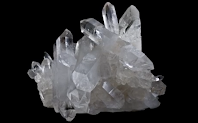
Quartz crystal.
How Piezoelectricity Works
Cesca Fleischer


Feel the Squeeze: How Piezoelectricity Works to Make Crystals Conduct Electric Current
Piezo what? It sounds like a lot to take in, but it’s simple to understand.
The word piezoelectric originates from the Greek word piezein, which literally means to squeeze or press.
Instead of squeezing grapes to make wine, we’re squeezing crystals to make an electric current!
Piezoelectricity is found in a ton of everyday electronic devices, from quartz watches to speakers and microphones.
In a nutshell:
Piezoelectricity is the process of using crystals to convert mechanical energy into electrical energy, or vice versa.
Regular crystals are defined by their organized and repeating structure of atoms that are held together by bonds - this is called a unit cell.
Most crystals, such as iron have a symmetrical unit cell, which makes them useless for piezoelectric purposes.
There are other crystals that get lumped together as piezoelectric materials.
The structure in these crystals aren’t symmetrical but they still exist in an electrically neutral balance.
However, if you apply mechanical pressure to a piezoelectric crystal, the structure deforms, atoms get pushed around, and suddenly you have a crystal that can conduct an electrical current.
If you take the same piezoelectric crystal and apply an electric current to it, the crystal will expand and contract, converting electrical energy into mechanical energy.
Types of Piezoelectric Materials
There are a variety of piezoelectric materials that can conduct an electric current, both man-made and natural.
The most well-known, and the first piezoelectric material used in electronic devices is the quartz crystal.
Other naturally occurring piezoelectric materials include cane sugar, Rochelle salt, topaz, tourmaline, and even bone.
As piezoelectric technology started to take off after World War I we began developing man-made materials to rival the performance of quartz.
Man-made piezoelectric materials include:
PZT is made from lead zirconate titanate and can produce more voltage than quartz with the same amount of mechanical pressure.
Barium Titanate is a ceramic piezoelectric material that was discovered during World War II and is known for its long-lasting durability.
Lithium Niobate is a material that combines oxygen, lithium, and nobium together in a ceramic material that performs similar to barium titanate.
How Piezoelectricity Works
We have specific materials that are suited for piezoelectricity applications, but how exactly does the process work? With the Piezoelectric Effect.
The most unique trait of this effect is that it works two ways. You can apply mechanical energy or electrical energy to the same piezoelectric material and get an opposite result.
Applying mechanical energy to a crystal is called a direct piezoelectric effect and works like this:
1.      A piezoelectric crystal is placed between two metal plates. At this point the material is in perfect balance and does not conduct an electric current.
2.      Mechanical pressure is then applied to the material by the metal plates, which forces the electric charges within the crystal out of balance. Excess negative and positive charges appear on opposite sides of the crystal face.
3.      The metal plate collects these charges, which can be used to produce a voltage and send an electrical current through a circuit.
That’s it, a simple application of mechanical pressure, the squeezing of a crystal and suddenly you have an electric current.
You can also do the opposite, applying an electrical signal to a material as an inverse piezoelectric effect. 
It works like this:
1.      In the same situation as the example above, we have a piezoelectric crystal placed between two metal plates. The crystal’s structure is in perfect balance.
2.      Electrical energy is then applied to the crystal, which shrinks and expands the crystal’s structure.
3.      As the crystal’s structure expands and contracts, it converts the received electrical energy and releases mechanical energy in the form of a sound wave.
The inverse piezoelectric effect is used in a variety of applications. Take a speaker for example, which applies a voltage to a piezoelectric ceramic, causing the material to vibrate the air as sound waves.
The Discovery of Piezoelectricity
Piezoelectricity was first discovered in 1880 by two brothers and French scientists, Jacques and Pierre Curie.
While experimenting with a variety of crystals, they discovered that applying mechanical pressure to specific crystals like quartz released an electrical charge. They called this the piezoelectric effect.
The next 30 years saw Piezoelectricity reserved largely for laboratory experiments and further refinement.
It wasn’t until World War I when piezoelectricity was used for practical applications in sonar.
Sonar works by connecting a voltage to a piezoelectric transmitter. This is the inverse piezoelectric effect in action, which converts electrical energy into mechanical sound waves.
The sound waves travel through the water until they hit an object. They then return back to a source receiver.
This receiver uses the direct piezoelectric effect to convert sound waves into an electrical voltage, which can then be processed by a signal processing device.
Using the time between when the signal left and when it returned, an object’s distance can easily be calculated underwater.
With sonar a success, piezoelectricity gained the eager eyes of the military. World War II advanced the technology even further as researchers from the United States, Russia, and Japan worked to craft new man-made piezoelectric materials called ferroelectrics.
This research led to two man-made materials that are used alongside natural quartz crystal, barium titanate and lead zirconate titanate.
Piezoelectricity Today
In today’s world of electronics piezoelectricity is used everywhere.
Asking Google for directions to a new restaurant uses piezoelectricity in the microphone.
There’s even a subway in Tokyo that uses the power of human footsteps to power piezoelectric structures in the ground.
You’ll find piezoelectricity being used in these electronic applications:
Actuators
Actuators use piezoelectricity to power devices like knitting and braille machinery, video cameras, and smartphones. In this system, a metal plate and an actuator device sandwiched together a piezoelectric material. Voltage is then applied to the piezoelectric material, which expands and contracts it. This movement causes the actuator to move as well.
Speakers & Buzzers
Speakers use piezoelectricity to power devices like alarm clocks and other small mechanical devices that require high quality audio capabilities. These systems take advantage of the inverse piezoelectric effect by converting an audio voltage signal into mechanical energy as sound waves.
Drivers
Drivers convert a low voltage battery into a higher voltage which can then be used to drive a piezo device. This amplification process begins with an oscillator which outputs smaller sine waves. These sine waves are then amplified with a piezo amplifier.
Sensors
Sensors are used in a variety of applications such as microphones, amplified guitars, and medical imaging equipment. A piezoelectric microphone is used in these devices to detect pressure variations in sound waves, which can then be converted to an electrical signal for processing.
Power
One of the simplest applications for piezoelectricity is the electric cigarette lighter. Pressing the button of the lighter releases a spring-loaded hammer into a piezoelectric crystal. This produces an electrical current that crosses a spark gap to heat and ignite gas. This same piezoelectric power system is used in larger gas burners and oven ranges.
Motors
Piezoelectric crystals are perfect for applications that require precise accuracy, such as the movement of a motor. In these devices, the piezoelectric material receives an electric signal, which is then converted into mechanical energy to force a ceramic plate to move.
Piezoelectricity and the Future
What does the future hold for piezoelectricity? The possibilities abound.
One popular idea that inventors are throwing around is using piezoelectricity for energy harvesting.
Imagine having piezoelectric devices in your smartphone that could be activated from the simple movement of your body to keep them charged.
Thinking a bit bigger, you could also embed a piezoelectric system underneath highway pavement that can be activated by the wheels of traveling cars.
This energy could then be used light stoplights and other nearby devices. Couple that with a road filled with electric cars and you’d find yourself in net positive energy situation.
Want to help move piezoelectricity forward into the future? Autodesk EAGLE has a ton of free piezo libraries ready for use in your next project. Try Autodesk EAGLE for free today!

Cesca is a Stanford University graduate, with a Bachelor of Science in Science, Technology, and Society -- interdepartmental major focusing in Product Design, Technology and Organizational Management.
PCB design made easy
Make anything with EAGLE PCB design software. Professional power for every electronics designer.
 piezoelectric


unit-cellpiezoelectric-effect


PZT-piezo-ceramics
PZT piezo ceramics used in ultrasonic sensors.
lithium-niobate
Lithium niobate.
piezoelectric-effect


barium-titanate
Barium Titanate


piezoelectric-effect


pierre-curie
Pierre Curie with his wife Maria in his lab. 


piezoelectric-effectactuatorspeakers-buzzers


piezoelectric-effectsensorspiezo-electric


motors