Showing posts with label Tectonic plates. Show all posts

Saturday, August 8, 2020

EARTHQUAKES - When Nature Strikes - Most people know that earthquakes occur along the San Andreas Fault of California, but few realize that there is an ever greater danger lurking under the Pacific Northwest. A tectonic plate, known as the Juan de Fuca Plate, is expected to move underneath the Pacific Northwest edge of the North American continent, creating a magnitude 9 earthquake. Like the megathrust earthquake that struck Japan in 2011, the expected earthquake could topple buildings, cause the soil to behave like a liquid, and could generate a deadly tsunami. Luckily, megathrust earthquakes are infrequent. However, no one knows when the next one will strike. At plate boundaries, such as the boundary between the Juan de Fuca Plate and the North American Plate, plates are locked together by friction. Tectonic forces act upon the plates, adding stress that will eventually overcome the friction. As a result, the plates will finally move, releasing energy in the form of earthquake waves. By studying the tectonic forces, the history of faults and the kinds of rocks involved, scientists are searching for a way to predict when earthquakes will occur and to issue warnings. John Vidale and his team at the Pacific Northwest Seismic Network is carefully monitoring ground motion and is helping the states of Washington and Oregon to protect citizens from the effects of a devastating magnitude 9 earthquake.

Convergent Plate Boundaries—Subduction Zones - Geology (U.S. ...
..............................................................................................................................................................
When Nature Strikes
THE BIG ONE: UNDERSTANDING WHY THE BIG EARTHQUAKE IS PREDICTED FOR ...
Earthquakes
.
.
Fear of Juan de Fuca megathrust earthquakeLike the megathrust earthquake that struck Japan in 2011, the expected magnitude 9 earthquake could topple buildings, cause the soil to behave like a liquid, and could generate a deadly tsunami. Tectonic forces act upon the plates, adding stress that will eventually overcome the friction. As a result, the plates will finally move, releasing energy in the form of earthquake waves - no one knows when the next one will strike
Windows to the Universe 


Most people know that earthquakes occur along the San Andreas Fault of California, but few realize that there is an ever greater danger lurking under the Pacific Northwest.
A tectonic plate, known as the Juan de Fuca Plate, is expected to move underneath the Pacific Northwest edge of the North American continent, creating a magnitude 9 earthquake.
Like the megathrust earthquake that struck Japan in 2011, the expected earthquake could topple buildings, cause the soil to behave like a liquid, and could generate a deadly tsunami.
Juan de Fuca plate is making moves | Sequim GazetteLuckily, megathrust earthquakes are infrequent. However, no one knows when the next one will strike.
At plate boundaries, such as the boundary between the Juan de Fuca Plate and the North American Plate, plates are locked together by friction.
Tectonic forces act upon the plates, adding stress that will eventually overcome the friction.
As a result, the plates will finally move, releasing energy in the form of earthquake waves.
By studying the tectonic forces, the history of faults and the kinds of rocks involved, scientists are searching for a way to predict when earthquakes will occur and to issue warnings.
John Vidale and his team at the Pacific Northwest Seismic Network is carefully monitoring ground motion and is helping the states of Washington and Oregon to protect citizens from the effects of a devastating magnitude 9 earthquake.

"When Nature Strikes" is produced by NBC Learn in partnership with the National Science Foundation.
The Windows to the Universe website is a richly interlinked ecosystem for learning about the Earth and Space sciences for use by the general public, students, and teachers. Windows to the Universe has been in development since 1995. The project started, with support from NASA for a proposal submitted by Dr. Roberta Johnson, Director of Windows to the Universe, to NASA while she was on the Research Faculty at the University of Michigan's Department of Atmospheric, Oceanic, and Space Sciences. In 2000, Dr. Johnson moved with the project to the University Corporation for Atmospheric Research (UCAR), where she continued development on the project with the Windows to the Universe team on numerous grants and contracts over the past decade. In 2010, website management and ownership moved to the National Earth Science Teachers Association, where we will be expanding opportunities to collaborate with the project - with the hope that it becomes a platform for Earth and space science education globally.
Tomography reveals buoyant asthenosphere accumulating beneath the ...

Monday, July 27, 2020

HOW GEYSERS WORK - Geysers like Old Faithful create eruptions of this scale every day, to the delight of the millions of visitors who witness them each year. Yet, despite the unbelievable forces that drive their eruptions, geysers are among the rarest and most fragile natural phenomena on Earth. Landslides, earthquakes and many other factors can alter a geyser's eruptions or destroy the geyser altogether. There are only about a thousand geysers left active on the planet, in geyser fields in such diverse locales as Iceland, New Zealand, Chile and the U.S. The one thing all of these locations have in common with one another is a high level of geothermal activity, one of the key components of geyser formations. Geothermal energy, which is taken from heat within the Earth, drives volcanoes, hot springs and other forms of geothermal activity. Still, a geothermal energy source is just one necessary part of a typical geyser formation. In this article, we'll explore what else it takes to form a geyser, what exactly causes one to erupt and what makes some geysers so unique. Along the way, we'll also take a look at some springs that look and act like geysers, but operate in a completely different way. In addition to a heat source, geysers need a constant supply of water and an underground plumbing system that holds the water supply as it heats up. A geyser needs a water supply. What might not be so apparent is where the water in a geyser's eruption comes from. Many geysers are located near rivers and pull water from them. Others seem to depend more on rain and snow filtering miles beneath the ground for their water supply.

BBC - Travel - Five days in Russia's Ring of Fire
...............................................................................................................................................
USA: Yellowstone National Park - Geysers, hot springs and ...How Geysers Work
BY JONATHAN ATTEBERRY


Imagine taking all of the water from your neighborhood swimming pool, pouring it into a massive, magma-powered pressure cooker and shooting the water hundreds of feet in the air. 
Old Faithful may be the world's most well-known geyser.
Geysers like Old Faithful create eruptions of this scale every day, to the delight of the millions of visitors who witness them each year.
Yet, despite the unbelievable forces that drive their eruptions, geysers are among the rarest and most fragile natural phenomena on Earth. 
Landslides, earthquakes and many other factors can alter a geyser's eruptions or destroy the geyser altogether.
What's more, nature isn't the only thing that can impact a geyser: Man has helped to destroy numerous geysers as well, sometimes unintentionally and sometimes through deliberate acts of vandalism.
As of 2009, there are only about a thousand geysers left active on the planet, in geyser fields in such diverse locales as Iceland, New Zealand, Chile and the U.S.
The one thing all of these locations have in common with one another is a high level of geothermal activity, one of the key components of geyser formations. 
Geothermal energy, which is taken from heat within the Earth, drives volcanoes, hot springs and other forms of geothermal activity.
Still, a geothermal energy source is just one necessary part of a typical geyser formation.
In this article, we'll explore what else it takes to form a geyser, what exactly causes one to erupt and what makes some geysers so unique.
Along the way, we'll also take a look at some springs that look and act like geysers, but operate in a completely different way.
How Geysers Form and Erupt
Wildlife & Geysers: Yellowstone With Your Younger Grandchild ...In addition to a heat source, geysers need a constant supply of water and an underground plumbing system that holds the water supply as it heats up.
We'll examine each of these separately and then explore how they work together to cause geysers to erupt.
·      Water supply: Clearly, a geyser needs a water supply. What might not be so apparent, however, is where the water in a geyser's eruption comes from.
The answer depends on the geyser. Many geysers are located near rivers and pull water from them.
Others seem to depend more on rain and snow filtering miles beneath the ground for their water supply.
·      Plumbing system: A geyser's plumbing system is a series of fissures in the Earth that start at the geyser's mouth and run miles beneath the Earth's surface, where the system connects to the geyser's heat source.
Each geyser's plumbing system is different: Some consist of a single long, vertical shaft, while others connect to large pockets of water beneath the surface.
Certain types of soil are much more suitable for the plumbing system's formation, particularly soils that contain a high concentration of rhyolite, a volcanic rock that contains minerals that seal the geyser's plumbing system.
This mineral lining is crucial to the geyser's formation, as geysers operate under tremendous pressure and the plumbing system must be able to contain this pressure for the geyser to function.
·      Heat source: We already know that geysers occur in areas of high geothermal activity, but where does that energy come from?
The water in geysers is heated by magma that lies around 3 miles (4.8 kilometers) beneath the surface of the Earth.
While that might seem like a long way down, magma underneath a geyser field is actually relatively close to the Earth's surface.
There are different reasons why the magma is so close to the Earth's surface, though many geyser fields are located on the edges of the Earth's tectonic plates.
These plates, which compose the Earth's lithosphere, are constantly in motion, creating faults and generating tremendous energy.
This activity can cause earthquakes and volcanoes, and it can also create heat sources for geysers.
In the next section, we'll learn why the boiling point of water is so critical to understanding how a geyser erupts.
How Do Geysers Erupt?
Now that we understand how the key components of a geyser work, let's figure out how these parts work together to create such spectacular eruptions.
Plant – Human Interaction Courses – Green Life SciencesThe process begins as water migrates to the geyser's plumbing system through fissures in ground.
Since the plumbing system is miles deep, the water at the bottom of the geyser's plumbing is under incredible pressure from the water above it. Think of the entire system as a giant pressure cooker.
Pressure cookers work by creating a sealed, pressurized enclosure that helps to cook food much faster than cooking it in a normal pot.
Pressure cookers can do this because water's boiling point rises as it's pressurized. Think of what actually happens when water boils: Water starts to churn and bubbles of air begin to surface.
If more pressure pushes down on the water, water needs more and more energy (in the form of heat) to overcome that pressure and start pushing bubbles to the surface.
This explains why water inside a pressure cooker can reach temperatures of more than 125 degrees Celsius (257 degrees Fahrenheit), while the boiling point of water at standard pressure is only 100 degrees Celsius (212 degrees Fahrenheit).
Now consider the massive pressures placed on water within a geyser's plumbing system.
Water in such a system can reach incredibly high temperatures (and store incredible amounts of energy as a result) before it starts to boil.
As the magma at the base of the geyser transfers heat throughout the system, more energy gets trapped in the water. Eventually, pockets of water begin to reach their boiling point and become turbulent.
This turbulence pushes a relatively small quantity of water out of the opening of the geyser, decreasing the amount of pressure on the water remaining in the geyser.
With this sudden pressure drop (and corresponding drop in boiling point), the water in the geyser flashes into steam.
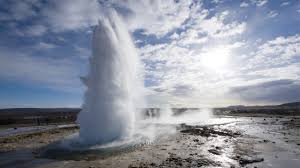
6 Incredible Stress-Reducing Life Hacks That Work Best If You Have ...The steam quickly expands to 1,500 times the volume of water and this expansion violently pushes water and steam from the mouth of the geyser in an eruption.
These eruptions last as long as the water in the geyser remains hot enough to push water out of the geyser opening.
Eventually, the entire system will either run out of water or the water will cool down enough for the eruption to stop. The cycle, of course, starts all over again.
COLD GEYSERS
While most geysers are hot enough to scald you, so-called cold-water geysers are a different story.
These geysers, such as Crystal Geyser in Utah and Brubbel Geyser in Germany, are driven by carbon dioxide-rich water trapped beneath the surface of the Earth.
Similar to how heat-driven geysers work, when pressure on a cold-water geyser decreases, the carbon dioxide bubbles in the water expand and push water out of the geyser in an eruption.
Exploring the World's Most Famous Geysers
While every geyser operates in fundamentally the same way, all geysers are not created equal. In this section, we'll explore some of the world's most famous geysers and what makes them stand out above the rest.
·      Geysir: This geyser, located in Iceland's Haukadalur valley, was first discovered in 1294, making the Geysir the oldest known geyser on the planet. Geysir's activity slowed toward the end of the 19th century and it became dormant around 1915.
In 1935, however, an earthquake reactivated the geyser, which currently erupts about every eight to 10 hours. Geysir remains a major tourist attraction to this day.
·      Old Faithful: Probably the most famous geyser on Earth, Old Faithful is famous for its 100- to 180-foot (30 to 55 meter) high eruptions, as well as for the regularity with which these eruptions occur (hence the name).
The geyser takes about 45 to 110 minutes between eruptions, though more recently, its eruptions have tended to be larger and consequently farther apart as more water is needed to replenish the geyser.
Old Faithful is also a great example of a cone geyser.
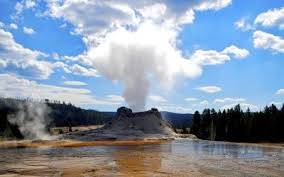
Unlike fountain geysers, which erupt from a pool of water, cone geysers erupt from a cone shaped structure formed from the mineral-rich water that constantly shoots from its opening.
·      Grand Geyser: The tallest regularly erupting geyser on Earth, Grand Geyser routinely fires water up to 200 feet (61 meters) into the air.
Located in Yellowstone National Park, Grand Geyser is a great example of a fountain geyser.
Unlike cone geysers, which tend to produce a fairly vertical, constant column of water, fountain geysers erupt in a much more chaotic fashion.
·      Strokkur Geyser: This geyser, named after the Icelandic verb "to churn," is known for its frequent eruptions, which occur five to 10 minutes apart.
First active in 1789, Strokkur became inactive in 1896 after an earthquake hit the area and blocked its plumbing system.
In 1963, locals cleared the blockage and the geyser has remained active ever since.
·      Steamboat Geyser: Don't bother waiting for one of Steamboat's massive eruptions.
While Steamboat is considered to be the world's tallest active geyser, shooting water up to 300 feet (91 meters) in the air, the geyser is also notoriously finicky.
At one point, the geyser went 50 years without an eruption.
·      Waimangu Geyser: The highest geyser eruption of all time took place at New Zealand's Waimangu Valley.
In 1902, a geyser in the valley reportedly spouted water 1,475 feet (450 meters) in the air.
Unfortunately, the geyser became inactive after a landslide in 1904, putting a premature end to a truly spectacular sight.
WHAT'S WITH THE NAME?
You probably don't have to stretch your imagination to figure out how geothermal features like hot springs and mud pools get their names.
The origin of the word "geyser," on the other hand, is a bit more mysterious.
The word "geyser" actually relates back to the first geyser ever discovered, Iceland's Geysir. Geysir, discovered in 1294, is fittingly named after the Icelandic verb "to gush" (gjósa).
Human Interaction with Geysers
People should be careful around geysers. In 2001, an erupting geyser in Kuirau Park, New Zealand, damaged trees in the area and splattered the park with mud.
People should be careful around geysers. In 2001, an erupting geyser
in Kuirau Park, New Zealand, damaged trees in the area and splattered
 the park with mud.
Now that we've taken a comprehensive look at how geysers work, we're ready to look at man's past and present interaction with them.
Considering the spectacle of a geyser eruption, it's no surprise that tourism is the most common way that people interact with geysers.
Tourism serves to educate the public both on how geysers work and on what it takes to protect these natural resources.
Parks often take great care to control how tourists interact with geysers, in part because tourists can harm geysers with their trash and debris, but also because geysers are quite capable of harming tourists as well.
In 1903, four tourists visiting New Zealand got caught in a geyser jet in Waimangu Valley. The eruption killed all four people and carried them more than a mile (1.6 kilometers) away from its source.
While such incidents are rare, we should always remain conscious of the amazing forces behind geysers.
Geysers serve as more than tourist attractions, however.
The same geothermal energy that drives geyser activity can also be used to generate power for houses and businesses.
While geothermal energy can provide a clean source of electricity, tapping into that source can sometimes create major consequences for geothermal features in the area by draining the geyser fields of their water or energy.
People have also been known to intentionally destroy geysers through vandalism, throwing trash and debris into a geyser's opening and blocking its plumbing system.
It's somewhat ironic, then, that man has also gone to great lengths to create "artificial" geysers by digging wells that tap into a geothermal heat source.
While that type of geyser has a man-made plumbing system, its eruptions are driven by the same forces that power its natural counterparts.
People have also put a lot of energy into repairing natural geysers, as in the case of Iceland's Strokkur Geyser.
As we understand more about how fragile geysers are, we'll see more measures put in place to protect these natural wonders.

Articles on HowStuffWorks that were written by Planet Green bloggers represent those bloggers' own opinions and viewpoints on subjects related to the environment and conservation. To provide feedback or corrections to these articles, please visit our Contact Us page and select "Planet Green feedback."
Human Impacts on Geyser Basins

Wednesday, August 22, 2018

EARTHQUAKES - Earthquakes are measured by their magnitude. The intensity of an earthquake is measured using a tool called a seismograph. Earthquakes and volcanoes often go hand in hand. The majority of each are located along the Earth's tectonic plates. The Ring of Fire is a horseshoe-shaped area of the Pacific Ocean known for a great deal of volcanic activity and earthquakes. While earthquakes can occur anywhere, approximately 80% of them occur in this area.

Learning About Earthquakes
...............................................................................
Earthquakes
All About Earthquakes
by Beverly Hernandez


What Is an Earthquake?

An earthquake is a natural disaster that is caused by the shift of the ground along the Earth's tectonic plates.
As the plates push and shift against each other, energy is released causing the ground above the plates to tremble and shake.
Although earthquakes can be devastating, they are also fascinating to study from a scientific standpoint.
They're also very eerie to experience.
I've only experienced one small earthquake in my lifetime, but I immediately knew what it was.
If you've ever felt an earthquake, you probably remember the distinct rolling feeling that only an earthquake can create.
Learning About Earthquakes
As you and your students begin learning about this natural phenomenon, it's helpful to first get a good understanding of what an earthquake is and how earthquakes work. 
Use the Internet to do some research or check out books and documentaries from your local library. You might try some of the following books:
·     National Geographic Kids Everything Volcanoes and Earthquakes by Kathy Furgang features dramatic photos and fascinating facts about earthquakes and volcanoes. This book helps kids get a good basic understanding of plate tectonics.
·    Earthquakes by Seymour Simon uses full-color photos, diagrams, and maps to explain what earthquakes are and why they happen.
·   The Magic Tree House: Earthquakes in the Early Morning by Mary Pope Osborne is a wonderful fiction book to include if you're learning about earthquakes with young children. It puts Jack and Annie right in the middle of the action of the famous 1906 San Francisco earthquake.
Earthquakes are measured by their magnitude, which isn't as easy as it may sound.
There are many complex factors that go into accurately measuring an earthquake. 
The intensity of an earthquake is measured using a tool called a seismograph. 
Most of us are familiar with the Richter Magnitude Scale, even if we don't understand the mathematical computations behind it.
Your students may already understand that a moderate earthquake is somewhere around a 5 on the Richter scale, while a 6 or 7 is a much more intense event.
Resources for Learning About Earthquakes
In addition to books and documentaries, try some of the following resources to learn more about earthquakes with your students. 
Download a free set of earthquake printable pages to learn about earthquakes and the terminology associated with them.
Learn about what do do if you experience an earthquake and how to make sure your family is ready. 
Couple the printables with this guide from the Red Cross, Are You Ready for an Earthquake? It teaches the steps to take to prepare for an earthquake.
Play the game Mountain Maker, Earth Shaker. This activity lets students manipulate tectonic plates. They can pull the plates apart and push them together and watch what happens to the Earth.
Try some of these online games and activities:
·       Cool Earthquake Facts - Read these cool earthquake facts from USGS.
·       Earthquake ABC - This online book presents a child's view of earthquake facts and the feelings that one may experience during such an event. There is also a parent's guide that goes into much more detail to help you further explain the terminology to your children.
·       Earthquake Glossary - Understand more about earthquakes by learning the earthquake terms associated with them.
·       Life Along the Faultline - What is a fault line and what's it like to live along one? Explore the graphics and activities to find out.
·       Candy Quakes - Using a candy bar, gum, and Twizzlers, students will demonstrate the effects of deformational forces on the earth's crust.
·       Did You Feel It? - Select a region tab, then an earthquake from the list to view the map or submit a report.
·       Earthquake Preparedness Coloring Page - If you're indoors during an earthquake, drop, cover and hold on.
Earthquakes and volcanoes often go hand in hand. The majority of each are located along the Earth's tectonic plates. 
The Ring of Fire is a horseshoe-shaped area of the Pacific Ocean known for a great deal of volcanic activity and earthquakes. While earthquakes can occur anywhere, approximately 80% of them occur in this area.
Because the two are closely related, you may also want to learn more about volcanoes with your students. 
Updated by Kris Bales
Beverly Hernandez
·   Former administrator of a large independent study program
·   Former owner and operator of a bookstore for homeschoolers
Experience
Beverly Hernandez is a former writer for ThoughtCo who contributed articles on homeschooling for over 12 years. She is a veteran homeschooler who taught her own children from preschool through high school. Hernandez was formerly the administrator of a large independent study program and the owner and operator of a bookstore for homeschoolers.
Education
Hernandez is a graduate of Excelsior High School. She studied at Cerritos College and has attended numerous homeschool training seminars and conventions.
ThoughtCo and Dotdash
ThoughtCo is a premier reference site focusing on expert-created education content. We are one of the top-10 information sites in the world as rated by comScore, a leading Internet measurement company. Every month, more than 13 million readers seek answers to their questions on ThoughtCo.
For more than 20 years, Dotdash brands have been helping people find answers, solve problems, and get inspired. We are one of the top-20 largest content publishers on the Internet according to comScore, and reach more than 30% of the U.S. population monthly. Our brands collectively have won more than 20 industry awards in the last year alone, and recently Dotdash was named Publisher of the Year by Digiday, a leading industry publication.
Learning About Earthquakes