Showing posts with label Earthworms. Show all posts

Wednesday, July 15, 2020

SQUIRM! DEADLY EARTHWORMS... AND WORM POOP...? - Earthworms are incapable of biting you. They are too small and lack the necessary muscles and teeth to inflict damage to your body. Unlike us humans, Earthworms do not have eyes. They instead have special cells in their body (called 'light cells of Hess'). These cells can detect light and because earthworms are photophobic (light deters them), it allows them to navigate in order to find a safe and dark place for them to hide and bury themselves. Surprisingly, Earthworms do not kill humans and eat their flesh. They instead, eat decaying plant matter, animal waste, and small organisms. - It came from the ground... the most horrifying... ravenous... hungry... monster you will ever see. It is a bunch of... Earthworms! BOO! After watching that trailer from the 1970's, I am sure your hands are shaking with terror. First of all, to clarify, Earthworms are incapable of biting you. They are too small and lack the necessary muscles and teeth to inflict damage to your body. These creatures are in a cylindrical shape and are made up of a series of compartments or body segments, called metamerisms. Earthworms have small holes throughout their body called pores; they excrete a slimy liquid to protect the worms body surface, also, allowing them to breathe. Unlike us humans, Earthworms do not have eyes. They instead have special cells in their body (called 'light cells of Hess').

..............................................................................................................................................................................................................................................................................................................................................................................

Squirm! Deadly Earthworms... and Worm Poop...?

.

Earthworms are incapable of biting you. They are too small and lack the necessary muscles and teeth to inflict damage to your body. Unlike us humans, Earthworms do not have eyes. They instead have special cells in their body (called 'light cells of Hess'). These cells can detect light and because earthworms are photophobic (light deters them), it allows them to navigate in order to find a safe and dark place for them to hide and bury themselves. Surprisingly, Earthworms do not kill humans and eat their flesh. They instead, eat decaying plant matter, animal waste, and small organisms.

antemonium.typepad.com


It came from the ground... the most horrifying... ravenous... hungry... monster you will ever see.

It is a bunch of... Earthworms! BOO!

After watching that trailer from the 1970's, I am sure your hands are shaking with terror.

First of all, to clarify, Earthworms are incapable of biting you.

They are too small and lack the necessary muscles and teeth to inflict damage to your body.

These creatures are in a cylindrical shape and are made up of a series of compartments or body segments, called metamerisms.

Earthworms have small holes throughout their body called pores; they excrete a slimy liquid to protect the worms body surface, also, allowing them to breathe.

Unlike us humans, Earthworms do not have eyes.

They instead have special cells in their body (called 'light cells of Hess').

These cells can detect light and because earthworms are photophobic (light deters them), it allows them to navigate in order to find a safe and dark place for them to hide and bury themselves.

Surprisingly, Earthworms do not kill humans and eat their flesh.

They instead, eat decaying plant matter, animal waste, and small organisms (i.g. nematodes, bacteria, fungi, etc).

Now, how do Earthworms eat?

Ok, so I know I just said Earthworms don't kill humans... but let's say you happened to get swallowed by a giant Earthworm... how would that go down...?

The Earthworm would eat you with its mouthparts which act as a type of suction cup.

You would then be crushed by minerals in the worm's body; found inside of you.

Afterward, you would further be digested inside the worm's intestines; by going through a bunch of chemical processes for the worm to digest the cellulose, fat, proteins, and polysaccharides found inside you.

After you are fully processed, all the parts of you, the worm does not need, would be pooped out (how fun...!).

The worm's 'poop system' consists of two organs, called nephridia (the equivalent of a kidney), which are present in almost every segment of the Earthworm.

The waste (you), would be carried through the 'wall' of the worm and then, excreted from the side of the worm, via a pore.

Hooray! You made it through an Earthworms digestive system!

Here, have some potting soil for your valiant efforts!

And yes... your reward is literally... dirt cheap.

Did you enjoy hearing about the worms digestive track?

Are you scared of Earthworms?

Did I scare you? Let me know in the comments!

https://youtu.be/fvlohQWDKR8

https://antemonium.typepad.com/my-blog/2018/07/squirm-deadly-earthworms-.html


You might also like:


Earthworms and Water 
Quality

CLICK HERE . . . to view . . . 

https://puricare.blogspot.com/2016/05/earthworms-improve-water-infiltration.html

...........................................................................................................................................................................................................................................................................................

Thank God for Earthworms

CLICK HERE . . . to view . . . 

https://puricarechronicles.blogspot.com/2020/11/thank-god-for-earthworms-earthworms-are.html

............................................................................................................................................................................................................................................................................................

Plants and Animals Change the Surface of the Planet

CLICK HERE . . . to view . . . 

https://puricare.blogspot.com/2020/01/bioturbation-how-plants-and-animals.html

..........................................................................................................................................................................................................................................................................................

Soil Aggregates

CLICK HERE . . . to view . . . 

https://puricare.blogspot.com/2020/10/blog-post_5.html

...........................................................................................................................................................................................................................................................................................

Earthworms and Rain

CLICK HERE . . . to view . . . 

https://puricare.blogspot.com/2017/05/earthworms-and-rain-why-do-earthworms.html

..............................................................................................................................................................................................

Wastewater In Agriculture

CLICK HERE . . . to view . . . 

https://puricare.blogspot.com/2020/12/wastewater-in-agriculture-exploring-use.html

.......................................................................................................................................................................................................

Solid Waste

CLICK HERE . . . to view . . . 

https://puricare.blogspot.com/2020/12/physical-characteristics-of-solid-waste.html

Friday, May 12, 2017

EARTHWORMS AND RAIN - Why Do Earthworms Surface After Rain? - Researchers hypothesize several reasons why heavy rain storms bring crawlers out of their soil homes. Exactly why earthworms have come to form herds is still being investigated, but it is possible that worms swarm to protect themselves. Protection from weather elements hasn't been ruled out.

Earthworms are held up at the Mount Nelson Hotel's earthworm farm 
in Cape Town, South Africa . The earthworms are fed on kitchen waste 
from the hotel, which the worms process into fertilizer in their garden. 
Earthworms and Rain
Why Do Earthworms Surface After Rain?

By By Carly Porter, Staff Writer


Earthworms laying on sidewalks or streets after a heavy spring rain has become commonplace, but why do they do this ... and could they be a travel hazard?
Researchers hypothesize several reasons why heavy rain storms bring crawlers out of their soil homes.
For years scientists seemed to think the only reason earthworms came to the soil surface after a good rain was to prevent drowning in their water-filled burrows.
"This is not true as earthworms breathe through their skins and actually require moisture in the soil to do so," said Dr. Chris Lowe, Lecturer in Waste and Environmental Management, University of Central Lancashire in Preston, United Kingdom.
Earthworms are unable to drown like a human would, and they can even survive several days fully submerged in water.
Soil experts now think earthworms surface during rain storms for migration purposes.
"It gives them an opportunity to move greater distances across the soil surface than they could do through soil," said Dr. Lowe. "They cannot do this when it is dry because of their moisture requirements."
Certain species of earthworms surface to mate, but only a few of the 4,400 existing species, making it unlikely that mating is a primary reason for widespread surfacing.
Another explanation involves rain drop vibrations on the soil surface sounding similar to predator vibrations, like that of moles. Earthworms often come to the surface to escape moles.
"Rain can set up vibrations on top of the soil like mole vibrations," said Professor Josef Gorres of the University of Vermont's Department of Plant and Soil Science.
"Similar to how earthworms move upwards and out of the way when predator vibrations are felt, they could move in a similar way for rain vibrations."
Similarly, humans create vibrations when "fiddling" for bait earthworms.
To coax worms from their burrows, fishermen run a piece of steel or a hand saw across the top of a stake, which causes a rubbing sound to occur as the stake vibrates.
Earthworms are then moved to the surface, much to the fisherman's delight.
A Travel Hazard?
Although there are no reports of travel disruptions or injuries due to earthworms creating slick road conditions, some researchers haven't ruled out the possibility.
"I have not heard of earthworms causing slick conditions on sidewalks, but I can believe it might happen as they exude a mucous through their skin that may cause slippery conditions," said Dr. Lowe.
Can Drought Affect Worms?
It is essential that worms live in a moist environment, but during drought conditions, life is certainly more difficult for a worm.
"Earthworms dig deeper into the soil where it is moister when conditions are dry," said Mary Ann Bruns, Associate Professor of Agronomy/Soil Microbiology in the Department of Crop and Soil Sciences at Penn State. "They will do all they can to avoid extreme temperature fluctuations."
Earthworm Swarming
New research published in the journal Ethology revealed that earthworms form herds, swarming together to make "group decisions," as reported by BBC.
Earthworms use touch to communicate and interact, according to scientists who performed experiments on earthworm swarms outside of soil.
Research confirmed that social cues among earthworms influence behavior.
Exactly why earthworms have come to form herds is still being investigated, but it is possible that worms swarm to protect themselves.
Protection from weather elements hasn't been ruled out.
RELATED POSTS:
.

Symphylans

Diagnose symphylans in your garden
CLICK HERE . . .
Disgusted residents find LIVE WORMS 
wriggling in their tap water
CLICK HERE . . .
.

.
PURICARE 
INDUSTRIAL 
ENTERPRISES 
Water 
Treatment 
Systems


...

CLICK HERE . . . to view company profile . . .
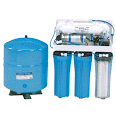
Reverse Osmosis with Steel Tank 
& Cartridge Pre-Filters

Submersible Pumps

Tachmina Solenoid-Driven
Chemical Metering Pump
- ensures regulated dosing
of chlorine into water system
without human intervention


...