Showing posts with label Nitrates. Show all posts

Saturday, December 14, 2019

ROTTEN EGG ODOR IN WATER - Hydrogen Sulfide and Sulfur Bacteria in Well Water - Bacterial slime may be white, grey, black, or reddish brown if associated with iron bacteria (signs of sulfur bacteria). The slime can clog wells, plumbing, and irrigation systems. While sulfur bacteria are not harmful, hydrogen sulfide gas in the air can be harmful at high levels. Black stains on silverware and plumbing fixtures (signs of hydrogen sulfide gas). Hydrogen sulfide gas (H2S) can give water a “rotten egg” taste or odor. Sulfur bacteria produce a slime and can help other bacteria grow, such as iron bacteria. It is important to remove the gas from the water, or vent the gas to the atmosphere. Corrosion on pipes and metal components of the water distribution system (signs of hydrogen sulfide gas). In most cases, the rotten egg smell does not relate to the sanitary quality of the water. In rare instances, the gas may be from sewage or other pollution. To be safe, test your well water for coliform bacteria and nitrate.


.........................................................................................................................................................
Rotten Egg Odor In Water
Why Does My Water Smell Like Rotten Eggs?
Hydrogen Sulfide and Sulfur Bacteria in Well Water
Well Management Program
Minnesota Department of Health


Hydrogen sulfide gas (H2S) can give water a “rotten egg” taste or odor. This gas can occur in wells anywhere and be:
-  Naturally occurring - a result of decay and chemical reactions with soil and rocks.
-  Produced by certain “sulfur bacteria” in the groundwater, well, or plumbing system.
-  Produced by sulfur bacteria or chemical reactions inside of water heaters.
-  From pollution (this is rare).
May Help Other Bacteria Grow
Sulfur bacteria produce a slime and can help other bacteria grow, such as iron bacteria. The slime can clog wells, plumbing, and irrigation systems.
Gas May be Harmful
While sulfur bacteria are not harmful, hydrogen sulfide gas in the air can be harmful at high levels.
It is important to remove the gas from the water, or vent the gas to the atmosphere.
Venting prevents the gas from collecting in low-lying spaces (such as well pits and basements) or enclosed spaces (such as well houses).
Only well professionals should enter a well pit or other enclosed space where hydrogen sulfide gas may be present.
How to Detect
Bacterial slime may be white, grey, black, or reddish brown if associated with iron bacteria (signs of sulfur bacteria).
Black stains on silverware and plumbing fixtures (signs of hydrogen sulfide gas).
Corrosion on pipes and metal components of the water distribution system (signs of hydrogen sulfide gas).
Have your water tested at a laboratory.
Consider Testing Your Water
Image result for images iron bacteria in well waterIn most cases, the rotten egg smell does not relate to the sanitary quality of the water.
In rare instances, the gas may be from sewage or other pollution. To be safe, test your well water for coliform bacteria and nitrate.
What You Can Do
The first step is to find out what the source of the issue is; that will let you know what treatment option is best.
How to Find the Source
After you have been away from your home for a few hours, smell the water coming out of the hot and cold water faucets. Determine which faucets have the “rotten egg” odor.
Flow chart decision tree. Is there a smell from the cold water faucet? If no, the problem is likely in the water heater.
If yes, is there a smell from faucets not connected to the water softener? If no, the problem is likely sulfur bacteria in the water softener.
If yes, is the smell less noticeable after the water runs for a few minutes? If no, the problem is likely hydrogen sulfide gas in the groundwater. If yes, the problem is likely sulfur bacteria in the well or plumbing system.
If the Problem is in the Water Heater
Unless you are very familiar with water heater operation and maintenance, have a plumber or water system professional to do the work.
Replace or remove the magnesium anode. Many water heaters have a magnesium anode, which is attached to a plug located on top of the water heater.
It can be removed by turning off the water, releasing the pressure from the water heater, and unscrewing the plug.
Be sure to plug the hole. Removal of the anode, however, may significantly decrease the life of the water heater.
You may wish to consult with a water heater dealer to determine if a replacement anode made of a different material, such as aluminum, can be installed.
A replacement anode may provide corrosion protection without contributing to the production of hydrogen sulfide gas.
Disinfect and flush the water heater with a chlorine bleach solution. Chlorination can kill sulfur bacteria.
If all bacteria are not destroyed by chlorination, the problem may return within a few weeks.
Increase the water heater temperature to 160 degrees Fahrenheit (71 degrees Celsius) for several hours.
This will destroy the sulfur bacteria. Flushing to remove the dead bacteria after treatment should control the odor problem.
CAUTION: Increasing the water heater temperature can be dangerous. Consult with the manufacturer or dealer regarding an operable pressure relief valve, and for other recommendations. Be sure to lower the thermostat setting and make certain the water temperature is reduced following treatment to prevent injury from scalding hot water and to avoid high energy costs.
How Hydrogen Sulfide Gas is Produced in a Water Heater
A water heater can provide an ideal environment for the conversion of sulfate to hydrogen sulfide gas.
The water heater can produce hydrogen sulfide gas in two ways - creating a warm environment where sulfur bacteria can live, and sustaining a reaction between sulfate in the water and the water heater anode.
A water heater usually contains a metal rod called an "anode," which is installed to reduce corrosion of the water heater tank.
The anode is usually made of magnesium metal, which can supply electrons that aid in the conversion of sulfate to hydrogen sulfide gas.
The anode is 1/2 to 3/4 inches in diameter and 30 to 40 inches long.
If the Problem is in the Well, Plumbing System, or Water Softener
Disinfect the well and plumbing system with a strong chlorine solution. You can hire a licensed well contractor to do this or refer to the Well Disinfection webpage for instructions.
Sulfur bacteria can be difficult to remove once established in a well.
Pre-work (such as scrubbing the well casing, using special treatment chemicals, and agitating the water before disinfection) may be necessary — especially if there are also iron bacteria.
Contact a licensed well contractor to do this pre-work.
If the bacteria are in the water softener or other treatment devices, contact the installer, manufacturer, or Minnesota Department of Health for disinfection instructions.
If the Problem is in Groundwater
Installing home water treatment or drilling a new well in a different formation are both options.
Below are types of home water treatment effective at removing hydrogen sulfide gas. Learn more at the Home Water Treatment webpage.
·   Activated carbon filters are effective for hydrogen sulfide levels less than 1 milligram per liter (mg/L). The gas is trapped by the carbon until the filter is saturated. Since the carbon filter can remove substances in addition to hydrogen sulfide gas, it is difficult to predict its service life. Some large carbon filters have been known to last for years, while some small filters may last for only weeks or even days.
·  The following are options are effective for levels both below and above 1 mg/L.
o Oxidizing media filtration (such as a manganese greensand filter) are effective for hydrogen sulfide levels up to about 6 mg/L. This type of treatment is often used to treat iron problems in water. The device consists of manganese greensand media, which is sand coated with manganese dioxide. The hydrogen sulfide gas in the water is changed to tiny particles of sulfur as it passes through the filter. The filter must be periodically regenerated, using potassium permanganate, before the capacity of the greensand is exhausted.
o  Aeration and filtration.
o  Continuous chlorination and filtration.
o  Ozonation and filtration.

Well Management Program
Approximately 70 percent of all Minnesotans rely on groundwater as their primary source of drinking water, and one million Minnesotans rely on private wells. Wells and borings used for drinking water, irrigation, industry, groundwater monitoring, heat pumps, hydraulic elevators, and other purposes must be properly constructed, maintained, and sealed (filled with an impervious material) when removed from service, to protect both public health and our invaluable groundwater resources.
Image result for images iron bacteria in well waterImage result for images iron bacteria in well water

Sunday, December 1, 2019

NITRATE IN WELL WATER - You cannot taste, see, or smell nitrate in your water. Nitrate is a compound that occurs naturally and also has many human-made sources. Nitrate is in some lakes, rivers, and groundwater. Some groundwater has nitrate concentrations that present a health risk - especially for babies. Consuming too much nitrate can affect how blood carries oxygen and can cause methemoglobinemia (also known as blue baby syndrome). Bottle-fed babies under six months old are at the highest risk of getting methemoglobinemia. Methemoglobinemia can cause skin to turn a bluish color and, left untreated, can result in serious illness or death.

Image result for images nitrates in well water
...............................................................................................................................................................
Image result for images nitrates in well waterNitrate in Well Water
Minnesota Department of Health
Well Management Program


This image shows some sources of nitrate in groundwater. Sources include septic systems, fertilizers, and animal waste. These sources can get into the ground and into well water.Nitrate is a compound that occurs naturally and also has many human-made sources.
Nitrate is in some lakes, rivers, and groundwater in Minnesota.
When nitrate is found in Minnesota groundwater, it is usually at very low concentrations.
However, some groundwater has nitrate concentrations that present a health risk - especially for babies.
You cannot taste, see, or smell nitrate in your water.
Safe Level
Drinking water with concentrations of nitrate (measured as nitrate-nitrogen) below 10 milligrams of nitrate per liter of water (mg/L) is considered safe for everyone in your family.
10 mg/L is the U.S. Environmental Protection Agency standard for nitrate in drinking water for public water supplies.
Health Risks
Consuming too much nitrate can affect how blood carries oxygen and can cause methemoglobinemia (also known as blue baby syndrome).
Bottle-fed babies under six months old are at the highest risk of getting methemoglobinemia.
Methemoglobinemia can cause skin to turn a bluish color and, left untreated, can result in serious illness or death.
The following conditions may also put people at higher risk of developing nitrate-induced methemoglobinemia: anemia, cardiovascular disease, lung disease, sepsis, glucose-6-phosphate-dehydrogenase deficiency, and some metabolic problems.
Only recently has scientific evidence emerged to assess the health impacts of drinking water with high nitrate on adults.
Map of Minnesota with dots representing new wells with nitrate above 3 mg/L and above 10 mg/L.
A growing body of literature indicates potential associations between nitrate/nitrite exposure and other health effects such as increased heart rate, nausea, headaches, and abdominal cramps. 
.
Some studies also suggest an increased risk of cancer, especially gastric cancer, associated with dietary nitrate/nitrite exposure, but there is not yet scientific consensus on this question.
Test Your Well Water
Test for nitrate every other year. You should also have your water tested for nitrate if you planning on becoming pregnant or if infants will be using the water.
You are responsible for keeping your well water safe and testing it as needed.
MDH recommends you use an accredited laboratory to test your water. 
.
Contact an accredited laboratory to get sample containers and instructions, or ask your county environmental or public health services if they provide well testing services (Accredited Labs in Minnesota Accepting Samples from Private Well Owners [PDF]).
Go to Well Testing, Results, and Options to learn more about testing well water.
MDH may recommend you test for additional contaminants based on where you live.
Prevent Contamination
·           Keep nitrate sources away from your well. Sources may include fertilizer, septic systems, and animal waste.
·           Construct your well in a safe spot.
·          Regularly inspect your well for damage. Contact a licensed well contractor if your well is damaged (Licensed Well and Boring Contractor Directory).
Wells Vulnerable to Nitrate
·           Shallow wells.
·           Wells in sand aquifers.
·           Dug wells with casings that are not watertight.
·           Wells with damaged or leaking casing or fittings.
Address Contamination
Drinking water with concentrations of nitrate above 10 mg/L can cause immediate health problems.
If nitrate is detected in your water at concentrations above 10 mg/L, follow these steps:
·          Get your drinking water from a safe alternative source, such as bottled water.
·          Make sure babies under six months old do not drink the well water.
·          Do not try to boil nitrate out of the water. Boiling will make nitrate more concentrated.
·          Have a licensed well contractor inspect your well.
·          Find and get rid of any potential sources of nitrate contamination. The Protecting Your Well webpage can help you identify sources to check.
·          Home water treatment may be an option if you meet these three criteria:
1.    You took steps to reduce or eliminate all potential sources of nitrate on your property;
2.    A licensed well contractor inspected your well and completed any needed repairs; and
3.    No babies under six months old drink the water (a safety precaution in the event the water treatment fails).
See the Home Water Treatment webpage or contact MDH for guidance.
How Nitrate Gets Into Groundwater
Nitrate occurs naturally and at safe and healthy levels in some foods (such as spinach and carrots) and comes from natural processes, such as plant decay.
Nitrate is in many fertilizers used on yards, golf courses, and crops. Other sources of nitrate include discharge from sewage systems and animal wastes.
Natural levels of nitrate in Minnesota groundwater are usually quite low (less than 3 milligrams per liter [mg/L]).
However, where sources of nitrate such as fertilizers, animal wastes, or human sewage are concentrated near the ground surface, nitrate may seep down and contaminate the groundwater.
High levels of nitrate in water can be a result of runoff or leakage from fertilized soil, wastewater, landfills, animal feedlots, septic systems, or urban drainage.
It can be difficult to pinpoint where the nitrate in drinking water comes from because there are many possibilities.
Nitrate in Minnesota Water
About 4 percent of new wells have nitrate concentrations above 3 mg/L in Minnesota. While 3 mg/L is less than the EPA standard, it suggests human-made sources of nitrate have contaminated the water and the level could increase over time.
Most concentrations above 3 mg/L are in central and southeastern Minnesota. Concentrations above 10 mg/L are mainly in central and southwestern Minnesota.
The Minnesota Department of Agriculture  Township Testing Program found that over 10 percent of the private wells sampled in some townships in southwestern, southeastern, central, and north-central Minnesota have nitrate levels above 10 mg/L.
Should I test my well water for anything besides lead?
Yes. Both natural sources and human activities can contaminate well water and cause short-term or long-term health effects.
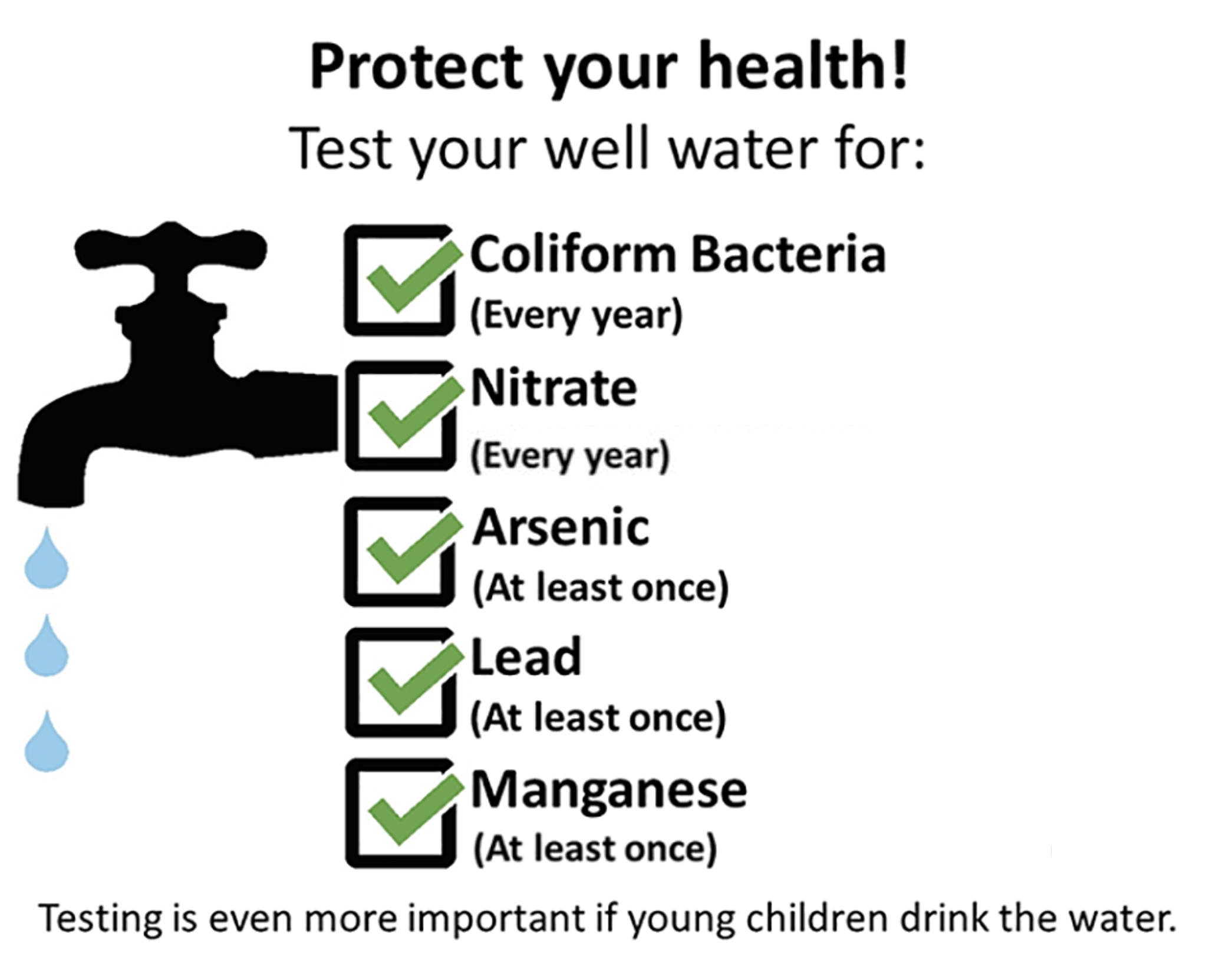
Protect your health! Test your well water for: Coliform Bacteria (every year), Nitrate (every other year), Arsenic (at least once), Lead (at least once), Manganese (before a baby drinks the water). Testing is even more important if young children drink the water.Testing your well water is the only way to detect most of the common contaminants in Minnesota groundwater; you cannot taste, see, or smell most contaminants. Minnesota Department of Health recommends testing for:
·          Coliform bacteria every year and any time the water changes in taste, odor, or appearance. Coliform bacteria can indicate that disease-causing microorganisms may be in your water.
·         Arsenic at least once. About 40 percent of wells in Minnesota have arsenic in the water.
Drinking water with arsenic in it for a long time can contribute to reduced intelligence in children and increased risks of cancer, diabetes, heart disease, and skin problems.
Lead at least once. The well and water system may have parts that have lead in them, and that lead can get into drinking water. Lead can damage the brain, kidneys, and nervous system. Lead can also slow development or cause learning, behavior, and hearing problems.
Manganese before a baby drinks the water. High levels of manganese can cause problems with memory, attention, and motor skills. It can also cause learning and behavior problems in infants and children.

Other contaminants sometimes occur in private water systems, but less often than the contaminants listed above. Consider testing for:
·          Volatile organic chemicals if the well is near fuel tanks or a commercial or industrial area.
·         Agricultural chemicals commonly used in the area if the well is shallow and is near cropped fields or handling areas for agricultural chemicals or is in an area of geologic sensitivity (such as fractured limestone).
·         Fluoride if children or teenagers drink the water.

Minnesota Department of Health
Image result for images nitrates in well water
Image result for images nitrates in well waterImage result for images nitrates in well waterImage result for images nitrates in well water