Showing posts with label Water softeners. Show all posts

Sunday, December 20, 2020

WATER SOFTENERS AND THE ENVIRONMENT - ARE WATER SOFTENERS BAD FOR THE ENVIRONMENT? The perceived waste associated with water softeners occurs during what’s known as regeneration. Media used to soften water by removing the hard minerals calcium and magnesium eventually gets exhausted and needs to be recharged. During the regeneration process, sodium from the solution in the brine tank refreshes the media by knocking off the calcium and magnesium ions collected by the water softening media. This gives the media new life and allows it to continue removing hard minerals. What gets flushed out of your system also contains the calcium and magnesium that the media collected during softening. The EPA has said that softener discharge is not harmful to septic systems and may actually be beneficial to the soil. More of us are paying much closer attention to how the things we buy and use impact the environment. We’re doing what we can to reduce waste and our individual carbon footprints in many different ways. If you’ve purchased new appliances in the past few years, you’ve probably noticed the shift towards more energy efficient options, and you’re likely familiar with the government’s ENERGY STAR® program. It rates appliances such as dishwashers, washing machines, and water heaters based on their energy efficiency. But, you won’t find water softeners on that list. So are water softeners bad for the environment?

.................................................................................................................................................................................................................................................................................................................................................................................................................................

Water Softeners and the Environment

ARE WATER SOFTENERS BAD FOR THE ENVIRONMENT?

.

The perceived waste associated with water softeners occurs during what’s known as regeneration. Media used to soften water by removing the hard minerals calcium and magnesium eventually gets exhausted and needs to be recharged (aka. regenerated). During the regeneration process, sodium from the solution in the brine tank refreshes the media by knocking off the calcium and magnesium ions collected by the water softening media. This gives the media new life and allows it to continue removing hard minerals. What gets flushed out of your system also contains the calcium and magnesium that the media collected during softening. The EPA has said that softener discharge is not harmful to septic systems and may actually be beneficial to the soil.

Water-Right


More of us are paying much closer attention to how the things we buy and use impact the environment.

We’re doing what we can to reduce waste and our individual carbon footprints in many different ways.

In fact, a 2019 study found the vast majority of people remodeling (78%), buying new homes (87%), and building new homes (89%) called energy efficiency a priority.

A slightly higher percentage of people in all three groups also said they’re willing to pay more for an energy efficient home.

If you’ve purchased new appliances in the past few years, you’ve probably noticed the shift towards more energy efficient options, and you’re likely familiar with the government’s ENERGY STAR® program.

It rates appliances such as dishwashers, washing machines, and water heaters based on their energy efficiency.

But, you won’t find water softeners on that list. So, what’s the truth about water softeners? Are they bad for the environment?

Water Softener Efficiency and Environmental Impact

There are certainly people who criticize water softeners in regards to sustainability.

The biggest complaints are that these residential water treatment systems waste too much water and put chloride (from salts) into aquatic environments.

Water softeners, as well as other types of water treatment do come with a certain amount of what some may view as waste.

But, is it really “wasted” water if it serves a useful purpose that also promotes energy efficiency and sustainability in other areas?

If you’re using softened water for better bathing, housecleaning, and to avoid other common hard water problems, it isn’t being wasted.

The perceived waste associated with water softeners occurs during what’s known as regeneration.

Media used to soften water by removing the hard minerals calcium and magnesium eventually gets exhausted and needs to be recharged (aka. regenerated).

During the regeneration process, sodium from the solution in the brine tank refreshes the media by knocking off the calcium and magnesium ions collected by the water softening media.

This gives the media new life and allows it to continue removing hard minerals.

What gets flushed out of your system also contains the calcium and magnesium that the media collected during softening.

The EPA has said that softener discharge is not harmful to septic systems and may actually be beneficial to the soil.

“Soil structure in the soil absorption field is positively affected by the calcium and magnesium ions in water softener effluent.”

The EPA goes on to explain that a common misconception is that influent (what’s in the brine tank) is the same as the effluent (the wastewater discharged after regeneration).

The amount of sodium (not salt or sodium chloride) in softened water that goes down the drains in your home will depend on the hardness level of the water before softening.

Historically, it took a substantial amount of water to flush the system sending the unwanted hardness minerals to the drain and regenerate the media.

However, the residential water treatment industry has made great strides in sustainability over the past decade, and high-efficiency water softeners can make a significant difference.

Systems that are properly calibrated to use less salt put less back into waste water.

So, those who want soft water while minimizing potential environmental impact should consider upgrading their residential water treatment solutions.

The Benefits of Water Efficient Technology

Most of the industry’s efforts to make water softening equipment more efficient focused on salt.

At Water-Right, however, we realized it was even more important to consider how we could conserve the precious natural resource of water.wet technology logo

That’s why we introduced Water Efficient Technology or W.E.T.

This water treatment innovation has the ability to reduce both water and salt used in a home’s softening system by as much as 50%, which compares to about 18% savings over the average high-efficiency water softeners.

As our equipment learns your household water usage routine, W.E.T. adjust its settings to use the optimal amount of salt and water.

So, if your system is regenerating when the softening media is at 75% capacity, it only uses 75% of the brine solution (salt and water) and reduces the rinse cycle times to use less water compared to regenerating a system that has used 100% of its capacity.

If your family uses more water on Saturdays, because that’s laundry day and bath day for the kids, the softener knows you need more soft water and may adjust accordingly to regenerate on Friday night.

This may mean that the media has only been 50% used before it starts regenerating.

Much like not filling the kitchen sink up all of the way to wash just a handle full of dishes, W.E.T. adjusts to only use the minimum amount of resources necessary to keep your water softener running effectively, reducing waste.

Water Softeners and Environmentally-Friendly, Energy Efficient Homes

Water softeners play a very important role in helping many other appliances in your home operate efficiently, and they’re even part of the solution for keeping certain detergents from polluting our waterways.

Let’s take water-using appliances such as washing machines and dishwashers as an example.

Many dish and laundry detergents contained phosphates to bond to the minerals in hard water and prevent them from depositing into your clothing.

However, there were serious concerns about phosphates leading to nutrient pollution, starving fish of oxygen, and causing harmful algae blooms, especially in the Great Lakes region.

All 50 states have introduced bans on phosphates in laundry detergents.

In 2010, 17 states and Washington, D.C. expanded that ban to dishwashing detergent and other soaps.

Manufacturers of these products decided it was too difficult and expensive to have different formulas for different states. So, phosphates are no longer found in most detergents.

After the ban, people started noticing things weren’t getting nearly as clean as they expected.

NPR even reported that some consumers were adding their own phosphates to dish detergent.

Pouring Detergent into the wash machine

Phosphates were basically trying to do the same thing for dishes and laundry that water softeners do for an entire house.

Homeowners with water softeners could use phosphate-free detergent without noticing any difference because the problematic minerals were already being removed from their water.

From this perspective, water softeners enable consumers to use a more environmentally-friendly product and help keep phosphates out of our waterways.

But, that’s not where the story ends.

Not only does hard water make it difficult to get dishes and laundry clean, it can also cause appliances to wear out sooner than expected and work harder than necessary.

Hard water leaves behind limescale inside appliances.

For energy-efficient models, this can mean they fail to run according to the manufacturer’s specifications.

So, they aren’t operating as efficiently as intended, which means you aren’t saving as much on your utility bills or as much energy as you thought.

That’s especially true for water heaters.

As we explained in our infographic on water softener savings, the Department of Energy found water heater scaling reduces efficiency by 10%.

Could Your Water Softener be More Efficient and Environmentally-Friendly?

If you’re concerned with how water softening in your home impacts the environment, the first thing you should evaluate is the age of your equipment.

If it’s been 10 years or more since you updated your water treatment solutions, you should consider a new, high-efficiency water softener, such as those equipped with W.E.T.™ from Evolve® and WaterCare®dealers.

W.E.T.™ will actually show you how much water and salt you are saving over time, so you’ll know it is working.

Select units can also be equipped with Wripli® Wi-Fi technology, which has features including the ability to track your water usage and turn on Vacation Mode remotely with a smartphone.

That way you won’t waste water during regeneration when you’re away from home. Wripli® is available exclusively from our Evolve® and WaterCare® dealers.

What you should avoid is simply purchasing equipment and making water softener installation a DIY project.

An expert from Water-Right’s family of water treatment professionals can test your water to find out how to accurately calibrate your equipment for the best water quality and optimal efficiency.

Without their help, the unit could fail to adequately treat your water, or it could over-soften and result in wasted water and salt.

It is possible to have soft water in your home and still feel good about your efforts to support a cleaner planet.

In fact, there are ways in which the two go hand-in-hand. You just need a helpful local expert to point you in the right direction.

THE RIGHT WATER FOR LIFE

Constant innovation and no shortcuts. Water-Right is first and foremost a company built on integrity. Since 1963, we’ve done things the right way. Our value set has driven the development of the finest water treatment systems, making it easy for industry professionals to satisfy today’s demand for the highest quality water.

Keeping water clean and safe is an increasingly difficult challenge. That’s why we push to make good products better, create industry-leading technology, and offer a state-certified, independent lab specializing in water testing. It’s about making life better as well as providing “The Right Water for Life.”

Mission: Passionately provide and create innovative water treatment solutions with a splash of inspiration

Vision: Deliver innovative water solutions honestly, ethically, and enthusiastically through education, teamwork, and engaging customer support

https://www.water-rightgroup.com/blog/are-water-softeners-bad-for-the-environment/


You might also like:


Water Softener Regeneration

CLICK HERE . . . to view . . . 

https://puricare.blogspot.com/2019/09/water-softener-regeneration-water.html

.............................................................................................................................................................................................................................................................................................

Myths and truths about water softeners

CLICK HERE . . . to view . . . 

https://puricare.blogspot.com/2019/10/myths-and-truths-about-water-softeners.html

.............................................................................................................................................................................................................................................................................................

Fabric Softeners

CLICK HERE . . . to view . . . 

https://puricare.blogspot.com/2020/05/fabric-softeners-fabric-softeners.html

............................................................................................................................................................................................................................................................................................

Laundry And Hard Water

CLICK HERE . . . to view . . . 

https://puricare.blogspot.com/2019/11/laundry-and-hard-water-if-your-laundry.html

.............................................................................................................................................................................................................................................................................................

Survival Solutions

Water Storage & Purification

CLICK HERE . . . to view . . . 

https://puricarechronicles.blogspot.com/2020/01/image-result-for-images-survivalist.html

...........................................................................................................................................................................................................................................................................................

Abiogenesis: Water and Oxygen Problems

CLICK HERE . . . to view . . . 

https://puricarechronicles.blogspot.com/2019/05/abiogenesis-water-and-oxygen-problems.html

Sunday, March 15, 2020

SHOWERING IN HARD WATER - When you bathe or shower in hard water, you may not be getting as clean as you should. Here’s why… Dissolved minerals like calcium and magnesium are what make the water in your home hard. Those minerals also create an undesirable chemical reaction with your soap, shampoo, and body wash as well as shaving cream. What happens is the calcium and magnesium ions in hard water react with fatty acids in soap to form insoluble lime soaps, which are ineffective at cleaning. If you have hard water, the same disgusting soap scum you’re always scrubbing in the tub is on your body too. The best way to know if you’re dealing with hard water problems in the shower is to look at how well you’re lathering up. Hard water prevents you from getting a nice soapy lather in the shower. When you have soft water, it’s much easier to produce a foamy lather from your soap and shampoo. After installing a water softener in their home, some people notice their skin feels slick and even slippery after bathing. Part of this may be due to the fact you aren’t accustomed to how truly-clean skin feels. What you feel might simply be the real you. But you may also be in the habit of using too much soap. You won’t need to use as much with soft water.


................................................................................................................................................................
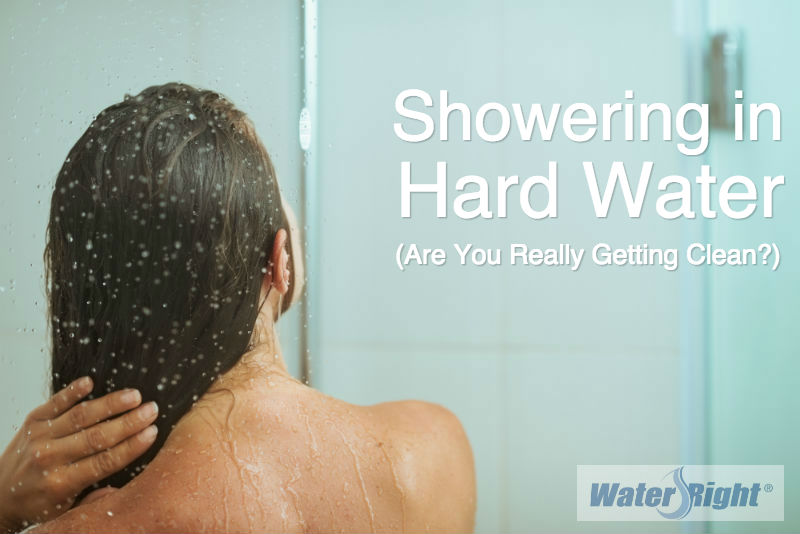
hard-water-hairShowering in hard water
Are you really getting clean?
Water-Right


For many of us, taking a shower is priceless personal time. You’re alone with your thoughts getting ready for the day, winding down from a workout or hectic daily schedule.
You are supposed to get out feeling clean and refreshed. But if you’re showering in hard water, your showering experience could definitely be better.
In fact, when you bathe or shower in hard water, you may not be getting as clean as you should. Here’s why…
How Minerals in Hard Water Keep You from Getting Clean
Dissolved minerals like calcium and magnesium are what make the water in your home hard.
Those minerals also create an undesirable chemical reaction with your soap, shampoo, and body wash as well as shaving cream.
What happens is the calcium and magnesium ions in hard water react with fatty acids in soap to form insoluble lime soaps, which are ineffective at cleaning.
If you were paying attention during Chemistry class, here’s the chemical equation:
2 C17H35COO−Na+ + Ca2+ → (C17H35COO)2Ca + 2 Na+
In this chemical reaction, positively-charged calcium ions replace sodium ions in your shampoo or soap leaving scum and lime scale deposits on your skin and in your hair.
That’s right. If you have hard water, the same disgusting soap scum you’re always scrubbing in the tub is on your body too.
The best way to know if you’re dealing with hard water problems in the shower is to look at how well you’re lathering up.
Hard water prevents you from getting a nice soapy lather in the shower. When you have soft water, it’s much easier to produce a foamy lather from your soap and shampoo.
After installing a water softener in their home, some people notice their skin feels slick and even slippery after bathing.
Part of this may be due to the fact you aren’t accustomed to how truly-clean skin feels. What you feel might simply be the real you.
But you may also be in the habit of using too much soap. You won’t need to use as much with soft water.
How Hard Water Affects Your Hair
Have you ever noticed how your hair can look and feel different when you shower in different places?
Your hair behaves one way after showering at the gym, turns out another way when you’re vacationing or staying in a hotel, and looks completely different when you wash your hair at home.
That’s most likely because the hardness of the water varies from location to location.
A writer for the beauty website xoVain experienced some hard water showering issues when she vacationed in rural Wisconsin.
She provides some great advice for showering in different types of water.
If you have hard water at home, your hair may feel dry all the time and become frizzy making it tangled and difficult to manage.
It may also have a dull, lifeless appearance. That’s because those minerals and deposits build up in your hair.
With a water softener in your home, those hard water issues are eliminated. You will find that your hair has a more-attractive shine when you shower in softened water.
And soft water will make your hair more manageable, so it’s easier for you to style it the way you want.
Sometimes people with finer hair complain that soft water can make their hair feel flat or even greasy.
This is probably because you’re using too much soap and not rinsing it out of the hair completely. Rinsing your hair in the shower for a little longer may solve that problem.
Of all the hard water hair issues, the scariest has to be hair loss. Calcium build up can form around the base of hair follicles causing hair to break off and potentially hindering growth of new hair.
How Hard Water Affects Your Skin
Hard water can give you skin troubles too. Let’s start with the scalp.
The calcium salts that build up in your scalp can cause dryness and flaking, AKA dandruff.
You might assume it’s the shampoo you buy causing dandruff. But hard water may be the real culprit.
Hard water can make the rest of your skin feel dry and itchy as well. That’s thanks to the soapy residue left on your body, which clogs pores.
Plus, the minerals in hard water can suck moisture right out of your skin leaving it even more dry and irritated.
In fact, certain studies indicate hard water may cause additional aggravation in people with skin conditions like eczema and dermatitis.
According to the dermatology site DermaHarmony.com:
“While hard water itself doesn’t cause dermatitis, it can irritate the condition or even initiate a flare-up. The combination of hard water with a co-existing dermatitis condition can lead to more frequent and severe outbreaks.”
Even washing clothes in hard water can be problematic to those with sensitive skin. Hard water leaves soap residue on your laundry too, and that residue is in contact with your skin all day long.
If you have sensitive skin, the soft water a high-quality water softener provides could help you avoid much of the dehydration that occurs.
As the American Cleaning Institute explains, soap’s “effectiveness is reduced when used in hard water.”
That means not only will you fail to get clean in the shower, it will be tougher to keep your house clean as well.
With hard water, you’ll end up using more soap to keep your body clean and more product to clean your home too. Softer water could mean you save significant money and time in the long run.
What Can You Do?
If you have a private well, you’re definitely dealing with hard water. But the majority of municipal water sources have levels of hardness as well.
According to the USGS, in the United States, 85% of the water is considered hard.
There are certainly little tips and tricks you can use to try and improve your showering experience. However, there’s really only one permanent solution… that’s a water softener.
Water softeners remove those dissolved minerals from the water in your home. They are an investment that will make life for you and your family more convenient and more enjoyable.
Want to learn more about water conditioning options and what kind of water softener would be ideal for your home? Water-Right’s product lines are among the best residential water treatment options in the industry.

Constant innovation and no shortcuts. Water-Right is first and foremost a company built on integrity. Since 1963, we’ve done things the right way. Our value set has driven the development of the finest water treatment systems, making it easy for industry professionals to satisfy today’s demand for the highest quality water.
Keeping water clean and safe is an increasingly difficult challenge. That’s why we push to make good products better, create industry-leading technology, and offer a state-certified, independent lab specializing in water testing. It’s about making life better as well as providing “The Right Water for Life.”
hard-water-skin

Tuesday, December 17, 2019

ZEOLITES – The most interesting thing about zeolites is their open, cage-like, "framework" structure and the way it can trap other molecules inside it. Zeolites can exchange other positively charged ions for the metal ions originally trapped inside them (technically this is known as cation exchange) and, they can gain or lose their water molecules very easily too (this is called reversible dehydration). Zeolites have regular openings in them of fixed size, which let small molecules pass straight through but trap larger ones; that's why they're sometimes referred to as molecular sieves. Unlike natural zeolites, which occur in random forms and mixed sizes, synthetic zeolites are manufactured in very precise and uniform sizes (typically from about 1μm to 1mm) to suit a particular application - they're made a certain size to trap molecules of a certain (smaller) size inside them. One of the biggest everyday uses for zeolites is in water softeners and water filters. The zeolites trap the calcium and magnesium ions and release sodium ions in their place, so the water becomes softer but richer in sodium.

Animation showing how ion exchange works.
Animation (above): Ion exchange in zeolites: the zeolite "cage" (gray) traps incoming ions (red and orange) and releases others (yellow) in their place.
...............................................................................................................................................
Artwork showing the structure of zeolite crystals
The power of nothingness: 
in zeolite crystals, 
like the one in this illustration,
the pores in between the aluminum, silicon, and oxygen atoms 
are as important as the crystal structure itself. 
Zeolites
hydrated aluminosilicate minerals


Heat a glass of water and you'll see steam rise off it sooner or later as it comes to the boil.
You certainly don't expect the same thing to happen if you heat a rock — unless it's a special kind of rock called a zeolite, which traps water inside it.
Back In 1756, Swedish geologist Axel Cronstedt (1722–1765) — best known as the discoverer of nickel — coined the name "zeolite" because it literally means "boiling stone"; today, the term refers to over 200 different minerals that have all kinds of interesting uses, from water softeners and cat litter to animal food and industrial catalysts.
What are zeolites and how do they work? Let's take a closer look!
What are zeolites?
Zeolites are hydrated aluminosilicate minerals made from interlinked tetrahedra of alumina (AlO4) and silica (SiO4).
In simpler words, they're solids with a relatively open, three-dimensional crystal structure built from the elements aluminum, oxygen, and silicon, with alkali or alkaline-Earth metals (such as sodium, potassium, and magnesium) plus water molecules trapped in the gaps between them.
Zeolites form with many different crystalline structures, which have large open pores (sometimes referred to as cavities) in a very regular arrangement and roughly the same size as small molecules.
There are about 40 naturally occurring zeolites, forming in both volcanic and sedimentary rocks; according to the US Geological Survey, the most commonly mined forms include chabazite, clinoptilolite, and mordenite.
Dozens more artificial, synthetic zeolites (around 150) have been designed for specific purposes, the best known of which are zeolite A (commonly used as a laundry detergent), zeolites X and Y (two different types of faujasites, used for catalytic cracking), and the petroleum catalyst ZSM-5 (a branded name for pentasil-zeolite).
What special properties do zeolites have?
Zeolites are very stable solids that resist the kinds of environmental conditions that challenge many other materials.
High temperatures don't bother them because they have relatively high melting points (over 1000°C), and they don't burn.
They also resist high pressures, don't disssolve in water or other inorganic solvents, and don't oxidize in the air.
They're not believed to cause health problems through, for example, skin contact or inhalation, though in fibrous form, they may have carcinogenic (cancer-causing) effects.
Since they're unreactive and based on naturally occurring minerals, they're not believed to have any harmful environmental impacts.
Although zeolites might sound incredibly boring, their stable and unreactive nature isn't what makes them useful.
The most interesting thing about zeolites is their open, cage-like, "framework" structure and the way it can trap other molecules inside it.
This is how water molecules and alkali or alkaline-Earth metal ions (positively charged atoms with too few electrons, sometimes called cations) become a part of zeolite crystals — although they don't necessarily remain there permanently.
Zeolites can exchange other positively charged ions for the metal ions originally trapped inside them (technically this is known as cation exchange) and, as Cronstedt found over 250 years ago, they can gain or lose their water molecules very easily too (this is called reversible dehydration).
Zeolites have regular openings in them of fixed size, which let small molecules pass straight through but trap larger ones; that's why they're sometimes referred to as molecular sieves.
Unlike natural zeolites, which occur in random forms and mixed sizes, synthetic zeolites are manufactured in very precise and uniform sizes (typically from about 1μm to 1mm) to suit a particular application; in other words, they're made a certain size to trap molecules of a certain (smaller) size inside them.
Although all zeolites are aluminosilicates, some contain more alumina, while others contain more silica.
Alumina-rich zeolites are attracted to polar molecules such as water, while silica-rich zeolites work better with nonpolar molecules.
What are zeolites used for?
The cage-like structure of zeolites makes them useful in all sorts of ways.
One of the biggest everyday uses for zeolites is in water softeners and water filters.
In ion-exchange water softeners, for example, hard water (rich in calcium and magnesium ions) is piped through a column filled with sodium-containing zeolites.
The zeolites trap the calcium and magnesium ions and release sodium ions in their place, so the water becomes softer but richer in sodium.
Many everyday laundry and dishwasher detergents contain zeolites to remove calcium and magnesium and soften water so they work more effectively.
Two other very common, everyday uses of zeolites are in odor control and pet litter; in both, the porous crystalline structure of the zeolites helps by trapping unwanted liquids and odor molecules.
This simple idea, so effective in our homes, has much more important uses outside them: zeolites have proved extremely effective at removing radioactive particles from nuclear waste and cleaning up soils contaminated with toxic heavy metals.
(Following the Fukushima nuclear disaster in Japan in 2011, rice farmers spread zeolites on their fields in an attempt to trap any lingering radioactive contaminants.)
The many other uses for zeolites including concrete production, soil-conditioners, and animal food.
It's easy to find websites claiming all sorts of health benefits for zeolite food supplements, even advocating them as a cure for cancer.
However, you need to be extremely careful about believing medical information you find online: when it comes to your health, make sure you refer to websites you know you can trust — and preferably ones that aren't trying to sell you things.
A search of Pubmed (the worldwide database of peer-reviewed biomedical papers run by the US National Library of Medicine) suggests there is currently little scientific evidence to support the idea that zeolites have positive benefits in human food supplements, though there are some papers that suggest possible benefits in dairy cows, poultry, goats, and mice.
In a one-page summary last updated in June 2017, the Memorial Sloan Kettering Cancer Center confirms this: "Zeolites are also marketed as dietary supplements to treat cancer, diarrhea, autism, herpes, and hangover, and to balance pH and remove heavy metals in the body... [There are] Benefits of using zeolites in animal feed... However, none of these benefits are applicable to humans... Currently, no studies of zeolite as a cancer treatment in humans have been published."
It's also worth noting that the US Food and Drug Administration has sent a number of warning letters to websites making unsubstantiated therapeutic claims about zeolite products (see references below for examples).
What are zeolite catalysts?
Another important use for zeolites is as catalysts in drug (pharmaceutical) production and in the petrochemical industry, where they're used in catalytic crackers to break large hydrocarbon molecules into gasoline, diesel, kerosene, waxes and all kinds of other byproducts of petroleum.
Again, it's the porous structure of zeolites that proves important.
The many pores in a zeolite's open structure are like millions of tiny test tubes where atoms and molecules become trapped and chemical reactions readily take place.
Since the pores in a particular zeolite are of a fixed size and shape, zeolite catalysts can work selectively on certain molecules, which is why they're sometimes referred to as shape-selective catalysts (they can select the molecules they work on in other ways beside shape and size, however).
Like all catalysts, zeolites are reusable over and over again.

Hello! I'm Chris Woodford, a British science writer, and I write all the articles on Explain that Stuff.
Books
I've written lots of books on science and technology, including the hugely popular how-it-works titles Cool Stuff and How it Works (How Cool Stuff Works) (with Ben Morgan et al), Cool Stuff 2.0 (The Gadget Book) (with Jon Woodcock), and Cool Stuff Exploded (published by Dorling Kindersley/DK), which have sold nearly four million copies worldwide. A couple of years ago, I wrote Science: A Visual/Children's Encyclopedia with Steve Parker, which has been garnering lots of five star reviews on Amazon and is now in its third major edition. My latest book, Atoms Under the Floorboards: The Surprising Science Hidden in Your Home, is published by Bloomsbury and is available worldwide.
I also work as a consultant and science adviser on other people's books, including children's science titles by Robert Winston, Johnny Ball, and Richard Hammond. Most recently, I've been helping David Macaulay with a revised edition of his classic mammoth book, The Way Things Work Now, which was Amazon.com's number one children's non-fiction book for 2016.
Awards
Books I've written, edited, consulted on, or otherwise contributed to have been translated into about 20 different languages and won or been shortlisted for over 40 awards, including the Royal Society Young People's Book Prize (in the UK) and the National Science Teachers Association Outstanding Science Trade Book award (in the United States). Atoms Under the Floorboards won The American Institute of Physics Science Writing Award for Books 2016 and was named one of Physics World's Top 10 Physics Books of 2015.
You can find a full list of my books, with review comments and details of the awards or other recognitions they've received on my personal website, chriswoodford.com.
Qualifications and experience
In case you're interested, I have an MA in Natural Sciences from Cambridge University. I specialized in physics (which I was very lucky to have been able to study at the Cavendish Laboratory) and experimental psychology, but also covered chemistry, crystallography, materials science, and math. (That's largely why the articles on Explain that Stuff lean so heavily toward the physical sciences rather than life-science topics, which I know less about.)
I've also spent a lot of my time working with computers and the Internet (I worked at IBM for about five years) and built my very first website in 1994, using an IBM System/390 mainframe and Mosaic. I had my first magazine article published back in 1981 (I was very young!) and I've been writing about science and technology pretty much ever since.
Examples of zeolite crystals.
 Synthetic zeolite crystals grown at CAMMP (Center for Advanced Microgravity Materials Processing), a NASA-sponsored Research Partnership Center. The ones on the right are about 10 times bigger (25μm) than the ones on the left (2.5μm).  


Pie chart showing world mine production of natural zeolites.
Green alfalfa growing in a field with a zeolite seed coating to protect against soil-borne plant pathogens.
Scientists at the US Department of Agriculture have found that a coating of zeolite can help to protect the country's valuable, $10 billion-a-year alfalfa crop against soil-borne diseases. Since the zeolite occurs naturally, this treatment counts as organic.
Photo of catalytic cracker in petroleum refinery.
Zeolite catalysts are used in catalytic crackers like this one, which turn crude oil (petroleum) into dozens of useful everyday products and chemicals.