Showing posts with label Aerosols. Show all posts

Wednesday, July 29, 2020

AIR CONDITIONING MAY BE SPREADING COVID - As COVID-19 cases rise rapidly some scientists believe there could be an important, but overlooked factor in the spread of the virus in the region -- air conditioning. Just as chilly winter temps create the perfect conditions for passing colds and flu — driving people indoors and into closer proximity for more hours of the day where it’s easy to swap germs, researchers believe broiling heat in the southern U.S. could be having the same effect, sending people indoors where whirring air conditioners are running full blast. Air conditioning is also risky because of the way air handlers work. When outdoor temperatures are extreme, HVAC systems adjust the mix of fresh air they pull in to save energy. That means the hotter it is outside, the more indoor air recirculates, which means, you’re breathing a higher percentage of the same air that other people are exhaling. If someone in the building is shedding the new coronavirus, it can build up in the recirculated air. And this may seem obvious, but air conditioners have fans that blow the air around. That gives the smallest viral particles — aerosols -- extra lift to stay suspended in the air. The air currents that are produced by air conditioners and also fans and other air moving devices can carry particles further than they might otherwise go. Air conditioners also remove moisture from the air, and we know viruses prefer dry air.

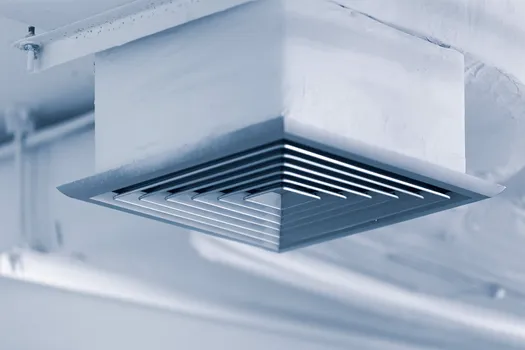
photo of air conditioning vent
..................................................................................................................................................
Air Conditioning May Be Spreading COVID
By Brenda Goodman, MA


As COVID-19 cases rise rapidly throughout the South, some scientists believe there could be an important, but overlooked factor in the spread of the virus in the region -- air conditioning.
Just as chilly winter temps create the perfect conditions for passing colds and flu — driving people indoors and into closer proximity for more hours of the day where it’s easy to swap germs, researchers believe broiling heat in the southern U.S. could be having the same effect, sending people indoors where whirring air conditioners are running full blast.
“You go indoors for the cool, just as in the northeast and other cool places you go in for the warmth in winter, so you’re less socially distanced,” says Edward Nardell, MD, professor of environmental health and immunology and infectious diseases at Harvard’s T.H. Chan School of Public Health.
“You’re more likely to be touching the same surfaces that have been contaminated by people speaking and coughing etc.,” he says.
And that’s not the only problem.
Air conditioning is also risky because of the way air handlers work. When outdoor temperatures are extreme, HVAC systems adjust the mix of fresh air they pull in to save energy.
That means the hotter it is outside, the more indoor air recirculates, which means, “You’re breathing a higher percentage of the same air that other people are exhaling,” Nardell says.
If someone in the building is shedding the new coronavirus, it can build up in the recirculated air.
And this may seem obvious, but air conditioners have fans that blow the air around.
That gives the smallest viral particles — aerosols -- extra lift to say suspended in the air for longer.
“The air currents that are produced by air conditioners and also fans and other air moving devices can carry particles further than they might otherwise go,” he says.
Air conditioners also remove moisture from the air, “and we know viruses prefer dry air,” he says.
In certain situations, that combination of factors may create the perfect conditions for contagion.
Emerging Evidence Points To Airborne Transmission
Studies of air conditioning come as more evidence emerges about airborne spread of COVID-19.
In a commentary published this week in the journal Clinical Infectious Diseases, an international group of 239 scientists have appealed to “national and international bodies” including the World Health Organization, to recognize this potential for airborne spread.
“We’re pushing because we need very clear, consistent messaging to the world,” said Shelly Miller, PhD, a professor of mechanical engineering who studies indoor air quality at the University of Colorado at Boulder.
Miller was one of the chief proponents of the commentary.
This virus is opportunistically airborne, you can get it by inhaling it,” she says.
Miller and others believe that WHO and other public health agencies have a blind spot when it comes to airborne transmission.
“Based on our assessments of outbreaks, air sampling, and animal studies and we have just as much evidence to show that airborne transmission is happening as is surface transmission, so we need clear guidance for how to address this,” Miller says.
In its latest press briefing, WHO experts responded to the communication, and said the agency would be publishing a scientific brief summarizing their view of the science shortly.
“We acknowledge that there is emerging evidence in this field,” said Benedetta Allegranzi, MD, WHO’s technical lead for infection prevention and control.
 “We believe we have to be open to this evidence and understand its implications regarding the modes of transmission and the precautions that need to be taken,” she said.
The Role of Air Conditioning
So far, there are just a few studies pointing to the role of air conditioning in the spread of COVID-19. They indicate more research in the area is needed.
In July, Chinese scientists published a short study detailing the results of their investigation of a cluster of COVID-19 cases linked to the same restaurant.
The 10 diners who fell ill were all sitting at tables on the same side of the room.
The tables were spaced more than 3 feet apart, though, indicating that the virus probably wasn’t being passed through larger droplets, which fall out of the air pretty quickly.
Instead, they think “strong airflow” from a wall mounted air conditioner probably spread aerosols, or “micro-droplets”, from a single infected, but asymptomatic person over the tables, infecting three different families.
In another study, which hasn’t yet been peer reviewed, researchers swabbed three different HVAC units at the Oregon Health and Science University Hospital in Portland.
Then they checked their samples for the presence of genetic material from the SARS-CoV-2 virus. The swabs were positive in 1 out of every 4 samples taken.
“We found it in multiple locations within the air handler,” says study author Kevin Van Den Wymelenberg, PhD, a professor of architecture and director of the Institute for Health in the Built Environment at the University of Oregon in Eugene.
similar study, from the University of Nebraska Medical Center, detected genetic material from the virus in air samples collected from rooms of COVID-19 patients, even air samples collected from more than six feet away.
Van Den Wymelenberg says their study can’t prove that the remnants of the virus they picked up could have actually infected anyone.
To know that, they would have had to try to grow their samples alongside cells in a petri dish and watch to see if those cells were infected.
Those are expensive studies to perform and they require a specialized lab certified to handle highly contagious germs — called a biosafety level 3 lab.
Those are less common, and they’re all currently slammed with projects.
But he says his study does show that genetic material from the virus is making it into the machinery of massive air handlers in hospitals, even ones that are using good filters, and he thinks that should make public health experts closely consider air conditioning as a vehicle for virus spread.
Steps for Safer Indoor Air
Miller says that the easiest thing to keep the virus from building up inside is to bring in more outdoor air.
In homes, that means opening windows and doors regularly to let fresh air in.
That’s harder to do in commercial buildings.
“What we’ve been recommending to minimize risk indoors is to provide 100% outside air, which you can’t do if you’re trying to heat or cool because it just costs way too much money,” she said.
Another strategy to reduce the risk of being indoors is to kill airborne viruses with special wall or ceiling mounted boxes that emit short-range UV radiation.
This kind of UV light doesn’t damage skin the way sunlight does, but still zaps harmful germs.
These so-called upper-room germicidal systems have successfully controlled outbreaks of other airborne pathogens, like tuberculosis, Nardell says.
Finally, you can invest in an air cleaner.
Miller cautions that if you go this route, you need to do a fair amount of homework first, learning about things like a machine’s clean air delivery rate, or CADR.
“I purchased an air cleaner strictly to operate when and if somebody in my household gets sick so we can reduce the viral load in my house air,” she says.
Ionizing cleaners don’t work, she says.
Miller recommends checking the website of the Association of Home Appliance Manufacturers, or AHAM to find a good air cleaner.
“They have a whole website set up to do your research and buy a good air cleaner that will work in your home or office,” she says.

Brenda Goodman, MA, is a staff writer for WebMD.  Her work has appeared in The New York Times, Scientific American, Psychology Today, The Boston Globe, Self, Shape, Parade, U.S. News and World Report, and Atlanta Magazine. She has a master’s degree in science and environmental reporting from New York University.
photo of air conditioning vent

Monday, May 4, 2020

CORONAVIRUS AND THE WATER CYCLE - Here Is What Treatment Professionals Need To Know - This is a new virus without an extensive body of literature on the effectiveness of water and wastewater treatment processes - for a coronavirus to be transferred via the water cycle, it must have the ability to survive in human waste, retain its infectivity, and come in contact with another person — most likely via aerosols - As the global health community tracks the spread of this virus, it’s important for water and wastewater professionals to keep updated on potential impacts. The World Health Organization (WHO) is calling it “public enemy number one.” But what information do we have that is related to coronaviruses in water and wastewater systems? And what can water- and wastewater-system operators do to protect public health? Modern water and wastewater treatment systems play an important role in public health protection. With the potential for environmental transmission, water and wastewater operators need to know the potential for survival of this type of virus in water and wastewater treatment systems. COVID-19 is a new variety of coronavirus and is an enveloped, single-stranded (positive-sense) RNA virus. The survival of coronaviruses is temperature dependent, with greater survival at lower temperatures. Therefore, coronavirus is expected to be reduced in raw wastewater and surface waters in warmer seasons.

Vaccine, Chemist, Outbreak, Coronavirus
...........................................................................................................................................................
coronavirus (002)Coronavirus And The Water Cycle
Here Is What Treatment Professionals Need To Know
.
Epidemic, Coronavirus, Lurking, VirusThis is a new virus without an extensive body of literature on the effectiveness of water and wastewater treatment processes - for a coronavirus to be transferred via the water cycle, it must have the ability to survive in human waste, retain its infectivity, and come in contact with another person — most likely via aerosols
By Nicole McLellan, David Pernitsky, and Arthur Umble


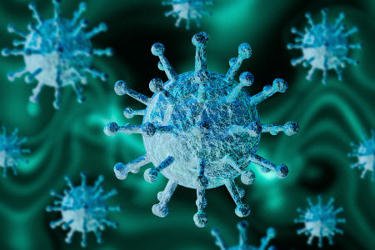
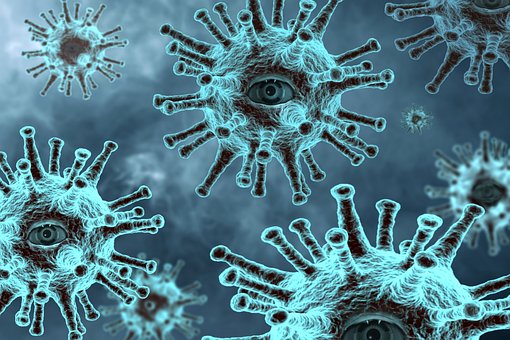
The spikes on the surface of coronaviruses give this virus family its name — corona, which is Latin for “crown.”
As the global health community tracks the spread of this virus, it’s important for water and wastewater professionals to keep updated on potential impacts.
It's hard to miss the headlines.
The recent outbreak of novel coronavirus (2019-nCoV or COVID-19) has dominated news cycles in recent weeks.
The World Health Organization (WHO) is calling it “public enemy number one.” 
But what information do we have that is related to coronaviruses in water and wastewater systems?
And what can water- and wastewater-system operators do to protect public health?
Modern water and wastewater treatment systems play an important role in public health protection.
With the potential for environmental transmission, water and wastewater operators need to know the potential for survival of this type of virus in water and wastewater treatment systems.
Coronaviruses, named for the crown-like spikes on their surface, were first identified in the mid-1960s.
Currently, seven coronaviruses are known to infect people and make them ill.
Three of these — MERS-CoV, SARS-CoV, and COVID-19 — emerged in the last 20 years and are examples of how some coronaviruses that infect animals can evolve to infect humans.
COVID-19 is a new variety of coronavirus and is an enveloped, single-stranded (positive-sense) RNA virus.
So, what is the fate of coronavirus in sewage and wastewater treatment plants?
Or in the aquatic environment?
And should we be worried about the efficacy of water treatment filtration and disinfection processes for coronavirus removal and inactivation?
The short answer: No — if we take proper precautions and risk considerations.
The long answer: This is a new virus without an extensive body of literature on the effectiveness of water and wastewater treatment processes. And real-life experiences will vary due to water quality and treatment plant details.
According to a 2008 University of Arizona study, coronaviruses have not been found to be more resistant to water treatment than other microorganisms such as E. coli, phage, or poliovirus — which are commonly used as surrogates for treatment performance evaluations.
Results from bench-scale studies suggest that the survival of coronaviruses is temperature dependent, with greater survival at lower temperatures.
Therefore, coronavirus is expected to be reduced in raw wastewater and surface waters in warmer seasons. 
How is it transmitted?
Human viruses do not replicate in the environment.
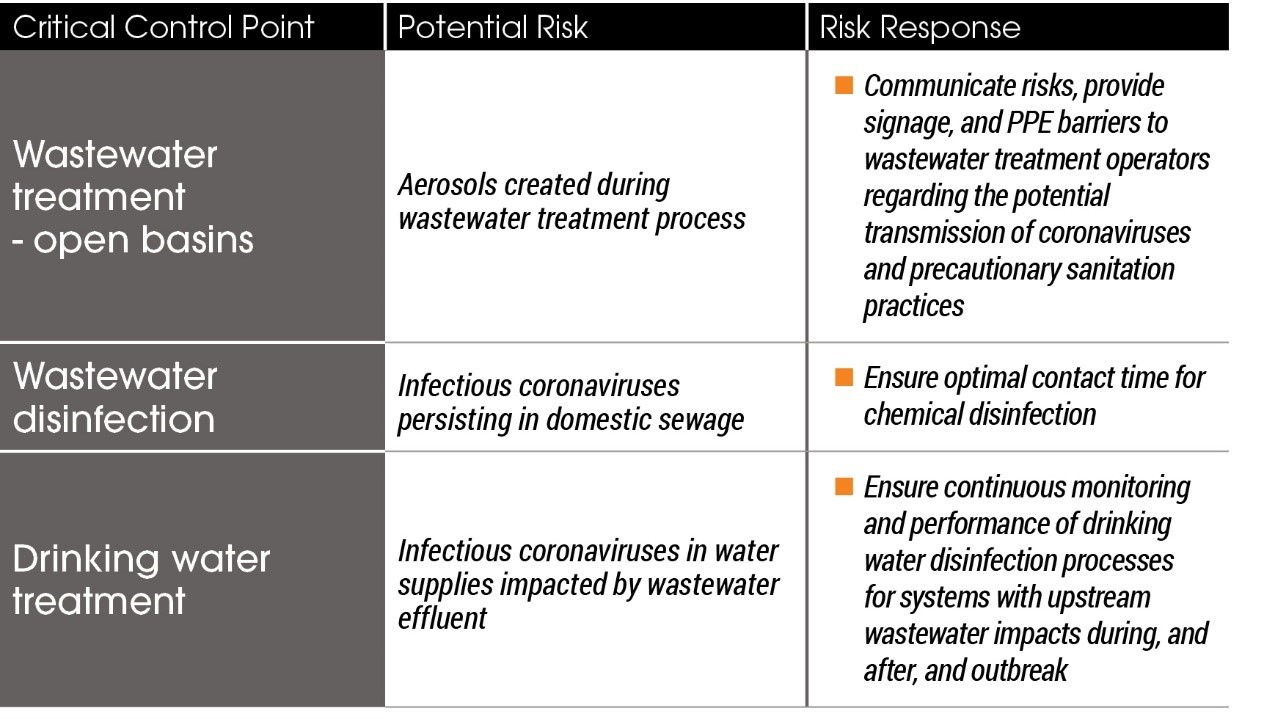
For a coronavirus to be transferred via the water cycle, it must have the ability to survive in human waste, retain its infectivity, and come in contact with another person — most likely via aerosols.
Findings suggest that COVID-19 can be transmitted through human waste.
Should a major virus pandemic occur, wastewater and drinking water treatment industries would face increased scrutiny.
Utilities would need to respond rapidly to minimize occupational and public health risks based on the available evidence.
Wastewater effluents would possibly impact recreation, irrigation, and drinking waters.
While wastewater treatment does reduce virus levels, infective human viruses are often detected in wastewater treatment plant effluent.
Information for wastewater treatment plant operators
Typically, human waste entering a sewage system is carried through an underground pipe system to a municipal treatment plant. Wastewater treatment plants receiving sewage from hospitals and isolation centers treating coronavirus patients — and domestic sewage from areas of known large contamination — may have elevated concentrations of viruses. Wastewater is treated by a variety of processes to reduce the pollution impacts on nearby receiving waters (lakes, rivers) and disinfected.
Currently, major data gaps exist on the potential role of the water cycle in the spread of enveloped viruses. The lack of detection methods for these strains of viruses is a main reason this type of information is still relatively unknown. Most detection methods are designed and optimized for non-enveloped enteric viruses, and there just isn’t enough information available.
In general, secondary wastewater treatment is credited with removing 1-log (90 percent) of viruses, though broad studies suggest the level of virus removal is highly variable, ranging from insignificant to greater than 2-log removal (99 percent). Because of this variability, the primary process for the inactivation of viruses in wastewater treatment is chemical disinfection (e.g., chlorination) and/or by ultraviolet light.
Drinking water treatment is an effective barrier
Surface-water treatment plants with upstream wastewater impacts are the most susceptible to having coronavirus contamination in the raw water supply during, and after, an outbreak.
Viruses are exposed to several potentially inactivating stresses in surface waters, including sunlight, oxidative chemicals, and predation by microorganisms.
Generally, enveloped viruses are more susceptible to common drinking water disinfectants than non-enveloped viruses.
Based on published research, water treatment processes that meet virus removal/inactivation regulations are effective for coronavirus control.
For example, drinking water quality guidelines from Health Canada note conventional treatment with free available chlorine can achieve at least 8-log inactivation of viruses in general.
Of course, disinfection performance must be continuously monitored (e.g., turbidity, disinfectant dose, residual, pH, temperature, and flow).
Optimized conventional filtration can achieve 2-log (99 percent) virus removal and is just one of many processes water treatment facilities incorporate to make our water safe to drink.
Modern drinking water treatment plants are well equipped to remove and disinfect viruses through filtration and disinfection processes.
So now what?
By and large, these viruses are not considered a major threat for the wastewater and water industries due to their low concentrations in municipal wastewater and high susceptibilities to degradation in aqueous environments.
According to new OHSA guidance, there is no evidence to suggest that additional, COVID-19-specific protections are needed for employees involved in wastewater treatment operations.
The WHO found that risk communication and community engagement (RCCE) has been integral to the success of response to health emergencies.
Action items related to coronavirus include communicating about preparedness measures and establishing a system for listening to public perceptions to prevent misinformation.
Basic recommendations for treatment-plant operators when dealing with a potential virus outbreak
So far, this virus does not appear to survive well in the environment and can be eliminated effectively by water treatment, especially chlorination, and would pose a minimal risk through drinking water.
As the outbreak continues, more water-quality experiments are needed before major conclusions can be drawn on their fate within treatment processes.
While this will be tricky, especially as viruses continue to replicate and evolve, quantitative risk assessments should be a top priority for enveloped viruses in wastewater, recreational waters, and drinking water.
Treatment-plant operators can download this white paper for more details on current state of knowledge on coronaviruses as it relates to our practice.
For additional reputable and reliable sources of information that are updated frequently with technical guidance, public health information, and the latest research visit the Water Environment Federation’s coronavirus site

About the authors
Nicole McLellan is an environmental scientist. She has an academic background in environmental microbiology and civil engineering for drinking water treatment performance evaluations.
David Pernitsky is global practice leader for water treatment. He has more than 25 years of environmental engineering experience, managing many challenging studies.
Arthur Umble is Stantec’s global lead for wastewater practice. He develops strategies and provides solutions for complex wastewater treatment challenges.
https://www.wateronline.com/doc/coronavirus-and-the-water-cycle-here-is-what-treatment-professionals-need-to-know-0001


You might also like:

Coronavirus prophecies: Christian crucifix
Coronavirus And The End Times
CLICK HERE . . . to view . . . 
https://puricarechronicles.blogspot.com/2020/03/coronavirus-and-end-times-just-as.html
..............................................................................................................

Coronavirus
Sewage water as indicator for spreading of COVID-19
CLICK HERE . . . to view . . . 
..............................................................................................................
Is Coronavirus a Divine Judgment or a Call to Faith?Is Coronavirus a Divine Judgment or a Call to Faith?
CLICK HERE . . . to view . . . 
.............................................................................................................. 

soapy hands
How Long Can Viruses Live on Surfaces?
CLICK HERE . . . to view . . . 
.............................................................................................................. 

The 12 
Deadliest 
Viruses on Earth
CLICK HERE . . . to view . . . 
Coronavirus, Virus, Mouth Guard

Tuesday, December 31, 2019

WD-40 – WD-40 literally stands for "Water Displacement 40th " attempt. That's the name straight out of the lab book used by the chemist who helped develop WD-40 back in 1953. WD-40 was invented by the three founders of the Rocket Chemical Company of San Diego, California. The team of inventors was working on a line of industrial rust-prevention solvents and degreasers for use in the aerospace industry. WD-40 was first used to protect the outer skin of the Atlas Missile from rust and corrosion. Two of the craziest purposes for WD-40 include a bus driver in Asia who used it to remove a python snake which had coiled itself around the undercarriage of his bus and police officers who used WD-40 to remove a naked burglar trapped in an air conditioning vent. Its properties make it useful in both domestic and commercial settings. Typical uses for WD-40 include removing dirt and removing stubborn screws and bolts. It can also be used to loosen stuck zippers and displace moisture.

Redstone nuclear rocket, low angle view, against a blue sky.
...................................................................................................................................................................
WD-40
The Interesting History of WD-40
by Mary Bellis


If you've ever used WD-40 to oil up something squeaky in your home, you may have wondered, just what does WD-40 stand for?
According to the company that makes it, WD-40 literally stands for "Water Displacement 40th " attempt.
That's the name straight out of the lab book used by the chemist who helped develop WD-40 back in 1953.
Norman Larsen was attempting to concoct a formula to prevent corrosion, a task which is done by displacing water.
Norm's persistence paid off when he perfected the formula for WD-40 on his 40th try.
Rocket Chemical Company
WD-40 was invented by the three founders of the Rocket Chemical Company of San Diego, California.
The team of inventors was working on a line of industrial rust-prevention solvents and degreasers for use in the aerospace industry.
Today, it is manufactured by the San Diego, California-based WD-40 Company.
WD-40 was first used to protect the outer skin of the Atlas Missile from rust and corrosion.
When it was discovered to have many household uses, Larsen repackaged WD-40 into aerosol cans for consumer use and the product was sold to the general public in 1958.
In 1969, the Rocket Chemical Company was renamed after its only product (WD-40).
Interesting Uses for WD-40
Two of the craziest purposes for WD-40 include a bus driver in Asia who used it to remove a python snake which had coiled itself around the undercarriage of his bus and police officers who used WD-40 to remove a naked burglar trapped in an air conditioning vent.
Ingredients
WD-40's main ingredients, as supplied in aerosol cans, according to the U.S. Material Safety Data Sheet information, are:
50 percent "aliphatic hydrocarbons." The manufacturer's website claims this ratio in the current formulation cannot accurately be described as Stoddard solvent, a similar mixture of hydrocarbons.
<25 percent petroleum base oil. Presumably, mineral oil or light lubricating oil.
12-18 percent low vapor pressure aliphatic hydrocarbon. Reduces the liquid's viscosity so that it can be used in aerosols. The hydrocarbon evaporates during application.
2-3 percent carbon dioxide. A propellant which is now used instead of the original liquefied petroleum gas to reduce WD-40's flammability.
<10 percent inert ingredients.
The long-term active ingredient is a non-volatile viscous oil which remains on the surface to which it is applied, giving lubrication and protection from moisture.
The oil is diluted with a volatile hydrocarbon to make a low viscosity fluid which can be aerosolized to penetrate crevices.
The volatile hydrocarbon then evaporates, leaving behind the oil. A propellant (originally a low-molecular-weight hydrocarbon, now carbon dioxide) creates pressure in the can to force the liquid through the can's nozzle before evaporating.
Its properties make it useful in both domestic and commercial settings.
Typical uses for WD-40 include removing dirt and removing stubborn screws and bolts. It can also be used to loosen stuck zippers and displace moisture.
Due to its lightness (i.e. low viscosity), WD-40 is not always the preferred oil for certain tasks.
Applications that require higher viscosity oils may use motor oils. Those requiring a mid-range oil could use honing oil instead.

Mary Bellis
Introduction
·         New York-based film producer and director
·         Singled out by Forbes magazine for her writing on inventors. 
·         Known in art and independent film circles by the name CalmX
·         Creator of computer-generated art
Experience
Mary Bellis was a former writer for ThoughtCo, where she covered inventors for 18 years. She was a freelance writer, film producer, and director.  In addition, Forbes Best of the Web credited her for creating the number one online destination for information about inventors and inventions. Her writing has been reprinted and referenced in numerous educational books and articles. She was known for her short independent  films and documentaries, including one on Alexander Graham Bell. She specialized in making and exhibiting computer-generated art, while working as an animator, journalist and an independent video game developer. She died on March 28, 2015.  
Education
Mary Bellis held a Master of Fine Arts in film and animation from the San Francisco Art Institute.
ThoughtCo and Dotdash
ThoughtCo is a premier reference site focusing on expert-created education content. We are one of the top-10 information sites in the world as rated by comScore, a leading Internet measurement company. Every month, more than 13 million readers seek answers to their questions on ThoughtCo.
For more than 20 years, Dotdash brands have been helping people find answers, solve problems, and get inspired. We are one of the top-20 largest content publishers on the Internet according to comScore, and reach more than 30% of the U.S. population monthly. Our brands collectively have won more than 20 industry awards in the last year alone, and recently Dotdash was named Publisher of the Year by Digiday, a leading industry publication.
Redstone nuclear rocket, low angle view, against a blue sky.

Thursday, December 5, 2019

AIR CONDITIONING MAY BE SPREADING COVID - As COVID-19 cases rise rapidly some scientists believe there could be an important, but overlooked factor in the spread of the virus in the region -- air conditioning. Just as chilly winter temps create the perfect conditions for passing colds and flu — driving people indoors and into closer proximity for more hours of the day where it’s easy to swap germs, researchers believe broiling heat in the southern U.S. could be having the same effect, sending people indoors where whirring air conditioners are running full blast. Air conditioning is also risky because of the way air handlers work. When outdoor temperatures are extreme, HVAC systems adjust the mix of fresh air they pull in to save energy. That means the hotter it is outside, the more indoor air recirculates, which means, you’re breathing a higher percentage of the same air that other people are exhaling. If someone in the building is shedding the new coronavirus, it can build up in the recirculated air. And this may seem obvious, but air conditioners have fans that blow the air around. That gives the smallest viral particles — aerosols -- extra lift to stay suspended in the air. The air currents that are produced by air conditioners and also fans and other air moving devices can carry particles further than they might otherwise go. Air conditioners also remove moisture from the air, and we know viruses prefer dry air.

photo of air conditioning vent
..................................................................................................................................................
Air Conditioning May Be Spreading COVID
By Brenda Goodman, MA


As COVID-19 cases rise rapidly throughout the South, some scientists believe there could be an important, but overlooked factor in the spread of the virus in the region -- air conditioning.
Just as chilly winter temps create the perfect conditions for passing colds and flu — driving people indoors and into closer proximity for more hours of the day where it’s easy to swap germs, researchers believe broiling heat in the southern U.S. could be having the same effect, sending people indoors where whirring air conditioners are running full blast.
“You go indoors for the cool, just as in the northeast and other cool places you go in for the warmth in winter, so you’re less socially distanced,” says Edward Nardell, MD, professor of environmental health and immunology and infectious diseases at Harvard’s T.H. Chan School of Public Health.
“You’re more likely to be touching the same surfaces that have been contaminated by people speaking and coughing etc.,” he says.
And that’s not the only problem.
Air conditioning is also risky because of the way air handlers work. When outdoor temperatures are extreme, HVAC systems adjust the mix of fresh air they pull in to save energy.
That means the hotter it is outside, the more indoor air recirculates, which means, “You’re breathing a higher percentage of the same air that other people are exhaling,” Nardell says.
If someone in the building is shedding the new coronavirus, it can build up in the recirculated air.
And this may seem obvious, but air conditioners have fans that blow the air around.
That gives the smallest viral particles — aerosols -- extra lift to say suspended in the air for longer.
“The air currents that are produced by air conditioners and also fans and other air moving devices can carry particles further than they might otherwise go,” he says.
Air conditioners also remove moisture from the air, “and we know viruses prefer dry air,” he says.
In certain situations, that combination of factors may create the perfect conditions for contagion.
Emerging Evidence Points To Airborne Transmission
Studies of air conditioning come as more evidence emerges about airborne spread of COVID-19.
In a commentary published this week in the journal Clinical Infectious Diseases, an international group of 239 scientists have appealed to “national and international bodies” including the World Health Organization, to recognize this potential for airborne spread.
“We’re pushing because we need very clear, consistent messaging to the world,” said Shelly Miller, PhD, a professor of mechanical engineering who studies indoor air quality at the University of Colorado at Boulder.
Miller was one of the chief proponents of the commentary.
This virus is opportunistically airborne, you can get it by inhaling it,” she says.
Miller and others believe that WHO and other public health agencies have a blind spot when it comes to airborne transmission.
“Based on our assessments of outbreaks, air sampling, and animal studies and we have just as much evidence to show that airborne transmission is happening as is surface transmission, so we need clear guidance for how to address this,” Miller says.
In its latest press briefing, WHO experts responded to the communication, and said the agency would be publishing a scientific brief summarizing their view of the science shortly.
“We acknowledge that there is emerging evidence in this field,” said Benedetta Allegranzi, MD, WHO’s technical lead for infection prevention and control.
 “We believe we have to be open to this evidence and understand its implications regarding the modes of transmission and the precautions that need to be taken,” she said.
The Role of Air Conditioning
So far, there are just a few studies pointing to the role of air conditioning in the spread of COVID-19. They indicate more research in the area is needed.
In July, Chinese scientists published a short study detailing the results of their investigation of a cluster of COVID-19 cases linked to the same restaurant.
The 10 diners who fell ill were all sitting at tables on the same side of the room.
The tables were spaced more than 3 feet apart, though, indicating that the virus probably wasn’t being passed through larger droplets, which fall out of the air pretty quickly.
Instead, they think “strong airflow” from a wall mounted air conditioner probably spread aerosols, or “micro-droplets”, from a single infected, but asymptomatic person over the tables, infecting three different families.
In another study, which hasn’t yet been peer reviewed, researchers swabbed three different HVAC units at the Oregon Health and Science University Hospital in Portland. 
Then they checked their samples for the presence of genetic material from the SARS-CoV-2 virus. The swabs were positive in 1 out of every 4 samples taken.
“We found it in multiple locations within the air handler,” says study author Kevin Van Den Wymelenberg, PhD, a professor of architecture and director of the Institute for Health in the Built Environment at the University of Oregon in Eugene.
similar study, from the University of Nebraska Medical Center, detected genetic material from the virus in air samples collected from rooms of COVID-19 patients, even air samples collected from more than six feet away.
Van Den Wymelenberg says their study can’t prove that the remnants of the virus they picked up could have actually infected anyone.
To know that, they would have had to try to grow their samples alongside cells in a petri dish and watch to see if those cells were infected.
Those are expensive studies to perform and they require a specialized lab certified to handle highly contagious germs — called a biosafety level 3 lab.
Those are less common, and they’re all currently slammed with projects.
But he says his study does show that genetic material from the virus is making it into the machinery of massive air handlers in hospitals, even ones that are using good filters, and he thinks that should make public health experts closely consider air conditioning as a vehicle for virus spread.
Steps for Safer Indoor Air
Miller says that the easiest thing to keep the virus from building up inside is to bring in more outdoor air.
In homes, that means opening windows and doors regularly to let fresh air in.
That’s harder to do in commercial buildings.
“What we’ve been recommending to minimize risk indoors is to provide 100% outside air, which you can’t do if you’re trying to heat or cool because it just costs way too much money,” she said.
Another strategy to reduce the risk of being indoors is to kill airborne viruses with special wall or ceiling mounted boxes that emit short-range UV radiation.
This kind of UV light doesn’t damage skin the way sunlight does, but still zaps harmful germs.
These so-called upper-room germicidal systems have successfully controlled outbreaks of other airborne pathogens, like tuberculosis, Nardell says.
Finally, you can invest in an air cleaner.
Miller cautions that if you go this route, you need to do a fair amount of homework first, learning about things like a machine’s clean air delivery rate, or CADR.
“I purchased an air cleaner strictly to operate when and if somebody in my household gets sick so we can reduce the viral load in my house air,” she says.
Ionizing cleaners don’t work, she says.
Miller recommends checking the website of the Association of Home Appliance Manufacturers, or AHAM to find a good air cleaner.
“They have a whole website set up to do your research and buy a good air cleaner that will work in your home or office,” she says.

Brenda Goodman, MA, is a staff writer for WebMD.  Her work has appeared in The New York Times, Scientific American, Psychology Today, The Boston Globe, Self, Shape, Parade, U.S. News and World Report, and Atlanta Magazine. She has a master’s degree in science and environmental reporting from New York University.