Showing posts with label Solar power. Show all posts

Friday, July 31, 2020

SOLAR PANELS ON CARS - Much like solar-powered homes, solar cars harness energy from the sun, and then convert it into electricity. That electricity then fuels the car's powertrain, which is similar to the combination of an electric motor and battery-based energy storage that drives modern hybrid cars. Solar cars can accomplish this through photovoltaic cells. PVCs are the components in solar paneling that convert the sun's energy to electricity. They're made up of semiconductors, usually made of silicon that absorb the light. The sunlight's energy then frees electrons in the semiconductors, creating a flow of electrons. That flow generates the electricity that powers the battery or the specialized motor in solar cars. The earliest solar cars were DIY jobs that date back to the 1970s and were mostly designed and assembled in car enthusiasts' garages. Several other organizations experimented with race cars designed to take advantage of solar power. These helped engineers understand the potential of collecting and storing solar energy, maximizing aerodynamics and identifying other challenges to running a car powered off the sun. As for major auto manufacturers' contributions to the field, Ford and Mazda, notably, both introduced solar hybrid concept cars in the mid-2000s, and Cadillac designed a concept car that used solar panels to help power accessories like interior lighting and audio that typically draw off a car's electrical system.

Tesla Cybertruck
.................................................................................................................................................
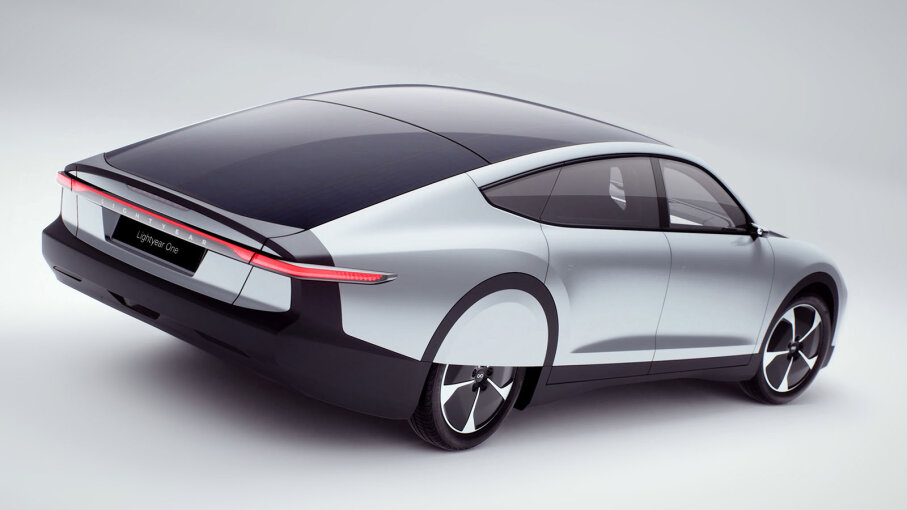
Lightyear One
The roof and hood of the Lightyear One are comprised of integrated
solar cells so the car can charge itself whenever it absorbs sunlight.
Solar Panels Are Slowly Making Their Way on Cars
BY CRISTEN CONGER & CHERISE THREEWITT


There may be no such thing as a free lunch, but what about a free ride?
Think of how awesome it would be if your car could keep running without you spending a dime on fuel.
If you drove a solar-powered car that dream could be a lot closer to a reality.
Much like solar-powered homes, solar cars harness energy from the sun, and then convert it into electricity.
That electricity then fuels the car's powertrain, which is similar to the combination of an electric motor and battery-based energy storage that drives modern hybrid cars.
Solar cars can accomplish this through photovoltaic cells (PVC).
PVCs are the components in solar paneling that convert the sun's energy to electricity. They're made up of semiconductors, usually made of silicon that absorb the light.
The sunlight's energy then frees electrons in the semiconductors, creating a flow of electrons. That flow generates the electricity that powers the battery or the specialized motor in solar cars.
The earliest solar cars were DIY jobs that date back to the 1970s and were mostly designed and assembled in car enthusiasts' garages.
Several other organizations experimented with race cars designed to take advantage of solar power.
These helped engineers understand the potential — and the limitations — of collecting and storing solar energy, maximizing aerodynamics and identifying other challenges to running a car powered off the sun.
As for major auto manufacturers' contributions to the field, Ford and Mazda, notably, both introduced solar hybrid concept cars in the mid-2000s, and Cadillac designed a concept car that used solar panels to help power accessories like interior lighting and audio that typically draw off a car's electrical system (which, in turn, contributes to fuel consumption).
None of these concept cars made it to production, which means they were never available to consumers.
After that, investment in solar car technology more or less went dark, at least as a mainstream pursuit.
On the upside, though, many automakers have shifted development resources toward making hybrid and plug-in hybrid cars more practical, efficient and affordable than ever.
This, in turn, means it might be time to give solar cars another shot, though the new-generation solar cars on the horizon are more like hybrids that add solar power to the mix.
Are Solar-powered Cars Practical?
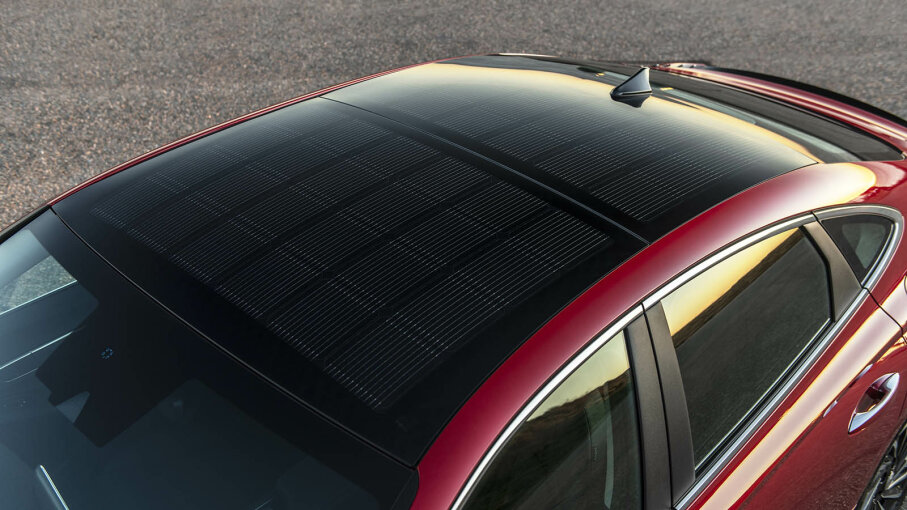
Hyundai Sonata
The 2020 Hyundai Sonata Hybrid features a Solar Roof System that recharges
 the car's hybrid battery and increases the car's driving range by a couple of miles a day.
The renewed interest in solar panels on cars is less about the panels themselves becoming better, and more about the fact that hybrid and electric cars, and their infrastructure, is better.
In other words, it's easier and more affordable than ever for consumers to go buy a readily available electric or hybrid car, and these cars are more efficient, easier to charge, and have fewer compromises overall than EVs and hybrids of just a couple generations ago.
That means there are more people who can take advantage of solar power to run a car, and that solar power will literally go farther than it would have in the past.
That said, solar panel technology has improved, too.
It's more affordable and easier for most consumers to incorporate into a home or garage update. But solar-powered cars still have a long way to go.
In fact, it's unlikely that we'll see a car that can be fully powered by a solar panel integrated into the roof, because a panel that size is just too small to produce the power needed.
EnergySage, a company that helps consumers research and shop for solar technology, estimates that a car completely covered in solar panels (not just the roof) could only power an electric car for a maximum of 25 miles (40 kilometers) a day, and that's assuming weather and other conditions are absolutely perfect.
Yet, EnergySage argues a solar panel that gives a car a boost of just a few miles a day is still worth the investment.
So which automakers are investing in the technology?
There are several. High-tech company Lightyear released two Lightyear Research Vehicles to test its integrated solar technology on the road in June 2020.
The company says it is preparing to produce an exclusive series of cars equipped with its solar technology by the end of 2021.
Germany's Sono Motors has spent three years developing a manufacturing process that will enable the seamless integration of solar cells into the body of its Sion electric car.
On June 30, 2020, the company announced it had partnered with Roding Automobile GmbH to begin production of its next generation of Sion prototypes.
Toyota is testing a version of the Prius with an integrated solar roof in Japan.
This demo version, which is not for sale, can charge the car while it is being driven; its earlier version could only charge while parked.
The 2020 Hyundai Sonata Hybrid, however, is available to American consumers and comes with a solar roof panel that recharges the car's batteries.
The roof panel generates enough electric power to increase the car's driving range by about 2 miles (3.2 kilometers) a day.
The Tesla Cybertruck, which was unveiled in November 2019 but isn't expected to be released until late 2021, has an option for solar panels, even though Tesla CEO Elon Musk has previously said that solar panels on cars are too inefficient.
And that brings us to the question of whether or not the extra cost of adding solar panels to a car is worth it.
For example, cars in sunnier locations and cars that are parked outside rather than in a garage, will generate more solar power and offer more of a financial benefit to owners.
But the question still remains to be seen whether the financial costs to automakers will be beneficial enough to produce them.
DIY solar panel kits that are designed to contribute to powering the battery of an electric or plug-in hybrid car via the home's charging system are available.
Similar aftermarket kits are offered and marketed as ways to help power RVs or trailers.
They can also be used to collect and store energy for camping accessories such as tents or cooking setups, like those designed to mount in the bed of a pickup truck.
Tesla Cybertruck
Tesla's Cybertruck has optional solar panels, which can be used to
power things like its camping equipment.
Solar kits for these purposes are mainstream enough that they're available at online and big box retailers.
As for now, though, adding solar panels directly to your car isn't very common. Though they may someday become more plausible for more consumers.
SOLAR CAR COMPETITIONS
Solar car racing has been going on since the 1980s, long before today's consumer-focused efforts at getting solar cars on the road.
The 1,872-mile (3,012-kilometer) World Solar Challenge began in 1983 and races across Australia every two years.
The American Solar Challenge started in 1990 and follows a route across North America that changes almost every year.

About Cristen Conger  
Raised on a steady diet of Technicolor musicals and library books, Cristen Conger always wanted to be a writer when she grew up. While working toward her journalism degree at the University of Georgia, she learned to avoid starry-eyed statements about childhood dreams and stick to hard facts. After graduating, Cristen decided she'd spent enough time chasing down REM band members in Athens and hitched up the road to Atlanta where she jumped on board with the award-winning web site HowStuffWorks.com.

As a writer and blogger for HowStuffWorks and a contributing writer for Discovery News, Cristen specializes in technology and the science of everyday living. Her articles have featured on Huffington Post, ABC Science and MSNBC.com. She also co-hosts the popular Stuff Mom Never Told You podcast, which explores gender issues such as relationships, careers and women's history. A graduate of University of Georgia, where she majored in journalism, Cristen reads, writes, runs and dabbles in improv comedy.

Cherise Threewitt
CONTRIBUTING WRITER 
Cherise Threewitt is a Chicago-based writer and editor with 15 years of experience covering the automotive industry. At HowStuffWorks, Cherise enjoys researching and writing stories that make cars and car culture interesting and accessible for everyone. When Cherise isn't writing, she's probably at the gym, paddling on Lake Michigan, or driving her 2019 Subaru WRX.
Hyundai Sonata

Monday, December 2, 2019

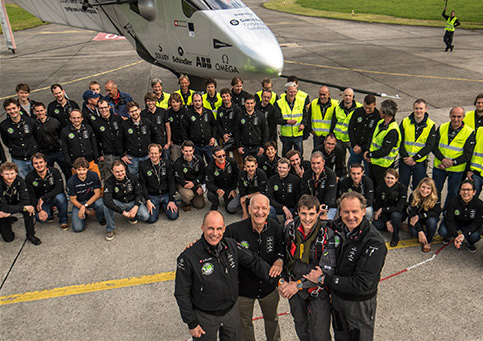
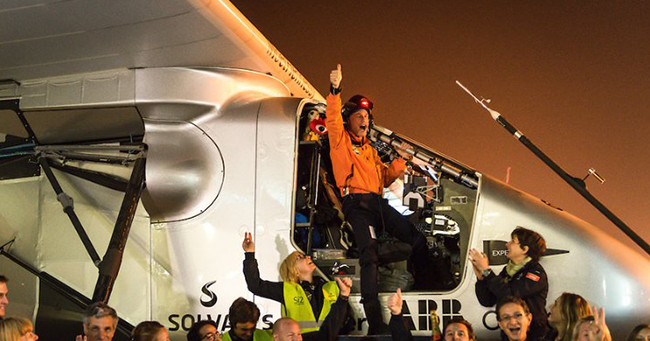
AROUND THE WORLD IN A SOLAR AIRPLANE - After the 8 world records set by the Solar Impulse prototype, when it became the first solar airplane ever to fly through the night, between two continents, and across the United States, Bertrand Piccard and André Borschberg accomplished the ultimate phase of the adventure: the 2015-2016 First Round-The-World Solar Flight. 40,000 km from Abu Dhabi, our departure and arrival Host City, to India, Myanmar, China, Japan, U.S.A and back to Europe and Abu Dhabi. As with all great firsts, there were no benchmarks. Strategies had to be invented from scratch to allow Solar Impulse 2 to fly across the Pacific for 5 consecutive days and nights, and become the first solar airplane to accomplish an oceanic crossing. This historic and record-breaking flight from Japan to Hawaii was achieved by André Borschberg in July 2015, proving that clean technologies can accomplish incredible things.


.................................................................................................................................................................
AROUND THE WORLD IN A SOLAR AIRPLANE
Solar Impulse Foundation


OUR ADVENTURE
In 2015 started the attempt of the First Round-The-World Solar Flight, from Abu Dhabi to Hawaii, already achieving the longest solo solar flight ever achieved in aviation history.
In 2016, Bertrand Piccard and André Borschberg, our two Pilots and Founders, completed the first circumnavigation of the globe with no fuel.
With their solar aircraft, a flying laboratory full of clean technologies, they flew 40,000 km to promote the use of renewable energies and energy efficiency on the ground, for a better quality of life.
Across the Round-The-World flight, the team overcame technical, human and operational challenges that had never been faced before.
After the 8 world records set by the Solar Impulse prototype, when it became the first solar airplane ever to fly through the night, between two continents, and across the United States, Bertrand Piccard and André Borschberg accomplished the ultimate phase of the adventure: the 2015-2016 First Round-The-World Solar Flight.
40,000 km from Abu Dhabi, our departure and arrival Host City, to India, Myanmar, China, Japan, U.S.A and back to Europe and Abu Dhabi.
As with all great firsts, there were no benchmarks. Strategies had to be invented from scratch to allow Solar Impulse 2 to fly across the Pacific for 5 consecutive days and nights, and become the first solar airplane to accomplish an oceanic crossing.
This historic and record-breaking flight from Japan to Hawaii was achieved by André Borschberg in July 2015, proving that clean technologies can accomplish incredible things.
Bertrand Piccard then finished crossing the Pacific, and flew over the Atlantic, making Si2 furthermore the first solar plane to have crossed the world’s two biggest oceans.
.
Because it is not possible to fly over oceans and continents in a single attempt, the solar airplane is doing its round-the-world flight in a total of about ten stages.
These stops give the plane respite before setting off again. They also allow the pilots to take over from each other, as the plane is a singleseater: the only seat in the cockpit is the one for the person at the controls.
Departure time and location for the round-the-world flight have not been decided by chance. The plane needs good weather in order to fly.
The month of March is early enough in the year to avoid flying over India during the monsoon; a season in which the winds blow very hard and the rains are abundant.
The Arabian Gulf region has been chosen because it has constant sunshine, which is needed to charge the plane with solar energy.
To determine the flight path that Solar Impulse will take in the sky, many factors must be considered: weather, air traffic areas, also the height of the land to be flown over and the performance of the airplane.
A team of engineers and meteorologists based in Monaco Mission Control Center (MCC) determines the best route for the plane and then prepares the flight plan.
Once the route is chosen, overflight and landing clearances must be negotiated for each country.
Abu Dhabi, Arrival and Departure Host City.
Abu Dhabi, capital city of the United Arab Emirates, will be the start and finish of the first solar powered flight around the world.
Masdar, Abu Dhabi’s renewable energy company, is the host partner of Solar Impulse.
The team was hosted by Masdar and Abu Dhabi at the start of January for testing and training before the start of the first solar powered flight around the world.
Si2 was delivered in Abu Dhabi by cargo plane from the Payerne aerodrome in Switzerland on January 6th and has been showcased during the World Future Energy Summit as part of the Abu Dhabi Sustainability Week, which is hosted by Masdar between 17 and 22 January 2015.
“This well matched partnership will show Abu Dhabi to be a centre of expertise when it comes to renewable energy and at the same time Solar Impulse will demonstrate the far reaching applications of clean energy during the first solar powered flight around the world,” declared Bertrand Piccard.
André Borschberg continued: “We have chosen this location as being the best and most suitable departure point for the round-the-world tour, due to its climate, infrastructure and commitment to clean technologies.”
Two men, both pioneers, innovators and pilots, are the driving force behind Solar Impulse.
Bertrand Piccard, a medical doctor specialized in psychiatry, explorer and aeronaut, who made the first non-stop round-the-world balloon flight, is the initiator and chairman.
André Borschberg, an engineer and graduate in management science, a fighter pilot and a professional airplane and helicopter pilot, is the co-founder and CEO.
The former’s avant-gardist vision and the latter’s entrepreneurial and managerial experience are an ideal combination.
« If governments had the courage to promote clean technologies on a massive scale, our society could simultaneously reduce its dependence on fossil fuels, create jobs and stimulate sustainable growth. » Bertrand Piccard
« Building teams is both art and science. The value of talent is created through differences, not similarities. » André Borschberg

ABOUT US
Let’s run the world with clean technologies The three record-breaking solo flights of André Borschberg from Nagoya to Hawaii and Bertrand Piccard from Hawaii to San Francisco and later New York to Seville give a clear message: everybody could use the same technologies on the ground to halve our world’s energy consumption, save natural resources and improve our quality of life.
To take the success of the solar-powered flight around the world further, the Solar Impulse Foundation is selecting 1000 solutions that protect the environment in a profitable way and awarding them the Solar Impulse Efficient Solution Label.
The Solar Impulse Efficient Solution label seeks to bridge the gap between ecology and economy, bringing together protection of the environment and financial viability to show that these solutions are not expensive fixes to problems, but rather opportunities for clean economic growth.