Showing posts with label Surface water. Show all posts

Sunday, November 22, 2020

GROUNDWATER FLOW - Groundwater moves much more slowly than surface water. Groundwater moves by percolating through a complex, crooked network of tiny conduits. Friction between groundwater and conduit walls slows down the water flow. The velocity of groundwater flow depends on the slope of the water table and the permeability of the material through which the groundwater is flowing. Thus, groundwater flows faster through high-permeability rocks than it does through low-permeability rocks, and it flows faster in regions where the water table has a steep slope than it does in regions where the water table has a gentle slope. What happens to groundwater over time? Does it just sit, unmoving, like the water in a stagnant puddle, or does it flow and eventually find its way back to the surface? Countless measurements confirm that groundwater enjoys the latter fate; groundwater indeed flows, and in some cases it moves great distances underground. Let’s examine factors that drive groundwater flow. In the unsaturated zone the region between the ground surface and the water table, water percolates straight down, like the water passing through a drip coffee maker, for this water moves only in response to the downward pull of gravity. But in the zone of saturation the region below the water table water flow is more complex, for in addition to the downward pull of gravity, water responds to differences in pressure.

.................................................................................................................................................................................................................................................................................................................................................................................................................................

Groundwater Flow

Groundwater moves much more slowly than surface water. Groundwater moves by percolating through a complex, crooked network of tiny conduits. Friction between groundwater and conduit walls slows down the water flow. The velocity of groundwater flow depends on the slope of the water table and the permeability of the material through which the groundwater is flowing. Thus, groundwater flows faster through high-permeability rocks than it does through low-permeability rocks, and it flows faster in regions where the water table has a steep slope than it does in regions where the water table has a gentle slope.

Muhammad Qasim


What happens to groundwater over time?

Does it just sit, unmoving, like the water in a stagnant puddle, or does it flow and eventually find its way back to the surface?

Countless measurements confirm that groundwater enjoys the latter fate; groundwater indeed flows, and in some cases it moves great distances underground.

Let’s examine factors that drive groundwater flow. 

In the unsaturated zone the region between the ground surface and the water table, water percolates straight down, like the water passing through a drip coffee maker, for this water moves only in response to the downward pull of gravity.

But in the zone of saturation the region below the water table water flow is more complex, for in addition to the downward pull of gravity, water responds to differences in pressure.

Pressure can cause groundwater to flow sideways, or even upward. (If you've ever watched water spray from a fountain, you've seen pressure pushing water upward.)

Thus, to understand the nature of groundwater flow, we must first understand the origin of pressure in groundwater.

For simplicity, we’ll consider only the case of groundwater in an unconfined aquifer. 

The shape of water table beneath hilly topography.


Pressure in groundwater at a specific point underground is caused by the weight of all the overlying water from that point up to the water table.

(The weight of overlying rock does not contribute to the pressure exerted on groundwater, for the contact points between mineral grains bear the rock’s weight.)

Thus, a point at a greater depth below the water table feels more pressure than does a point at lesser depth.

If the water table is horizontal, the pressure acting on an imaginary horizontal reference plane at a specified depth below the water table is the same everywhere.

But if the water table is not horizontal, as shown in above, the pressure at points on a horizontal reference plane at depth changes with location.

For example, the pressure acting at point p1, which lies below the hill in figure above, is greater than the pressure acting at point p2, which lies below the valley, even though both p1 and p2 are at the same elevation. 

Both the elevation of a volume of groundwater and the pressure within the water provide energy that, if given the chance, will cause the water to flow.

Physicists refer to such stored energy as potential energy.

The potential energy available to drive the flow of a given volume of groundwater at a location is called the hydraulic head.

To measure the hydraulic head at a point in an aquifer, hydrogeologists drill a vertical hole down to the point and then insert a pipe in the hole.

The height above a reference elevation (for example, sea level) to which water rises in the pipe represents the hydraulic head water rises higher in the pipe where the head is higher.

As a rule, groundwater flows from regions where it has higher hydraulic head to regions where it has lower hydraulic head.

This statement generally implies that groundwater regionally flows from locations where the water table is higher to locations where the water table is lower. 

Hydrogeologists have calculated how hydraulic head changes with location underground, by taking into account both the effect of gravity and the effect of pressure.

The flow of groundwater.

These calculations reveal that groundwater flows along concave-up curved paths, as illustrated in cross section (figure above a, b).

These curved paths eventually take groundwater from regions where the water table is high (under a hill) to regions where the water table is low (below a valley), but because of flow-path shape, some groundwater may flow deep down into the crust along the first part of its path and then may flow back up, toward the ground surface, along the final part of its path.

The location where water enters the ground (where the flow direction has a downward trajectory) is called the recharge area, and the location where groundwater flows back up to the surface is called the discharge area (see figure above a). 

Flowing water in an ocean current moves at up to 3 km per hour, and water in a steep river channel can reach speeds of up to 30 km per hour.

In contrast, groundwater moves at less than a snail’s pace, between 0.01 and 1.4 m per day (about 4 to 500 m per year).

Groundwater moves much more slowly than surface water, for two reasons.

First, groundwater moves by percolating through a complex, crooked network of tiny conduits, so it must travel a much greater distance than it would if it could follow a straight path.

Second, friction between groundwater and conduit walls slows down the water flow. 

Simplistically, the velocity of groundwater flow depends on the slope of the water table and the permeability of the material through which the groundwater is flowing.

Thus, groundwater flows faster through high-permeability rocks than it does through low-permeability rocks, and it flows faster in regions where the water table has a steep slope than it does in regions where the water table has a gentle slope.

For example, groundwater flows relatively slowly (2 m per year) through a low-permeability aquifer under the Great Plains, but flows relatively quickly (30 m per year) through a high-permeability aquifer under a steep hillslope.

In detail, hydrogeologists use Darcy’s Law to determine flow rates at a location.

Darcy’s Law for Groundwater Flow 

The rate at which groundwater flows at a given location depends on the permeability of the material containing the groundwater; groundwater flows faster in a more permeable material than it does in a less permeable material.

The level to which water rises in a drill hole is the hydraulic head (h).
 The hydraulic gradient (HG) is the difference in head divided by
 the length of the flow path.

The rate also depends on the hydraulic gradient, the change in hydraulic head per unit of distance between two locations, as measured along the flow path. 

To calculate the hydraulic gradient, we divide the difference in hydraulic head between two points by the distance between the two points as measured along the flow path. This can be written as a formula:

hydraulic gradient = h1 - h2/j

where h1 - h2 is the difference in head (given in meters or feet, because head can be represented as an elevation) between two points along the water table, and j is the distance between the two points as measured along the flow path.

A hydraulic gradient exists anywhere that the water table has a slope.

Typically, the slope of the water table is so small that the path length is almost the same as the horizontal distance between two points.

So, in general, the hydraulic gradient is roughly equivalent to the slope of the water table. 

In 1856, a French engineer named Henry Darcy carried out a series of experiments designed to characterize factors that control the velocity at which groundwater flows between two locations (1 and 2), each of which has a different hydraulic head (h1 and h2).

Darcy represented the velocity of flow by a quantity called the discharge (Q), meaning the volume of water passing through an imaginary vertical plane perpendicular to the groundwater’s flow path in a given time.

He found that the discharge depends on the hydraulic head (h1- h2); the area (A) of the imaginary plane through which the groundwater is passing; and a number called the hydraulic conductivity (K).

The hydraulic conductivity represents the ease with which a fluid can flow through a material.

This, in turn, depends on many factors (such as the viscosity and density of the fluid), but mostly it reflects the permeability of the material.

The relationship that Darcy discovered, now known as Darcy’s law, can be written in the form of an equation as:

Q = KA(h1 - h2)/j 

The equation states that if the hydraulic gradient increases, discharge increases, and that as conductivity increases, discharge increases.

Put in simpler terms, the flow rate of groundwater increases as the permeability increases and as the slope of the water table gets steeper.

Muhammad Qasim

Gender  MALE

Industry Education

Location Pakistan

Interests Earth Sciences, Hydrogeology, Geoscience Communication, Geoscience Education and Outreach

Learning Geology is a science website and a community of Earth Scientists that shares geology lessons and host live virtual field tours from all around the world.

With our postings we aim to reach to our fellows with broader public regardless of the boundaries. The postings are done in the great interests of the fellow to learn more and more. The reason for writing is to provide an environment where we can give the best knowledge present just to be shared in the field of Earth and space sciences that we present here. Nobody judge anyone so feel free to feedback and let us know what great ideas you have, be a contributor. 

http://geologylearn.blogspot.com/2015/12/groundwater-flow.html


You might also like:

.

Where Did All That Water Come From?

The "fountains of the great deep" most likely refer to subterranean sources of water

CLICK HERE . . . to view . . . 

https://puricarechronicles.blogspot.com/2018/05/the-waters-of-noahs-flood-we-dont-know.html

................................................................................................................................................................................................................................................................ pchron


Friday, October 16, 2020

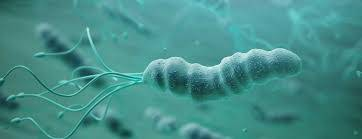
THE BACTERIUM ASSOCIATED WITH STOMACH ULCERS - Could my municipal water supply have the bacteria that causes ulcers? This is not very likely. Even though very little is currently known about the epidemiology of Helicobactor pylori, the bacterium associated with stomach ulcers — it is believed that all standard disinfection methods used in the U.S. are capable of killing this organism in drinking water. Dr. Katherine Baker, Assistant Professor of Environmental Microbiology and John Hegarty, a graduate student at Penn State Harrisburg, found H. pylori in more than 75 percent of 36 tested surface water samples in Central Pennsylvania. This study is the first report of H. pylori in surface water in the United States, demonstrating a major reservoir for this organism outside the human body. The results of the research were delivered on in May at the 98th General Meeting of the American Society for Microbiology in Atlanta, Georgia. H. pylori was first described in the early 1980s by Australian researchers. The organism is found in the stomachs of the majority of people in the world. In most people, H. pylori does not cause any disease. In a small percentage of individuals, the organism causes serious consequences. It is now accepted that H. pylori is the cause of most duodenal ulcers and between 70 and 80 percent of gastric ulcers. In the late 1980s, a link between H. pylori and certain types of stomach cancer was shown by researchers. Epidemiological studies have shown that infection with H. pylori is associated with the level of sanitation, particularly water sanitation. For those people who obtain their drinking water from untreated wells have the well tested to see if surface water contamination occurs.

Helicobactor pylori the bacterium associated with stomach ulcers

Could my municipal water supply have the bacteria that causes ulcers?

APEC Water


This is not very likely.

Even though very little is currently known about the epidemiology of Helicobactor pylori, the bacterium associated with stomach ulcers — it is believed that all standard disinfection methods used in the U.S. are capable of killing this organism in drinking water.

But here is what we understand most about this issue...

Dr. Katherine Baker, Assistant Professor of Environmental Microbiology and John Hegarty, a graduate student at Penn State Harrisburg, found H. pylori in more than 75 percent of 36 tested surface water samples in Central Pennsylvania.

This study is the first report of H. pylori in surface water in the United States, demonstrating a major reservoir for this organism outside the human body.

The results of the research were delivered on in May at the 98th General Meeting of the American Society for Microbiology in Atlanta, Georgia.

"Water looks to be a major factor in the transmission of the bacterium," Dr. Baker said, pointing out that the organism was found in both surface water and untreated groundwater from shallow wells where surface water contamination is likely to occur.

H. pylori was first described in the early 1980s by Australian researchers.

The organism is found in the stomachs of the majority of people in the world.

In most people, H. pylori does not cause any disease. In a small percentage of individuals, the organism causes serious consequences.

It is now accepted that H. pylori is the cause of most duodenal ulcers and between 70 and 80 percent of gastric ulcers.

In the late 1980s, a link between H. pylori and certain types of stomach cancer was shown by researchers at Stanford University.

Epidemiological studies have shown that infection with H. pylori is associated with the level of sanitation, particularly water sanitation.

In developed countries, less than 50 percent of the population is typically infected, while in developing countries the infection is almost universal.

In addition, H. pylori DNA has been found in sewage contaminated water samples in Peru where the infection rate is extremely high, leading researchers to speculate that water might be a source of infection.

Normal testing procedures do not detect the presence of active H. pylori in water.

Therefore, the Penn State researchers had to develop a method to detect the organism.

The researchers combined two staining techniques to enable them to count metabolically active (viable) H. pylori in water samples.

The first stain specifically reacts with H. pylori allowing the researchers to distinguish this organism from other microorganisms in a water sample.

The second stain only reacts with organisms that are active.

Since the staining process is quite labor intensive, the team's next step is to develop their detection method into a quick and easy test for monitoring water for this harmful bacteria.

Initially, Dr. Baker limited her study to surface water.

Shortly after the research began, one of the secretaries in her department called Dr. Baker because the secretary's mother had just been diagnosed with an H. pylori infection.

"Her drinking water came from an untreated shallow well and she just recently had started to drink lots of water to help her lose weight."

Dr. Baker, examined water from the well after a rain storm when surface water contamination was likely to be high and found active H. pylori.

Dr. Baker notes that "while we do not have conclusive evidence that the contaminated groundwater caused the woman's H. pylori infection, the possibility certainly exists"

Dr. Baker emphasizes that the research thus far has been limited to untreated water sources.

"More than half of Pennsylvania's residents obtain their drinking water from non-municipal supplies. Many of these individuals draw their water from shallow wells which receive no disinfection. Therefore, we targeted non-municipal supplies in our research."

There is no evidence that H. pylori is found in treated drinking water supplies, and research by the Environmental Protection Agency indicates that chlorine disinfection, as commonly used for municipal water supplies, kills H. pylori.

"I certainly have no qualms about drinking municipal water," Dr. Baker notes.

For those people who obtain their drinking water from untreated wells, Dr. Baker recommends having the well tested to see if surface water contamination occurs.

If it does, or if individuals wish to take additional precautions, Dr. Baker said having a disinfection system installed is a good idea.

If you have severe stomach ulcers, see your doctor for treatment regardless of your water supply.

Persons with ulcers are more likely to develop stomach cancer and other cancers of the intestinal track, and great diligence is advised to those who develop ulcers.

About APEC Water

APEC, Advanced Purification Engineering Corp. APEC is the leading manufacturer of residential reverse osmosis drinking water filtration systems in the United States. We are based out of the City of Industry, California where we designe and assemble our famous Reverse Osmosis Systems.

With more than 20 years of industry experience and a loyal customer base that spans the globe, we are proud of our unbeatable reputation in delivering the highest quality water filtration systems. Our products are shipped worldwide to treat all types of water problems and have been employed successfully for a variety of residential, commercial and industrial applications.

APEC systems are designed, engineered and assembled at our laboratories here in the United States where they are thoroughly inspected and tested before shipping. In the past 20 years, our superior engineering, design expertise, and attention to detail qualities have earned our products the distinction of being the most durable water-filtration systems on the market. We are one of the last manufacturers whose membranes and primary filters are all manufactured in the United States. 

This website is our direct channel to the public. Our mission is to provide our visitors with useful, current information on the importance of water treatment as it pertains to their health, while delivering affordable water filtration solutions through our factory direct discounts and pricing.

In the years ahead, look to APEC to be at the forefront of design and innovation in the ever-changing water purification industry.

APEC has been developing customized water treatment systems for over 20 years. The following are just a few of the organizations that have utilized our systems for their water purification solutions.

https://www.freedrinkingwater.com/water_health/health2/municipal-water-supply-bacteria-ulcers.htm


Wednesday, May 13, 2020

DRILLING A WELL - Ground water is defined as underground water found in the pore space of rocks. Ground water moves as part of the hydrologic cycle, the endless circulation of water from the atmosphere onto the surface and into the subsurface regions of the earth and then back from the surface to the atmosphere. Precipitation becomes surface water, soil moisture, and ground water. Like surface water, ground water flows toward and into streams, rivers, marshes, and lakes. Ground water circulates back to the surface in this way, and, from the surface, water returns to the atmosphere through evaporation and transpiration. The level below which all the pore spaces in the ground are filled with water is called the water table. An aquifer is an underground formation of permeable rock or loose material that can produce useful quantities of water when tapped by a well or as discharge via a spring. Ground water fills and moves through the openings between the grains. Fractured aquifers are rocks in which ground water moves through cracks, joints, or fractures in otherwise solid rock. A well sunk into an unconfined aquifer will encounter water when the well reaches the water table, which is the approximate level at which water will stand in the well. Some aquifers, however, lie beneath layers of impermeable materials. These are called confined aquifers, or sometimes artesian aquifers. A well in such an aquifer is called an artesian well.


................................................................................................................................................................
What You Should Know About Drilling a Well
W.S. Heitman Drilling & Pumps


What you should know about drilling a water well on your land
Whether you are thinking about drilling a water well on your property or about buying land and would like to know the potential for drilling on that property, you should consider many things.
There are no simple solutions, no detailed maps of ground-water presence, and no guarantees.
But information is available that can be helpful when making a decision about whether to drill, or where to drill.
To further your understanding of the available information and why some areas provide water and others do not Understanding Ground Water Systems
Ground Water on the Move: Ground water is defined as underground water found in the pore space of rocks.
Ground water does not stay underground forever, and it does not lie still waiting for us to draw it from a well.
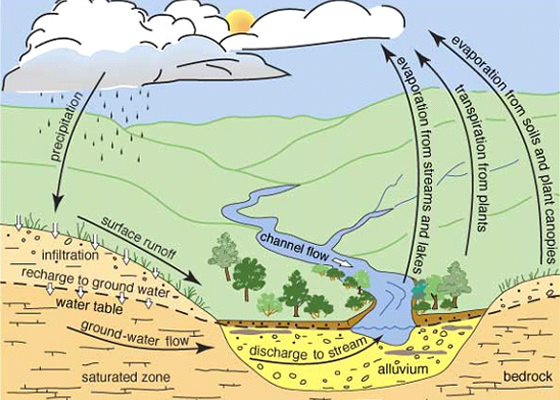
Ground water moves as part of the hydrologic cycle, the endless circulation of water from the atmosphere onto the surface and into the subsurface regions of the earth and then back from the surface to the atmosphere (fig. 1).
Precipitation becomes surface water, soil moisture, and ground water.
Like surface water, ground water flows toward and into streams, rivers, marshes, and lakes.
Ground water circulates back to the surface in this way, and, from the surface, water returns to the atmosphere through evaporation and transpiration (plant respiration).
The process by which water from rainfall and melting snow seeps into the soil and percolates into the saturated zone is called recharge.
Places where recharge occurs are referred to as recharge areas.
When this water reappears at the ground surface, this is called discharge.
Besides flowing into streams, marshes, and lakes, ground water also may discharge in the form of springs and flowing wells.
Ground Water and Aquifers: Many terms are used to describe the nature and extent of ground-water resources. The level below which all the pore spaces in the ground are filled with water is called the water table (fig. 1). The entire region below the water table is called the saturated zone, and water in this saturated zone is called ground water.
map_img01
Figure 1 –
The hydrologic cycle. Precipitation falls to the earth’s surface, runs off or infiltrates the ground, then moves back to the surface and into the atmosphere through transpiration or evaporation.
The alluvial aquifer is the cross-sectional area shown in yellow and labeled alluvium.
An aquifer is an underground formation of permeable rock or loose material that can produce useful quantities of water when tapped by a well or as discharge via a spring.
Porous media aquifers consist of aggregates of individual particles such as sand or gravel. Ground water fills and moves through the openings between the grains.
Porous media where the grains are not connected to each other are unconsolidated.
For example, an alluvial aquifer consists of loose sand, gravel, silt, and clay deposited in a stream valley or floodplain, and it is hydrologically connected to the stream flowing on its surface (figs. 1 and 2).
In consolidated aquifers, such as sandstone aquifers, grains in the porous media are cemented together.
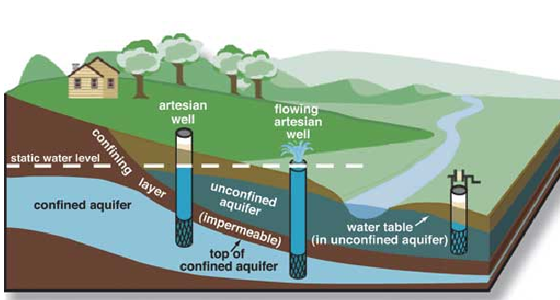
Figure 2 – Confined and unconfined aquifers and how they affect water levels in wells screened in each type of aquifer.
Fractured aquifers are rocks in which ground water moves through cracks, joints, or fractures in otherwise solid rock.
map_img02
(fig. 2)
Unconfined aquifers are bound by the water table; that is, they have no confining rock layers over the top of them. 
A well sunk into an unconfined aquifer will encounter water when the well reaches the water table, which is the approximate level at which water will stand in the well.
Some aquifers, however, lie beneath layers of impermeable materials.
These are called confined aquifers, or sometimes artesian aquifers. A well in such an aquifer is called an artesian well.
The water in these wells rises above the top of the aquifer because of confining pressure; the level to which it rises is called the static water level.
If the water level rises above the ground surface, a flowing artesian well occurs.
Drilling a well into an unconfined aquifer is often easier and less expensive than drilling into a confined aquifer.
Unconfined aquifers are generally nearer the surface, so wells are shallower.
Also, many unconfined aquifers are unconsolidated (for example, alluvial aquifers), thus more easily drilled, whereas confined aquifers more often are reached by drilling through hard rock.
On the other hand, near-surface, unconfined aquifers are more susceptible to contamination than confined aquifers that are sealed off from surface contaminants.
Most well water is good quality because of the filtering process in the soil and the long travel time underground between the water occurring as rain which eventually reaches the well.
However, in addition to possible pollution from agriculture, industry and transportation, even contamination sources in our homes can pose threats to ground water.
Incorrect disposal of common household chemicals (polish, thinners, paints, etc.), excess use of lawn chemicals, pesticides and garden chemicals, faulty or overladed septic tanks, or an accidental spill during an automobile driveway oil change, can wreak havoc with drinking water safety.
Ground-water Quality and Contamination: Water is never found in a pure state in nature.
Both ground water and surface water may contain many constituents, including minerals, microorganisms, gases, and inorganic and organic materials. Some are present naturally, and others are human-induced.
The chemical nature of water continually changes as it moves through the hydrologic cycle.
Although ground-water chemistry depends, in part, on the initial chemistry of the precipitation and recharge water, the most important natural changes in ground-water chemistry occur in the soil.
Ground water may dissolve substances it encounters or it may deposit some of its constituents along the way.
The eventual quality of the ground water depends on the kinds of rock and soil formations through which it flows.
Thus, ground water in some areas may be too salty or contain too much bicarbonate of soda for domestic use or irrigation.
Iron content can be very high in some settings, which usually does not render the water unusable, but it can be a nuisance because of rust staining of plumbing fixtures and an undesirable taste and smell.
It is advisable to have the water in a new well tested to determine its quality and suitability for use.
How to protect your water source:
With the property owners help, the professional work of ground water specialists like W. S. Heitman Drilling & Pumps along with the regulation and technical work of government agencies, can help to ensure safe drinking water.
What you know, and what you do about contamination risks are important for the safety of water in homes and communities throughout the US.
What you should know
§    The source of your drinking water
§    How contamination occurs
§    What to do to prevent problems
What you should do
§    Handle domestic chemicals responsibly
§    Protect against automotive fluid spills
§    Properly maintain septic systems
§    Use lawn & garden chemicals
§    Safeguard the area around wells
§    Always use licensed contractors for water wells
§    Routinely check and maintain wells to prevent contamination
What communities should have
§    Land-use policies
§    Agricultural best management practices
§    Water resource management plans
§    Programs protecting aquifers and wells
§    Well abandonment programs
§    Ground water education and consumer awareness programs
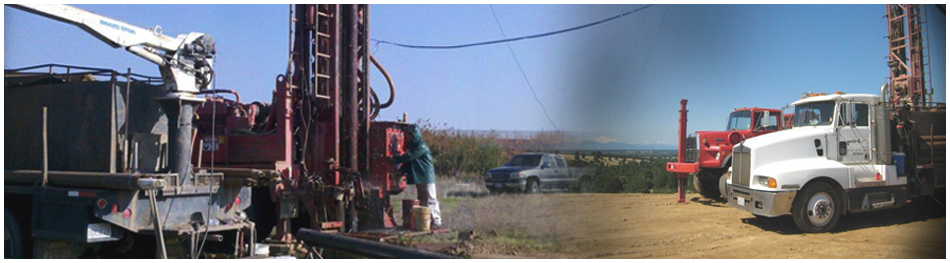
Drilling:
The hole for most home wells is usually drilled at a diameter between 6 to 8 inches.
The drilling method will depend on the geologic formations, the required water yield and the type of drilling equipment used.
Drill rigs are expensive (often up to $800,000) and their use requires considerable skill.
All wells require casing to protect them from possible contaminants at or near the ground surface.
A liner may be used in place of casing in hard rock formations.
For most home wells it is not necessary to undertake extensive testing.
The experienced drillers at Heitman Drilling will have a good idea of the well’s performance from the drilling and development process.
The yield potential is important for selecting the right pump. It is very important to understand the well’s limitations.
Ideally water will flow into the well at the same rate that it’s removed by the pump.
There are three important pieces of information that impact the design of an efficient water system
§    The static water level
§    The water level after pumping a known volume
§    The time it takes for the well water level to recover once pumping stops
For low-yield wells, to insure the pumping system is suitable for the customers needs, an extensive pump test is recommended to determine the draw down and recovery rate of the water in the well.
Some sites may not be capable of producing the amount of water normally expected for domestic supply (30 gallons per minute [gpm]).
However, with an adequate storage tank, a well producing as little as one gpm can be sufficient for domestic needs.
In many wells, several hundreds of gallons of water are already stored in the well column.
Every foot below water level of a 6-inch diameter well contains 1.5 gallons of water.
Here’s the math: There are 1,440 minutes in every day.
If a well produces 1 gpm, 1,440 gallons can be pumped in a storage tank daily.
Assuming that each member of a family of 4 uses 75 gallons per day, that’s a total of 300 gallons. Total consumption for the entire family is less than 21 percent of the stored water.
The well would be required to produce water for a total of only 5 hours a day in order to replenish the tank.
Generally, 5 gallons per minute for 2 hours is considered the minimum acceptable yield in any 24-hour period.
Wisely planned, a dependable water well can supply all the water you need now and into the future.
A rule of thumb is to allow between 75 to 150 gallons per person per day.
You need to take into account the peak demand, for example when there may be extra guests for holidays and weekends.
Outside use of water can pose much greater demands. You need to calculate the required well yield if your well is needed for additional water uses such as swimming pools, irrigation, fire protection, heating & cooling, etc.
Water from properly constructed wells is normally potable.
Routine testing is performed on new wells for bacteria, mineral content, Ph, and turbidity.
All of our well and pump installations are thoroughly disinfected using chlorine to kill bacteria that may have been introduced from the drilling and pump installation process.
While the chlorinated water may be a temporary inconvenience, once pumped out of the system, it will provide the best chance for a potable water supply.
Local and state jurisdictions, together with some lending institutions, may require additional testing for other potential contaminants – such as arsenic, radon and various man-made chemicals.
It is Heitman Drilling’s recommendation to test your well water for potability at least once a year to insure it’s safe for you and your family.
The names of local laboratories which we use in your area are available from your W.S. Heitman Drilling’s project manager. These labs are state certified and prompt.
Because of the nature of well drilling, W.S. Heitman Drilling cannot provide an exact quote or estimate.
The final cost of the well and pump installation is based upon the actual feet drilled, casing used and water obtained to satisfy requirements.
Here is a breakdown of items that may be included in the cost of a water well system:
§  Permits
§  Drilling per foot by diameter of casing and liner
§  Grouting annular seals
§  Pumping equipment
The American Ground Water Trust recommends that a written contract be executed prior to the start of any well drilling.
This will give you an itemized list of expected costs. W. S. Heitman Drilling will inspect your site and prepare a printed agreement form that will reduce the chance for misunderstandings by identifying liabilities, responsibilities and uncertainties.
Far too many homeowners have paid dearly for using amateurs or part-time, non-specialists for water well and pump installation work.
W. S. Heitman Drilling is fully licensed, certified and insured for all the work we do. The AGWT cautions homeowners against high pressure sales or scare tactics and “bonus” offers to get your business.
Property owners can become involved in litigation involving uninsured water well drillers.
If an employee of an uninsured contractor is injured on your premises, you may be responsible for any resultant injuries or disabilities.
In addition, you probably have no protection in the event of damage to your property or the property of others by the drilling company or pump installer during the course of the work.
The AGWT warns not to base your selection of a well contractor on price alone.
Your well system is permanent and future changes may be much more expensive in the long run.
Make sure that bids and estimates are “Apples-to-Apples” and that they are for comparable quality materials, service and guarantees.
The lowest bid is usually not the best value. Be sure your contract contains:
§    The contractor’s business address and state license number
§   A written proposal that details:
§    what work is to be done
§    materials to be used
§    the charge for drilling per foot
§    the type of equipment to be installed
§    terms of contractor or manufacturer guarantee on the well and well equipment
§    the expected start and completion dates
§    payment schedule
§    details of client and contractor responsibility for site access and site clean-up
§    responsibility for obtaining all permits
§    Proof of the contractor’s liability insurance while working on your job to protect against:
§    personal injury to you or others
§    damage to your property
§    damage to the property of others
§    Proof of Worker’s Compensation insurance to protect the contractor’s employees or sub-contractors while working on your job.
Be assured that W. S. Heitman Drilling & Pumps, as Northern California’s most reputable well drilling company, adheres to all of these recommendations by the AGWT.

Wes Heitman, founder and president of W.S. Heitman Drilling & Pumps, was born and raised in Red Bluff, Ca. Heitman Drilling is based out of Red Bluff and serves the entire north state
In 1976 Wes then bought his first drill rig, a mud/air combination. In 1977 he bought a new Schram T64 and mounted a Tigra Tierra casing hammer, this being the first on a Schram in the state. Serving locally, it quickly became the #1 drilling and pump com any and still is today. The credit for the lofty position of being #1 goes to the loyalty of our many, many customers who appreciate our unwavering position of honesty and our high standards or material and workmanship. In this same respect, our employees honor these parameters, many of which have worked for Heitman Drilling 20 years and more.
W.S. Heitman Drilling & Pumps is a family owned and operated company which was founded in 1976 and incorporated in 1978. All of or our equipment and our yard is located in Red Bluff with two more offices in Chico. We are members of the National Groundwater Association and the California Groundwater Association.We attend yearly conventions for both and attend seminars to continue our education and to stay on top of all the changes and advancements in the industry.
Wes Heitman (founder and president) is an executive board member of the California Groundwater Association.