Showing posts with label Teflon cookware. Show all posts

Sunday, June 30, 2019

SAFEST COOKWARE - Stainless steel is a mixture of several different metals, including nickel, chromium, and molybdenum, all of which can trickle into foods. Stainless steel cookware in good condition can be considered safe for cooking. Anodized aluminum cookware makes for what many cooks consider an ideal non-stick and scratch-resistant cooking surface. Cast iron cookware can also help ensure that eaters in your house get enough iron — which the body needs to produce red blood cells — as it seeps off the cookware into food in small amounts. For those who like the feel and heat distribution properties of cast iron but dread the seasoning process, ceramic enameled cookware is a good, if expensive, choice. One other surface favored by chefs for sauces and sautés is copper, which excels at quick warm-ups and even heat distribution.

Cast iron skillet
...............................................................................................................................................
 Safest Cookware
What Type of Cookware Is Safest for Cooking?
by Larry West


We are increasingly careful about the food we eat, and this concern is spreading to the materials in contact with our food.
For example, the choice of a safe reusable water bottle preoccupies many.
Let's examine the choices we have when considering which cookware to use. 
Stainless Steel Cookware Combines Different Metals
In reality, stainless steel is really a mixture of several different metals, including nickel, chromium, and molybdenum, all of which can trickle into foods.
However, unless your stainless steel cookware is dinged and pitted, the amount of metals likely to get into your food is negligible.
Stainless steel cookware in good condition can be considered safe for cooking.
Anodized Aluminum Cookware May Be a Safer Alternative
These days, many health-conscious cooks are turning to anodized aluminum cookware as a safer alternative.
The electrochemical anodizing process locks in the cookware’s base metal, aluminum, so that it can’t get into food, and makes for what many cooks consider an ideal non-stick and scratch-resistant cooking surface.
Calphalon is the leading manufacturer of anodized aluminum cookware, but newer offerings from All-Clad (endorsed by celebrity chef Emeril Lagasse) and others are coming on strong.
Can Cast Iron Cookware Actually Improve Health?
Another good choice is that old standby, cast iron, which is known for its durability and its even heat distribution.
Cast iron cookware can also help ensure that eaters in your house get enough iron — which the body needs to produce red blood cells — as it seeps off the cookware into food in small amounts.
Unlike the metals that can come off of some other types of pots and pans, iron is considered a healthy food additive by the U.S. Food and Drug Administration.
Consumers should beware, though, that most cast iron cookware needs to be seasoned after each use to prevent rust and as such is not as worry-free as other alternatives.
Ceramic Cookware Provides Some Benefits of Cast Iron Without the Bother
For those who like the feel and heat distribution properties of cast iron but dread the seasoning process, ceramic enameled cookware is a good, if expensive, choice.
The smooth and colorful enamel is dishwasher-friendly and somewhat non-stick and covers the entire surface of such cookware to minimize clean-up headaches.
Copper Cookware Is Excellent for Certain Uses
One other surface favored by chefs for sauces and sautés is copper, which excels at quick warm-ups and even heat distribution.
Since copper can leak into food in large amounts when heated, the cooking surfaces are usually lined with tin or stainless steel.
Non-Stick Coatings Can Be Safe, If Used Properly
Teflon is a non-stick coating used to prevent food from adhering to the cookware's surface.
Some environmental and health concerns have emerged associated with the manufacturing process of Teflon, but as for its domestic use, the answer is more complex.
Studies have shown that non-stick coatings are stable and safe during normal use conditions.
However, when subject to temperatures above normal cooking heat (above 500 degrees Fahrenheit), fumes can be released.
For a yet to be discovered reason, birds appear sensitive to those fumes. 
The American Cancer Society states that there are no known risks associated with Teflon-coated cookware.
With proper use and care, these pots and pan—which constitute more than half of all cookware sales in the U.S.—should be safe to use.

Edited by Frederic Beaudry.

Frederic Beaudry
Associate professor of environmental science at Alfred University in New York
Ph.D. in wildlife ecology from the University of Maine
Experience
Dr. Frederic Beaudry is a former writer for ThoughtCo who contributed articles on pollution, global warming, and climate science for three years. He is an associate professor of environmental science at Alfred University in New York. Prior to teaching, he worked as a wildlife biologist, focusing on the ecology and conservation of birds and turtles. Beaudry has authored several scientific papers on land use and conservation and has conducted research examining land use changes and their effects on bird and amphibian communities.
Education
Beaudry has a B.S. in biology from Université du Québec à Rimouski and an M.A. in natural resources from Humboldt State University. He earned a Ph.D. in wildlife ecology at the University of Maine. Beaudry completed postdoctoral research at the University of Wisconsin-Madison.
ThoughtCo and Dotdash
ThoughtCo is a premier reference site focusing on expert-created education content. We are one of the top-10 information sites in the world as rated by comScore, a leading Internet measurement company. Every month, more than 13 million readers seek answers to their questions on ThoughtCo.
For more than 20 years, Dotdash brands have been helping people find answers, solve problems, and get inspired. We are one of the top-20 largest content publishers on the Internet according to comScore, and reach more than 30% of the U.S. population monthly. Our brands collectively have won more than 20 industry awards in the last year alone, and recently Dotdash was named Publisher of the Year by Digiday, a leading industry publication.

Cast iron skillet

Sunday, June 25, 2017

TEFLON PANS - Are You Being Poisoned By Your Teflon Pan? - The problem is that at high temperatures, PTFE and other “Teflon chemicals” begin to break down into more toxic byproducts. These chemicals then aerosolize and can be inhaled. Inhaling these chemicals can also produce acute poisoning in humans, leading to a cluster of flu-like symptoms known as “Teflon flu.”

 Teflon Pans
ARE YOU BEING POISONED BY YOUR TEFLON PAN?

Natural News – David Gutierrez


Did you know that nonstick cookware is made with highly reactive and toxic fluoride chemicals that can turn to toxic gas at everyday cooking temperatures? 
Although numerous chemicals are used to produce nonstick coatings, all of them are in the family known as perfluorinated chemicals (PFCs).
These toxins have been linked to a wide array of health problems, including thyroid dysfunction, lowered infant birth weight, liver inflammation, high cholesterol and weakened immune function.
They build up in the body and are nearly impossible to flush out or destroy. They have been found in the bodies of nearly every U.S. resident tested.
According to the U.S. Environmental Protection Agency (EPA), PFC’s – including those released by your Teflon cookware – exhibit “persistence, bioaccumulation, and toxicity properties to an extraordinary degree.”

Canary in a coal mine
So how exactly do PFC’s get from your nonstick pan and into your body?
.
Particularly when, according to DuPont, Teflon is made from a chemical known as PTFE which is biologically inert?

The problem is that at high temperatures, PTFE and other “Teflon chemicals” begin to break down into more toxic byproducts.
These chemicals then aerosolize and can be inhaled. 
It is well established that toxic chemicals produced from heating nonstick pans can kill pet birds (which, like the famed “canary in the coal mine,” have more sensitive lungs than human beings).
Inhaling these chemicals can also produce acute poisoning in humans, leading to a cluster of flu-like symptoms known as “Teflon flu.”
Although cookware manufacturers regularly claim that pans need to be heated to extraordinary temperatures to release toxic fumes, tests by the Environmental Working Group showed that it took just two to five minutes for a pan on a regular stove-top to reach these temperatures.
For example, birds have been shown to die when pans are heated to as low as 325 degrees.
At 680 degrees, nonstick pans release chemicals shown to cause cancerkidney damage and even fatal poisoning.
A nonstick pan can reach 750 degrees after being heated for just eight minutes.
Notably, there has been almost no research conducted on the health effects of long-term exposure to Teflon fumes. 
Nor has there been any follow up to look for long-term effects from Teflon flu.
What is known, however, is that PFC breakdown products, including those of Teflon, accumulate in the human body, causing lifelong health effects.
PFC’s have been shown to be so resistant to being broken down or flushed from the body that a single exposure can cause the chemicals to remain in the body for decades.
Higher body burden of PFC’s has been linked to elevated risk of heart disease, cancer and stroke.

Use cast iron for your health

Perhaps the worst part of the fact that so many people are poisoning themselves for the supposed convenience of nonstick pans, is that it is completely unnecessary.
You can get the same convenience from a cast-iron pan, and it will actually improve your health rather than worsening it.
Although they have a reputation of being hard to care for, cast-iron cookware is actually very low maintenance.
It simply needs to be scrubbed clean with just water (no soap) after each use, then dried completely and given a very light coating of oil.
A well seasoned cast-iron is nonstick, and becomes more so over time; the oil used in cooking forms a tight seal.
Cast-iron is incredibly durable, and can be expected to last for your entire lifetime.
This makes it a much better value for its cost than any other type of cookware, given that a pre-seasoned cast-iron skillet retails for less than $20!
Due to its thickness, cast-iron cookware distributes heat more evenly, and can be used to give food much more appealing flavor and textures than other cookware. It can even be used in the oven.
And to top it off, cooking with cast-iron actually increases the amount of iron in your diet.
So, why would anyone keep using toxic Teflon?
RELATED POSTS:
.
Nitrate 
in 
Processed Meat
CLICK HERE . . .
Water 
Fluoridation

Destroys Kids Brains and Teeth

CLICK HERE . . .
.
Aerosols

Tiny Particulates in the Air

CLICK HERE . . .
.


Multi-Media Filter, Highly-Activated Carbon Filter,
Zeolite-Process Water Softener With Brine Tank,
Fiberglass Ballast-Type Pressure Tank
(fully automatic backwash & regeneration)
.
PURICARE 
INDUSTRIAL 
ENTERPRISES 
Water 
Treatment 
Systems
.
...

Aganan, Pavia, Iloilo, Philippines
...
CLICK HERE . . . to view company profile . . .
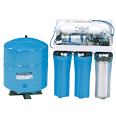
Reverse Osmosis with Steel Tank 
& Cartridge Pre-Filters

Submersible Pumps

Tachmina Solenoid-Driven
Chemical Metering Pump
- ensures regulated dosing
of chlorine into water system
without human intervention