Showing posts with label Surfactants. Show all posts

Tuesday, January 19, 2021

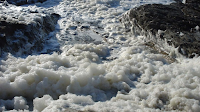
SEA FOAM - Sea foam is created by the agitation of seawater containing high concentrations of dissolved organic matter, which can come from the natural environment in the form of algal blooms or from man-made sources. As the waves crash onto the shore or lap at the beach, depending on where you are, there's usually some leftover frothy bits that cling to the sand. On windy days, this foamy stuff can even be lifted off the ground and blown around. What is it? And is it dangerous to touch it or let the dog run around in it? It's sea foam, and it is not nearly as green as the color we call sea foam. It's usually whitish, though it's probably a little dingy rather than being sparkling white. Sometimes it's more of a reddish-brown, though, and that's the sea foam to watch out for. Sea water is 96.5 percent water and 2.5 percent salt. That only adds up to 99 percent, so what's the other 1 percent? A lot of things - it's "proteins, fats, dead algae, detergents and other pollutants," plus other bits of organic and inorganic matter. When these particles get agitated by wind and waves, they froth. You can create the same effect by putting some sea water in a bottle and shaking it. The bubbles happen because of molecules called surfactants. These surfactants can come from natural sources, like algae and seaweed, or from human pollution, like fertilizers, detergents and sewage. One end of the molecule is hydrophobic – it repels water. The other end is hydrophilic – it attracts water.

.......................................................................................................................................................................................................................................................................................................................................................................................................

What Exactly Is Sea Foam?

BY KRISTEN HALL-GEISLER


Sea foam is created by the agitation of seawater containing high concentrations of dissolved organic matter, which can come from the natural environment in the form of algal blooms or from man-made sources. 

As the waves crash onto the shore or lap at the beach, depending on where you are, there's usually some leftover frothy bits that cling to the sand.

On windy days, this foamy stuff can even be lifted off the ground and blown around.

What is it? And is it dangerous to touch it or let the dog run around in it?

It's sea foam, and it is not nearly as green as the color we call sea foam. It's usually whitish, though it's probably a little dingy rather than being sparkling white.

Sometimes it's more of a reddish-brown, though, and that's the sea foam to watch out for.

Sea water is 96.5 percent water and 2.5 percent salt. That only adds up to 99 percent, so what's the other 1 percent?

A lot of things. According to the National Oceanic and Atmospheric Administration (NOAA), it's "proteins, fats, dead algae, detergents and other pollutants," plus other bits of organic and inorganic matter.

When these particles get agitated by wind and waves, they froth. You can create the same effect by putting some sea water in a bottle and shaking it.

The bubbles happen because of molecules called surfactants, which Popular Science explains are "sticky molecules that cling to the surface between water and air."

These surfactants can come from natural sources, like algae and seaweed, or from human pollution, like fertilizers, detergents and sewage.

One end of the molecule is hydrophobic – it repels water. The other end is hydrophilic – it attracts water.

The easiest shape for these molecules to form is a sphere, with the hydrophobic ends on the inside and the hydrophilic ends pointing outward.

Spheres (even if they aren't perfect) make bubbles. And a lot of bubbles make sea foam!

Now, about that reddish-brown sea foam. That's often due to phytoplankton, also known as algae blooms, which is a natural phenomenon.

These tiny organisms release toxins that aren't good for you, your dog, the birds, or anything, really. The toxins can irritate eyes and ears, and even the respiratory system.

The white foam may not be toxic, but that doesn't mean it's harmless.

When weather gets completely out of control, the churning of the water creates a lot of sea foam.

Like, a lot. In the winter of 2020, a king tide in Washington state with 25-foot (nearly 8-meter) waves created a "blender effect" that churned up sea foam as high as a man's chest.

Later that spring and halfway around the world, so much sea foam appeared in the Netherlands that it killed five very experienced surfers.

NOW THAT'S COLOR

In 2001, Crayola introduced a minty-green crayon called "seafoam."

According to Canva, it's a soft blue-green that is not the same as mint green. These two colors have different hex codes used by designers.

Seafoam is a mix of green, blue and a little gray, and it looks nothing like the sea foam found in the actual sea.

Kristen Hall-Geisler

CONTRIBUTING WRITER

Kristen Hall-Geisler is a freelance writer and book editor living in Oregon. As an automotive journalist since 2006, she's honed her research and interviewing skills with HowStuffWorks, The New York Times, TechCrunch, Popular Science, US News & World Report and more. She loves falling down the rabbit hole of research and emerging with a book or article that others find useful and — she hopes — entertaining while still being based on solid sources. She is the author of the historical novel "Skull and Sidecar" as well as the nonfiction books "Take the Wheel: A Woman’s Guide to Buying a Car Her Own Damn Self" and "Lightning in a Throttle: Three Early Electric Vehicle Victories."

https://science.howstuffworks.com/environmental/earth/oceanography/sea-foam.htm?utm_medium=recirc&utm_source=taboola&utm_campaign=feed


You might also like:


Algae Blooms 

(Red Tides)

CLICK HERE . . . to view . . . 

https://puricare.blogspot.com/2017/07/algae-blooms-red-tides-algae-blooms-are.html

...........................................................................................................................................................................................................................................................................................

Detergents And Water Pollution

CLICK HERE . . . to view . . . 

https://puricare.blogspot.com/2017/07/detergents-and-water-pollution-many-of.html

...........................................................................................................................................................................................................................................................................................

A dangerous guide to beachcombing

CLICK HERE . . . to view . . . 

https://puricarechronicles.blogspot.com/2017/12/beachcombing-if-you-see-something-that.html

...........................................................................................................................................................................................................................................................................................

Water Contaminants 

CLICK HERE . . . to view . . . 

https://puricare.blogspot.com/2016/10/water-contaminants-health-effects-epas.html

...........................................................................................................................................................................................................................................................................................

Foam Definition in Chemistry

CLICK HERE . . . to view . . . 

https://puricare.blogspot.com/2019/10/foam-definition-foam-is-substance-made.html

...........................................................................................................................................................................................................................................................................................

The Dead Sea & Bible Prophecy

CLICK HERE . . . to view . . . 

https://puricarechronicles.blogspot.com/2020/05/the-dead-sea-bible-prophecy-ezekiels.html

...........................................................................................................................................................................................................................................................................................

Worsening Algal Blooms

CLICK HERE . . . to view . . . 

https://puricare.blogspot.com/2020/05/worsening-algal-blooms-toxic-algae.html

Saturday, November 23, 2019

IRON BACTERIA IN WELL WATER - Iron bacteria are not known to cause disease. However, they can create conditions where other disease-causing organisms may grow. They can also affect how much water the well produces and may cause clogging issues. To be safe, test the water for nitrate and coliform bacteria. Make sure the well is properly constructed, located, and maintained. May be more noticeable after the water has not been used for a while. Yellow, orange, red, or brown stains and colored water. Sticky rusty, yellow, brown, or grey slime. Only place disinfected water in a well for drilling, repair, or priming pumps. Never use water taken from a lake or pond. Make sure the well casing is capped, watertight, and extends at least 1 foot above ground. Disinfect the well, pump, and plumbing after repairs.

Image result for images iron bacteria in well water
................................................................................................................................................................
Image result for images iron bacteria in well waterIron Bacteria in Well Water
Well Management Program
Minnesota Department of Health


Image result for images iron bacteria in well waterIron bacteria are small living organisms that naturally occur in soil, shallow groundwater, and surface waters.
These bacteria combine iron (or manganese) and oxygen to form deposits of “rust,” bacterial cells, and a slimy material that sticks the bacteria to well pipes, pumps, and plumbing fixtures.
Iron Bacteria May Help Other Organisms Grow
Iron bacteria are not known to cause disease. However, they can create conditions where other disease-causing organisms may grow.
They can also affect how much water the well produces and may cause clogging issues.
To be safe, test the water for nitrate and coliform bacteria. Make sure the well is properly constructed, located, and maintained.
How to Detect Iron Bacteria
Tastes and Odors
·          Swampy, oily or petroleum, cucumber, sewage, rotten vegetation, or musty.
·          May be more noticeable after the water has not been used for a while.
Color
·          Yellow, orange, red, or brown stains and colored water.
·          Rainbow colored, oil-like sheen.
Red Slimy Deposits
·          Sticky rusty, yellow, brown, or grey slime.
·          “Feathery" or filamentous growths (especially in standing water).
You can confirm that it is iron bacteria by having the water tested at a laboratory.
Prevent Iron Bacteria
Iron bacteria are in most soils in Minnesota. Drilling, repair, or service work can also introduce iron bacteria into a well or water system.
Here are some ways to prevent iron bacteria from entering your well:
·          Only place disinfected water in a well for drilling, repair, or priming pumps. Never use water taken from a lake or pond.
·          Make sure the well casing is capped, watertight, and extends at least 1 foot above ground.
·          Avoid placing pumps, well pipes, and well equipment on the ground when doing repairs.
·          Disinfect the well, pump, and plumbing after repairs.
Treatment to Address Iron Bacteria
Some treatment techniques may remove or reduce iron bacteria.
Eliminating iron bacteria can be difficult and expensive. Sometimes treatment techniques may only be partly effective.
Contact a licensed well contractor or water treatment professional to determine the best approach for your situation.
Physical Removal
Physical removal is usually the first step in very infected wells. A licensed well contractor will:
1.    Remove and clean the pumping equipment.
2.    Scrub the well casing with brushes.
3.    The next step is usually chemical treatment.
Chemical Treatment
This is the most common treatment technique for iron bacteria. There are three groups of chemicals people use for this:
·            Disinfectants are the most common chemicals used to treat for iron bacteria. The most common disinfectant is household laundry bleach, which contains chlorine.
Contact a licensed well contractor to disinfect your well, or use the instructions on the Well Disinfection webpage.
·            Surfactants are detergent-like chemicals, such as phosphates. Surfactants are generally used with other chemical treatment.
It is important to use a disinfectant (such as chlorine) if phosphates are used; bacteria may use phosphates as a food source. Only trained professionals should do a surfactants treatment.
·            Acids can dissolve iron deposits, destroy bacteria, and loosen bacterial slime. Acids are typically part of a series of treatments involving chlorine and sometimes bases.
Only trained professionals should do an acid treatment. Be very careful you properly use and dispose of these chemicals. Never mix acid and chlorine.
Pasteurization
Pasteurization injects steam or hot water into the well to keep the well water temperature at 60 degrees Celsius (140 degrees Fahrenheit) for 30 minutes. Pasteurization can be effective, but expensive.
Chlorine
Chlorine is cheap and easy to use, but it may not always get rid of iron bacteria. You may have to treat with chlorine more than once.
Both the concentration of chlorine and how long the chlorine solution is in contact with the bacteria are important.
Some people have used continuous chlorine injection into the well, but the Minnesota Department of Health does not usually recommend this.
The continuous chlorine injection may hide other bacterial contamination and cause corrosion problems.
Shock Chlorination
"Shock" chlorination is the process of using a strong chlorine solution to disinfect the well and system. The chlorine concentration should be close to but not greater than 200 parts per million (ppm).
A concentration greater than 200 ppm reduces how effective the disinfection is. Before adding the chlorine solution, the well should be pumped until clear or physically cleaned.
Should I test my well water for anything besides iron bacteria?
Yes. Both natural sources and human activities can contaminate well water and cause short-term or long-term health effects.
Testing your well water is the only way to detect most of the common contaminants in Minnesota groundwater; you cannot taste, see, or smell most contaminants. Minnesota Department of Health recommends testing for:
·          Coliform bacteria every year and any time the water changes in taste, odor, or appearance. Coliform bacteria can indicate that disease-causing microorganisms may be in your water.
·          Nitrate every other year. Bottle-fed infants under six months old are at the highest risk of being affected by levels of nitrate higher than 10 milligrams per liter in drinking water.
·          Arsenic at least once. About 40 percent of wells in Minnesota have arsenic in the water. Drinking water with arsenic in it for a long time can contribute to reduced intelligence in children and increased risks of cancer, diabetes, heart disease, and skin problems.
·          Lead at least once. The well and water system may have parts that have lead in them, and that lead can get into drinking water. Lead can damage the brain, kidneys, and nervous system. Lead can also slow development or cause learning, behavior, and hearing problems.
·          Manganese before a baby drinks the water. High levels of manganese can cause problems with memory, attention, and motor skills. It can also cause learning and behavior problems in infants and children.
Other contaminants sometimes occur in private water systems but less often than the contaminants listed above. Consider testing for:
·          Volatile organic chemicals if the well is near fuel tanks or a commercial or industrial area.
·          Agricultural chemicals commonly used in the area if the well is shallow and is near cropped fields or handling areas for agricultural chemicals or is in an area of geologic sensitivity (such as fractured limestone).
·         Fluoride if children or teenagers drink the water.
Image result for images iron bacteria in well water