Showing posts with label Evaporation. Show all posts

Saturday, December 5, 2020

THE WATER CYCLE - The Atmosphere and Weather are Essential to the Water Cycle - Of the world's total water supply, 97% is salt water found in our oceans. That means that less than 3% of available water is freshwater and acceptable for our use. Consider that of that three percent, over 68% is frozen in ice and glaciers and 30% is underground. This means that under 2% of freshwater is readily available to quench the needs of everyone on Earth! Every drop of rain that falls from the sky isn't brand new, nor is every glass of water you drink. They have always been here on Earth they've just been recycled and re-purposed. Evaporation is considered to be the first step of the water cycle. In it, water that's stored in our oceans, lakes, rivers, and streams absorbs heat energy from the sun which turns it from a liquid into a gas called water vapor (or steam). Of course, evaporation doesn't just happen over bodies of water -- it happens on land too. When the sun heats the ground, water is evaporated from the top layer of soil -- a process known as evapotranspiration. Likewise, any extra water that isn't used by plants and trees during photosynthesis is evaporated from its leaves in a process called transpiration. A similar process happens when water that's frozen in glaciers, ice, and snow converts directly into water vapor (without first turning into a liquid). Called sublimation, this happens when the air temperature is extremely low or when high pressure is applied. Now that water has vaporized, it is free to rise up into the atmosphere. The higher it rises, the more heat it loses and the more it cools off. Eventually, the water vapor particles cool so much that they condense and turn back into liquid water droplets. When enough of these droplets collect, they form clouds.

..........................................................................................................................................................................................................................................................................................................

The Water Cycle

The Atmosphere and Weather are Essential to the Water Cycle

By Tiffany Means


You've likely heard of the hydrologic (water) cycle before and know that it describes how Earth's water journeys from the land to the sky, and back again.

But what you may not know is why this process is so essential.

Of the world's total water supply, 97% is salt water found in our oceans.

That means that less than 3% of available water is freshwater and acceptable for our use.

Think that's a small amount?

Consider that of that three percent, over 68% is frozen in ice and glaciers and 30% is underground.

This means that under 2% of freshwater is readily available to quench the needs of everyone on Earth!

Are you beginning to see why the water cycle is so essential? Let's explore the steps. 

All Water Is Recycled Water

Here's some food (or drink) for thought: every drop of rain that falls from the sky isn't brand new, nor is every glass of water you drink.

They have always been here on Earth, they've just been recycled and re-purposed, thanks to the water cycle which includes 5 main processes:

o  Evaporation (including sublimation, transpiration)

o  Condensation

o  Precipitation

o  Surface runoff (including snowmelt and streamflow)

o  Infiltration (groundwater storage and eventual discharge)

Evaporation, Transpiration, Sublimation Move Water Into the Air

Evaporation is considered to be the first step of the water cycle.

In it, water that's stored in our oceans, lakes, rivers, and streams absorbs heat energy from the sun which turns it from a liquid into a gas called water vapor (or steam).

Of course, evaporation doesn't just happen over bodies of water -- it happens on land too.

When the sun heats the ground, water is evaporated from the top layer of soil -- a process known as evapotranspiration.

Likewise, any extra water that isn't used by plants and trees during photosynthesis is evaporated from its leaves in a process called transpiration.

A similar process happens when water that's frozen in glaciers, ice, and snow converts directly into water vapor (without first turning into a liquid).

Called sublimation, this happens when the air temperature is extremely low or when high pressure is applied.

Condensation Makes Clouds

Now that water has vaporized, it is free to rise up into the atmosphere. The higher it rises, the more heat it loses and the more it cools off.

Eventually, the water vapor particles cool so much that they condense and turn back into liquid water droplets. When enough of these droplets collect, they form clouds.

Precipitation Moves Water From the Air to Land

As winds move clouds around, clouds collide with other clouds and grow.

Once they grow big enough, they fall out of the sky as precipitation (rain if the atmosphere's temperatures are warm, or snow if its temperatures are 32° F or colder).

From here, precipitating water can take one of several paths:

If it falls into the oceans and other bodies of water, its cycle has ended and it is ready to begin again by evaporating yet again.

On the other hand, if it falls on land, it continues on the water cycle journey and must find its way back to the oceans.

So that we can continue exploring the complete water cycle, let's assume option #2 -- that the water has fallen over land areas.

Ice and Snow Move Water Very Slowly Along in the Water Cycle

The precipitation that falls as snow over land accumulates, forming seasonal snowpack (layers upon layers of snow that continually accumulates and becomes packed down).

As spring arrives and temperatures warm, these large amounts of snow thaw and melt, leading to runoff and streamflow.

(Water also stays frozen and stored in ice caps and glaciers for thousands of years!)

Runoff and Streamflow Moves Water Downhill, Towards Oceans

Both the water that melts from snow and that which falls on the land as rain flows over the surface of the earth and downhill, due to gravity's pull.

This process is known as runoff. (Runoff is hard to visualize, but you've probably noticed it during heavy rain or a flash flood, as water flows hurriedly down your driveway and into storm drains.)

Runoff works like this: As water runs over the landscape, it displaces the ground's top-most layer of soil.

This displaced soil forms channels which the water then follows and feeds into the nearest creeks, streams, and rivers. Because this water flows directly into rivers and streams it is sometimes referred to as streamflow.

The runoff and streamflow steps of the water cycle play a key part in making sure water gets back into the oceans to keep the water cycle going.

How so? Well, unless rivers are diverted or dammed up, all of them eventually empty into the ocean!

Infiltration

Not all of the water that precipitates ends up as runoff. Some of it soaks into the ground -- a water cycle process known as infiltration.

At this stage, the water is pure and drinkable.

Some of the water that infiltrates the ground fills aquifers and other underground stores.

Some of this groundwater finds openings in the land surface and re-emerges as freshwater springs.

And still, some of it is absorbed by plant roots and ends up evapostranspiring from leaves.

Those amounts that stay close to the land surface, seep back into surface bodies of water (lakes, oceans) where the cycle starts all over again.

Additional Water Cycle Resources for Kids and Students

Thirsty for more water cycle visualizations? Check out this student-friendly water cycle diagram, courtesy of the U.S. Geological Survey.

And don't miss this USGS interactive diagram available in three versions: beginner, intermediate, and advanced.

Activities for each of the water cycle's main processes can be found at the National Weather Service's Jetstream School for Weather Hydrologic Cycle page.

The USGS Water Science School has two great resources: The Water Cycle Summary and Where is Earth's Water?

Tiffany Means

Meteorology Expert

Education

B.S., Atmospheric Sciences and Meteorology, University of North Carolina

Introduction

Studied atmospheric sciences and meteorology at the University of North Carolina

Former administrative assistant for the National Oceanic and Atmospheric Administration

Member of the American Meteorological Society

Experience

Tiffany Means is a former writer for ThoughtCo who contributed articles about weather for five years. She has interned with the domestic and international weather departments at CNN, written monthly climate reports for NOAA’s National Centers for Environmental Prediction, and participated in a number of science outreach events, including the Science Olympiad Competition. Means has personally experienced such weather greats as the Blizzard of 1993 and the floods of Hurricane Francis (2004) and Ivan (2004).

Education

Bachelor's degree in atmospheric sciences and meteorology from the University of North Carolina at Asheville

ThoughtCo and Dotdash

ThoughtCo is a premier reference site focusing on expert-created education content. We are one of the top-10 information sites in the world as rated by comScore, a leading Internet measurement company. Every month, more than 13 million readers seek answers to their questions on ThoughtCo.

For more than 20 years, Dotdash brands have been helping people find answers, solve problems, and get inspired. We are one of the top-20 largest content publishers on the Internet according to comScore, and reach more than 30% of the U.S. population monthly. Our brands collectively have won more than 20 industry awards in the last year alone, and recently Dotdash was named Publisher of the Year by Digiday, a leading industry publication.

https://www.thoughtco.com/the-water-cycle-4049926


You might also like:

.

Rain Clouds

Without clouds, it would not rain

CLICK HERE . . . to view . . . 

https://puricarechronicles.blogspot.com/2020/11/rain-clouds-science-in-bible-clouds-are.html

.......................................................................................................................................................................................................................................................................................

 Water Vapor Saturation 

CLICK HERE . . . to view . . . 

https://puricarechronicles.blogspot.com/2019/10/water-vapor-saturation-air-in-our.html

.......................................................................................................................................................................................................................................................................................

Let's Talk About Water

CLICK HERE . . . to view . . . 

https://puricarechronicles.blogspot.com/2019/12/lets-talk-about-water-in-all.html

.......................................................................................................................................................................................................................................................................................

The Hydrologic Cycle

CLICK HERE . . . to view . . . 

https://puricare.blogspot.com/2018/02/the-hydrologic-cycle-sun-causes.html

.......................................................................................................................................................................................................................................................................................

The Hydrological Cycle or Water Cycle

CLICK HERE . . . to view . . . 

https://puricare.blogspot.com/2016/05/the-hydrological-cycle-or-water-cycle.html

.......................................................................................................................................................................................................................................................................................

Hydrologic Cycle, Surface and Groundwater Impurities

CLICK HERE . . . to view . . . 

https://puricare.blogspot.com/2016/07/water-sources-hydrologic-cycle-and.html

Wednesday, May 13, 2020

DRILLING A WELL - Ground water is defined as underground water found in the pore space of rocks. Ground water moves as part of the hydrologic cycle, the endless circulation of water from the atmosphere onto the surface and into the subsurface regions of the earth and then back from the surface to the atmosphere. Precipitation becomes surface water, soil moisture, and ground water. Like surface water, ground water flows toward and into streams, rivers, marshes, and lakes. Ground water circulates back to the surface in this way, and, from the surface, water returns to the atmosphere through evaporation and transpiration. The level below which all the pore spaces in the ground are filled with water is called the water table. An aquifer is an underground formation of permeable rock or loose material that can produce useful quantities of water when tapped by a well or as discharge via a spring. Ground water fills and moves through the openings between the grains. Fractured aquifers are rocks in which ground water moves through cracks, joints, or fractures in otherwise solid rock. A well sunk into an unconfined aquifer will encounter water when the well reaches the water table, which is the approximate level at which water will stand in the well. Some aquifers, however, lie beneath layers of impermeable materials. These are called confined aquifers, or sometimes artesian aquifers. A well in such an aquifer is called an artesian well.


................................................................................................................................................................
What You Should Know About Drilling a Well
W.S. Heitman Drilling & Pumps


What you should know about drilling a water well on your land
Whether you are thinking about drilling a water well on your property or about buying land and would like to know the potential for drilling on that property, you should consider many things.
There are no simple solutions, no detailed maps of ground-water presence, and no guarantees.
But information is available that can be helpful when making a decision about whether to drill, or where to drill.
To further your understanding of the available information and why some areas provide water and others do not Understanding Ground Water Systems
Ground Water on the Move: Ground water is defined as underground water found in the pore space of rocks.
Ground water does not stay underground forever, and it does not lie still waiting for us to draw it from a well.
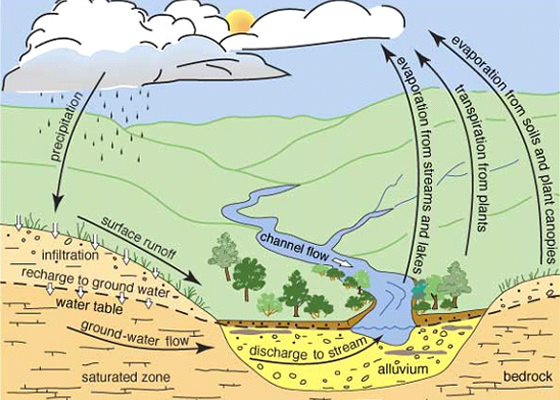
Ground water moves as part of the hydrologic cycle, the endless circulation of water from the atmosphere onto the surface and into the subsurface regions of the earth and then back from the surface to the atmosphere (fig. 1).
Precipitation becomes surface water, soil moisture, and ground water.
Like surface water, ground water flows toward and into streams, rivers, marshes, and lakes.
Ground water circulates back to the surface in this way, and, from the surface, water returns to the atmosphere through evaporation and transpiration (plant respiration).
The process by which water from rainfall and melting snow seeps into the soil and percolates into the saturated zone is called recharge.
Places where recharge occurs are referred to as recharge areas.
When this water reappears at the ground surface, this is called discharge.
Besides flowing into streams, marshes, and lakes, ground water also may discharge in the form of springs and flowing wells.
Ground Water and Aquifers: Many terms are used to describe the nature and extent of ground-water resources. The level below which all the pore spaces in the ground are filled with water is called the water table (fig. 1). The entire region below the water table is called the saturated zone, and water in this saturated zone is called ground water.
map_img01
Figure 1 –
The hydrologic cycle. Precipitation falls to the earth’s surface, runs off or infiltrates the ground, then moves back to the surface and into the atmosphere through transpiration or evaporation.
The alluvial aquifer is the cross-sectional area shown in yellow and labeled alluvium.
An aquifer is an underground formation of permeable rock or loose material that can produce useful quantities of water when tapped by a well or as discharge via a spring.
Porous media aquifers consist of aggregates of individual particles such as sand or gravel. Ground water fills and moves through the openings between the grains.
Porous media where the grains are not connected to each other are unconsolidated.
For example, an alluvial aquifer consists of loose sand, gravel, silt, and clay deposited in a stream valley or floodplain, and it is hydrologically connected to the stream flowing on its surface (figs. 1 and 2).
In consolidated aquifers, such as sandstone aquifers, grains in the porous media are cemented together.
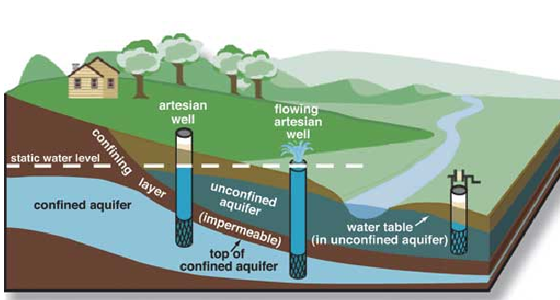
Figure 2 – Confined and unconfined aquifers and how they affect water levels in wells screened in each type of aquifer.
Fractured aquifers are rocks in which ground water moves through cracks, joints, or fractures in otherwise solid rock.
map_img02
(fig. 2)
Unconfined aquifers are bound by the water table; that is, they have no confining rock layers over the top of them. 
A well sunk into an unconfined aquifer will encounter water when the well reaches the water table, which is the approximate level at which water will stand in the well.
Some aquifers, however, lie beneath layers of impermeable materials.
These are called confined aquifers, or sometimes artesian aquifers. A well in such an aquifer is called an artesian well.
The water in these wells rises above the top of the aquifer because of confining pressure; the level to which it rises is called the static water level.
If the water level rises above the ground surface, a flowing artesian well occurs.
Drilling a well into an unconfined aquifer is often easier and less expensive than drilling into a confined aquifer.
Unconfined aquifers are generally nearer the surface, so wells are shallower.
Also, many unconfined aquifers are unconsolidated (for example, alluvial aquifers), thus more easily drilled, whereas confined aquifers more often are reached by drilling through hard rock.
On the other hand, near-surface, unconfined aquifers are more susceptible to contamination than confined aquifers that are sealed off from surface contaminants.
Most well water is good quality because of the filtering process in the soil and the long travel time underground between the water occurring as rain which eventually reaches the well.
However, in addition to possible pollution from agriculture, industry and transportation, even contamination sources in our homes can pose threats to ground water.
Incorrect disposal of common household chemicals (polish, thinners, paints, etc.), excess use of lawn chemicals, pesticides and garden chemicals, faulty or overladed septic tanks, or an accidental spill during an automobile driveway oil change, can wreak havoc with drinking water safety.
Ground-water Quality and Contamination: Water is never found in a pure state in nature.
Both ground water and surface water may contain many constituents, including minerals, microorganisms, gases, and inorganic and organic materials. Some are present naturally, and others are human-induced.
The chemical nature of water continually changes as it moves through the hydrologic cycle.
Although ground-water chemistry depends, in part, on the initial chemistry of the precipitation and recharge water, the most important natural changes in ground-water chemistry occur in the soil.
Ground water may dissolve substances it encounters or it may deposit some of its constituents along the way.
The eventual quality of the ground water depends on the kinds of rock and soil formations through which it flows.
Thus, ground water in some areas may be too salty or contain too much bicarbonate of soda for domestic use or irrigation.
Iron content can be very high in some settings, which usually does not render the water unusable, but it can be a nuisance because of rust staining of plumbing fixtures and an undesirable taste and smell.
It is advisable to have the water in a new well tested to determine its quality and suitability for use.
How to protect your water source:
With the property owners help, the professional work of ground water specialists like W. S. Heitman Drilling & Pumps along with the regulation and technical work of government agencies, can help to ensure safe drinking water.
What you know, and what you do about contamination risks are important for the safety of water in homes and communities throughout the US.
What you should know
§    The source of your drinking water
§    How contamination occurs
§    What to do to prevent problems
What you should do
§    Handle domestic chemicals responsibly
§    Protect against automotive fluid spills
§    Properly maintain septic systems
§    Use lawn & garden chemicals
§    Safeguard the area around wells
§    Always use licensed contractors for water wells
§    Routinely check and maintain wells to prevent contamination
What communities should have
§    Land-use policies
§    Agricultural best management practices
§    Water resource management plans
§    Programs protecting aquifers and wells
§    Well abandonment programs
§    Ground water education and consumer awareness programs
Drilling:
The hole for most home wells is usually drilled at a diameter between 6 to 8 inches.
The drilling method will depend on the geologic formations, the required water yield and the type of drilling equipment used.
Drill rigs are expensive (often up to $800,000) and their use requires considerable skill.
All wells require casing to protect them from possible contaminants at or near the ground surface.
A liner may be used in place of casing in hard rock formations.
For most home wells it is not necessary to undertake extensive testing.
The experienced drillers at Heitman Drilling will have a good idea of the well’s performance from the drilling and development process.
The yield potential is important for selecting the right pump. It is very important to understand the well’s limitations.
Ideally water will flow into the well at the same rate that it’s removed by the pump.
There are three important pieces of information that impact the design of an efficient water system
§    The static water level
§    The water level after pumping a known volume
§    The time it takes for the well water level to recover once pumping stops
For low-yield wells, to insure the pumping system is suitable for the customers needs, an extensive pump test is recommended to determine the draw down and recovery rate of the water in the well.
Some sites may not be capable of producing the amount of water normally expected for domestic supply (30 gallons per minute [gpm]).
However, with an adequate storage tank, a well producing as little as one gpm can be sufficient for domestic needs.
In many wells, several hundreds of gallons of water are already stored in the well column.
Every foot below water level of a 6-inch diameter well contains 1.5 gallons of water.
Here’s the math: There are 1,440 minutes in every day.
If a well produces 1 gpm, 1,440 gallons can be pumped in a storage tank daily.
Assuming that each member of a family of 4 uses 75 gallons per day, that’s a total of 300 gallons. Total consumption for the entire family is less than 21 percent of the stored water.
The well would be required to produce water for a total of only 5 hours a day in order to replenish the tank.
Generally, 5 gallons per minute for 2 hours is considered the minimum acceptable yield in any 24-hour period.
Wisely planned, a dependable water well can supply all the water you need now and into the future.
A rule of thumb is to allow between 75 to 150 gallons per person per day.
You need to take into account the peak demand, for example when there may be extra guests for holidays and weekends.
Outside use of water can pose much greater demands. You need to calculate the required well yield if your well is needed for additional water uses such as swimming pools, irrigation, fire protection, heating & cooling, etc.
Water from properly constructed wells is normally potable.
Routine testing is performed on new wells for bacteria, mineral content, Ph, and turbidity.
All of our well and pump installations are thoroughly disinfected using chlorine to kill bacteria that may have been introduced from the drilling and pump installation process.
While the chlorinated water may be a temporary inconvenience, once pumped out of the system, it will provide the best chance for a potable water supply.
Local and state jurisdictions, together with some lending institutions, may require additional testing for other potential contaminants – such as arsenic, radon and various man-made chemicals.
It is Heitman Drilling’s recommendation to test your well water for potability at least once a year to insure it’s safe for you and your family.
The names of local laboratories which we use in your area are available from your W.S. Heitman Drilling’s project manager. These labs are state certified and prompt.
Because of the nature of well drilling, W.S. Heitman Drilling cannot provide an exact quote or estimate.
The final cost of the well and pump installation is based upon the actual feet drilled, casing used and water obtained to satisfy requirements.
Here is a breakdown of items that may be included in the cost of a water well system:
§  Permits
§  Drilling per foot by diameter of casing and liner
§  Grouting annular seals
§  Pumping equipment
The American Ground Water Trust recommends that a written contract be executed prior to the start of any well drilling.
This will give you an itemized list of expected costs. W. S. Heitman Drilling will inspect your site and prepare a printed agreement form that will reduce the chance for misunderstandings by identifying liabilities, responsibilities and uncertainties.
Far too many homeowners have paid dearly for using amateurs or part-time, non-specialists for water well and pump installation work.
W. S. Heitman Drilling is fully licensed, certified and insured for all the work we do. The AGWT cautions homeowners against high pressure sales or scare tactics and “bonus” offers to get your business.
Property owners can become involved in litigation involving uninsured water well drillers.
If an employee of an uninsured contractor is injured on your premises, you may be responsible for any resultant injuries or disabilities.
In addition, you probably have no protection in the event of damage to your property or the property of others by the drilling company or pump installer during the course of the work.
The AGWT warns not to base your selection of a well contractor on price alone.
Your well system is permanent and future changes may be much more expensive in the long run.
Make sure that bids and estimates are “Apples-to-Apples” and that they are for comparable quality materials, service and guarantees.
The lowest bid is usually not the best value. Be sure your contract contains:
§    The contractor’s business address and state license number
§   A written proposal that details:
§    what work is to be done
§    materials to be used
§    the charge for drilling per foot
§    the type of equipment to be installed
§    terms of contractor or manufacturer guarantee on the well and well equipment
§    the expected start and completion dates
§    payment schedule
§    details of client and contractor responsibility for site access and site clean-up
§    responsibility for obtaining all permits
§    Proof of the contractor’s liability insurance while working on your job to protect against:
§    personal injury to you or others
§    damage to your property
§    damage to the property of others
§    Proof of Worker’s Compensation insurance to protect the contractor’s employees or sub-contractors while working on your job.
Be assured that W. S. Heitman Drilling & Pumps, as Northern California’s most reputable well drilling company, adheres to all of these recommendations by the AGWT.

Wes Heitman, founder and president of W.S. Heitman Drilling & Pumps, was born and raised in Red Bluff, Ca. Heitman Drilling is based out of Red Bluff and serves the entire north state
In 1976 Wes then bought his first drill rig, a mud/air combination. In 1977 he bought a new Schram T64 and mounted a Tigra Tierra casing hammer, this being the first on a Schram in the state. Serving locally, it quickly became the #1 drilling and pump com any and still is today. The credit for the lofty position of being #1 goes to the loyalty of our many, many customers who appreciate our unwavering position of honesty and our high standards or material and workmanship. In this same respect, our employees honor these parameters, many of which have worked for Heitman Drilling 20 years and more.
W.S. Heitman Drilling & Pumps is a family owned and operated company which was founded in 1976 and incorporated in 1978. All of or our equipment and our yard is located in Red Bluff with two more offices in Chico. We are members of the National Groundwater Association and the California Groundwater Association.We attend yearly conventions for both and attend seminars to continue our education and to stay on top of all the changes and advancements in the industry.
Wes Heitman (founder and president) is an executive board member of the California Groundwater Association.