Showing posts with label Chlorine. Show all posts

Thursday, August 13, 2020

HOW MODERN WASTEWATER TREATMENT CHANGED OUR WORLD - Without wastewater treatment, diseases and infections would ravage our society. Wastewater treatment is often an overlooked necessity of civilization. Without proper sewer systems, wastewater treatment plants, and overall regulation, our cities would be ripe with disease and human waste everywhere. When you flush a toilet, your waste flows through the sewers to a wastewater treatment plant that treats it. Sewer systems are a topic all their own, so we'll mainly focus on how your wastewater goes from one of the dirtiest substances on the planet back into water that's safe for the environment. Some wastewater plants known as full-cycle reuse plants will even take wastewater and treat it all the way back to drinking water, which will then be pumped to city inhabitants. Today's level of engineering and chemistry allow full-cycle reuse plants to output drinking water chemically identical to what's in your tap right now. When wastewater arrives at a treatment facility, it first gets all the large chunks filtered out through a screen, a rather large one. These screens are generally called bar screens, and their main job is to make the sewage more homogenous so it can flow through pumps and pipes in the plant. The waste removed from bar screens is sent off to the landfill, and the slightly less chunky sewage heads to the next step, the grit chamber.

How Modern Wastewater Treatment Changed our World
...............................................................................................................................................................
How Modern Wastewater Treatment Changed our World
How Modern Wastewater Treatment Changed our WorldWithout wastewater treatment, diseases and infections would ravage our society
By Trevor English


Wastewater treatment is often an overlooked necessity of civilization.
Without proper sewer systems, wastewater treatment plants, and overall regulation, our cities would be ripe with disease and human waste everywhere.
Believe it or not, much of the modern wastewater management technology we consider standard in any 21st century home, things like toilets and sewer pipes, are actually relatively new in the grand scheme of history.
The history of wastewater treatment
That's not to say that sewer systems haven't been around for ages.
After all, the ancient Romans had a complex system of sewers at the peak of their empire.
How Modern Wastewater Treatment Changed our World
Roman sewer in Cologne
Rather, the knowledge of how poorly managed wastewater can drastically impact the health of society is relatively new.
The Romans had a centralized sewage management system, although it was fairly rudimentary by today's standards.
Open and closed ditches and pipes would carry away excrement and trash, primarily using rainwater runoff.
The contaminated water would then flow into large concrete tanks that let the sewage settle out before the water was allowed to flow into the nearby rivers.
There was indoor plumbing, and public latrines were also built over the sewers.
In medieval Europe, closed sewers, stone conduits, or ditches were used to drain sewage away from residential areas, often in conjunction with septic tanks, but chamber pots were often dumped directly onto the streets.
Between 1858 and 1859 the Thames in London was chock full of untreated wastewater, which combined with very hot weather to cause what became known as "the Great Stink".
The 17th and 18th centuries saw a rapid expansion in waterworks and pumping systems, but the Industrial Revolution led to even more rapid growth of cities and pollution, which acted as a constant source for the outbreak of deadly diseases like cholera and typhoid.
As cities grew in the 19th century, increasing public health concerns led to the development of municipal sanitation programs and the construction of sewer systems in many cities.
These systems often discharged sewage directly into rivers without treatment, but by the late 19th century, chemical treatments and sedimentation systems were in use in many cities.
The construction of centralized sewage treatment plants began between the late 19th and early 20th centuries.
These systems passed sewage through a combination of physical, biological, and chemical processes to remove pollutants.
Also beginning in the 1900s, new sewage-collection systems were designed to separate storm-water from domestic wastewater, to prevent treatment plants from becoming overloaded during heavy rains.
In the 1910s and 20s, engineers developed more sophisticated systems to treat drinking water before it was supplied to residents in cities.
Stepping back for a moment and examining the timeline here, we can begin to understand just how recent effective wastewater treatment on a grand scale appeared.
Roughly 150 years ago was the first few centralized instances of water treatment for cities. It would take decades for more rigid practices to emerge.
In 1972, the Clean Water Act was passed in the United States. Up until this point, sewage treatment for some cities still relied on chemical treatment and filtration, and the treated sewage was often dumped into rivers and streams.
There was little in the way of pretreatment of industrial wastewater to prevent toxic chemicals from interfering with the biological processes used at sewage treatment plants.
After the passage of the Clean Water Act, cities started a process known as secondary treatment, which removes all the pollutant organic materials from the effluent.
Wastewater with high concentrations of organic materials and nutrients being dumped into rivers was causing algal blooms and the bacteria growth, which created dead zones in rivers.
The secondary treatment essentially eradicates the effluent of microorganisms and organics so that when it's discharged, it has little effect on the surrounding environment.
To think, just 50 years ago many communities in the world were dumping mostly untreated sewage into rivers.
Wastewater treatment processes have really experienced their most rapid growth in the last 30 or so years, now with every planned municipality in the world having some form of a centralized wastewater management system.
It's all at a hefty cost too - on the scale of billions and billions of dollars.
Now, however, we can flush our toilets and shower without really having to worry about what's happening to all that dirty water.
It gets handled by trusty wastewater treatment plant operators before being discharged into local rivers and lakes.
"Oh, and what happens to all the solids from wastewater?" you might wonder.
Well in some cases, wastewater treatment plants will let it dry, package it up and sell it as fertilizer to help supplement the hefty costs of running a treatment plant.
In other cases, some plants will use the sludge to produce methane, which they will then burn for power or sell.
Wastewater treatment today uses science and engineering, though it is still a little bit smelly. We suppose it comes with the territory.
Now that we understand just how recently our knowledge of sanitation when it comes to human waste has emerged, let's take a closer look at exactly how wastewater treatment plants work. 
How modern wastewater treatment works
When you flush a toilet, your waste flows through the sewers to a wastewater treatment plant that treats it.
Sewer systems are a topic all their own, so we'll mainly focus on how your wastewater goes from one of the dirtiest substances on the planet back into water that's safe for the environment, and in theory, safe enough to drink.
Some wastewater plants known as full-cycle reuse plants will even take wastewater and treat it all the way back to drinking water, which will then be pumped to city inhabitants.
This may sound gross, but today's level of engineering and chemistry allow full-cycle reuse plants to output drinking water chemically identical to what's in your tap right now.
Before we dive into the specific process of wastewater treatment, let's put things into a scale.
New York City has an array of 14 wastewater treatment plants that handle 1.3 billion gallons of wastewater per day (4.9 billion liters).
That is enough wastewater to fill the dead sea with sewage in 8 years, just from one large city.
So, society produces a lot of waste. Let's see what happens first when it arrives at a wastewater treatment plant.
How Modern Wastewater Treatment Changed our World
Pre & Primary Treatment
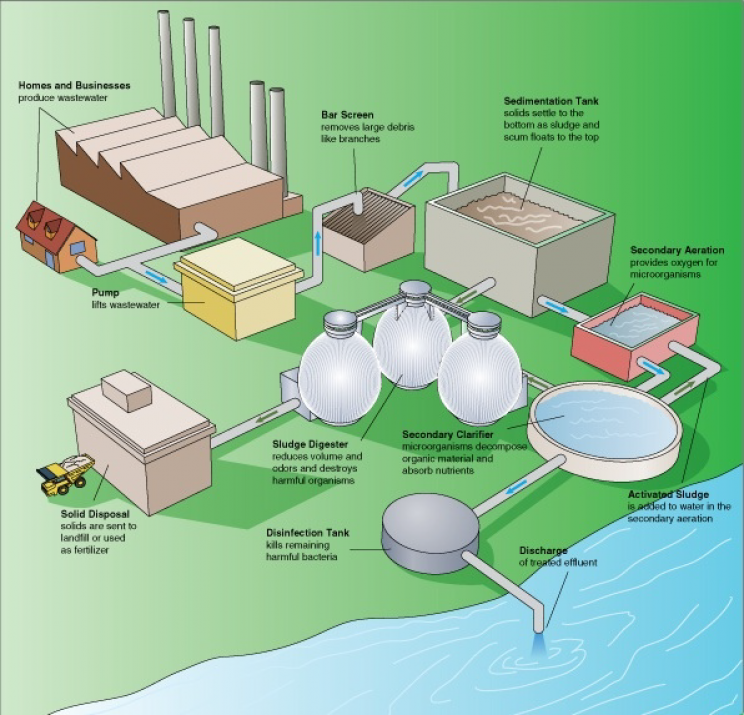
How Modern Wastewater Treatment Changed our WorldWhen wastewater arrives at a treatment facility, it first gets all the large chunks filtered out through a screen, a rather large one.
These screens are generally called bar screens, and their main job is to make the sewage more homogenous so it can flow through pumps and pipes in the plant.
The waste removed from bar screens is sent off to the landfill, and the slightly less chunky sewage heads to the next step, the grit chamber.
Grit chambers are essentially just big pools that you definitely don't want to swim in, they allow the larger particles in the sewage to settle out to the bottom.
These larger particles, things like dirt, sand, and large food particles, are called grit. Again, this process aids in making the sewage more homogenous than when it came in. The grit is also trucked off to landfills.
After the sewage gets pretty homogenized in these first few processes, it moves onto the primary clarifiers.
Primary clarifiers function as giant settling basins that allow particles larger than 10 μm (0.01 mm), referred to as suspended solids, to settle out to the bottom of the basin.
A giant skimming arm also scrapes away fat and grease that rise along the surface of the water.
These primary clarifiers are based on a principle called settling velocity, essentially just the speed at which particles settle.
Engineers make sure that the inflow of the water to the primary clarifier isn't more than the settling velocity of the particles, which ensures that particles still settle out and the sewage keeps on flowing.
Upon leaving the primary clarifiers, the sewage is free of solids bigger than 10 μm and at this point, is mostly contaminated with organic matter.
The sewage then moves on to aeration basins, beginning the secondary treatment processes.
Secondary wastewater treatment
Aeration basins are essentially bubbly hot tubs for sewage.
They bubble up air through the bottom of the sewage, which invigorates the sewage with dissolved oxygen.
How Modern Wastewater Treatment Changed our World
A view of 3 clarifiers
Engineers also pump in activated sludge into aeration basins, which is essentially bacteria and waste from the next round of clarifiers.
This activated sludge raises the oxygen content of the water and the bacteria go on a feeding frenzy, eating up all of the organic matter.
After the aeration basins, the sewage is going to look a lot clearer and it will head onto the secondary clarifiers.
This is the final filtering process, where all the remaining particles settle out.
The stuff that settles out is that activated sludge just mentioned, and a part of it is reused to make the aeration basins run smoothly.
What isn't used is left to dry out before it's disposed of or used as fertilizer.
How Modern Wastewater Treatment Changed our World
By the time the sewage leaves the secondary clarifiers, 85 percent of all organic matter has been removed and it will look fairly clear.
It might also be safe to drink too, but you're probably not going to want to. The final process before discharge is disinfection.
This process kills off all the bacteria still left in the water and makes sure there aren't any diseases being discharged into rivers.
This is typically done through chlorine, ozone, or ultraviolet disinfection (or a combination of these).
Ozone disinfection involves discharging electricity into the water to cause oxygen gas molecules to turn into ozone molecules, which oxidizes the bacteria, causing their cell walls to break, and kills them.
Chlorine treatment kills the bacteria in a similar manner but is a liquid chemical added to the water, and the treatment plant operators will generally remove the chlorine before releasing the effluent so the chlorine doesn't damage the environment.
Lastly, engineers can also use ultraviolet light to scramble the DNA of the bacteria, making it impossible for them to reproduce.
All three of these processes have different pros and cons and are used fairly interchangeably across the world.
In most cases, after disinfection, the water is released into rivers and streams.
In regions where water is scarce, sometimes the treated wastewater will head back for another round of treatment to be made into drinking water.
Chemically, this is very safe and could probably be used in many more places around the world if it wasn't for the stigma surrounding the closed-loop process of turning wastewater back into drinking water.
The entire process takes around 24 to 36 hours for a molecule of water to make it through the treatment plant.
And that's the magic of wastewater treatment. It's an essential process that allows us to live our lives without having to think about our own waste.
Be sure to thank all the wastewater treatment plant operators around you, because they have to deal with what you don't want to, 24/7.

Trevor English
Author
Trevor is a civil engineer (B.S.) by trade and an accomplished writer with a passion for inspiring everyone with new and exciting technologies. He is also a published children’s book author and the producer for the YouTube channel Concerning Reality.

Founded on the core mission of connecting likeminded engineers around the globe, Interesting Engineering is now a leading community with more than 15 million+ minds. Every day we share a new idea, a new thought, an upcoming technology OR an engineering breakthrough that will change the way you think about technology and engineering in today’s world and in the near future. Whether it’s a device that can charge your mobile in seconds or it’s the latest model of Boeing that has launched moments ago, we will bring everything up on your screen to view, to share and to grant you the power to comment. We believe that sharing information is the only way that can enrich and empower humans on this earth and we follow this as our core mission and responsibility. If you have got something that could entice the world, then Interesting Engineering is a perfect platform to show off your work to the outside world.
How Modern Wastewater Treatment Changed our World

Thursday, August 6, 2020

TOP 5 MOST PERVASIVE CARCINOGENS IN DRINKING WATER - Several carcinogens commonly find their way into tap water. These are largely tasteless and odorless, making them difficult to detect without proper equipment. The chemical known as 1,4-Dioxane has been used as a stabilizer in industrial applications for over six decades. This compound is also present in inks and adhesives and has been classified as a likely carcinogen to humans. It is also present in many shampoos and detergents, where it exists as a byproduct of the manufacturing process. Whereas 1,4-Dioxane is a likely carcinogen, arsenic is known to be an especially formidable one. This element occurs naturally in the earth and can be present as deposits in rocks and other excavations. It also leaches into soil and water as a result of mining refuse, the production of metals and power plants that burn coal and other fossil fuels. Otherwise known as hexavalent chronium, Chronium-6 causes cancer even in very small doses, making it a particularly insidious carcinogen and a very present danger in our drinking water. It is used in plenty of industrial processes and products, including dyes for fabrics, preserving wood, preventing corrosion and welding metals like stainless steel. Disinfecting water is a massively important process in the modern world and is one of the factors responsible for our ability to distribute drinking water via a grid to large portions of society.

top 5 most pervasive carcinogens in drinking water
................................................................................................................................................................
Top 5 Most Pervasive Carcinogens In Drinking Water
Multipure


Recent headlines about water quality have grabbed the nation’s attention and left many wondering what they can do to protect their homes and families.
top 5 most pervasive carcinogens in drinking waterWhile there are instances of cancer-causing chemicals in tap water, the good news is that filtration systems can keep chemical water pollution out of your home.
Several carcinogens commonly find their way into tap water. These are largely tasteless and odorless, making them difficult to detect without proper equipment.
It is important to know about them for several reasons:
Health: Your and your family’s health can be significantly affected by these carcinogens.
Applying Pressure on Utility Companies: If you know what carcinogens to look for, you will know what type of pressure to apply on your local utility company to remove them.
Here is some information on the top five cancer-causing agents present in tap water.
1. 1,4-Dioxane
The chemical known as 1,4-Dioxane has been used as a stabilizer in industrial applications for over six decades.
This compound is also present in inks and adhesives and has been classified as a likely carcinogen to humans.
In liquid form, it is clear and has a faintly sweet odor.
It is also present in many shampoos and detergents, where it exists as a byproduct of the manufacturing process.
1,4-Dioxane dissolves completely in water but does not easily break down, causing it to remain as a contaminant for long periods of time.
This carcinogen leaches into the water supply as a result of its use in industry.
Though it is more carefully regulated today, it was heavily used for many years and accumulated in landfills. From there, it seeps into the groundwater.
Because it blends so easily with water, it moves through soil effortlessly and subsequently reaches surface water.
From there, it can cause damage to kidneys and irritation of the lungs in addition to cancer.
Wastewater treatment plants cannot remove 1,4-Dioxane from water in significant quantities, which makes it especially persistent in surface water.
According to the EPA, 1,4-Dioxane at a concentration of 0.35 parts per billion is the amount predicted to lead to a maximum of one case of cancer in a sample of one million people.
This level is generally accepted to be the minimum standard for safety.
While 1,4-Dioxane has not been explicitly implicated as a cause of cancer, its administration via drinking water has caused liver cancer in laboratory rats.
Consequently, both the International Agency for Research on Cancer and the U.S. Department of Health and Human Services consider it a likely candidate for causing cancer.
2. Arsenic
arsenic in drinking waterWhereas 1,4-Dioxane is a likely carcinogen, arsenic is known to be an especially formidable one.
This element occurs naturally in the earth and can be present as deposits in rocks and other excavations.
It also leaches into soil and water as a result of mining refuse, the production of metals and power plants that burn coal and other fossil fuels.
Arsenic is a useful n-type doping agent within silicon semiconductors and is used in an ever-shrinking list of consumer products.
Arsenic gets into the water supply in many different ways.
It can come as a byproduct of agriculture, excavation, mining, and chemical or other types of industry.
It is present in smoke from tobacco and the smoke from burning pressure-treated lumber.
Those who have water delivered by a utility company may find arsenic in their tap water, while those who have dug wells are at risk of naturally-occurring arsenic in their well water.
A 2015 study found that over 70 million Americans had unsafe levels of arsenic in their water.
This type of arsenic, known as inorganic arsenic, comes from the ground and is more harmful than the arsenic found in many food products.
Because arsenic is always present in our bodies, it is the particular levels that are of concern.
When our water contains fewer than 10 parts per billion of arsenic, food becomes the main contributor to our arsenic levels.
Arsenic is associated with many medical ailments:
o  Cancer of the bladder, lungs, liver, kidneys, prostate, and skin
o  Damages internal organs and leads to cardiovascular diseases
o  Interfering with cellular functions
Even the EPA’s legal limit of 10 parts per billion is likely too high, as it still contributes 600 cases of cancer to every one million people.
More recent EPA research has found arsenic to be 17 times more poisonous than preceding research had indicated, but there is political pressure that may be preventing these findings from coming to light.
3. Chronium-6
chromium 6 in drinking waterOtherwise known as hexavalent chronium, this chemical received its moment in the spotlight with the 2000 film “Erin Brockovich.”
Chronium-6 causes cancer even in very small doses, making it a particularly insidious carcinogen and a very present danger in our drinking water.
It is used in plenty of industrial processes and products, including dyes for fabrics, preserving wood, preventing corrosion and welding metals like stainless steel.
One frustrating roadblock to keeping chronium-6 out of tap water is that there is currently no safe federal limit.
An older study, which limited chronium-6 and chronium-3 to 100 parts per billion, listed the two chemicals as skin irritants.
It was later revealed that chrobium-6 could cause cancer.
When researchers in the EPA completed a new study in 2011, which concluded that chromium-6 was indeed dangerously carcinogenic, the industry applied pressure and its released was postponed.
It could still be some time before chronium-6 in drinking water is limited.
Chromium-6 may be present in at least 75% of American drinking water supplies. It finds its way into them from industrial processes and spills.
For instance, a steel plant in Indiana was responsible for a spill that dumped 300 pounds of chromium-6 into a local waterway in 2017.
This release of chromium-6 was nearly 600 times the limit allowed by law. Spills aside, the chemical leaches into the water table from industrial processes and runoff.
Chromium-6 causes skin irritation when it is used in tanning leather or other similar products.
Ingesting it leads to a host of unwelcome side effects, including liver toxicity, stomach ulcers and irritation, tooth decay and asthma.
It is mostly banned within the European Union due to its health hazards.
4. Disinfection Byproducts
Disinfecting water is a massively important process in the modern world and is one of the factors responsible for our ability to distribute drinking water via a grid to large portions of society.
Chemicals like chlorine kill potentially deadly disease agents like cholera and dysentery that are a cause of so many deaths in other parts of the world.
When chlorine and similar disinfectants combine with waste products from plants and animals in our water system, however, they can form carcinogenic impurities. These are called disinfection byproducts.
Disinfection byproducts lead to a greater risk of cancer and might even cause harm to fetuses.
There are at least 250 million Americans who ingest disinfection byproducts in their drinking water.
Dangerous examples include four types of trihalomethanes, five different types of haloacetic acids, bromate and chlorite.
However, this is just the set of disinfectant byproducts identified by the government as dangerous — there are hundreds more that have been identified outside of these.
Because disinfection is such a critical part of our infrastructure, it is important to integrate disinfection byproduct removal with our current methods of killing diseases.
However, as it stands, disinfection byproducts find their way into the water as a result of organic waste flowing into reservoirs and mixing with disinfectants.
While the government and utility providers have experimented with different disinfectants to minimize harmful byproducts, the most promising method is preventing organic waste from entering the water system in the first place.
Trihalomethanes and haloacetic acids are the most prevalent disinfectant byproducts in drinking water.
These cause bladder cancer and have led to tumors in the intestines, livers, and kidneys of lab animals.
Chlorite can harm thyroid function and sperm as well as cause stomach ulcers.
Presently, it appears to be a carcinogen — albeit not a particularly powerful one.
Bromate is a disinfectant byproduct that can cause damage to DNA and is the result of the ozonation of water in treatment plants.
5. Nitrate
nitrate in drinking waterNitrate is a carcinogen affecting more than half of the United States’ population.
Nitrate is present in chemical fertilizers, manure and wastewater effluent from treatment plants.
It is extremely common in areas with heavy agriculture and can reside in water wells near livestock or septic tanks.
In 1962, the federal government imposed a limit of 10 milligrams per liter of nitrate, which was sufficient to prevent blue baby syndrome in newborns.
However, the limit has not been updated since learning that nitrate is a carcinogen.
Aside from being a byproduct of agriculture, nitrate also exists naturally in soil. However, this level is greatly increased by the addition of nitrate-rich fertilizers.
When rain falls, it washes much of this nitrate away, carrying it into rivers and the water table.
From there, it enters wells, reservoirs, lakes and other sources of water that people use to drink.
Nitrate often exists in conjunction with nitrite, which is even more dangerous to humans.
One interesting note about nitrate is its concentration in leafy vegetables.
When we consume these, we are also consuming nitrate — though the vegetables also contain enough antioxidants to have a net positive health effect.
Tap water remains the other primary source of nitrates and is especially dangerous for infants.
Nitrate leads to methemoglobinemia, or blue baby syndrome, in which a baby’s bloodstream is starved of oxygen.
Additionally, it leads to thyroid problems and can cause thyroid cancer in women.
It harms reproduction and damages DNA, which can lead to cancer in the blood, throat, and other organs.
Despite the mandates of the 1962 limit, it is likely that a lower level of nitrate should be ingested to avoid long-term health effects.
Unfortunately, agriculture continues to use more and more fertilizers.
This means we will have to find ways to alter agricultural practices to limit the amount of nitrate that runs off fields.
How do I know if my water contains these chemicals?
drinking water professionalDue to a large amount of interest in public safety, there are several resources to start out with when trying to gauge the quality of your local water.
One of the first places to search is on the EPA’s interactive water quality map. By typing in your zip code or city, you can view waterways that are impaired in your area.
This allows you to see immediately if the government has identified a water safety issue near you.
Additionally, you can view discharge sites. These are places where industrial concerns dump their waste.
If you are downriver from any of these discharge sites, it is a good idea to invest in a water filtration system.
Generally, it is a good idea no matter what. If you receive water from a utility company, that water may come from some distance away.
If you have a well, there could be chemicals or metals leaching into your well water, and filtration is a great way to ensure your safety.
You can also search for local water providers by going to the Environmental Working Group’s tap water database. Here, you can again type in your zip code and will receive a list of all tap water providers nearby.
Getting a professional water test is the surest way to know what your water contains and what precautions you need to take to ensure its purity.
Contact a local water testing organization to test your tap water.
What can I do to remove these chemicals from my drinking water?
Water filters come in many shapes and sizes to treat drinking water. At Multipure, we offer a broad selection of filtration systems for homes and businesses. Here are some of the products we have to choose from:
Aqualuxe: Built to offer a combination of artistic beauty and superb functionality, the Aqualuxe is an NSF-certified system that uses carbon block technology to filter out chemicals, viruses, and bacteria from drinking water. It provides peace of mind through industry-leading water filtration performance.
Aquaversa: This NSF-certified system can be used on a countertop or below the sink. Its carbon block filter treats both aesthetic and health contaminants.
Aquaperform: This NSF-certified system adds additional media to the carbon block to reduce the amount of Arsenic V in water. It comes in a stainless steel housing and is extremely effective at reducing impurities found in tap water.
Aquadome: This NSF-certified system comes in a plastic casing that is resistant to both impacts and high pressure and is easy to install for countertop uses.
Come to Multipure to taste the difference
When the safety of the natural environment and your family is on the line, look no further than
Multipure to provide top-of-the-line protection. Our broad range of Solid Carbon Block filters keep carcinogens out of your system and gives you control over the quality of the water in your home. Browse our products today and contact us with any questions.

Water is everywhere - in the air, in the ground, in the rivers and lakes. Water affects our body
and mind, from our skin and muscles to our metabolism and focus. Water is life.
Multipure is dedicated to better water, better health, and better lives. We are the premier manufacturer of high quality drinking water systems, filters, and purifiers, and our vision is demonstrated through
innovative water filtration technology and an extraordinary opportunity for success.
Welcome to Multipure, and welcome to our rich history, tradition, and leadership in
water treatment and the improvement of people's lives.
https://www.multipure.com/purely-social/science/top-5-pervasive-carcinogens-drinking-water/
top 5 most pervasive carcinogens in drinking water

Sunday, March 1, 2020

ALLERGIES AT HOME - Is Your Water Quality to Blame? - Municipalities add chlorine and other chemical purifiers to their water systems to make tap water safe for drinking and bathing, but what’s not as widely understood is how some of these chemicals can disrupt our body’s hormones. These purifying chemicals can interfere with our immune systems. When your body’s immune system identifies an allergen like dust, peanuts or shellfish as a potential danger, it will release antibodies to attack the foreign substance, which is what leads to everything from annoying seasonal allergy symptoms like nasal congestion to life-threatening conditions like anaphylaxis. What many allergy sufferers may not realize is that their body might be identifying the chemicals in their home’s tap water as potential attackers. Chlorine, which is primarily added to water to kill bacteria, could exacerbate allergy and asthma symptoms. In fact, research suggests that even the fumes from a steamy shower in chlorine-treated water could trigger an asthma attack.

Water Quality Allergens
...................................................................................................................................................................
Water Quality AllergensAllergies at Home
Is Your Water Quality to Blame?
Jennifer L. Nelson


From peanuts to pollen, millions of people worldwide suffer from allergies, but what they may not realize is that their drinking water could be partially to blame for their symptoms.
Most of us probably don’t want to think about what could be lurking in the tap water that we drink, cook with and bathe in, but studies have shown that certain allergies and respiratory conditions like asthma might be linked to chemicals that are commonly used to clean tap water.
How Tap Water Affects Your Allergy Symptoms
It’s widely known that municipalities add chlorine and other chemical purifiers to their water systems to make tap water safe for drinking and bathing, but what’s not as widely understood is how some of these chemicals can disrupt our body’s hormones.
However, researchers are finding that these purifying chemicals can interfere with our immune systems much like pet dander can cause hives in someone with animal allergies.
When your body’s immune system identifies an allergen like dust, peanuts or shellfish as a potential danger, it will release antibodies to attack the foreign substance, which is what leads to everything from annoying seasonal allergy symptoms like nasal congestion to life-threatening conditions like anaphylaxis.
Though it is possible to be allergic to water itself — an incredibly rare condition known as aquagenic urticaria — what many allergy sufferers may not realize is that their body might be identifying the chemicals in their home’s tap water as potential attackers.
Which Chemicals Are to Blame?
A study conducted in Belgium concluded that chlorine, which is primarily added to water to kill bacteria, could exacerbate allergy and asthma symptoms.
In fact, research suggests that even the fumes from a steamy shower in chlorine-treated water could trigger an asthma attack.
Other research has linked chlorine exposure to conditions ranging from skin and eye irritation to respiratory issues like bronchitis.
In recent years, another type of water purifying chemical that has been called into question is known as dichlorophenol.
Also used to clean drinking water, dichlorophenol is often used to make pesticides — meaning it might just be lingering on some of your favorite seasonal fruits and vegetables this summer.
The link between dichlorophenol and allergies is continuing to be established; one study tested more than 10,000 Americans and found that those with the highest levels of dichlorophenol in their urine were more likely to have food allergies, which currently affect some 15 million Americans.
But the chlorine that could be in your water at home isn’t solely to blame for any adverse allergy symptoms.
Fluoride has also been added to community water supplies for years due to its ability to fight tooth decay, but research has been done that suggests both adults and children who suffer from asthma and allergy symptoms may have negative reactions to fluoride.
How to Filter Your Tap Water to Improve Symptoms
If there’s someone with allergies or asthma in your home, experts agree you should consider filtering your tap water.
The majority of home water filters remove chlorine by relying on a semi-permeable membrane and a process known as reverse osmosis filtration, which also successfully removes pesticides in addition to lead, calcium, and other hard water minerals.
Reverse osmosis filters remove virtually all of the chemicals typically found in tap water, and have proven particularly effective in removing chemicals like fluoride from your drinking and bathing water.
You can also take your home’s water filtration a step further and invest in a shower filter to prevent absorbing the chemicals through your skin, but these filters may not eliminate all chemicals in the water and will likely have to be replaced on a fairly regular basis.
Alternatively, there are whole house filters on the market that are designed to remove all chemicals, including chlorine and fluoride, from every faucet in your home.
When installed on all of your kitchen and bathroom faucets, these filters can provide completely purified drinking and bath water throughout your home.
5 Water Quality-Related Tips To Relieve Allergies
Still concerned about how traces of chemicals like chlorine in your tap water might be affecting your existing allergies or asthma symptoms?
Here are some other water quality-related tips for allergy and asthma sufferers.
Keep Your Showers Short (and Cool)
Long showers in hot water can lead to increased absorption of any chemicals that might be lingering in your home’s water supply.
Allergy and asthma sufferers should consider limiting the amount of time spent in the shower, using lukewarm water, and turning off the water entirely while lathering or shaving.
Choose Bottled Water
For those who are concerned about chemicals in tap water, investing in water purifiers for your faucets will likely be the most economical option in the long run. However, bottled water can provide a safe alternative for drinking water when you’re on the go.
Opt For Organic
Even if you install a top-of-the-line faucet water filter, that doesn’t mean the produce you eat wasn’t previously treated with the very chemicals or pesticides you’re trying to avoid.
Choose organic fruits and vegetables whenever possible, and be sure to thoroughly rinse all produce with filtered water prior to consuming.
Limit Pool Time
Public pools are dependent on increased levels of chemicals like chlorine in order to kill bacteria. So if you or a loved one has severe allergies or asthma, you might want to limit time spent at the community pool.
You can also seek out pools — or treat your own backyard pool — with non-chlorine chemical alternatives like bromine or processes like ionization, which relies on copper and silver ions to keep the water clean.
Use Distilled Water in Humidifiers
Longtime asthma and allergy sufferers probably already know that humidity in that air can improve their breathing.
But if you’re relying on a humidifier to sleep comfortably through the night, you might want to fill it with distilled water.
The minerals commonly found in tap water can form deposits that ultimately promote the growth of bacteria — which, of course, can then be released into the air and potentially worsen your symptoms.
By following the above tips, you can better protect yourself and your family from the allergies caused by poor water quality.
With a little preparation and care, you can fight back against the allergens that lace our water sources, promoting a healthier home.

AllergyAndAir.com specializes in affordable, practical, and innovative products to improve air quality and regulate the temperature in your home.
At AllergyAndAir.com we strive to make online shopping quick, easy and affordable. Our catalog is always growing and we carry the latest selection of products to safeguard your home from allergens, mold, moisture, and more. With three distribution centers across the United States, we can deliver faster than the competition. We have a dedicated call center with product experts to answer your questions.
Water Quality Allergens