Showing posts with label Calculus. Show all posts

Sunday, October 27, 2019

POWER AND HORSEPOWER - Defining Power in Physics - When you walk a mile, your motive force is displacing your body, which is measured as the work is done. When you run the same mile, you are doing the same amount of work but in less time. The runner has a higher power rating than the walker. A car with 80 horsepower can produce faster acceleration than a car with 40 horsepower. In the end the 80-hp engine can reach that speed faster. Horsepower is often used to describe the power delivered by a machine. Horsepower is a unit of power in the British system of measurement. It is the power required to lift 550 pounds by one foot in one second and is about 746 watts. The watt is often seen in relation to light bulbs.

Red Race Car on Drag Strip
.....................................................................................................................................................
Power And Horsepower
Defining Power in Physics
by Andrew Zimmerman Jones 


Power is the rate at which work is done or energy is transferred in a unit of time.
Power is increased if work is done faster or energy is transferred in less time.
Calculating Power
The equation for power is P = W/t
·         P stands for power (in watts)
·         W stands for the amount of work done (in Joules) or energy expended (in Joules)
·         t stands for the amount of time (in seconds)
In calculus terms, power is the derivative of work with respect to time. If work is done faster, power is higher. If work is done slower, power is smaller.
Since work is force times displacement (W=F*d), and velocity is displacement over time (v=d/t), power equals force times velocity: P = F*v. More power is seen when the system is both strong in force and fast in velocity.
Units of Power
Power is measured in energy (joules) divided by time.
The SI unit of power is the watt (W) or joule per second (J/s). 
Power is a scalar quantity, it has no direction.
Horsepower is often used to describe the power delivered by a machine. 
Horsepower is a unit of power in the British system of measurement. It is the power required to lift 550 pounds by one foot in one second and is about 746 watts.
The watt is often seen in relation to light bulbs.
In this power rating, it is the rate at which the bulb converts electrical energy into light and heat. A bulb with a higher wattage will use more electricity per unit of time.
If you know the power of a system, you can find the amount of work that will be produced, as W = Pt.
If a bulb has a power rating of 50 watts, it will produce 50 joules per second. In an hour (3600 seconds) it will produce 180,000 joules.
Work and Power
When you walk a mile, your motive force is displacing your body, which is measured as the work is done.
When you run the same mile, you are doing the same amount of work but in less time. The runner has a higher power rating than the walker, putting out more watts.
A car with 80 horsepower can produce faster acceleration than a car with 40 horsepower. In the end, both cars are going 60 miles per hour, but the 80-hp engine can reach that speed faster.
In the race between the tortoise and the hare, the hare had more power and accelerated faster, but the tortoise did the same work and covered the same distance in a much longer time. The tortoise showed less power.
Average Power
When discussing power, people are usually referring to average power, Pavg.
It is the amount of work done in a period of time (ΔW/Δt) or the amount of energy transferred in a period of time (ΔE/Δt).
Instantaneous Power
What is the power at a specific time? When the unit of time approaches zero, calculus is needed to derive an answer, but it is approximated by force times speed.

Andrew Zimmerman Jones
Introduction
Academic researcher, educator, and writer with 23 years of experience in physical sciences
Works at Indiana Department of Education as senior assessment specialist in mathematics
Experience
Andrew Zimmerman Jones is a former writer for ThoughtCo who contributed nearly 200 articles for more than 10 years. His topics ranged from the definition of energy to vector mathematics. Andrew is a dedicated educator; and he uses his background in the physical sciences, educational assessment, writing, and communications to advance that mission. 
Andrew is co-author of String Theory For Dummies, which discusses the basic concepts of this controversial approach. String theory tries to explain certain phenomena that are not currently explainable under the standard quantum physics model. 
Since 2018, Andrew has worked at the Indiana Department of Education as a senior assessment specialist in mathematics; prior to which he served as a senior assessment editor at CTB/McGraw Hill for 10 years. In addition, Andrew was a researcher at Indiana University's Cyclotron Facility. He is a member of the National Association of Science Writers. 
Education
Andrew Zimmerman Jones has a Master of Science (M.S.) in Mathematics Education from Indiana University–Purdue, Indianapolis, Ind.; and a Bachelor of Arts (B.A.) in Physics from Wabash College, Crawfordsville, Ind. 
Awards and Publications
String Theory For Dummies (Wiley–For Dummies Series, 2009)
Graduated magna cum laude (Wabash College, 1999)
Harold Q. Fuller Prize in Physics (Wabash College, 1998)
ThoughtCo and Dotdash
ThoughtCo is a premier reference site focusing on expert-created education content. We are one of the top-10 information sites in the world as rated by comScore, a leading Internet measurement company. Every month, more than 13 million readers seek answers to their questions on ThoughtCo.
For more than 20 years, Dotdash brands have been helping people find answers, solve problems, and get inspired. We are one of the top-20 largest content publishers on the Internet according to comScore, and reach more than 30% of the U.S. population monthly. Our brands collectively have won more than 20 industry awards in the last year alone, and recently Dotdash was named Publisher of the Year by Digiday, a leading industry publication.
Red Race Car on Drag Strip

Sunday, October 13, 2019

OPPOSITE OF INFINITY - Infinity has baffled humanity since antiquity. One must realize that infinity is not a concrete number, but rather an idea; it exists only in abstraction. Infinity cannot be a concrete number, say, x, because we can, by the logic of addition, add 1 to x and create a new infinity. We can then add another 1 to create a larger infinity. We can, in fact, add infinity to infinity to create perhaps the infinity of all infinities, but then we can add to this infinity another 1 and … you know the drill. The microscopic realm isn’t any different. The opposite of infinity is called infinitesimal, and its nature is equally bizarre.

An Infinite Reflection Turns Green
////////////////////////////////////////////////////////////////////////////////////////////////////////////////////////////////////////
Opposite Of Infinity
Triangle area of circle
Infinite triangles right angle triangle and calculation

What Is The Opposite Of Infinity?
Akash Peshin  


No, the answer isn’t zero. Infinity is the largest number there is, so the opposite of infinity would be the smallest number there is.
Zero would mean nothing, so what we’re looking for is a number just greater than zero.
However, as we’ll find out, determining this number isn’t as simple as pointing to the number 1.
Infinities are weird
Infinity has baffled humanity since antiquity. One must realize that infinity is not a concrete number, but rather an idea; it exists only in abstraction.
Infinity cannot be a concrete number, say, x, because we can, by the logic of addition, add 1 to x and create a new infinity. We can then add another 1 to create a larger infinity.
We can, in fact, add infinity to infinity to create perhaps the infinity of all infinities, but then we can add to this infinity another 1 and … you know the drill.
The microscopic realm isn’t any different. The opposite of infinity is called infinitesimal, and its nature is equally bizarre.
Unlike whole numbers, real numbers aren’t rigid. Their splintered nature allows us to find and create infinite numbers between any two numbers.
A number can be combined as many times as it can be divided. There could be a hundred numbers between 0 and 1, from 0.01-0.99, or even millions, one just has to add zeroes after the decimal point — divide it increasingly to create new numbers. So, while 0.00000000000000001 seems infinitesimal, one can just divide it by 10 to create a new infinitesimal — 0.000000000000000001.
So, infinitesimal, like infinity, exists only in abstraction, yet its uncertain nature is very disconcerting not just for mathematicians, but also physicists.
Infinitesimal Errors
Mathematics is the language we use to express our ideas in physics, so an inconsistency in math translates to an inconsistency in physics, in our knowledge of nature – of reality.
The inconsistency arises from our uncertainty of the value of infinitesimal, which has been used to derive many crucial formulae.
In fact, an entire branch of mathematics is based on infinitesimal, without which, progress in physics would have been sluggish.
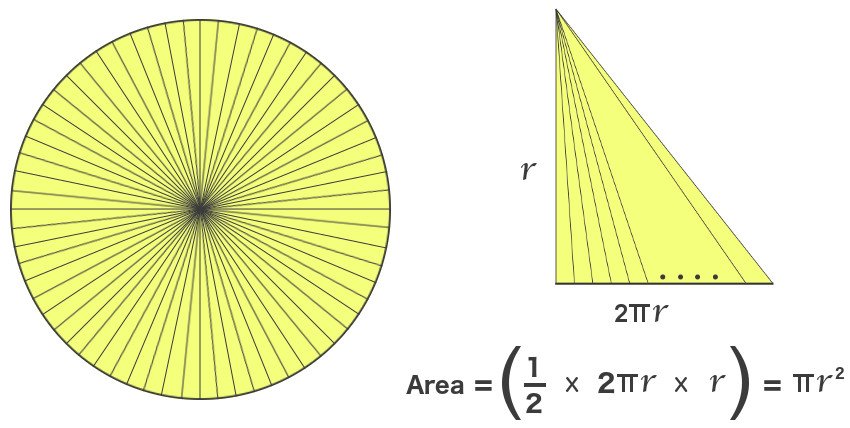
One formula I can think of is the area of a circle. Kepler calculated the area of a circle by dividing it into triangles.
The area of the circle, therefore, would be the sum of areas of each triangle.
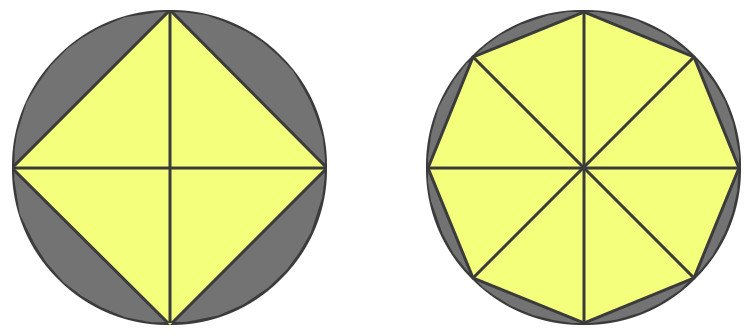
A circle can be divided into four triangles with two diameters, however, the sides of these triangles do not approximate the curves properly, excluding some space, so the area calculated is erroneous.
To reduce this error, we can draw more diameters to create more triangles of shorter sides. However, the error is reduced in this way, but it is still finite.
So, we further divide the circle into more and more triangles until there is no space left excluded. However, to eliminate this error entirely, we must divide it into an infinite number of triangles.
Now, because a line can be interpreted as part of a huge circle, we can say that our circle is composed of infinite lines, which are approximated by the infinitesimal bases of our infinite triangles.
One may notice that the sequence of triangles is reminiscent of a Chinese fan. All the triangles occupy an equal area, but we can convert the fan into a large right-angled triangle by distributing or stretching this area.
Their perimeters have changed, but the total area remains the same. The height of this triangle, with the summit being the circle’s center, is the length of the fan — the radius of our circle, and the base, the circle’s circumference.
The area is ½ times base times height, which is ½ times r times 2πr, or πr².
This is, of course, the correct answer, but the outcome is still erroneous.
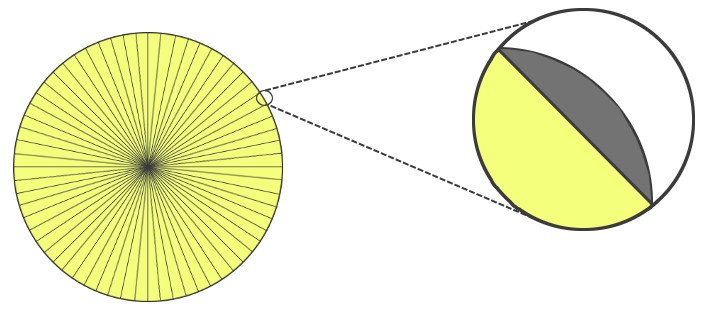
The bases must be truly infinitesimal, so even though Kepler draws really, really, really thin triangles, we know that he could have drawn more.

The moment he stops drawing triangles, he leaves behind spaces, albeit really, really, really small ones, but still, finite.
The curves are then inadequately approximated and the calculation of the area of the circle is slightly erroneous.
While this might make a mathematician uncomfortable, the majority “ignore” such differences for, as we have seen, the results procured aren’t incorrect.
Calculus, either invented or discovered by Leibniz and Newton independently, was also founded on infinitesimals.
That branch of mathematics is concerned with change, with curves.
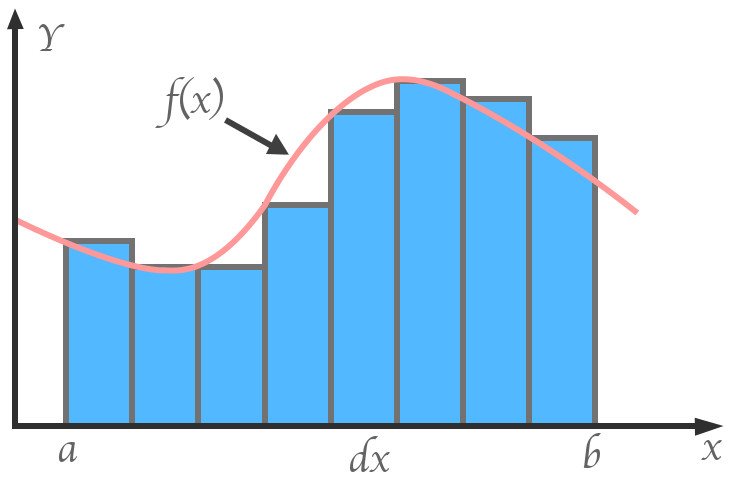
For instance, when we integrate a function, we essentially calculate the area under the curve it draws.
However, like calculating the area of a circle, we calculate it by approximating the curve with infinitesimally thin rectangles. The thinner the rectangles, the smaller the error.
The area of one rectangle is the product of its length — the value on the Y-axis at that point on the curve and its breadth – the infinitesimal unit we call ‘dx’.
We calculate the area of each rectangle and sum them to determine the area under the curve.
This is very useful in physics; for instance, the area under the velocity curve of a body gives the value of its displacement, but then shouldn’t the outcome be erroneous, just like the area of the circle was?
This ineradicable, insoluble problem bothered mathematicians for two centuries following the advent of calculus until the concept of limits was refined.
Limits were implicit in Newton and Leibniz’s work, but they were modified and redefined later in the early 1800s.
The new ideas were mathematically rigorous and consistent. The details are beyond the scope of this article, but limits allowed mathematicians to finally get rid of infinitesimals for good.
What we still haven’t gotten rid of is the absurdity that is infinity.

Akash Peshin is an Electronic Engineer from the University of Mumbai, India and a science writer at ScienceABC. Enamored with science ever since discovering a picture book about Saturn at the age of 7, he believes that what fundamentally fuels this passion is his curiosity and appetite for wonder.
Area of circle

An Infinite Reflection Turns Green
Infinity
Curve area diagramArea of circle border zoom

Sunday, May 19, 2019

MATHEMATICS AND CIVIL ENGINEERING - Civil engineers use trigonometry often when surveying a structure. Surveying deals with land elevations as well as the various angles of structures. Physics takes on a huge roll in a civil engineer’s job - equations are applied to all angles of an engineering problem to make sure the structure being created is going to function the way it must. When a bridge is being designed, physics is used to figure out how large the supporting piers should be, as well as how thick the steel columns of bridge need to be, and how many of them should be installed. Physics equations typically use algebra, calculus, and trigonometry.

Image result for Mathematics And Civil Engineering images
.....................................................................................................
Mathematics And Civil Engineering
Image result for Mathematics And Civil Engineering imagesHow Is Math Used in Civil Engineering?
By Benjamin Skinner


A civil engineer uses nearly every form of math at one point in time to do her job.
Algebra is used on a daily basis, and many engineers will have to deal with differential equations, statistics, and calculus occasionally.
A good portion of a civil engineer's time is not spent doing math, but when the time comes civil engineers have to be very comfortable with all the forms of math, especially those that deal with physics.
Civil engineers have to use math equations that are derived from chemistry on a daily basis.
Chemistry's equations are used to measure the strength of materials, and engineers must use these equations to select the right material for a project.
Civil engineers use trigonometry often when surveying a structure. Surveying deals with land elevations as well as the various angles of structures.
Physics takes on a huge roll in a civil engineer’s job.
Physics equations are applied to all angles of an engineering problem to make sure the structure being created is going to function the way it must.
When a bridge is being designed, physics is used to figure out how large the supporting piers should be, as well as how thick the steel columns of bridge need to be, and how many of them should be installed.
Physics equations typically use algebra, calculus, and trigonometry.
Basic math skills such as accounting and statistics must be utilized during the planning phase of any project.
Figuring out the financial side of a project is an important part of a civil engineer’s job and he must figure out how much a project is going to cost its investors.

About the Author
Located in New York State, Benjamin Skinner has been writing technology and health articles since 2008. He has worked with large companies such as Women’s Forum and Great Leap Studios. Skinner has more than six years of experience in the construction industry and understands the inner workings of buildings. He holds a Bachelor of Arts in English literature from Syracuse University.

Friday, June 15, 2018

THE STUDY OF CALCULUS - Before calculus was invented, all math was static: It could only help calculate objects that were perfectly still. But, the universe is constantly moving and changing. No objects - from the stars in space to subatomic particles or cells in the body - are always at rest. Indeed, just about everything in the universe is constantly moving. Calculus helped to determine how particles, stars, and matter, actually move and change in real time.


 .
Calculus
An Introduction to the Study of Calculus
The branch of mathematics studies rates of change

Calculus is the study of rates of change.
The principals behind calculus date back centuries to the ancient Greeks, as well as to ancient China, India and even medieval Europe.
Before calculus was invented, all math was static: It could only help calculate objects that were perfectly still.
But, the universe is constantly moving and changing. No objects - from the stars in space to subatomic particles or cells in the body - are always at rest.
Indeed, just about everything in the universe is constantly moving. Calculus helped to determine how particles, stars, and matter, actually move and change in real time.

History

Calculus was developed in the latter half of the 17th century by two mathematicians, Gottfried Leibniz and Isaac Newton.
Newton first developed calculus and applied it directly to the understanding of physical systems.
Independently, Leibniz developed the notations used in calculus.
Put simply, while basic math uses operations such as plus, minus, times, and division (+, -, x, and ÷), calculus uses operations that employ functions and integrals to calculate rates of change.
The Story of Mathematics explains the importance of Newton's fundamental theorem of the calculus:
"Unlike the static geometry of the Greeks, calculus allowed mathematicians and engineers to make sense of the motion and dynamic change in the changing world around us, such as the orbits of planets, the motion of fluids, etc."
Using calculus, scientists, astronomers, physicists, mathematicians, and chemists could now chart the orbit of the planets and stars, as well as the path of electrons and protons at the atomic level.
Economists to this day use calculus to determine the price elasticity of demand.

Two Types of Calculus

There are two main branches of calculus: differential and integral calculus.
Differential calculus determines the rate of change of a quantity, while integral calculus finds the quantity where the rate of change is known.
Differential calculus examines the rates of change of slopes and curves, while integral calculus determines the areas of those curves.

Practical Applications

Calculus has many practical applications in real life, as the website, teachnology explains:
"Among the physical concepts that use concepts of calculus include motion, electricity, heat, light, harmonics, acoustics, astronomy, and dynamics. In fact, even advanced physics concepts including electromagnetism and Einstein's theory of relativity use calculus."
Calculus is also used to calculate the rates of radioactive decay in chemistry, and even to predict birth and death rates, the science website notes.
Economists use calculus to predict supply, demand, and maximum potential profits. Supply and demand are, after all, essentially charted on a curve - and an ever-changing curve at that.
Economists refer to this ever-changing curve as "elastic," and the actions of the curve as "elasticity."
To calculate an exact measure of elasticity at a particular point on a supply or demand curve, you need to think about infinitesimally small changes in price and, as a result, incorporate mathematical derivatives into your elasticity formulas.
Calculus allows you to determine specific points on that ever-changing supply-and-demand curve.