Showing posts with label Bentonite. Show all posts

Friday, November 22, 2019

EXPANSIVE SOIL AND EXPANSIVE CLAY - The hidden force behind basement and foundation problems – When expansive soils absorb water, they increase in volume. The more water they absorb, the more their volume increases. This change in volume can exert enough force on a building or other structure to cause damage. Cracked foundations, floors, and basement walls are typical types of damage done by swelling soils. Damage to the upper floors of the building can occur when motion in the structure is significant. Expansive soils will also shrink when they dry out. This shrinkage can remove support from buildings or other structures and result in damaging subsidence. Fissures in the soil can also develop. These fissures can facilitate the deep penetration of water when moist conditions or runoff occurs.

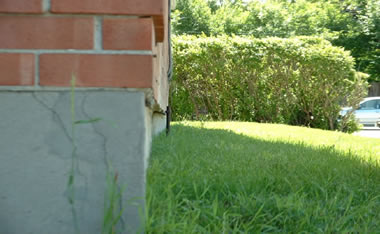
foundation cracks caused by expansive soils
Building damage: Note displaced bricks and inward deflection of foundation.
...................................................................................................................................................................
Expansive Soil and Expansive Clay
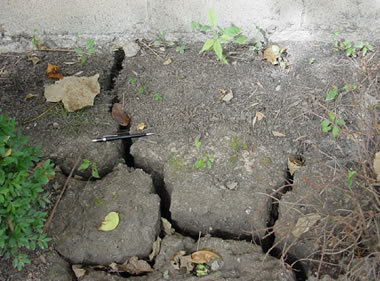
cracks in expansive soil
Cracks in expansive soil: Desiccation cracks in soil caused by drying. 
The hidden force behind basement and foundation problems
Article by: Hobart M. King, Ph.D., RPG


What is an "Expansive Soil"?
Expansive soils contain minerals such as smectite clays that are capable of absorbing water. When they absorb water, they increase in volume.
The more water they absorb, the more their volume increases. Expansions of ten percent or more are not uncommon. This change in volume can exert enough force on a building or other structure to cause damage.
Cracked foundations, floors, and basement walls are typical types of damage done by swelling soils. Damage to the upper floors of the building can occur when motion in the structure is significant.
In a typical year in the United States, expansive soils cause a greater financial loss to property owners than earthquakes, floods, hurricanes, and tornadoes combined.
Expansive soils will also shrink when they dry out. This shrinkage can remove support from buildings or other structures and result in damaging subsidence.
Fissures in the soil can also develop. These fissures can facilitate the deep penetration of water when moist conditions or runoff occurs.
This cycle of shrinkage and swelling places repetitive stress on structures, and damage worsens over time.
How Many Buildings are at Risk?
Expansive soils are present throughout the world and are known in every US state. Every year they cause billions of dollars in damage.
The American Society of Civil Engineers estimates that 1/4 of all homes in the United States have some damage caused by expansive soils.
In a typical year in the United States, they cause a greater financial loss to property owners than earthquakes, floods, hurricanes, and tornadoes combined.
Even though expansive soils cause enormous amounts of damage, most people have never heard of them.
This is because their damage is done slowly and cannot be attributed to a specific event.
The damage done by expansive soils is then attributed to poor construction practices or a misconception that all buildings experience this type of damage as they age.
Homeowners Insurance and Expansive Soils
Damage to a home caused by expansive soils can be catastrophic for a homeowner. Why?
Most homeowners insurance policies do not cover damage caused by expansive soils. The cost of repairs and mitigation can be extremely high - it sometimes exceeds the value of the home.
In many cases the homeowner noticed the problem, didn’t realize its severity, didn’t realize that it was progressing, and the problem progressed to a point where repair didn’t make economic sense.
Expandable, Shrink-Swell, Heavable Soils?
Expandable soils are referred to by many names. "Expandable soils," "expansive clays," "shrink-swell soils," and "heavable soils" are some of the many names used for these materials.
The problem is so unfamiliar to the average homeowner that they don't know what to call it.
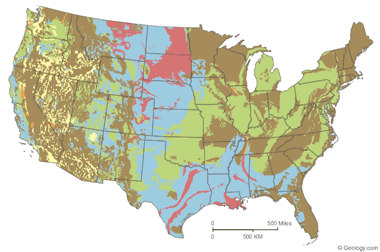
Expansive Soils Map
The map on this page shows the generalized geographic distribution of soils that are known to have expandable clay minerals which can cause damage to foundations and structures. It also includes soils that have a clay mineral composition which can potentially cause damage.
How to Interpret the Map
The map is meant to show general trends in the geographic distribution of expansive soils. It is not meant to be used as a property evaluation tool. It is useful for learning areas where expansive soils underlie a significant portion of the land and where expansive soils might be a localized problem.
All construction projects should include a soil analysis to identify the types of soil present and determine their expansive properties. Local occurrences of expansive soils can be found in all of the soil categories shown on this map.
Why Do These Soils Expand?
Soils are composed of a variety of materials, most of which do not expand in the presence of moisture.
However, a number of clay minerals are expansive. These include: smectite, bentonite, montmorillonite, beidellite, vermiculite, attapulgite, nontronite, and chlorite. There are also some sulfate salts that will expand with changes in temperature.
When a soil contains a large amount of expansive minerals, it has the potential of significant expansion. When the soil contains very little expansive minerals, it has little expansive potential.
Changes in Moisture Content Trigger Damage
When expansive soils are present, they will generally not cause a problem if their water content remains constant. The situation where greatest damage occurs is when there are significant and repeated moisture content changes.
The Bottom Line
It is possible to build successfully and safely on expansive soils if stable moisture content can be maintained or if the building can be insulated from any soil volume change that might occur.
The procedure for success is as follows:
·         Testing to identify any problems
·         Design to minimize moisture content changes and insulate from soil volume changes
·         Build in a way that will not change the moisture conditions of the soil
·         Maintain a constant moisture environment after construction
Expert assistance is usually needed to do these things successfully.

Hobart M. King, Ph.D., GIA GG
Hobart M. King is the owner and publisher of Geology.com. He is a geologist with over 40 years of experience, has a Ph.D. in geology, and is a GIA graduate gemologist. Much of his work has focused on coal geology, industrial minerals, gemology, geologic hazards, and geoscience education.
He has authored many of the internet’s most popular articles about rocksminerals and gems. He writes most of the content published on Geology.com and compiles its daily news. His writing is read by over a million people each month, making him one of the world’s most widely read geologists.
Dr. King earned a Ph.D. and an M.S. in geology from West Virginia University; a B.S. in geology from California University of Pennsylvania; and, a Graduate Gemologist Diploma from the Gemological Institute of America. He is a registered professional geologist in the Commonwealth of Pennsylvania.
He has worked as a geologist in a variety of settings since 1975.
https://geology.com/articles/expansive-soil.shtml
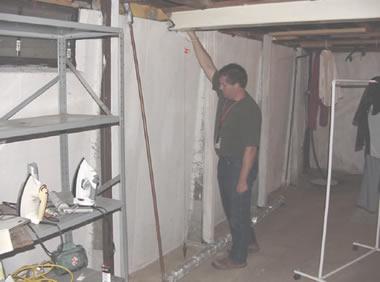
deflected basement wall
Deflected basement wall: Inward deflection of a basement wall and pilasters. The plumb-bob reveals 9 inches of inward displacement.
expansive soils map
Expansive soils map: The map above is based upon "Swelling Clays Map of the Conterminous United States"

Wednesday, November 6, 2019

BENTONITE CLAY - Bentonite presents strong colloidal properties and its volume increases several times when coming into contact with water, creating a gelatinous and viscous fluid. The special properties of bentonite make it a valuable material for a wide range of uses. Bentonite deposits are normally exploited by quarrying. The material is initially crushed and activated with the addition of soda ash (Na2CO3). Bentonite is subsequently dried (air and/or forced drying) to reach a moisture content of approximately 15%. According to the final application, bentonite is either sieved (granular form) or milled (into powder and super fine powder form). For special applications, bentonite is purified by removing the associated gangue minerals, or treated with acids to produce acid-activated bentonite (bleaching earths), or treated with organics to produce organoclays.

Image result for images bentonite
..........................................................................................................................................................
Image result for images bentoniteBentonite Clay
What is Bentonite?
The Industrial Minerals Association


The term Bentonite was first used for a clay found in about 1890 in upper cretaceous tuff near Fort Benton, Wyoming.
The main constituent, which is the determinant factor in the clay's properties, is the clay mineral montmorillonite.
This in turn, derives its name from a deposit at Montmorillon, in Southern France.
Bentonite is a clay generated frequently from the alteration of volcanic ash, consisting predominantly of smectite minerals, usually montmorillonite.
Other smectite group minerals include hectorite, saponite, beidelite and nontronite.
Smectites are clay minerals, i.e. they consist of individual crystallites the majority of which are <2µm in largest dimension.
Smectite crystallites themselves are three-layer clay minerals. They consist of two tetrahedral layers and one octahedral layer.
In montmorillonite tetrahedral layers consisting of [SiO4] - tetrahedrons enclose the [M(O5,OH)]-octahedron layer (M = and mainly Al, Mg, but Fe is also often found).
The silicate layers have a slight negative charge that is compensated by exchangeable ions in the intercrystallite region.
The charge is so weak that the cations (in natural form, predominantly Ca2+, Mg2+ or Na+ ions) can be adsorbed in this region with their hydrate shell.
The extent of hydration produces intercrystalline swelling. Depending on the nature of their genesis, bentonites contain a variety of accessory minerals in addition to montmorillonite.
These minerals may include quartz, feldspar, calcite and gypsum.
The presence of these minerals can impact the industrial value of a deposit, reducing or increasing its value depending on the application.
Bentonite presents strong colloidal properties and its volume increases several times when coming into contact with water, creating a gelatinous and viscous fluid.
The special properties of bentonite (hydration, swelling, water absorption, viscosity, thixotropy) make it a valuable material for a wide range of uses and applications.
Bentonite deposits are normally exploited by quarrying. Extracted bentonite is distinctly solid, even with a moisture content of approximately 30%.
The material is initially crushed and, if necessary, activated with the addition of soda ash (Na2CO3).
Bentonite is subsequently dried (air and/or forced drying) to reach a moisture content of approximately 15%.
According to the final application, bentonite is either sieved (granular form) or milled (into powder and super fine powder form).
For special applications, bentonite is purified by removing the associated gangue minerals, or treated with acids to produce acid-activated bentonite (bleaching earths), or treated with organics to produce organoclays.
Foundry: Bentonite is used as a bonding material in the preparation of molding sand for the production of iron, steel and non-ferrous casting.
   The unique properties of bentonite yield green sand moulds with good flowability, compactability and thermal stability for the production of high quality castings.
Cat Litter: Bentonite is used for cat litter, due to its advantage of absorbing refuse by forming clumps (which can be easily removed) leaving the remaining product intact for further use.
Pelletizing: Bentonite is used as a binding agent in the production of iron ore pellets. Through this process, iron ore fines are converted into spherical pellets, suitable as feed material in blast furnaces for pig iron production, or in the production of direct reduction iron (DRI).
Construction and Civil Engineering: Bentonite in civil engineering applications is used traditionally as a thixotropic, support and lubricant agent in diaphragm walls and foundations, in tunnelling, in horizontal directional drilling and pipe jacking. Bentonite, due to its viscosity and plasticity, also is used in Portland cement and mortars.
Environmental Markets: Bentonite's adsorption/absorption properties are very useful for wastewater purification.
   Common environmental directives recommend low permeability soils, which naturally should contain bentonite, as a sealing material in the construction and rehabilitation of landfills to ensure the protection of groundwater from the pollutants. Bentonite is the active protective layer of geosynthetic clay liners.
Drilling: Another conventional use of bentonite is as a mud constituent for oil and water well drilling. Its roles are mainly to seal the borehole walls, to remove drill cuttings and to lubricate the cutting head.
Oils/Food Markets: Bentonite is utilized in the removal of impurities in oils where its adsorptive properties are crucial in the processing of edible oils and fats (Soya/palm/canola oil). In drinks such as beer, wine and mineral water, and in products like sugar or honey, bentonite is used as a clarification agent.
Agriculture: Bentonite is used as an animal feed supplement, as a pelletizing aid in the production of animal feed pellets, as well as a flowability aid for unconsolidated feed ingredients such as soy meal.
   It also is used as an ion exchanger for improvement and conditioning of the soil. When thermally treated, it can be used as a porous ceramic carrier for various herbicides and pesticides.
Pharmaceuticals: Cosmetics and Medical Markets: Bentonite is used as filler in pharmaceuticals, and due to its absorption/adsorption functions, it allows paste formation.
   Such applications include industrial protective creams, calamine lotion, wet compresses, and anti-irritants for eczema.
   In medicine, bentonite is used as an antidote in heavy metal poisoning. Personal care products such as mud packs, sunburn paint, baby and facepowders, and face creams may all contain bentonite.
Detergents: Laundry detergents and liquid hand cleansers/soaps rely on the inclusion of bentonite, in order to remove the impurities in solvents and to soften the fabrics.
Paints: Dyes and Polishes: Due to its thixotropic properties, bentonite and organoclays function as a thickening and/or suspension agent in varnishes, and in water and solvent paints.
   Its adsorption properties are appreciated for the finishing of indigo dying cloth, and in dyes (lacquers for paints & wallpapers).
Paper: Bentonite is crucial to paper making, where it is used in pitch control, i.e. absorption of wood resins that tend to obstruct the machines and to improve the efficiency of conversion of pulp into paper as well as to improve the quality of the paper.
   Bentonite also offers useful de-inking properties for paper recycling. In addition, acid-activated bentonite is used as the active component in the manufacture of carbonless copy paper.
Catalyst: Chemically-modified clay catalysts find application in a diverse range of duties where acid catalysis is a key mechanism. Most particularly, they are employed in the alkylation processes to produce fuel additives.

The Industrial Minerals Association - North America (IMA-NA) is the representative voice of companies which extract and process a vital and beneficial group of raw materials known as industrial minerals. Industrial minerals are the ingredients for many of the products used in everyday life, and our companies and the people they employ are proud of their industry and the socially responsible methods they use to deliver these beneficial resources.
IMA-NA represents ball clay, barite, bentonite, borates, calcium carbonate, diatomite, feldspar, industrial sand, kaolin, magnesia, soda ash, talc and wollastonite.
Industrial minerals . . . Your world is made of them!
Image result for images bentonite
Image result for images bentoniteImage result for images bentoniteImage result for images bentonite