Showing posts with label Toxins. Show all posts

Tuesday, January 19, 2021

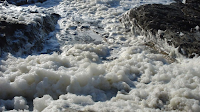
SEA FOAM - Sea foam is created by the agitation of seawater containing high concentrations of dissolved organic matter, which can come from the natural environment in the form of algal blooms or from man-made sources. As the waves crash onto the shore or lap at the beach, depending on where you are, there's usually some leftover frothy bits that cling to the sand. On windy days, this foamy stuff can even be lifted off the ground and blown around. What is it? And is it dangerous to touch it or let the dog run around in it? It's sea foam, and it is not nearly as green as the color we call sea foam. It's usually whitish, though it's probably a little dingy rather than being sparkling white. Sometimes it's more of a reddish-brown, though, and that's the sea foam to watch out for. Sea water is 96.5 percent water and 2.5 percent salt. That only adds up to 99 percent, so what's the other 1 percent? A lot of things - it's "proteins, fats, dead algae, detergents and other pollutants," plus other bits of organic and inorganic matter. When these particles get agitated by wind and waves, they froth. You can create the same effect by putting some sea water in a bottle and shaking it. The bubbles happen because of molecules called surfactants. These surfactants can come from natural sources, like algae and seaweed, or from human pollution, like fertilizers, detergents and sewage. One end of the molecule is hydrophobic – it repels water. The other end is hydrophilic – it attracts water.

.......................................................................................................................................................................................................................................................................................................................................................................................................

What Exactly Is Sea Foam?

BY KRISTEN HALL-GEISLER


Sea foam is created by the agitation of seawater containing high concentrations of dissolved organic matter, which can come from the natural environment in the form of algal blooms or from man-made sources. 

As the waves crash onto the shore or lap at the beach, depending on where you are, there's usually some leftover frothy bits that cling to the sand.

On windy days, this foamy stuff can even be lifted off the ground and blown around.

What is it? And is it dangerous to touch it or let the dog run around in it?

It's sea foam, and it is not nearly as green as the color we call sea foam. It's usually whitish, though it's probably a little dingy rather than being sparkling white.

Sometimes it's more of a reddish-brown, though, and that's the sea foam to watch out for.

Sea water is 96.5 percent water and 2.5 percent salt. That only adds up to 99 percent, so what's the other 1 percent?

A lot of things. According to the National Oceanic and Atmospheric Administration (NOAA), it's "proteins, fats, dead algae, detergents and other pollutants," plus other bits of organic and inorganic matter.

When these particles get agitated by wind and waves, they froth. You can create the same effect by putting some sea water in a bottle and shaking it.

The bubbles happen because of molecules called surfactants, which Popular Science explains are "sticky molecules that cling to the surface between water and air."

These surfactants can come from natural sources, like algae and seaweed, or from human pollution, like fertilizers, detergents and sewage.

One end of the molecule is hydrophobic – it repels water. The other end is hydrophilic – it attracts water.

The easiest shape for these molecules to form is a sphere, with the hydrophobic ends on the inside and the hydrophilic ends pointing outward.

Spheres (even if they aren't perfect) make bubbles. And a lot of bubbles make sea foam!

Now, about that reddish-brown sea foam. That's often due to phytoplankton, also known as algae blooms, which is a natural phenomenon.

These tiny organisms release toxins that aren't good for you, your dog, the birds, or anything, really. The toxins can irritate eyes and ears, and even the respiratory system.

The white foam may not be toxic, but that doesn't mean it's harmless.

When weather gets completely out of control, the churning of the water creates a lot of sea foam.

Like, a lot. In the winter of 2020, a king tide in Washington state with 25-foot (nearly 8-meter) waves created a "blender effect" that churned up sea foam as high as a man's chest.

Later that spring and halfway around the world, so much sea foam appeared in the Netherlands that it killed five very experienced surfers.

NOW THAT'S COLOR

In 2001, Crayola introduced a minty-green crayon called "seafoam."

According to Canva, it's a soft blue-green that is not the same as mint green. These two colors have different hex codes used by designers.

Seafoam is a mix of green, blue and a little gray, and it looks nothing like the sea foam found in the actual sea.

Kristen Hall-Geisler

CONTRIBUTING WRITER

Kristen Hall-Geisler is a freelance writer and book editor living in Oregon. As an automotive journalist since 2006, she's honed her research and interviewing skills with HowStuffWorks, The New York Times, TechCrunch, Popular Science, US News & World Report and more. She loves falling down the rabbit hole of research and emerging with a book or article that others find useful and — she hopes — entertaining while still being based on solid sources. She is the author of the historical novel "Skull and Sidecar" as well as the nonfiction books "Take the Wheel: A Woman’s Guide to Buying a Car Her Own Damn Self" and "Lightning in a Throttle: Three Early Electric Vehicle Victories."

https://science.howstuffworks.com/environmental/earth/oceanography/sea-foam.htm?utm_medium=recirc&utm_source=taboola&utm_campaign=feed


You might also like:


Algae Blooms 

(Red Tides)

CLICK HERE . . . to view . . . 

https://puricare.blogspot.com/2017/07/algae-blooms-red-tides-algae-blooms-are.html

...........................................................................................................................................................................................................................................................................................

Detergents And Water Pollution

CLICK HERE . . . to view . . . 

https://puricare.blogspot.com/2017/07/detergents-and-water-pollution-many-of.html

...........................................................................................................................................................................................................................................................................................

A dangerous guide to beachcombing

CLICK HERE . . . to view . . . 

https://puricarechronicles.blogspot.com/2017/12/beachcombing-if-you-see-something-that.html

...........................................................................................................................................................................................................................................................................................

Water Contaminants 

CLICK HERE . . . to view . . . 

https://puricare.blogspot.com/2016/10/water-contaminants-health-effects-epas.html

...........................................................................................................................................................................................................................................................................................

Foam Definition in Chemistry

CLICK HERE . . . to view . . . 

https://puricare.blogspot.com/2019/10/foam-definition-foam-is-substance-made.html

...........................................................................................................................................................................................................................................................................................

The Dead Sea & Bible Prophecy

CLICK HERE . . . to view . . . 

https://puricarechronicles.blogspot.com/2020/05/the-dead-sea-bible-prophecy-ezekiels.html

...........................................................................................................................................................................................................................................................................................

Worsening Algal Blooms

CLICK HERE . . . to view . . . 

https://puricare.blogspot.com/2020/05/worsening-algal-blooms-toxic-algae.html

Saturday, August 29, 2020

OLEANDRIN A POSSIBLE TREATMENT FOR COVID-19 - What is oleandrin, the compound touted as a possible COVID-19 treatment? Scientists warn that the botanical natural product is unproven and could have lethal side effects. Recent news that US President Donald J. Trump has expressed interest in researchers investigating oleandrin as a possible COVID-19 treatment has scientists raising alarms that the compound is unproven and has dangerous, potentially lethal side effects. So what is oleandrin and what do we know about it? Oleandrin is a sugar-containing compound found in Nerium oleander, a shrub that’s popular for landscaping in the southern US and elsewhere. The plant is poisonous, causing nausea, vomiting, irregular heartbeat, and in some cases death when consumed. Oleandrin accounts for much of N. oleander’s toxicity, and it’s in every part of the plant from root to flower. Animals and people have died from eating the plant. Reports of poisonings resulting from the use of twigs from the plants to roast food date back to the 1800s. Oleandrin inhibits the action of sodium and potassium pumps in heart tissue, which are involved in the electrical signaling responsible for heart-muscle contractions. Sodium and potassium pumps also control the water balance in cells, which is why people with oleandrin poisoning experience nausea and diarrhea, adds Justin Brower, a forensic toxicologist.

Beware Oleandrin, It is a Deadly Cardiac Poison, Not a COVID-19 Cure – The  Skeptical Cardiologist
..............................................................................................................................................................
Notes from the Kakistocracy: Miracle cure or deadly toxin? | BlueNC
Oleandrin a possible treatment for COVID-19
.
New Poison For You: Oleander Cure Covid - Oleandrin Supplement - Oleander  Trump - Oleandrin Trump - YouTubeWhat is oleandrin, the compound touted as a possible COVID-19 treatment?
Scientists warn that the botanical natural product is unproven and could have lethal side effects
by Bethany Halford


Oleandrin is not a coronavirus cure, Trump. It's a plant poisonRecent news that US President Donald J. Trump has expressed interest in researchers investigating oleandrin as a possible COVID-19 treatment has scientists raising alarms that the compound is unproven and has dangerous, potentially lethal side effects.
So what is oleandrin and what do we know about it?
Oleandrin is a sugar-containing compound found in Nerium oleander, a shrub that’s popular for landscaping in the southern US and elsewhere.
The plant is poisonous, causing nausea, vomiting, irregular heartbeat, and in some cases death when consumed.
“Most people who have grown up around this plant have been told since childhood, ‘Don’t eat this plant. It will kill you,’” says Cassandra L. Quave, a medical ethnobotanist at Emory University.
Oleandrin accounts for much of N. oleander’s toxicity, and it’s in every part of the plant from root to flower.
Oleandrin won't cure coronavirus Flipboard에서 Popular Science님Animals and people have died from eating the plant.
Reports of poisonings resulting from the use of twigs from the plants to roast food date back to the 1800s, although more recent tales about deadly feasts of hot dogs roasted on oleander twigs have been debunked.
A case report from 2006 details how two people suffered oleandrin poisoning after dining on homemade snail stew (J. Anal. Toxicol. 2006, DOI: 10.1093/jat/30.9.683).
The snails had been found near N. oleander plants in their garden and analysis of the frozen leftover snails revealed they contained oleandrin, which the snails probably took in when their slime mingled with the plant’s juices.
Oleandrin photos, royalty-free images, graphics, vectors & videos | Adobe  StockOleandrin inhibits the action of sodium and potassium pumps in heart tissue, which are involved in the electrical signaling responsible for heart-muscle contractions.
Sodium and potassium pumps also control the water balance in cells, which is why people with oleandrin poisoning experience nausea and diarrhea, adds Justin Brower, a forensic toxicologist who writes the Nature’s Poisons blog about toxic natural products and is working on a book by the same name.
Quave and Brower point out that oleandrin is structurally similar to digoxin, a cardiac glycoside used to treat various cardiac conditions.
But they note that digoxin has a narrow therapeutic window — the dose required for it to be an effective treatment is close to the dose that makes it toxic.
oleandrin Archives - Kara Fitzgerald ND Naturopathic DoctorThe US Food and Drug Administration has not approved oleandrin or experimental N. oleander extracts, such as Anvirzel or PBI-05204, for the treatment of any disease.
Oleandrin and N. oleander extracts have been studied as potential treatments for cancer and as antivirals.
In July, a preprint published on bioRxiv claimed that oleandrin can stop SARS-CoV-2, the virus that causes COVID-19, from replicating in cells in a test tube (2020, DOI: 10.1101/2020.07.15.203489).
The paper has not yet been vetted by other scientists.
Robert Harrod, a virologist at Southern Methodist University, has studied oleandrin’s ability to block human T-cell leukemia virus, type 1, a retrovirus that causes a fatal blood cancer, from spreading to other cells in test tubes (J. Antivir. Antiretrovir. 2019, DOI: 10.35248/1948-5964.19.11.184).
He says oleandrin probably does this by blocking cells from binding to the virus’s glycoprotein spike — a process he says could be general for envelope viruses, including SARS-CoV-2.
He notes that there’s a lot more research needed to go from the preprint to giving oleandrin to people, including tests in human cells, animal models, and early clinical trials.
“Even if it does make it into treatment of coronavirus as a therapeutic, this is going to have to be monitored very closely by doctors,” Harrod says.
“It is a very dangerous compound.”
Even so, he’s not willing to dismiss the idea.
“We should wait and look at the data before making a decision,” he says.
Because of the recent hype around oleandrin, Emory’s Quave worries that people might try to self-treat with N. oleander.
“Don’t consume or smoke this plant or consume any oleandrin,” she warns.

Bethany Halford, Senior Correspondent
Bethany Halford
Phone: 202-579-4133
E-Mail: b_halford@acs.org
Twitter: @beth_halford
Areas of coverage: Chemistry in general, particularly organic chemistry, medicinal chemistry, nanotechnology, and materials science. Also, as Newscripts editor, loves a quirky science story.
Once upon a time Bethany was a synthetic organic chemist, churning out new molecules. She used to tell people she was a sculptor on a very small scale. Now she sculpts stories. She works in her office and various coffee shops in the Boston area.
What You Need to Know About Oleandrin, the Unproven COVID 'Cure'COVID-19: Doctors refute claim that oleandrin can be a cure for coronavirus  - EconoTimesOleandrin, touted as COVID-19 cure, has no scientific support | NestiaCan oleandrin treat COVID-19? - CGTN

Tuesday, April 14, 2020

TETANUS - In many countries, the average doctor may never see a patient with tetanus - this is because the tetanus vaccine is part of childhood immunization and the infection has become rare - Tetanus, also called lockjaw, is a serious infection caused by Clostridium tetani. This bacterium produces a toxin that affects the brain and nervous system, leading to stiffness in the muscles. If Clostridium tetani spores are deposited in a wound, the neurotoxin interferes with nerves that control muscle movement. The infection can cause severe muscle spasms, serious breathing difficulties, and can ultimately be fatal. Although tetanus treatment exists, it is not uniformly effective. The best way to protect against tetanus is to take the vaccine. The bacteria exist in soil, manure, and other environmental agents. A person who experiences a puncture wound with a contaminated object can develop the infection, which can affect the whole body. It can be fatal. Tetanus is a medical emergency. It will need aggressive wound treatment and antibiotics. Tetanus symptoms usually emerge about 7 to 10 days after initial infection. However, this can vary from 4 days to about 3 weeks, and may, in some cases, may take months. Muscle symptoms include spasms and stiffness. Stiffness usually starts with the chewing muscles, hence the name lockjaw.

Tetanus | healthdirect

..........................................................................................................................................................
Tetanus
Tetanus Vaccine: What You Need To Know - Tinystep
Everything you need to know about tetanus
.
.

In many countries, the average doctor may never see a patient with tetanus - this is because the tetanus vaccine is part of childhood immunization and the infection has become rare
Written by Adam Felman


Tetanus, also called lockjaw, is a serious infection caused by Clostridium tetani. This bacterium produces a toxin that affects the brain and nervous system, leading to stiffness in the muscles.
If Clostridium tetani spores are deposited in a wound, the neurotoxin interferes with nerves that control muscle movement.
The infection can cause severe muscle spasms, serious breathing difficulties, and can ultimately be fatal.
Although tetanus treatment exists, it is not uniformly effective. The best way to protect against tetanus is to take the vaccine.
Fast facts on tetanus
You Don't Get Tetanus From RustHere are some key points about tetanus. More detail and supporting information is in the main article.
·     Tetanus is caused by the Clostridium tetani bacterium
·     The early symptoms of tetanus include diarrhea, fever, and headache
·     Earlier diagnosis predicts better outcomes
What is tetanus?
Tetanus can be fatal but vaccinations are standard in the U.S.
Tetanus is a serious bacterial infection.
The bacteria exist in soil, manure, and other environmental agents.
A person who experiences a puncture wound with a contaminated object can develop the infection, which can affect the whole body. It can be fatal.
In the United States, there are about 30 cases a year. These are mostly people who have not been vaccinated against tetanus or who have not kept up their booster shots every 10 years.
Tetanus is a medical emergency. It will need aggressive wound treatment and antibiotics.
Symptoms
Tetanus symptoms usually emerge about 7 to 10 days after initial infection. However, this can vary from 4 days to about 3 weeks, and may, in some cases, may take months.
In general, the further the injury site is from the central nervous system, the longer the incubation period. Patients with shorter incubation times tend to have more severe symptoms.
Muscle symptoms include spasms and stiffness. Stiffness usually starts with the chewing muscles, hence the name lockjaw.
Muscle spasms then spread to the neck and throat, causing difficulties with swallowing. Patients often have spasms in their facial muscles.
Breathing difficulties may result from neck and chest muscle stiffness. In some people, abdominal and limb muscles are also affected.
In severe cases, the spine will arch backward as the back muscles become affected. This is more common when children experience a tetanus infection.
Most individuals with tetanus will also have the following symptoms:
·       bloody stools
·       diarrhea
·       fever
·       headache
·       sensitivity to touch
·       sore throat
·       sweating
·       rapid heartbeat
Treatment
Do Rusty Nails Really Give You Tetanus? | Live ScienceWounds should be thoroughly cleaned to prevent infection.
Any cut or wound must be thoroughly cleaned to prevent infection. A tetanus-prone wound should be treated by a medical professional immediately.
A wound likely to develop tetanus is defined as:
·     a wound or burn that requires surgical intervention that is delayed for over 6 hours
·     a wound or burn that has a considerable amount of removed tissue
·     any puncture-type injury that has been in contact with manure or soil
·    serious fractures where the bone is exposed to infection, such as compound fractures
·     wounds or burns in patients with systemic sepsis
Any patient with a wound listed above should receive tetanus immunoglobulin (TIG) as soon as possible, even if they have been vaccinated.
Tetanus immunoglobulin contains antibodies that kill Clostridium tetani. It is injected into a vein and provides immediate short-term protection against tetanus.
TIG is just short-term and does not replace the long-term effects of vaccination. Experts say that TIG injections can be safely administered to pregnant and breastfeeding mothers.
Doctors may prescribe penicillin or metronidazole for tetanus treatment. These antibiotics prevent the bacterium from multiplying and producing the neurotoxin that causes muscle spasms and stiffness.
Patients who are allergic to penicillin or metronidazole may be given tetracycline instead.
In treating muscle spasms and stiffness, patients may be prescribed:
·     Anticonvulsants, such as diazepam (Valium), relax the muscles to prevent spasms, reduce anxiety, and work as a sedative.
·     Muscle relaxants, such as baclofen, suppress nerve signals from the brain to the spinal cord, resulting in less muscle tension.
·     Neuromuscular blocking agents block the signals from nerves to muscle fibers and are useful in controlling muscle spasms. They include pancuronium and vecuronium.
Surgery
If the doctor thinks the tetanus prone wound is very large, they may surgically remove as much of the damaged and infected muscle as possible (debridement).
Debridement is the act of removing dead or contaminated tissue, or foreign material. In the case of a tetanus-prone wound, the foreign material may be dirt or manure.
Nutrition
A patient with tetanus requires a high daily calorie intake because of increased muscle activity.
Ventilator
Some patients may need ventilator support to help with breathing if their vocal cords or respiratory muscles are affected.
Causes
Tetanus is caused by the Clostridium tetani bacterium.
Clostridium tetani spores are able to survive for a long time outside of the body. They are most commonly found in animal manure and contaminated soil, but may exist virtually anywhere.
When Clostridium tetani enter the body, they multiply rapidly and release tetanospasmin, a neurotoxin. When tetanospasmin enters the bloodstream, it rapidly spreads around the body, causing tetanus symptoms.
Tetanospasmin interferes with the signals traveling from the brain to the nerves in the spinal cord, and then on to the muscles, causing muscle spasms and stiffness.
Clostridium tetani enters the body mainly through skin cut or puncture wounds. Thoroughly cleaning any cut helps prevent an infection from developing.
Common ways of contracting tetanus include:
·     wounds that have been contaminated with saliva or feces
·     burns
·     crush injuries
·     wounds that include dead tissue
·     puncture wounds
Rare ways of contracting tetanus include:
·     surgical procedures
·     superficial wounds
·     insect bites
·     compound fractures
·     intravenous drug use
·     injections into the muscle
·     dental infections
Prevention
Most cases of tetanus occur in people who have never had the vaccine or who did not have a booster shot within the previous decade.
Vaccination
The tetanus vaccine is routinely given to children as part of the diphtheria and tetanus toxoids and acellular pertussis (DTaP) shot.
The DTaP vaccine consists of five shots, usually given in the arm or thigh of children when they are aged:
·       2 months
·       4 months
·       6 months
·       15 to 18 months
·       4 to 6 years
A booster is normally given between the ages of 11 and 18 years, and then another booster every 10 years.
If an individual is traveling to an area where tetanus is common, they should check with a doctor regarding vaccinations.
Do I need a tetanus shot?
Anyone who receives a deep or dirty wound and has not had a booster shot over the last 5 years should have another booster.
A patient in this situation may also be given tetanus immune globulin, which works to prevent infection.
It is important that medical attention is sought swiftly as tetanus immune globulin only works for a short time after the injury.
Diagnosis
In many countries, the average doctor may never see a patient with tetanus. This is because the tetanus vaccine is part of childhood immunization and the infection has become rare.
In the U.S. in 2009, for example, there were only 19 reported cases of tetanus.
The earlier a patient is diagnosed with tetanus, the more effective the treatment will be. A patient with muscle spasms and stiffness who has recently had a wound or cut is usually diagnosed quickly.
Diagnosis may take longer with patients who inject drugs because they often have other medical conditions. They made need a blood test for confirmation.
Anybody who experiences muscle spasms and stiffness should seek medical attention immediately.
Complications
If the patient does not receive treatment, the risk of life-threatening complications is higher and mortality rates vary from 40 to 76 percent.
Complications may include:
·     Fractures: Sometimes, in severe cases, the muscle spasms and convulsions may lead to bone fractures.
·     Aspiration pneumonia: If secretions or contents of the stomach are inhaled, a lower respiratory tract infection can develop, leading to pneumonia.
·     Laryngospasm: The voice box goes into a spasm which can last up to a minute and cause breathing difficulties. In severe cases, the patient can suffocate.
·     Tetanic seizures: If infection spreads to the brain, the person with tetanus can experience fits.
·     Pulmonary embolism: A blood vessel in the lung can become blocked and affect breathing and circulation. The patient will urgently need oxygen therapy and anti-clotting medication.
·     Severe kidney failure (acute renal failure): Severe muscle spasms can result in the destruction of skeletal muscle which can cause a muscle protein to leak into the urine. This can cause severe kidney failure.

Adam Felman
Adam is an Assistant Editor for Medical News Today’s Updates team, which focuses on maintaining the quality and accuracy of our clinical content. Before joining the team in 2017, Adam gained medical knowledge through hands-on experience in global health insurance, and he developed his love of writing by giving advice on building self-esteem and confidence. Outside of work, he is an internationally decorated rapper, producer, and musician, and he even proposed to his wife in a rap battle.
Vaccination Against Tetanus: are you due for a booster shot? | Uniprix
This Is Why You Should Forget Everything You Think You Know About ...
What Is Tetanus? Treatment, Prevention, Causes, Symptoms, Vaccine ...