.....................................................................................................................................................
 |
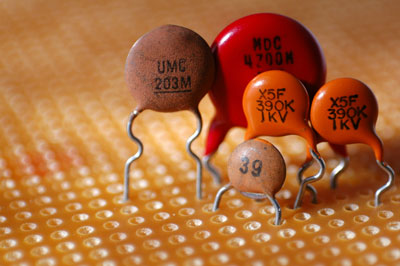
Flash capacitor from a point-and-shoot camera.
|
How Capacitors Work
BY MARSHALL BRAIN & CHARLES W. BRYANT
In a way, a capacitor is a little like a battery. Although they
work in completely different ways, capacitors and batteries both store
electrical energy.
If you have read How Batteries Work, then you know that a battery has two terminals. Inside the
battery, chemical reactions produce electrons on one terminal
and absorb electrons on the other terminal.
A capacitor is much simpler than a battery, as it can't produce
new electrons -- it only stores them.
In this article, we'll learn exactly what a capacitor is, what
it does and how it's used in electronics.
We'll also look at the history of the capacitor and how several people helped
shape its progress.
Inside the capacitor, the terminals connect to two metal plates separated
by a non-conducting substance, or dielectric. You
can easily make a capacitor from two pieces of aluminum foil and a piece of paper. It won't be a particularly good
capacitor in terms of its storage capacity, but it will work.
In theory, the dielectric can be any non-conductive substance.
However, for practical applications, specific materials are used
that best suit the capacitor's function. Mica, ceramic, cellulose, porcelain, Mylar, Teflon and even air are some of the non-conductive materials used.
The dielectric dictates what kind of capacitor it is and for
what it is best suited. Depending on the size and type of dielectric, some
capacitors are better for high frequency uses, while some are better for high
voltage applications.
Capacitors can be manufactured to serve any purpose, from the
smallest plastic capacitor in your calculator, to an ultra capacitor that can
power a commuter bus.
NASA uses glass
capacitors to help wake up the space shuttle's circuitry and help deploy space
probes. Here are some of the various types of capacitors and how they are used.
· Air - Often used in radio tuning circuits
· Mylar - Most commonly used for timer circuits
like clocks, alarms and counters
· Glass - Good for high voltage applications
· Ceramic - Used for high frequency purposes
like antennas, X-ray and MRI machines
· Super capacitor - Powers electric and hybrid
cars
In the next section, we'll take a closer look at exactly how
capacitors work.
In an electronic circuit, a
capacitor is shown like this:
When you connect a capacitor to a
battery, here's what happens:
· The plate on the capacitor that attaches to
the negative terminal of the battery accepts electrons that the battery is
producing.
· The plate on the capacitor that attaches to
the positive terminal of the battery loses electrons to the battery.
Once it's charged, the capacitor has the
same voltage as the battery (1.5 volts on the battery
means 1.5 volts on the capacitor).
For a small capacitor, the capacity is small.
But large capacitors can hold quite a bit of charge. You can find capacitors as
big as soda cans that hold enough charge to light a flashlight bulb for a minute or more.
Even nature shows the capacitor at work in the
form of lightning. One plate is the cloud, the other plate is
the ground and the lightning is the charge releasing between these
two "plates." Obviously, in a capacitor that large, you can hold a
huge amount of charge!
Let's say you hook up a capacitor like this:
Here you have a battery, a light bulb and a capacitor. If the capacitor is pretty big, what you
will notice is that, when you connect the battery, the light bulb will light up
as current flows from the battery to the capacitor to charge it up.
The bulb will get progressively dimmer and
finally go out once the capacitor reaches its capacity. If you then remove the
battery and replace it with a wire, current will flow from one plate of the
capacitor to the other. The bulb will light initially and then dim as the
capacitor discharges, until it is completely out.
In the next section, we'll learn more about
capacitance and take a detailed look at the different ways that capacitors are
used.
LIKE A WATER TOWER
One way to visualize the action of a capacitor
is to imagine it as a water
tower hooked to a
pipe. A water tower "stores" water pressure -- when the water system
pumps produce more water than a town needs, the excess is stored in the water
tower. Then, at times of high demand, the excess water flows out of the tower
to keep the pressure up. A capacitor stores electrons in the same way and can
then release them later.
Farad
A capacitor's storage potential, or capacitance,
is measured in units called farads. A 1-farad capacitor can store
one coulomb (coo-lomb) of charge at 1 volt. A coulomb is 6.25e18 (6.25 * 10^18,
or 6.25 billion billion) electrons.
One amp represents a rate of
electron flow of 1 coulomb of electrons per second, so a 1-farad capacitor can
hold 1 amp-second of electrons at 1 volt.
A 1-farad capacitor would typically be pretty
big. It might be as big as a can of tuna or a 1-liter soda bottle, depending on
the voltage it can handle. For this reason, capacitors are typically measured
in microfarads (millionths of a farad).
To get some perspective on how big a farad is,
think about this:
· A standard alkaline AA battery holds about 2.8 amp-hours.
· That means that a AA battery can produce 2.8
amps for an hour at 1.5 volts (about 4.2 watt-hours -- a AA battery can light a
4-watt bulb for a little more than an hour).
· Let's call it 1 volt to make the math easier.
To store one AA battery's energy in a capacitor, you would need 3,600 * 2.8 =
10,080 farads to hold it, because an amp-hour is 3,600 amp-seconds.
If it takes something the size of a can of
tuna to hold a farad, then 10,080 farads is going to take up a LOT more space
than a single AA battery!
Obviously, it's impractical to use capacitors
to store any significant amount of power unless you do it at a high voltage.
Applications
The difference between a capacitor and a
battery is that a capacitor can dump its entire charge in a tiny fraction of a
second, where a battery would take minutes to completely discharge.
That's why the electronic flash on a camera uses a capacitor -- the battery charges up the flash's
capacitor over several seconds, and then the capacitor dumps the full charge
into the flash tube almost instantly.
This can make a large, charged capacitor
extremely dangerous -- flash units and TVs have warnings
about opening them up for this reason. They contain big capacitors that can,
potentially, kill you with the charge they contain.
Capacitors are used in several different ways
in electronic circuits:
· Sometimes, capacitors are used to store charge
for high-speed use. That's what a flash does. Big lasers use this technique as well to get very bright,
instantaneous flashes.
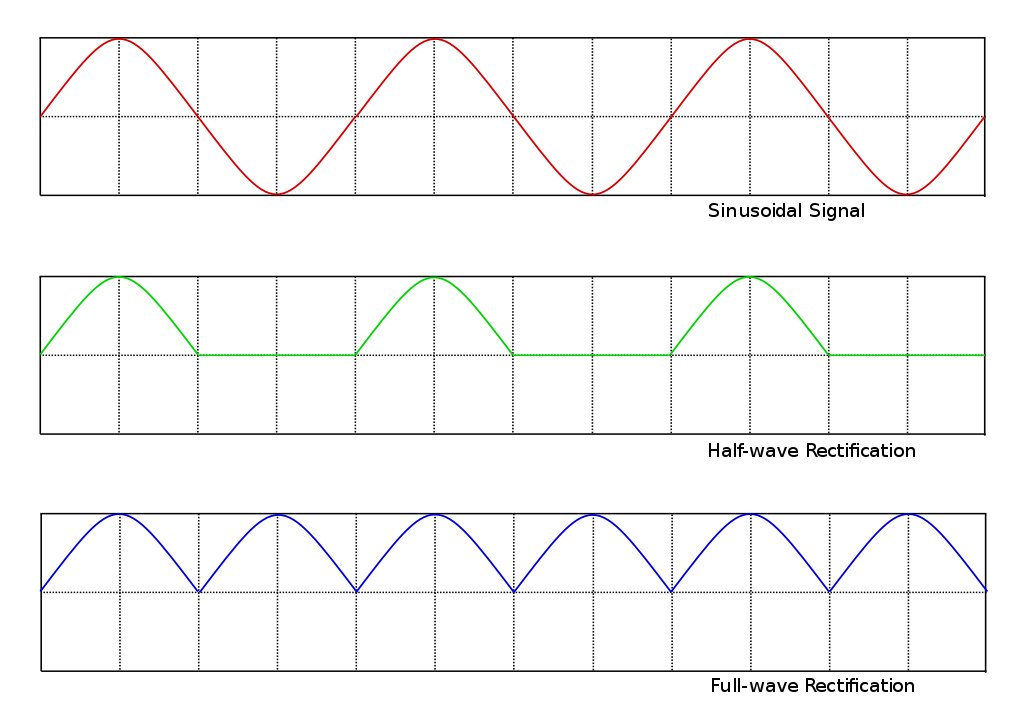
· Capacitors can also eliminate ripples. If a
line carrying DC voltage has ripples or spikes in it, a big capacitor can even
out the voltage by absorbing the peaks and filling in the valleys.
· A capacitor can block DC voltage. If you hook
a small capacitor to a battery, then no current will flow between the poles of
the battery once the capacitor charges. However, any alternating current (AC)
signal flows through a capacitor unimpeded. That's because the capacitor will
charge and discharge as the alternating current fluctuates, making it appear
that the alternating current is flowing.
In the next section, we'll look at the history
of the capacitor and how some of the most brilliant minds contributed to its
progress.
CAPACITIVE TOUCH
SCREENS
One of the more futuristic applications of
capacitors is the capacitive touch screen.
These are glass screens that have a very thin, transparent metallic coating.
A built-in electrode pattern charges the
screen so when touched, a current is drawn to the finger and creates a voltage
drop. This exact location of the voltage drop is picked up by a controller and
transmitted to a computer. These touch screens are commonly found in
interactive building directories and more recently in Apple's iPhone.
The invention of the capacitor varies somewhat
depending on who you ask. There are records that indicate a German scientist
named Ewald Georg von Kleist invented the capacitor in November 1745.
Several months later Pieter van Musschenbroek,
a Dutch professor at the University of Leyden came up with a very similar
device in the form of the Leyden jar, which is typically credited
as the first capacitor.
Since Kleist didn't have detailed records and
notes, nor the notoriety of his Dutch counterpart, he's often overlooked as a
contributor to the capacitor's evolution.
However, over the years, both have been given
equal credit as it was established that their research was independent of each
other and merely a scientific coincidence [source: Williams].
The Leyden jar was a very simple device. It
consisted of a glass jar, half filled with water and lined inside and out with
metal foil. The glass acted as the dielectric, although it was thought for a
time that water was the key ingredient.
There was usually a metal wire or chain driven
through a cork in the top of the jar. The chain was
then hooked to something that would deliver a charge, most likely a
hand-cranked static generator.
Once delivered, the jar would hold two equal
but opposite charges in equilibrium until they were connected with a wire,
producing a slight spark or shock [source: Williams].
Benjamin Franklin worked with the Leyden jar
in his experiments with electricity and soon found that a flat piece of glass
worked as well as the jar model, prompting him to develop the flat
capacitor, or Franklin square.
Years later, English chemist Michael Faraday
would pioneer the first practical applications for the capacitor in trying to
store unused electrons from his experiments. This led to the first usable
capacitor, made from large oil barrels.
Faraday's progress with capacitors is what
eventually enabled us to deliver electric power over great distances. As a
result of Faraday's achievements in the field of electricity, the unit of
measurement for capacitors, or capacitance, became known as the
farad [source: Ramasamy].
Capacitors can be manufactured to serve any purpose, from the
smallest plastic capacitor in your calculator, to an ultra capacitor that can
power a commuter bus.
NASA uses glass capacitors to help wake
up the space shuttle's circuitry and help deploy space probes. Here are some of
the various types of capacitors and how they are used.
· Air - Often
used in radio tuning circuits
· Mylar - Most
commonly used for timer circuits like clocks, alarms and counters
· Glass - Good for high voltage
applications
· Ceramic - Used
for high frequency purposes like antennas, X-ray and MRI machines
· Super capacitor
- Powers electric and hybrid
cars
In the next section, we'll take a closer look at exactly how
capacitors work.
In an electronic circuit, a capacitor is
shown like this:
When you connect a capacitor to a battery,
here's what happens:
· The plate on
the capacitor that attaches to the negative terminal of the battery accepts
electrons that the battery is producing.
· The plate on
the capacitor that attaches to the positive terminal of the battery loses
electrons to the battery.
Once it's charged, the capacitor has the same voltage as the battery (1.5 volts on the
battery means 1.5 volts on the capacitor).
For a small capacitor, the capacity is small. But
large capacitors can hold quite a bit of charge. You can find capacitors as big
as soda cans that hold enough charge to light a flashlight
bulb for a minute or more.
Even nature shows the capacitor at work in the form
of lightning. One plate is the cloud, the other plate is the ground and
the lightning is the charge releasing between
these two "plates." Obviously, in a capacitor that large, you can
hold a huge amount of charge!
Let's say you hook up a capacitor like this:
Here you have a battery, a light
bulb and a capacitor. If the capacitor is pretty big, what you
will notice is that, when you connect the battery, the light bulb will light up
as current flows from the battery to the capacitor to charge it up.
The bulb will get progressively dimmer and finally go
out once the capacitor reaches its capacity. If you then remove the battery and
replace it with a wire, current will flow from one plate of the capacitor to
the other. The bulb will light initially and then dim as the capacitor
discharges, until it is completely out.
In the next section, we'll learn more about
capacitance and take a detailed look at the different ways that capacitors are
used.
Farad
A capacitor's storage potential, or capacitance,
is measured in units called farads. A 1-farad capacitor can store
one coulomb (coo-lomb) of charge at 1 volt. A coulomb is 6.25e18 (6.25 * 10^18,
or 6.25 billion billion) electrons.
One amp represents a rate of electron
flow of 1 coulomb of electrons per second, so a 1-farad capacitor can hold 1
amp-second of electrons at 1 volt.
A 1-farad capacitor would typically be pretty big. It
might be as big as a can of tuna or a 1-liter soda bottle, depending on the
voltage it can handle. For this reason, capacitors are typically measured in
microfarads (millionths of a farad).
To get some perspective on how big a farad is, think
about this:
· A standard
alkaline AA battery holds
about 2.8 amp-hours.
· That means that
a AA battery can produce 2.8 amps for an hour at 1.5 volts (about 4.2
watt-hours -- a AA battery can light a 4-watt bulb for a little more than an
hour).
· Let's call it 1
volt to make the math easier. To store one AA battery's energy in a capacitor,
you would need 3,600 * 2.8 = 10,080 farads to hold it, because an amp-hour is
3,600 amp-seconds.
If it takes something the size of a can of tuna to
hold a farad, then 10,080 farads is going to take up a LOT more space than a
single AA battery!
Obviously, it's impractical to use capacitors to store
any significant amount of power unless you do it at a high voltage.
Applications
The difference between a capacitor and a battery is
that a capacitor can dump its entire charge in a tiny fraction of a second,
where a battery would take minutes to completely discharge.
That's why the electronic flash on a camera uses a
capacitor -- the battery charges up the flash's capacitor over several seconds,
and then the capacitor dumps the full charge into the flash tube almost
instantly.
This can make a large, charged capacitor extremely
dangerous -- flash units and TVs have warnings
about opening them up for this reason. They contain big capacitors that can,
potentially, kill you with the charge they contain.
Capacitors are used in several different ways in electronic
circuits:
· Sometimes,
capacitors are used to store charge for high-speed use. That's what a flash
does. Big lasers use
this technique as well to get very bright, instantaneous flashes.
· Capacitors can
also eliminate ripples. If a line carrying DC voltage has ripples or spikes in
it, a big capacitor can even out the voltage by absorbing the peaks and filling
in the valleys.
· A capacitor can
block DC voltage. If you hook a small capacitor to a battery, then no current
will flow between the poles of the battery once the capacitor charges. However,
any alternating current (AC) signal flows through a capacitor unimpeded. That's
because the capacitor will charge and discharge as the alternating current
fluctuates, making it appear that the alternating current is flowing.
In the next section, we'll look at the history of the
capacitor and how some of the most brilliant minds contributed to its progress.
History of the
Capacitor
The invention of the capacitor varies somewhat
depending on who you ask. There are records that indicate a German scientist
named Ewald Georg von Kleist invented the capacitor in November 1745.
Several months later Pieter van Musschenbroek, a
Dutch professor at the University of Leyden came up with a very similar device
in the form of the Leyden jar, which is typically credited as the
first capacitor.
Since Kleist didn't have detailed records and notes,
nor the notoriety of his Dutch counterpart, he's often overlooked as a
contributor to the capacitor's evolution.
However, over the years, both have been given equal
credit as it was established that their research was independent of each other
and merely a scientific coincidence [source: Williams].
The Leyden jar was a very simple device. It consisted
of a glass jar, half filled with water and lined inside and out with metal
foil. The glass acted as the dielectric, although it was thought for a time
that water was the key ingredient.
There was usually a metal wire or chain driven through
a cork in the top of the jar. The chain was
then hooked to something that would deliver a charge, most likely a
hand-cranked static generator.
Once delivered, the jar would hold two equal but
opposite charges in equilibrium until they were connected with a wire,
producing a slight spark or shock [source: Williams].
Benjamin Franklin worked with the Leyden jar in his
experiments with electricity and soon found that a flat piece of glass worked
as well as the jar model, prompting him to develop the flat capacitor,
or Franklin square.
Years later, English chemist Michael Faraday would
pioneer the first practical applications for the capacitor in trying to store
unused electrons from his experiments. This led to the first usable capacitor,
made from large oil barrels.
Faraday's progress with capacitors is what eventually
enabled us to deliver electric power over great distances. As a result of
Faraday's achievements in the field of electricity, the unit of measurement for
capacitors, or capacitance, became known as the farad [source: Ramasamy].
Marshall
Brain, Founder
Marshall Brain is the founder of HowStuffWorks. He holds a bachelor's degree in electrical engineering from Rensselaer Polytechnic Institute and a master's degree in computer science from North Carolina State University. Before founding HowStuffWorks, Marshall taught in the computer science department at NCSU and ran a software training and consulting company. Learn more at his site.
Marshall Brain is the founder of HowStuffWorks. He holds a bachelor's degree in electrical engineering from Rensselaer Polytechnic Institute and a master's degree in computer science from North Carolina State University. Before founding HowStuffWorks, Marshall taught in the computer science department at NCSU and ran a software training and consulting company. Learn more at his site.
Charles
W.(Chuck) Bryant co-hosts the 'Stuff You Should Know'
podcast along with his trusty sidekick, Josh Clark. He was born in Atlanta in
the early 1970s under the sign of Pisces. Twenty-four years later, he earned an
English degree at the University of Georgia. He spent the next decade
traveling, pursuing creative endeavors and getting street smart. He and his
wife-to-be moved back to Atlanta in 2004, with four pets in tow. He hooked up
with HowStuffWorks.com shortly
after co-host Josh was hired, and the pair bonded immediately over their love
of Hunter S. Thompson, the fight-or-flight response and dive bars. In his
off-time, Chuck enjoys hanging out with his wife, cooking and playing in his
old-man band. He loves his neti pot and hates cold bathroom floors. You can find
Chuck on Twitter at @SYSKPodcast and
on Facebook at the official Stuff You Should Know
page.https://electronics.howstuffworks.com/capacitor.htm