Showing posts with label Acid rain. Show all posts

Wednesday, January 13, 2021

WHAT IS PH? - pH describes the acidity or alkalinity of a solution. A low pH indicates acidic conditions, and a high pH indicates basic conditions. pH is actually a measure of the amount of hydrogen ions in solution. In fact, some people think of it as being the “power of hydrogen.” A low pH has a large number of free hydrogen ions in the water, whereas a high pH has relatively few. Technically, pH is the negative logarithm of the free hydrogen activity in solution. pH is highly important and is used to monitor for safe water conditions. Many animals cannot live in a pH level below 5 or above 9. Once the normal pH range for a water has been established, a rise or fall in pH can indicate chemical pollution, or acid rain. How is pH measured? What is pH pH is measured on a scale of 0 to 14; 7 is neutral, below 7 is acidic, greater than 7 is basic. A lower number represents a greater number of hydrogen ions, and each pH unit represents a 10-fold change in the hydrogen ion concentration and amount of acidity. For instance, a pH of 6 has ten times more free hydrogen ions than a pH of 7, and one hundred times more free hydrogen ions than a pH of 8. pH Technology The most accurate way to measure pH is with an electric pH probe. When the probe is submersed in water, it measures the pH of the water relative to the pH of a solution within the probe. pH is commonly measured using a combination pH electrode. The pH electrode has a glass bulb filled with a pH 7 solution.

..............................................................................................................................................................................................................................................................................................................................................................................

What is pH?

By Fondriest Staff


pH describes the acidity or alkalinity of a solution. A low pH indicates acidic conditions, and a high pH indicates basic conditions.

pH is actually a measure of the amount of hydrogen ions in solution.

In fact, some people think of it as being the “power of hydrogen.”

A low pH has a large number of free hydrogen ions in the water, whereas a high pH has relatively few.

Technically, pH is the negative logarithm of the free hydrogen activity in solution.

Why is pH Important?

pH is highly important and is used to monitor for safe water conditions.

Many animals cannot live in a pH level below 5 or above 9.

Once the normal pH range for a water has been established, a rise or fall in pH can indicate chemical pollution, or acid rain.

How is pH measured? What is pH

pH is measured on a scale of 0 to 14; 7 is neutral, below 7 is acidic, greater than 7 is basic.

A lower number represents a greater number of hydrogen ions, and each pH unit represents a 10-fold change in the hydrogen ion concentration and amount of acidity.

For instance, a pH of 6 has ten times more free hydrogen ions than a pH of 7, and one hundred times more free hydrogen ions than a pH of 8.

pH Technology

The most accurate way to measure pH is with an electric pH probe.

When the probe is submersed in water, it measures the pH of the water relative to the pH of a solution within the probe.

pH is commonly measured using a combination pH electrode.

The pH electrode has a glass bulb filled with a pH 7 solution.

The difference between the pH in the water and the pH 7 solution within the glass bulb generates an electrical potential, which is measured relative to a stable electrical potential generated by a reference electrode located within the pH probe.

The pH of the solution is then determined by the difference between these two electrical potentials.

Fondriest Environmental is the trusted partner you can turn to for help with environmental monitoring projects. We can assist in everything from planning and monitoring to systems integration, equipment calibration and even staff training. We produce the Environmental Monitor to provide the latest in monitoring technology and environmental applications.

https://www.fondriest.com/news/whatis-ph.htm


You might also like:


Acid Strength

CLICK HERE . . . to view . . . 

https://puricare.blogspot.com/2020/01/acid-strength-for-strong-acids-most-or.html

..........................................................................................................................................................................................................................................................................................

Bleach and Chlorine

CLICK HERE . . . to view . . . 

https://puricare.blogspot.com/2020/01/bleach-and-chlorine-chlorine-is.html

..........................................................................................................................................................................................................................................................................................

Negative Effects of Acid Rain

CLICK HERE . . . to view . . . 

https://puricare.blogspot.com/2020/01/acid-rain-chemically-acid-rain-is.html

..........................................................................................................................................................................................................................................................................................

Alkaline Water

CLICK HERE . . . to view . . . 

https://puricare.blogspot.com/2020/01/alkaline-water-benefits-and-risks.html

..........................................................................................................................................................................................................................................................................................

.What You Need to Know About Acid Rain

CLICK HERE . . . to view . . . 

https://puricare.blogspot.com/2020/05/what-you-need-to-know-about-acid-rain.html

..........................................................................................................................................................................................................................................................................................

Your tap water might be dangerous to drink

CLICK HERE . . . to view . . . 

https://puricare.blogspot.com/2020/05/signs-your-tap-water-might-be-dangerous.html

Thursday, May 14, 2020

WHAT YOU NEED TO KNOW ABOUT ACID RAIN - Acid rain is made up of water droplets that are unusually acidic because of atmospheric pollution, most notably the excessive amounts of sulfur and nitrogen released by cars and industrial processes. Acid rain is also called acid deposition because this term includes other forms of acidic precipitation (such as snow). Acidic deposition occurs in two ways: wet and dry. Wet deposition is any form of precipitation that removes acids from the atmosphere and deposits them on Earth’s surface. Dry deposition polluting particles and gases stick to the ground via dust and smoke in the absence of precipitation. Even though dry, this form of deposition is dangerous as well, because precipitation can eventually wash pollutants into streams, lakes, and rivers. Acid deposition can be caused by natural sources such as volcanoes, but it is mainly caused by the release of sulfur dioxide and nitrogen oxide during fossil fuel combustion. When these gases are discharged into the atmosphere, they react with the water, oxygen, and other gases already present there to form sulfuric acid, ammonium nitrate, and nitric acid. These acids then disperse over large areas because of wind patterns and fall back to the ground as acid rain or other forms of precipitation. The gases most responsible for acid deposition are a byproduct of electric power generation and the burning of coal.

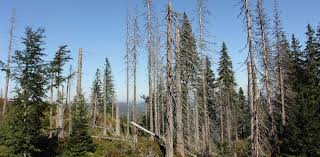
Large stand of trees killed by acid rain under a gray sky.
..................................................................................................................................................................
What You Need to Know About Acid Rain
The Causes, History, and Effects of Acid Rain
By Amanda Briney


Acid rain is made up of water droplets that are unusually acidic because of atmospheric pollution, most notably the excessive amounts of sulfur and nitrogen released by cars and industrial processes.
Acid rain is also called acid deposition because this term includes other forms of acidic precipitation (such as snow).
Acidic deposition occurs in two ways: wet and dry.
Wet deposition is any form of precipitation that removes acids from the atmosphere and deposits them on Earth’s surface.
Dry deposition polluting particles and gases stick to the ground via dust and smoke in the absence of precipitation.
Even though dry, this form of deposition is dangerous as well, because precipitation can eventually wash pollutants into streams, lakes, and rivers.
Acidity itself is determined based on the pH level (the amount of acidity or alkalinity) of the water droplets.
The pH scale ranges from 0 to 14, with a lower pH being more acidic, while a high pH is alkaline, and seven is neutral.
Normal rainwater is slightly acidic, with a pH range of 5.3-6.0.
Acid deposition is anything below that range. It is also important to note that the pH scale is logarithmic, and each whole number on the scale represents a 10-fold change.
Today, acid deposition is present in the northeastern United States, southeastern Canada, and much of Europe, including portions of Sweden, Norway, and Germany.
In addition, parts of South Asia (particularly China, Sri Lanka, and southern India) and South Africa are all in danger of being affected by acid deposition in the future.
What Causes Acid Rain?
Acid deposition can be caused by natural sources such as volcanoes, but it is mainly caused by the release of sulfur dioxide and nitrogen oxide during fossil fuel combustion.
When these gases are discharged into the atmosphere, they react with the water, oxygen, and other gases already present there to form sulfuric acid, ammonium nitrate, and nitric acid.
These acids then disperse over large areas because of wind patterns and fall back to the ground as acid rain or other forms of precipitation.
The gases most responsible for acid deposition are a byproduct of electric power generation and the burning of coal.
As such, man-made acid deposition began becoming a significant issue during the Industrial Revolution and was first discovered by a Scottish chemist Robert Angus Smith in 1852.
In that year, he discovered the relationship between acid rain and atmospheric pollution in Manchester, England.
Although it was discovered in the 1800s, acid deposition did not gain significant public attention until the 1960s, and the term "acid rain" was coined in 1972.
Public attention further increased in the 1970s when the "New York Times" published reports about problems occurring in the Hubbard Brook Experimental Forest in New Hampshire.
Effects of Acid Rain
After studying the Hubbard Brook Forest and other areas, researchers found several important effects of acid deposition on both natural and man-made environments.
Aquatic settings are the most clearly affected by acid deposition, however, because acidic precipitation falls directly into them.
Both dry and wet deposition also runs off from forests, fields, and roads and flows into lakes, rivers, and streams.
As this acidic liquid flow into larger bodies of water, it is diluted.
However, over time, acids can accrue and lower the overall pH of the body of water.
Acid deposition also causes clay soils to release aluminum and magnesium, further lowering the pH in some areas.
If the pH of a lake drops below 4.8, its plants and animals risk death.
It is estimated that around 50,000 lakes in the United States and Canada have a pH below normal (about 5.3 for water).
Several hundred of these have a pH too low to support any aquatic life.
Aside from aquatic bodies, acid deposition can significantly affect forests.
As acid rain falls on trees, it can make them lose their leaves, damage their bark, and stunt their growth.
By damaging these parts of the tree, it makes them vulnerable to disease, extreme weather, and insects.
Acid falling on a forest’s soil is also harmful because it disrupts soil nutrients, kills microorganisms in the soil, and can sometimes cause a calcium deficiency.
Trees at high altitudes are also susceptible to problems induced by acidic cloud cover as the moisture in the clouds blankets them.
Damage to forests by acid rain is seen all over the world, but the most advanced cases are in Eastern Europe.
It’s estimated that in Germany and Poland, half of the forests are damaged, while 30 percent in Switzerland have been affected.
Finally, acid deposition also has an effect on architecture and art because of its ability to corrode certain materials.
As acid lands on buildings (especially those constructed with limestone), it reacts with minerals in the stones, sometimes causing them to disintegrate and wash away.
Acid deposition can also cause concrete to deteriorate, and it can corrode modern buildings, cars, railroad tracks, airplanes, steel bridges, and pipes above and below ground.
What's Being Done?
Because of these problems and the adverse effects of air pollution has on human health, a number of steps are being taken to reduce sulfur and nitrogen emissions.
Most notably, many governments are now requiring energy producers to clean smokestacks with scrubbers that trap pollutants before they are released into the atmosphere and to reduce car emissions with catalytic converters.
Additionally, alternative energy sources are gaining more prominence and funding is being put toward the restoration of ecosystems damaged by acid rain worldwide.

Amanda Briney
Geography Expert
Education
M.A., Geography, California State University - East Bay
B.A., English and Geography, California State University - Sacramento
Introduction
Professional geographer, writer, and scholar
Certificate of Advanced Study in Geographic Information Systems (GIS) 
More than 10 years of experience writing about a broad array of geographical topics
Experience
Amanda Briney is a professional geographer and writer who contributed to ThoughtCo for more than 10 years. She wrote countless articles on a wide range of topics such as an introduction to the subject of geography, reviews of ecotourism, discussions about environmental determinism, and the structure of Latin American cities. The scope of her work also includes other formats such as histories, guides, and fact sheets about many parts of the world. An ultimate scholar, Amanda also contributes work to academic venues and the GIS Lounge, an informational portal about geography.
Amanda enjoys all aspects of geography and mapping but is especially interested in examining natural landscapes through spatial analysis. As such, she holds a certificate in Geographic Information Systems (GIS) from California State University. She also attended Diablo Valley College where she studied air photo interpretation and the formation of the Earth's landscapes.
Education
Amanda Briney received a Master Arts (M.A.) in Geography from California State University–East Bay. She also holds a Bachelor Arts (B.A.) in English and Geography from California State University–Sacramento and earned a Certificate of Advanced Study in Geographic Information Systems (GIS) from California State University.
ThoughtCo and Dotdash
ThoughtCo is a premier reference site focusing on expert-created education content. We are one of the top-10 information sites in the world as rated by comScore, a leading Internet measurement company. Every month, more than 13 million readers seek answers to their questions on ThoughtCo.
For more than 20 years, Dotdash brands have been helping people find answers, solve problems, and get inspired. We are one of the top-20 largest content publishers on the Internet according to comScore, and reach more than 30% of the U.S. population monthly. Our brands collectively have won more than 20 industry awards in the last year alone, and recently Dotdash was named Publisher of the Year by Digiday, a leading industry publication.
https://www.thoughtco.com/acid-rain-definition-1434936


You might also like:

Image result for images acid rain effectsHow Acid Rain Works
CLICK HERE . . . to view . . . 
..............................................................................................................
Image result for images Negative Effects of Acid Rain
Negative Effects of Acid Rain
CLICK HERE . . . to view . . . 
..............................................................................................................
Acid Rain Effects
CLICK HERE . . . to view . . . 
https://puricare.blogspot.com/2016/10/studies-show-increase-of-chronic.html
..............................................................................................................
Oxidation turns this peridotite to different tones of red
Chemical Weathering
CLICK HERE . . . to view . . . 
..............................................................................................................
Dramatic limestone sceneryTypes of Weathering and Their Results
CLICK HERE . . . to view . . . 

Large stand of trees killed by acid rain under a gray sky.

Wednesday, July 25, 2018

ACID RAIN - Acid rain, also known as acid deposition, is caused by emissions of sulfur dioxide (SO2) and nitrogen oxides (NOx) from power plants, cars and factories. Natural sources like volcanoes, forest fires and lightning strikes also add to the man-made pollution. SO2 and NOx become acids when they enter the atmosphere and react with water vapor. The resulting sulfuric and nitric acids can fall as wet or dry depositions. Wet deposition is precipitation: acid rain, snow, sleet or fog. Dry deposition falls as acidic particulates or gases.


Image result for images acid rain effects
.
Emissions of sulfur dioxide and nitrogen oxides react with water vapor in the atmosphere to create sulfuric and nitric acids.
Emissions of sulfur dioxide and nitrogen oxides react with water vapor
 in the atmosphere to create sulfuric and nitric acids.

Acid Rain

How Acid Rain Works

BY SARAH DOWDEY


If you hike through the Appalachian Mountains, you'll spot stands of dead and weakened trees.
If you live in a city, you might notice worn stone buildings, streaks on your car roof or corroded metal railings and statues.
You can see the effects of acid rain nearly everywhere you go, but with media and public attention turned to the more ominous prospect of global warming, acid rain has fallen by the wayside.
The scourge from the sky almost seems like a 20th-century problem -- an issue dealt with in the 1980s and 1990s by legislation.
Acid rain occurs mostly in the Northern Hemisphere -- the more industrialized, dirtier half of the globe.
Winds can sweep up emissions from high smokestacks and carry pollutants far from their original sources, crossing state lines and national borders in the process.
Acid rain may not have the complete global range of greenhouse gases, but it is a transboundary, and therefore international, issue.
Acid rain, also known as acid deposition, is caused by emissions of sulfur dioxide (SO2) and nitrogen oxides (NOx) from power plants, cars and factories.
Natural sources like volcanoes, forest fires and lightning strikes also add to the man-made pollution.
SO2 and NOx become acids when they enter the atmosphere and react with water vapor.
The resulting sulfuric and nitric acids can fall as wet or dry depositions.
Wet deposition is precipitation: acid rain, snow, sleet or fog. Dry deposition falls as acidic particulates or gases.
The pH of Acid Rain
Scientists express the acidity of acid rain using the pH scale.
The scale defines a solution's acidity, neutrality or alkalinity based on its concentration of hydrogen ions.
The pH scale is a measure of acidity and alkalinity. Acid rain has a pH of 5.0 or less.
The pH scale is a measure of acidity and alkalinity. Acid rain has a pH of 5.0 or less.
Acids have a high concentration of hydrogen ions and a low pH. The scale ranges from zero to 14, with pure water at a neutral 7.0.
Most water, however, is not exactly pure. Even clean, normal rain has a pH of about 5.6. This is because it reacts with carbon dioxide in the atmosphere and forms mildly acidic carbonic acid before it becomes rain.
Acid rain has a pH of 5.0 or less. Most acid deposition ranges from pH 4.3 to 5.0 -- somewhere between the acidity of orange juice and black coffee.
But comparing acid rain to safe, natural acids can be misleading. Even at its weakest, acid rain wrecks ecosystems by stunting sensitive plants and killing delicate aquatic eggs.
Programs that monitor acid rain analyze hydrogen content to determine pH. They also measure atmospheric concentrations of nitric acid, nitrate, sulfur dioxide, sulfate and ammonium.
In the United States, the National Atmospheric Deposition Program (NADP) supervises wet deposition while the Clean Air Status and Trends Network (CASTNET) observes dry deposition.
Monitoring acid deposition helps determine critical loads, or the amount of pollutants an ecosystem can support before damage. Accurate critical loads help set effective targets for SO2 and NOx reductions.
Now we'll learn about the harmful effects of acid rain on aquatic environments, forests, finishes, building materials and human health.

Surface Waters

Surface waters and their fragile ecosystems are perhaps the most famous victims of acid rain.
Acid deposition weakens trees and pollutes surface waters.
Most of the precipitation that enters a lake, river, stream or marsh must first pass over and seep through soil.
All soil has a buffering capacity, or ability to resist changes in acidity and alkalinity.
The soil's buffering capacity determines a water body's acidity. If the capacity is low, or has reached its limit, acid rain can pass through un-neutralized.
Most life is comfortable at a near-neutral pH -- stray too far from pH 7.0, and delicate organisms begin to die. Plankton and invertebrates are sensitive to changes in acidity and die first.
At pH 5.0, fish eggs degrade and young cannot develop.
Adult fish and frogs can sometimes tolerate acidities as low as pH 4.0, but they starve as their weaker food sources die out. When acid rain disrupts the food chain, biodiversity decreases.
Nitrogen deposition from acid rain also damages coastal waters and estuaries. Nitrogen-rich water supports massive algae growth ­ and algal blooms.
Bacteria decompose the dead algae, flourish themselves and soak up the water's available oxygen.
Fish, shellfish, sea grass beds and coral reefs die in the algae-choked, oxygen-depleted waters.
Scientists estimate that 10 percent to 45 percent of human-produced nitrogen that winds up in coastal waters comes from atmospheric deposition [Source: Environmental Protection Agency].
Most acidic bodies of water do not look polluted. As decaying organic matter settles, acidified water can appear clear and blue. Some species, like rushes and moss, even thrive in acidic conditions.
But the greenery and clear waters belie an unwholesome environment. Diversity drops, and species left without predators often grow disturbingly large.
The Effects of Acid Rain
Forests rely on their soil's buffering capacity to protect them from acid rain.
Acidic waters draw out soil toxins like aluminum. Trees take in the poisonous substances, and runoff dumps it in lakes, rivers and streams.
Acid rain can eat through stone and metal. It has accelerated the natural weathering process of this scarred stone angel's face.
Acid rain can eat through stone and metal. It has acceleratedthe natural weathering process of this scarred stone angel's face.
Acid rain also dissolves helpful minerals and nutrients like calcium, magnesium and potassium before trees can absorb them.
Acid rain rarely kills a forest outright but instead stunts its growth through years of soil degradation.
Nutrient deprivation and exposure to toxins make trees more likely to topple in storms or die in cold weather.
Even trees in well-buffered soil can weaken in harsh acid fog. High-elevation forests soak in acidic clouds, which strip leaves of nutrients and break down trees' ability to resist cold.
The bald peaks of the Appalachian Mountains tell of the poisonous effect of acid rain on high-elevation forests.

Materials and Finishes

Acid rain has the unsettling ability to erase and obliterate stone and metal, the most durable of materials.
Old buildings, monuments and tombstones bear the smooth signs of acidic corrosion and deterioration. Acid deposition speeds up natural weathering caused by rain, sun, snow and wind.
Acid rain also mars automotive paint. The auto industry considers acid deposition one type of corrosive environmental fallout, along with tree sap, pollen and bird droppings.
Acid markings leave irregular, etched shapes on horizontal surfaces. Repainting is the only way to fix a car finish disfigured by acid rain.
Reducing Acid Rain
Acid rain has existed since the first factories of the Industrial Revolution began spitting out toxic emissions.
Power plants must limit emissions of SO and NOx to meet targets set by the Acid Rain Program.
Power plants must limit emissions of SO and NOx
to meet targets
 set by the Acid Rain Program.
An English scientist, Robert Angus Smith, coined the term "acid rain" in 1872 when he wrote of its corroding touch on buildings and deadly effect on plants.
But acid rain did not become a government-monitored environmental problem until more than a century later.
Scientists had by then determined that acid rain was a transboundary rather than a local concern.


In 1980, the Acid Deposition Act launched a 10-year study on acid rain under the direction of the National Acidic Precipitation Assessment Program (NAPAP) to monitor sites around the country.
In 1990, armed with the NAPAP's study, Congress changed the existing Clean Air Act to include acid rain.
The new Title IV amendment of the Clean Air Act called for SO2 and NOx reductions.
The Acid Rain Program (ARP) was formed in 1995 to bring Title IV into effect.
The ARP places limits on the power industry to reduce annual emissions of SO2 and NOx.
The ARP uses a cap and trade program to cut SO2 emissions. It sets a cap on the total amount of SO2 that power plants in the contiguous United States can produce.
After setting a cap, the ARP distributes allowances to power plant units. Units are only allowed to produce as much SO2 as they have credit for.
If they reduce emissions faster than the ARP requires, they can bank allowances for future use or sell them to other plants. The final 2010 cap will be 8.95 million tons allowed per year, a remarkable 50 percent less than power plant emissions from 1980 [Source: EPA].
The ARP regulates NOx reductions with a more conventional rate-based regulatory system. The program sets a limit on allowable pounds of NOx per million British thermal units (lb/mmBtu) for every power plant's boiler.
Owners either meet target reductions for individual boilers or average the emissions of all units owned and meet a combined target. The ARP aims to reduce NOx to 2 million tons below the projected 2000 level had Title IV not existed [Source: EPA].
Power plants meet their ARP targets by using low sulfur coal, "wet scrubbers" or flue gas desulphurization systems, low NOx burners and other clean coal technologies. They can also trade SO2 credits amongst themselves.
Even with an increased energy demand, the ARP has successfully reduced emissions of SO2 and NOx.
But NAPAP suggests that for ecosystems to fully recover, reductions will have to drop an additional 40 percent to 80 percent below the full-force limits of 2010 [Source: EPA].
Cars also emit NOx. Newer designs of catalytic converters help treat exhaust and remove NOx and other pollutants like carbon monoxide and the VOCs that contribute to smog.
Even with remarkable clean coal technologies, catalytic converters and strong caps and regulations, fossil fuels are still a dirty power source.
Alternative forms of energy like nuclear, solear and hydropower do not emit the millions of tons of SO2 and NOx­ that upend ecosystems, blight buildings and monuments and weaken people's health.

Sarah Dowdey, Contributing Editor 
Sarah Dowdey holds a bachelor's degree in English from the University of Georgia.
 Image result for images acid rain effects