Showing posts with label Wastewater Treatment. Show all posts

Monday, January 11, 2021

ACTIVATED SLUDGE WASTEWATER TREATMENT - The activated sludge wastewater treatment process is widely used and relied on by many municipalities. This process utilizes a multi-chamber reactor unit that uses microorganisms as a method to remove nutrients from the water. Oxygen is used to establish and regulate aerobic conditions and to suspend the sludge. The activated sludge wastewater treatment provides many advantages, but it may not be appropriate in all situations. The activated sludge process is an integral process used to treat wastewater. Air or oxygen is blown into raw sewage. It is most effective for large volumes of water. Wastewater is mixed and aerated in a special tank. This step in the process occurs by pumping air or oxygen into the activated sludge tank or using surface aerators. The process oxidizes organic matters in the wastewater, producing new cells, carbon dioxide, and water. The sludge particles can then be removed through the process of gravity settling. Activated sludge sewage treatment is ideally completed in a centralized treatment facility. The treatment of activated sludge can occur in most climates. The activated sludge process in the treatment of wastewater involves blowing oxygen or air into raw, unsettled sewage. The sewage is bubbled, and sewage liquor is discharged into an activated sludge chamber. Live bacteria settle to the bottom of the tank and dead bacteria float to the top.

............................................................................................................................................................................................................................................................................................................................................................................................

Activated Sludge Wastewater Treatment

How Does Activated Sludge Wastewater Treatment Work?

Written by AOS Treatment Solutions


The activated sludge wastewater treatment process is widely used and relied on by many municipalities.

This process utilizes a multi-chamber reactor unit that uses microorganisms as a method to remove nutrients from the water.

Oxygen is used to establish and regulate aerobic conditions and to suspend the sludge.

The activated sludge wastewater treatment provides many advantages, but it may not be appropriate in all situations.

WHAT IS ACTIVATED SLUDGE WASTEWATER TREATMENT?

The activated sludge process is an integral process used to treat wastewater.

Air or oxygen is blown into raw sewage. It is most effective for large volumes of water.

Wastewater is mixed and aerated in a special tank. This step in the process occurs by pumping air or oxygen into the activated sludge tank or using surface aerators.

The process oxidizes organic matters in the wastewater, producing new cells, carbon dioxide, and water.

The sludge particles can then be removed through the process of gravity settling.

Activated sludge sewage treatment is ideally completed in a centralized treatment facility.

The treatment of activated sludge can occur in most climates. However, colder environments reduce the treatment capacity.

AOS professionals can discuss activated sludge treatment methods and other wastewater treatment services during a thorough consultation.

HOW DOES THE ACTIVATED SLUDGE PROCESS WORK?

The activated sludge process in the treatment of wastewater involves blowing oxygen or air into raw, unsettled sewage.

This process smashes the solids. The sewage is bubbled, and sewage liquor is discharged into an activated sludge chamber.

Live bacteria settle to the bottom of the tank and dead bacteria float to the top.

Clean water is discharged into a soakaway or watercourse while the live bacteria return to the digestion chamber.

It is important to understand what activated sludge is to comprehend how the complete activated sludge system works.

The sludge is considered activated because the particles are actively swarming with beneficial bacteria that digest the sewage.

ADVANTAGES OF THE ACTIVATED SLUDGE TREATMENT PROCESS

The activated sludge treatment process provides many significant advantages over other options.

Sewage treatment plants that primarily use the process for the treatment of activated sludge offer the following advantages:

o     The amount of undesired sludge is reduced.

o     The sewage treatment plants re-seed themselves with beneficial bacteria.

o     The activated sludge treatment process allows the emptying intervals to be longer.

o     The process is very reliable.

o     The process is more simple.

o     Costs are reduced.

o     The process can be odorless.

The activated sludge treatment process is one of the water treatment services that AOS has provided for decades. Our professionals can discuss if this method is appropriate, as well as other services that we provide.

DISADVANTAGES OF THE ACTIVATED SLUDGE TREATMENT PROCESS

The activated sludge treatment process does have some drawbacks and may not be appropriate for all applications.

Some disadvantages associated with activated sludge include:

o     There are initial high capital and operating costs that may deter some facilities from utilizing this method.

o     Experts are required to design and construct the activated sludge system.

o     Skilled personnel must operate and maintain the treatment of activated sludge.

o     Electricity must be continuously used, increasing wastewater treatment energy consumption.

o     Parts and materials may not be available on a local level.

o     Sludge and effluent might require further treatment or appropriate discharge.

The activated sludge treatment process can provide an effective method to treat wastewater.

Contact AOS today to discuss whether activated sludge is a process that is appropriate for you.

AOS TREATMENT SOLUTIONS

Since 1999, AOS Treatment Solutions has provided specialized treatment of water and wastewater to the industrial and municipal markets. Over the years, we have become a leading water/wastewater treatment company utilizing an analytical and scientific approach to developing optimum treatment programs. Through our meticulous testing methodology, we find cost effective solutions to meet the needs of all our customers.

At AOS, our goal is to provide clients with a single-point source for all their water and wastewater treatment needs. We use the latest testing equipment and analyzers to deliver practical solutions that enhance operational reliability.

https://aosts.com/how-does-activated-sludge-wastewater-treatment-work/


You might also like:


Activated Sludge Process

CLICK HERE . . . to view . . . 

https://puricare.blogspot.com/2020/11/activated-sludge-process-activated.html

..........................................................................................................................................................................................................................................................................................

ADVANCED OXIDATION Waste Water Treatment System 

simulates nature’s way of processing waste water .

CLICK HERE . . . to view . . . 

https://puricare.blogspot.com/2016/05/advanced-oxidation-waste-water.html

..........................................................................................................................................................................................................................................................................................

Wastewater Treatment

CLICK HERE . . . to view . . . 

https://puricare.blogspot.com/2020/06/wastewater-treatment-wastewater.html

..........................................................................................................................................................................................................................................................................................
Aerators And Aerobic Digestion

CLICK HERE . . . to view . . . 

https://puricare.blogspot.com/2017/10/aerators-and-aerobic-digestion-aerobic.html

..........................................................................................................................................................................................................................................................................................

Essential Guide To Wastewater Treatment

CLICK HERE . . . to view . . . 

https://puricare.blogspot.com/2020/05/wastewater-our-essential-guide-to.html

..........................................................................................................................................................................................................................................................................................

Algae & Wastewater Treatment

CLICK HERE . . . to view . . . 

https://puricare.blogspot.com/2017/08/wastewater-treatment-putting-algae-to.html

..........................................................................................................................................................................................................................................................................................

Aerobic Wastewater Treatment Systems

CLICK HERE . . . to view . . . 

https://puricare.blogspot.com/2020/08/aerobic-wastewater-treatment-systems.html

Tuesday, December 22, 2020

BIOLOGICAL WASTEWATER TREATMENT WITH ACTIVATED-SLUDGE PROCESS – In a simplified flow diagram for biological processes used for wastewater treatment, the influent wastewater (e.g. municipal wastewater) goes through several stages in which different compound are removed out of the wastewater. In the Bar Rack coarse solids are removed, such as sticks, rags, and other debris in untreated wastewater by interception. By use of fine screening even floatable matter and algae are removed. In the Grit Chamber grit is removed consisting of sand, gravel, cinders, or other heavy solid materials that have subsiding velocities or specific gravities substantially greater than those of the organic putrescible solids in wastewater. The Primary Clarifier is a basin where water has a certain retention time where the heavy organic solids can sediment (suspended solids). Efficiently designed and operated primary sedimentation tanks should remove from 50 to 70 percent of the suspended solids and 25 to 40 percent of the BOD. The influent of the aeration tank is mixed with activated sludge and in the Aeration Tank the mixed liquor is aerated. By aerating the mixed liquor the aerobic processes will be stimulated, the growth rate of bacteria will be must faster. Because the bacteria deplete the substrate, flocculation takes place. The soluble substrate becomes a solid biomass. These flocks of biomass will sediment in the Secondary Clarifier. At the end of the process the effluent water is treated to Disinfect it and make it free of disease-causing organisms. Lenntech provides innovative and sustainable solutions for water treatment and liquid separation, focusing on industrial applications.

............................................................................................................................................................................................................................................................................................................................

Biological Wastewater Treatment with Activated-Sludge Process

Lenntech Water Treatment Solutions


The picture below shows a simplified flow diagram for biological processes used for wastewater treatment.


The influent wastewater (e.g. municipal wastewater) goes through several stages in which different compound are removed out of the wastewater.

For more information about the process, please click on one of the process stages.

Simplified flow diagram for a biological wastewater treatment with a activated-sludge process.

In the Bar Rack coarse solids are removed, such as sticks, rags, and other debris in untreated wastewater by interception.

By use of fine screening even floatable matter and algae are removed. (p. 314)

In the Grit Chamber grit is removed consisting of sand, gravel, cinders, or other heavy solid materials that have subsiding velocities or specific gravities substantially greater than those of the organic putrescible solids in wastewater. (p. 384)

The Primary Clarifier is a basin where water has a certain retention time where the heavy organic solids can sediment (suspended solids). (p.384)

Efficiently designed and operated primary sedimentation tanks should remove from 50 to 70 percent of the suspended solids and 25 to 40 percent of the BOD. (p.396)

The influent of the aeration tank is mixed with activated sludge and in the Aeration Tank the mixed liquor is aerated.

By aerating the mixed liquor the aerobic processes will be stimulated, the growth rate of bacteria will be must faster.

Because the bacteria deplete the substrate, flocculation takes place.

The soluble substrate becomes a solid biomass. These flocks of biomass will sediment in the Secondary Clarifier.

At the end of the process the effluent water is treated to Disinfect it and make it free of disease-causing organisms.

Lenntech Water Treatment Solutions, established in 1993, is a design and manufacturing company situated in The Netherlands, near the Technical University of Delft.
Lenntech provides innovative and sustainable solutions for water treatment and liquid separation, focusing on industrial applications. With an experienced team of sales, environmental, chemical, mechanical and electrical engineers we are specialized in providing turnkey and customized water purification and membrane separation systems for numerous different industries and applications.
Our wide range of technologies and extended know-how in all water-related sectors will guarantee you a cost-efficient solution that will meet your water quality requirements. Each water and liquid stream are unique, and we prioritize research and development to keep our solutions and products in the front line.
https://www.lenntech.com/wwtp/wwtp-overview.htm


You might also like:


Activated Sludge Process

IWA Publishing 

CLICK HERE . . . to view . . . 

https://puricare.blogspot.com/2020/11/activated-sludge-process-activated.html

...........................................................................................................................................................................................................................................................................................

Aerobic Wastewater Treatment and How They Work

CLICK HERE . . . to view . . . 

https://puricare.blogspot.com/2020/08/aerobic-wastewater-treatment-systems.html

...........................................................................................................................................................................................................................................................................................

Wastewater Treatment

CLICK HERE . . . to view . . . 

https://puricare.blogspot.com/2020/06/wastewater-treatment-wastewater.html

...........................................................................................................................................................................................................................................................................................

How Modern Wastewater Treatment Changed our World

CLICK HERE . . . to view . . . 

https://puricare.blogspot.com/2020/08/how-modern-wastewater-treatment-changed.html

...........................................................................................................................................................................................................................................................................................

Anti-Gravity Water Transport in Trees

CLICK HERE . . . to view . . . 

https://puricarechronicles.blogspot.com/2020/06/anti-gravity-water-transport-in-trees.html

...........................................................................................................................................................................................................................................................................................

An Ocean of Viruses

CLICK HERE . . . to view . . . 

https://puricarechronicles.blogspot.com/2020/05/an-ocean-of-viruses-virus-is-very-tiny.html


Sunday, November 15, 2020

ACTIVATED SLUDGE PROCESS - The activated sludge process was discovered in 1913 in the UK by two engineers, Edward Arden and W.T. Lockett, conducting research for the Manchester Corporation Rivers Department at Davyhulme Sewage Works. Experiments on treating sewage in a draw-and-fill reactor (the precursor to today's sequencing batch reactor) produced a highly treated effluent. Believing that the sludge had been activated (in a similar manner to activated carbon) the process was named activated sludge. Not until much later was it realized that what had actually occurred was a means to concentrate biological organisms, decoupling the liquid retention time (ideally, low, for a compact treatment system) from the solids retention time (ideally, fairly high, for an effluent low in BOD5 and ammonia.) Activated sludge (AS) is a process dealing with the treatment of sewage and industrial wastewaters. Atmospheric air or in rare cases pure oxygen is introduced to a mixture of primary treated or screened sewage (or industrial wastewater) combined with organisms to develop a biological floc ("Activated Sludge" AS). The mixture of raw sewage (or industrial wastewater) and biological mass is commonly known as Mixed Liquor. With all activated sludge plants, the concentration of biodegradable components present in the influent is reduced due to biological (and sometimes chemical) processes in the aeration tank.

..........................................................................................................................................................................................................................................................................................................

Activated Sludge Process

IWA Publishing 


Activated sludge (AS) is a process dealing with the treatment of sewage and industrial wastewaters and developed around 1912-1914.

o  There is a large variety of design, however, in principle all AS consist of three main components: an aeration tank, which serves as bio reactor;

o  a settling tank ("final clarifier") for separation of AS solids and treated waste water;

o  a return activated sludge (RAS) equipment to transfer settled AS from the clarifier to the influent of the aeration tank (Fig. 1).

Atmospheric air or in rare cases pure oxygen is introduced to a mixture of primary treated or screened sewage (or industrial wastewater) combined with organisms to develop a biological floc ("Activated Sludge" AS).

The mixture of raw sewage (or industrial wastewater) and biological mass is commonly known as Mixed Liquor.

Typically, dry solids concentrations of mixed liquor (MLSS) range from 3 to 6 g/L.

With all activated sludge plants, the concentration of biodegradable components present in the influent is reduced due to biological (and sometimes chemical) processes in the aeration tank.

The removal efficiency is controlled by different boundary conditions, e.g. the hydraulic residence time (HRT) in the aeration tank, which is defined by aeration tank volume divided by the flow rate.

Other factors are: Influent load (BOD5, COD, Nitrogen,...) in relation to the AS solids present in the aeration tank (Food:Microorganism Ratio, F:M Ratio), oxygen supply, temperature, etc.

At the effluent of the aeration tank, mixed liquor is discharged into settling tanks and the supernatant (treated waste water) is run off to be discharged to a natural water or undergo further treatment before discharge.

The settled AS is returned to the head of the aeration tank (RAS) to re-seed the new sewage (or industrial wastewater) entering the tank and to ensure the desired MLSS concentration in the aeration tank.

Due to biological growth (and solids present in the raw waste water which are only partly degraded), excess sludge eventually accumulates beyond the desired MLSS concentration in the aeration tank.

This amount of solid (called Waste Activated Sludge WAS) is removed from the treatment process to keep the ratio of biomass to food supplied (sewage or wastewater) in balance and the F:M ratio in a defined range.

WAS is stored away from the main treatment process in storage tanks and is further treated by digestion, either under anaerobic or aerobic conditions prior to disposal.

Activated Sludge Process

Figure1. The diagram of activated sludge process

Many sewage treatment plants use axial flow pumps to transfer nitrified mixed liquor from the aeration zone to the anoxic zone for de-nitrification.

These pumps are often referred to as Internal Mixed Liquor Recycle pumps (IMLR pumps).

The raw sewage, the RAS, and the nitrified mixed liquor are mixed by submersible mixers in the anoxic zones in order to achieve de-nitrification.

Purpose

In a sewage (or industrial wastewater) treatment plant, the activated sludge process can be used for one or several of the following purposes:

o  oxidizing carbonaceous matter: biological matter.

o  oxidizing nitrogeneous matter: mainly ammonium and nitrogen in biological materials.

o  removing phosphate.

o  driving off entrained gases carbon dioxide, ammonia, nitrogen, etc.

o  generating a biological floc that is easy to settle.

o  generating a liquor low in dissolved or suspended material

History

The activated sludge process was discovered in 1913 in the UK by two engineers, Edward Arden and W.T. Lockett, conducting research for the Manchester Corporation Rivers Department at Davyhulme Sewage Works.

Experiments on treating sewage in a draw-and-fill reactor (the precursor to today's sequencing batch reactor) produced a highly treated effluent.

Believing that the sludge had been activated (in a similar manner to activated carbon) the process was named activated sludge.

Not until much later was it realized that what had actually occurred was a means to concentrate biological organisms, decoupling the liquid retention time (ideally, low, for a compact treatment system) from the solids retention time (ideally, fairly high, for an effluent low in BOD5 and ammonia.)

Activated Sludge Process Variables

The main variables of activated sludge process are the mixing regime, loading rate, and the flow scheme.

Mixing Regime

Generally, two types of mixing regimes are of major interest in activated sludge process: plug flow and complete mixing.

In the first one, the regime is characterized by orderly flow of mixed liquor through the aeration tank with no element of mixed liquor overtaking or mixing with any other element.

There may be lateral mixing of mixed liquor but there must be no mixing along the path of flow. 

In complete mixing, the contents of aeration tank are well stirred and uniform throughout.

Thus, at steady state, the effluent from the aeration tank has the same composition as the aeration tank contents.

The type of mixing regime is very important as it affects

(1) oxygen transfer requirements in the aeration tank,

(2) susceptibility of biomass to shock loads,

(3) local environmental conditions in the aeration tank, and

(4) the kinetics governing the treatment process.

Flow Scheme

o  The flow scheme involves:

o  the pattern of sewage addition

o  the pattern of sludge return to the aeration tank and

o  the pattern of aeration.

Sewage addition may be at a single point at the inlet end or it may be at several points along the aeration tank.

The sludge return may be directly from the settling tank to the aeration tank or through a sludge reaeration tank.

Aeration may be at a uniform rate or it may be varied from the head of the aeration tank to its end.

Types of plants

There are a variety of types of activated sludge plants. These include:

Package plants

There are a wide range of other types of plants, often serving small communities or industrial plants that may use hybrid treatment processes often involving the use of aerobic sludge to treat the incoming sewage.

In such plants the primary settlement stage of treatment may be omitted. In these plants, a biotic floc is created which provides the required substrate.

Package plants are commonly variants of extended aeration, to promote the 'fit & forget' approach required for small communities without dedicated operational staff.

There are various standards to assist with their design.

Oxidation ditch

In some areas, where more land is available, sewage is treated in large round or oval ditches with one or more horizontal aerators typically called brush or disc aerators which drive the mixed liquor around the ditch and provide aeration.

These are oxidation ditches, often referred to by manufacturer's trade names such as Pasveer, Orbal, or Carrousel.

They have the advantage that they are relatively easy to maintain and are resilient to shock loads that often occur in smaller communities (i.e at breakfast time and in the evening).

Oxidation ditches are installed commonly as 'fit & forget' technology, with typical design parameters of a hydraulic retention time of 24-48 hours, and a sludge age of 12-20 days.

This compares with nitrifying activated sludge plants having a retention time of 8 hours, and a sludge age of 8-12 days.

Deep Shaft

Where land is in short supply sewage may be treated by injection of oxygen into a pressured return sludge stream which is injected into the base of a deep columnar tank buried in the ground.

Such shafts may be up to 100 m deep and are filled with sewage liquor.

As the sewage rises the oxygen forced into solution by the pressure at the base of the shaft breaks out as molecular oxygen providing a highly efficient source of oxygen for the activated sludge biota.

The rising oxygen and injected return sludge provide the physical mechanism for mixing of the sewage and sludge.

Mixed sludge and sewage is decanted at the surface and separated into supernatant and sludge components.

The efficiency of deep shaft treatment can be high.

Surface aerators are commonly quoted as having an aeration efficiency of 0.5-1.5 kg O2/kWh, diffused aeration as 1.5-2.5 kg O2/KWh.

Deep Shaft claims 5-8 kg O2/kWh.

However, the costs of construction are high. Deep Shaft has seen greatest uptake in Japan, because of the land area issues.

Deep Shaft was developed by ICI, as a spin-off from their Pruteen process.

In the UK it is found at three sites: Tilbury, Anglian water, treating a wastewater with a high industrial contribution; Southport, United Utilities, because of land space issues; and Billingham, ICI, again treating industrial effluent, and built (after the Tilbury shafts) by ICI to help the agent sell more.

Deep Shaft is a patented, licensed, process. The licensee has changed several times and, currently (2007), it is Aker Kvaerner Engineering Services.

Surface-aerated basins

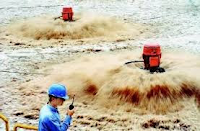
A Typical Surface-Aerated Basing (using motor-driven floating aerators)

Most biological oxidation processes for treating industrial wastewaters have in common the use of oxygen (or air) and microbial action.

Surface-aerated basins achieve 80 to 90% removal of BOD with retention times of 1 to 10 days. The basins may range in depth from 1.5 to 5.0 m and utilize motor-driven aerators floating on the surface of the wastewater.

In an aerated basin system, the aerators provide two functions: they transfer air into the basins required by the biological oxidation reactions, and they provide the mixing required for dispersing the air and for contacting the reactants (that is, oxygen, wastewater and microbes).

Typically, the floating surface aerators are rated to deliver the amount of air equivalent to 1.8 to 2.7 kg O2/kWh.

However, they do not provide as good mixing as is normally achieved in activated sludge systems and therefore aerated basins do not achieve the same performance level as activated sludge units.

Biological oxidation processes are sensitive to temperature and, between 0 °C and 40 °C, the rate of biological reactions increase with temperature.

Most surface aerated vessels operate at between 4 °C and 32 °C.

Aeration methods

Diffused Aeration

Sewage liquor is run into deep tanks with diffuser blocks attached to the floor. These are like the diffuser blocks used in tropical fish tanks but on a much larger scale.

Air is pumped through the blocks and the curtain of bubbles formed both oxygenates the liquor and also provide the necessary stirring action.

Where capacity is limited or the sewage is unusually strong or difficult to treat, oxygen may be used instead of air.

Typically, the air is generated by some type of blower or compressor. 

Surface aerators

Vertically mounted tubes of up to 1 m diameter extending from just above the base of a deep concrete tank to just below the surface of the sewage liquor.

A typical shaft might be 10 m high. At the surface end the tube is formed into a cone with helical vanes attached to the inner surface.

When the tube is rotated, the vanes spin liquor up and out of the cones drawing new sewage liquor from the base of the tank.

In many works each cone is located in a separate cell that can be isolated from the remaining cells if required for maintenance.

Some works may have two cones to a cell and some large works may have 4 cones per cell.

IWA Publishing spreads knowledge about our most valuable resource, water, helping to improve global health and well-being. We publish a portfolio of 17 peer reviewed journals and 800 books, along with other information resources. 

https://www.iwapublishing.com/news/activated-sludge-process