Showing posts with label Carcinogenics. Show all posts

Saturday, August 1, 2020

TOXIC BENZENE AND PARKED CARS - Benzene is a toxic chemical known to produce a variety of ill health effects, including anemia and cancer (specifically leukemia) in humans. The substance occurs both naturally and as a byproduct of human activities, e.g. as a component of petroleum-based products and products manufactured using benzene as a solvent (such as plastics, synthetic fibers, dyes, glues, detergents, and drugs). It's also a constituent of tobacco smoke. Low levels of benzene are typically present in outdoor air due to automobile exhaust and industrial emissions. Thanks to vapors emitted by household products such as glues, paints, and furniture wax, even higher levels of benzene can sometimes be found in indoor air, especially in new buildings. In most cars, these items are made from plastics, synthetic fabrics, and glues, some of which are manufactured using benzene. Such items may "off-gas" trace amounts of benzene, especially under hot weather conditions. As to car air fresheners, there's precious little information available about the ingredients, though one European study found that some household air fresheners emit measurable amounts of benzene. It's not inconceivable that some car air fresheners do, too. The crucial question is how much. Might all of these potential emitters cumulatively give off enough benzene to harm your health? Most of the published studies wherein benzene levels were measured inside passenger vehicles have been done in traffic. So, while such studies have indeed found that in-vehicle benzene levels can significantly exceed those outside the vehicle, and could pose a human health hazard, this is mainly attributed to the presence of exhaust fumes.

Woman sleeping in car with rain on the window
.................................................................................................................................................
Toxic Benzene and Parked Cars
David Emery


This viral message claims car interiors contain toxic levels of cancer-causing benzene emitted by dashboards, car seats, and air fresheners, and recommends opening windows to expel trapped benzene gas before turning on the car air conditioner.
True or false?
·      Description: Online rumor
·      Circulating since May 2009
·      Status: Grain of truth / Overblown (see details below)
·      Example: Email text contributed by Glennis A., May 11, 2009:
Car A/C (Air Conditioning) MUST READ!!!

Please do NOT turn on A/C as soon as you enter the car.
Open the windows after you enter your car and turn ON the air-conditioning after a couple of minutes.

Here's why:

According to a research, the car dashboard, sofa, air freshener emit Benzene, a Cancer causing toxin (carcinogen - take time to observe the smell of heated plastic in your car).

In addition to causing cancer, Benzene poisons your bones, causes anemia and reduces white blood cells.

Prolonged exposure will cause Leukemia, increasing the risk of cancer. May also cause miscarriage.

Acceptable Benzene level indoors is 50 mg per sq. ft.

A car parked indoors with windows closed will contain 400-800 mg of Benzene. If parked outdoors under the sun at a temperature above 60 degrees F, the Benzene level goes up to 2000-4000 mg, 40 times the acceptable level...

People who get into the car, keeping windows closed will inevitably inhale, in quick succession excessive amounts of the toxin.

Benzene is a toxin that affects your kidney and liver. What's worse, it is extremely difficult for your body to expel this toxic stuff. So friends, please open the windows and door of your car - give time for interior to air out - dispel the deadly stuff - before you enter.

Our Analysis

While it isn't one hundred percent false, the above text is a font of misinformation. Don't let it scare you.
Starting with the basics, it's true that benzene is a toxic chemical known to produce a variety of ill health effects, including anemia and cancer (specifically leukemia) in humans.
The substance occurs both naturally (mainly as a component of crude oil) and as a byproduct of human activities, e.g. as a component of petroleum-based products (such as gasoline) and products manufactured using benzene as a solvent (such as plastics, synthetic fibers, dyes, glues, detergents, and drugs).
It's also a constituent of tobacco smoke.
Low levels of benzene are typically present in outdoor air due to automobile exhaust and industrial emissions.
Thanks to vapors emitted by household products such as glues, paints, and furniture wax, even higher levels of benzene can sometimes be found in indoor air, especially in new buildings.

Benzene in Cars

Do automobile dashboards, door panels, seats, and other interior components emit benzene, as claimed in the email?
Most likely.
In most cars, these items are made from plastics, synthetic fabrics, and glues, some of which are manufactured using benzene.
According to scientists, such items may "off-gas" trace amounts of benzene, especially under hot weather conditions.
As to car air fresheners, there's precious little information available about the ingredients, though one European study found that some household air fresheners emit measurable amounts of benzene.
It's not inconceivable that some car air fresheners do, too.
The crucial question is how much.
Might all of these potential emitters cumulatively give off enough benzene to harm your health?

What the Scientists Say

Most of the published studies wherein benzene levels were measured inside passenger vehicles have been done under driving conditions, in traffic.
So, while such studies have indeed found that in-vehicle benzene levels can significantly exceed those outside the vehicle, and could pose a human health hazard, this is mainly attributed to the presence of exhaust fumes.
Also, the amounts of benzene actually detected by researchers, albeit statistically significant, were much, much smaller than the amounts stated in the email.
A 2006 study summarizing all the data collected to date reported in-vehicle benzene levels from exhaust fumes ranging from .013 mg to .56 mg per cubic meter — a far cry from the 400 mg to 4,000 mg per square foot (do they mean cubic foot?) reported in the email.

Benzene Levels in Parked Cars

In the one study, we were able to find that measured benzene levels inside parked cars with their engines turned off.
The results were more benign.
Toxicologists took samples of the air inside both a new and a used vehicle under simulated hot-sunlight conditions, measuring the levels of volatile organic compounds (VOCs) including C3- and C4-alkylbenzenes, and exposing human and animal cells to the samples to determine their toxicity.
Despite the detectable presence of VOCs (a total of 10.9 mg per cubic meter in the new car and 1.2 mg per cubic meter in the old car), no toxic effects were observed.
Apart from noting the slight possibility that allergy-prone individuals might find their condition exacerbated by exposure to such compounds, the study concluded there is "no apparent health hazard of parked motor vehicle indoor air."

When in Doubt, Ventilate

Despite this finding, some drivers may still be concerned about the presence of any benzene vapors inside their car, especially given the World Health Organization's stated position that there is "no safe level of exposure" to the carcinogen.
They may also worry, per the email warning above, that turning on the vehicle's air conditioner might exacerbate their exposure to trapped toxins by recirculating contaminated air.
If that's the case, there's no harm done — and much peace of mind to be gained — by simply opening the windows and ventilating the car before turning it on.

David Emery is a freelance writer and avid chronicler of folklore and popular culture, with a special interest in the quick-fire folklife of the digital age.
Experience
Dubbed About.com's "urban legend guru" by Salon magazine and cited in the New York Times, Christian Science Monitor, Washington Post, the BBC and USA Today, David Emery has more than 18 years' experience as an Internet folklore expert and debunker of urban legends, hoaxes, and popular misconceptions. Other professional credits include stints as a newsroom librarian, staff writer for a TV sitcom, freelance journalist, and contributing editor of a satirical newspaper. Mr. Emery first won recognition in the online universe as an arch commentator on the outer limits of Net culture with Iron Skillet Magazine, "a compendium of offbeat views run through the blender of the author's savage sense of humor ... [with] on-target skewerings of strange ideas" (Houston Chronicle, 1997).
Testimonials
“[Emery is] a strong writer with a bright, amusing style. This fun, informative, and concise site is extremely easy to navigate and a good first step for those new to the subject.” – Brandon Toropov, The Complete Idiot's Guide to Urban Legends (Alpha Books, 2001)
“The best place to track urban legends is the About.com section run by guide David Emery. In addition to his usual smart debunking of various urban legends, he has been tracking rumors about the attacks since Sept. 11. “ – Sree Sreenivasan, “Keeping Track of Rumors and Hoaxes” (Poynter.org, 2002)
“This About.com subsite has been hosted for ten years by David Emery and frankly, he has done a great job. He is passionate about finding and debunking all those rumors, myths, pranks and odd stories. “ – Tim Malone, “Top 10 Sites to Debunk Urban Legends" (Tech Republic, 2008)
"David Emery's urban legend site at About.com has been a reliable source of information for years." – Jan Harold Brunvand, Encyclopedia of Urban Legends, Updated and Expanded Edition (ABC-CLIO, 2012)
Education
Mr. Emery holds a BA in Philosophy.
David Emery
Please join me in what promises to be a constantly entertaining, ever-enlightening exploration into the urban legends and folklore of the digital age.
Woman sleeping in car with rain on the window

Sunday, November 3, 2019

BURNING DRIFTWOOD - Why Burning Driftwood Makes Colored (Toxic) Fire - Burning driftwood, especially from the ocean, gets a fire with blue and lavender flames. The colored fire comes from excitation of the metal salts that have soaked into the wood. While the flames are pretty, the smoke given off of the fire is toxic. Driftwood releases a lot of dioxin from combustion of salt-soaked wood. Dioxins are carginogenic, so burning driftwood from beaches is not recommended. All smoke contains particulates which can cause health problems when the smoke is inhaled, but you may have been unaware of the additional issue with burning driftwood.

Driftwood and Rocks on Ruby Beach
............................................................................................................................................
Burning Driftwood
Why Burning Driftwood Makes Colored (Toxic) Fire
by Anne Marie Helmenstine, Ph.D. 


Did you know you can burn driftwood, especially from the ocean, to get a fire with blue and lavender flames?
The colored fire comes from excitation of the metal salts that have soaked into the wood. 
While the flames are pretty, the smoke given off of the fire is toxic.
Specifically, driftwood releases a lot of dioxin from combustion of salt-soaked wood.
Dioxins are carcinogenic, so burning driftwood from beaches is not recommended.
Some coastal communities have considered burn bans on driftwood to reduce the levels of pollution from the smoke.
All smoke contains particulates which can cause health problems when the smoke is inhaled, but you may have been unaware of the additional issue with burning driftwood.

Anne Marie Helmenstine, Ph.D.
Introduction
Ph.D. in biomedical sciences from the University of Tennessee at Knoxville - Oak Ridge National Laboratory.
Science educator with experience teaching chemistry, biology, astronomy, and physics at the high school, college, and graduate levels.
ThoughtCo and About Education chemistry expert since 2001.
Widely-published graphic artist, responsible for printable periodic tables and other illustrations used in science.
Experience
Anne Helmenstine, Ph.D. has covered chemistry for ThoughtCo and About Education since 2001, and other sciences since 2013. She taught chemistry, biology, astronomy, and physics at the high school, college, and graduate levels. She has worked as a research scientist and also abstracting and indexing diverse scientific literature for the Department of Energy.
In addition to her work as a science writer, Dr. Helmenstine currently serves as a scientific consultant, specializing in problems requiring an interdisciplinary approach. Previously, she worked as a research scientist and college professor. 
Education
Dr. Helmenstine holds a Ph.D. in biomedical sciences from the University of Tennessee at Knoxville and a B.A. in physics and mathematics with a minor in chemistry from Hastings College. In her doctoral work, Dr. Helmenstine developed ultra-sensitive chemical detection and medical diagnostic tests.
ThoughtCo and Dotdash
ThoughtCo is a premier reference site focusing on expert-created education content. We are one of the top-10 information sites in the world as rated by comScore, a leading Internet measurement company. Every month, more than 13 million readers seek answers to their questions on ThoughtCo.
For more than 20 years, Dotdash brands have been helping people find answers, solve problems, and get inspired. We are one of the top-20 largest content publishers on the Internet according to comScore, and reach more than 30% of the U.S. population monthly. Our brands collectively have won more than 20 industry awards in the last year alone, and recently Dotdash was named Publisher of the Year by Digiday, a leading industry publication.

Driftwood and Rocks on Ruby Beach

Saturday, September 7, 2019

PHONE TOWERS AND CANCER - Phone towers are not the only thing we should be worried about; phones and routers are similar to miniature towers themselves. In fact, not only are they greater in number, but they also lie much closer to us than most cell phone towers do. Microwaves generating non-ionizing radiation are harmless, but concentrated microwaves can penetrate our skin and burn tissues; this is exactly how ovens work! Antennas are generally mounted on top of tall towers or buildings, which causes the power levels of the emitted radiation to dwindle as it descends toward the ground. At ground level, the emission is 1000 times lower than the limits for safe transmission set by the Federal Communication Commission (FCC). In other words, damage is highly unlikely. Second, the signals are not transmitted constantly, but intermittently.

mobile network tower
.................................................................................................................................
Microwave OvenPhone Towers And Cancer
Do Phone Towers Cause Cancer?
Akash Peshin  


Well, the answer isn’t an outright no. One can find some solace in the fact that the evidence for the case hasn’t been conclusive.
Right now, at this very moment, you are drowning in an ocean of electromagnetic radiation. Its waters are a myriad of radiation – radio waves, the sun’s light, infrared and all the rest.
Initially, the world was dominated by the sun’s light and infrared radiation, the harbingers of heat.
Now, however, with the construction of soaring phone towers and the ubiquity of smartphones, radio waves seem to be growing in domination.
The notion of whether phone towers pose a health risk has been speculated for decades.
The presence of towers and cell phones concerned people even at times when mobile devices were a luxury – complex technological equipment that only a few people carried.
The situation today seems to cause even more apprehension – cell phones are as common and necessary as footwear, every household has a router, and to accommodate both of these, radio towers are planted more often than trees.
Ionizing vs Non-ionizing radiation
Any type of fear is largely spurred by uncertainty, which is essentially a lack of information.
In this case, the fear of phone towers seems to be fueled by our lack of understanding of electromagnetic physics.
The seven types of electromagnetic radiation can be categorized into two classes based on their energies: ionizing and non-ionizing radiation
Ionizing radiation represents the high-frequency spectra of electromagnetic radiation, which includes high-frequency ultraviolet rays, X-rays and gamma rays – remnants of a nuclear aftermath.
Prolonged exposure to these emissions can cause cellular mutation, which can lead to various cancers. This is because, as the name suggests, they tend to ionize and destabilize molecules.
These high-frequency waves are so energetic that they interact with matter as if they are individual particles, colliding and kicking matter’s constituents out of their stable structures. 
Exposure to such an energetic radiation disrupts the structure of DNA, a major cause of cancer and other autoimmune diseases.
On the other hand, non-ionizing radiation represents the low-frequency spectra of electromagnetic radiation.
These include radio waves, microwaves, infrared and visible light.
Owing to their low frequencies, these waves travel with very low energies, rendering them non-ionizable — they are unable to knock particles away from stable molecular structures.
The fact that low-frequency waves aren’t energized enough to disrupt DNA molecules implies that the radio waves constantly emanating from phone towers are harmless.
Even so, could constant exposure to them, like an interference pattern, positively add up to threaten us with a fatal health risk?
The fear is most likely to be observed in parents who are apprehensive about radiation affecting the developing brains and bodies of children.
Are these apprehensions justified? Let’s see what the experts have to say.
They are “possibly carcinogenic”
Phone towers are not the only thing we should be worried about; phones and routers are similar to miniature towers themselves.
In fact, not only are they greater in number, but they also lie much closer to us than most cell phone towers do.
Microwaves generating non-ionizing radiation are harmless, but concentrated microwaves can penetrate our skin and burn tissues; this is exactly how ovens work!
So… should we be worried? Well, the answer isn’t an outright no.
One can find some solace in the fact that the evidence for the case hasn’t been conclusive.
This is reflected in the World Health Organization’s (WHO) International Agency for Research on Cancer (IARC), which deems radio transmission “possibly carcinogenic” — towers don’t seem to pose a threat, but we aren’t sure.
However, there are multiple reasons why they might be harmless.
First, antennas are generally mounted on top of tall towers or buildings, which causes the power levels of the emitted radiation to dwindle as it descends toward the ground.
At ground level, the emission is 1000 times lower than the limits for safe transmission set by the Federal Communication Commission (FCC).
In other words, damage is highly unlikely.
Second, the signals are not transmitted constantly, but intermittently.
However, could the radiation affect people who live in the vicinity of these towers, such as people living right below the roof or inhabitants of buildings whose windows face towers mounted on a shorter building directly adjacent to them?
The answer is still “No”. Cement, wood and other obstructions attenuate signals, thereby deterring any copious amounts of potentially harmful radiation.
The power levels are known to be at a maximum right next to the antenna, so access to the places with direct exposure might be limited.
Still, a lack of studies relating to residents living near a glut of towers and their likelihood of cancer hasn’t allowed any definitive conclusion to appear.

Akash Peshin is an Electronic Engineer from the University of Mumbai, India and a science writer at ScienceABC. Enamored with science ever since discovering a picture book about Saturn at the age of 7, he believes that what fundamentally fuels this passion is his curiosity and appetite for wonder.


mobile network tower
Phone towers on top of a hill.


The electromagnetic spectrum.

mir satellite
Mir, a Russian space station that operated in low Earth orbit from 1986 to 2001, as seen in orbit around Earth in a file picture.


Microwave Oven
A microwave oven. 


Alexander Graham Telephone in New york
Bell on the telephone in New York (calling Chicago) in 1892. Good ol’ times, huh?


Thursday, August 15, 2019

CANCER AND INSULATION MATERIALS - A properly insulated home will save money on energy costs by resisting the flow of heat and making your heating and air conditioning work less. Fiberglass insulation, a man-made mineral fiber con¬structed from a variety of materials, such as sand and recycled glass, is the most popular form of insulation in the United States -- more than 90 percent of homes in America are lined with the pink stuff But while many see the benefits of insulating our houses with fiberglass, some are worried fiberglass can cause various health problems -- it's capable of causing immediate skin irritation.

Hidden Home Dangers Image Gallery A worker sprays fiberglass over a spa mold at Sundance Spas. Is insulation like fiberglass dangerous? See more pictures of hidden home dangers.
............................................................................................................................................
A worker pulls fiberglass straight as it is manufactured at a factory in Chengdu, Sichuan Province, China.Cancer And Insulation Materials
Is insulation dangerous?
BY JOHN FULLER


Rummaging around in your friend's newly renovated attic, you notice what looks like a rolled-up blanket in the far corner.
You give it a kick, and the blanket unfurls onto the floor. It's pink, and the material looks a little like cotton candy.
You run your hand over it to see what it feels like, but you soon realize that was a mistake. Before you know it, your hand is red and itchy -- you've just come in contact with fiberglass insulation.
Insulating our homes is one of the most important parts of house construction, and insulation has a big effect on the costs of energy.
Heat naturally flows from a warm space to a cool space, and our homes suffer from this transfer.
In the winter, warm air from the inside will move to the outside and make us cold.
In the summer, hot air moves from the outside to the inside and makes it uncomfortably warm.
We have heating and air conditioning systems to fix these problems, but the more opportunities warm air has to flow out of or into the house, the harder those systems have to work.
As those systems work harder, we use more energy and pay much higher utility bills.
A properly insulated home will save money on energy costs by resisting the flow of heat and making your heating and air conditioning work less.
Fiberglass insulation, a man-made mineral fiber con­structed from a variety of materials, such as sand and recycled glass, is the most popular form of insulation in the United States -- more than 90 percent of homes in America are lined with the pink stuff [source: Spencer and Gulick].
But while many see the benefits of insulating our houses with fiberglass, some are worried fiberglass can cause various health problems -- it's capable of causing immediate skin irritation.
But while some research suggests that inhaling fiberglass particles could cause cancer, but in 2001, the International Agency for Research on Cancer removed glass, rock and slag wool fibers -- common elements of fiberglass insulation -- from its list of substances possibly carcinogenic to humans [sources: NTP, IARC].
Fiberglass and Asbestos
If you've ever come in contact with fiberglass, you already know what it can do to your skin. The tiny fibers of glass from insulation wool can irritate your skin and eyes.
If you experience too much contact with fiberglass, it can cause what's called irritant contact dermatitis, or inflammation of the skin.
Breathing in fibers can also increase the difficulty of breathing. Is that the extent of the trouble fiberglass can cause, or are there more serious health effects?
Fiberglass became popular in the United States as another insulating material -- asbestos -- was phased out of use.
Asbestos, unlike fiberglass, is a naturally occurring silicate material found in rocks. Its known use goes back to the ancient Greeks, who admired it for its ability to withstand very high temperatures.
Indeed, asbestos isn't just resistant to heat. It also doesn't evaporate in the air, dissolve in water or react with most chemicals.
All of these properties made it particularly attractive for home construction, and asbestos was the main material used for building insulation for the late 19th century and much of the 20th century.
But as early as the 1930s, the health hazards of asbestos became clear. When asbestos fibers are released into the air, they split into microscopic pieces.
Once breathed in, asbestos fibers will be inhaled deep into the lungs, where they stay for long periods of time.
During that time, the fibers irritate the lungs and any other part of the body they may travel to, disrupting cell division by interfering with chromosome distribution and changing important genetic material.
This increases the chances of developing illnesses such as asbestosis, mesothelioma and other cancers, although symptoms of any such disease typically won't show up for 10 to 40 years.
Asbestos is classified as a known human carcinogen by state, federal and international agencies, and new uses of the material were banned in 1989 by the Environmental Protection Agency.
Still, we frequently see asbestos-related problems, from the evacuation of poorly constructed school buildings to debris created from Hurricane Katrina in New Orleans in 2005.
While asbestos is a natural material and fiberglass is man-made, the two materials are often compared because they're both fibrous.
This quality made fiberglass a good substitute once the health effects of asbestos became apparent. It also has the heat-resistant qualities that made asbestos so desirable for insulation.
It also has some worried that the fibers from fiberglass are just as dangerous as asbestos -- it's sometimes referred to negatively as "man-made asbestos" or the asbestos of the 20th century.
But while early research on rats in the 1970s stated that "fibrous glass of small diameter is a potent carcinogen," more modern research isn’t as sweeping in its findings [source: Montague].
The American Conference of Governmental Industrial Hygienists, on the other hand, claims fiberglass is "Not Classifiable as a Human Carcinogen," meaning there isn't even data to say whether or not it causes cancer in people [source: Yeshiva University].
The U.S. National Toxicology Program issued its 13th Report on Carcinogens in fall of 2014, and while its entry on Certain Glass Wool Fibers (Inhalable) states that they are “reasonably anticipated to be human carcinogens,” it also goes on to say that there is so much variation in production that full assessments must be made on a case-by-case basis [source: NTP].
Fiberglass is generally considered safe when properly installed. Once it's installed, fiberglass rests safely between panels, sheetrock and plaster -- only when it's removed will fibers become airborne.
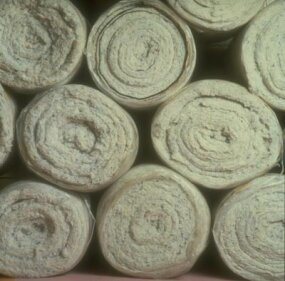
In the meantime, people are still suggesting alternative ways to insulate homes -- everything including cork, corn cobs, cotton, newspapers and brick are other ways to keep the heat from escaping houses. 

John Fuller earned a bachelor’s degree in English from the University of Georgia, where he also minored in film studies. After a brief stint in film and television production, John began his career at HowStuffWorks as a staff writer, writing about spacewalks, cave dives and everything in between. He eventually switched to a position as editor, which is where you’ll find him now. John also co-hosted the music podcast 'Stuff From the B-Side' with publisher Mark Larson from 2008 to 2009, and he currently contributes to “Stuff From the Future.'
John stands at his desk while he works, which still gets him the occasional funny look from his coworkers. When he’s not editing articles or eating too much free candy from the office, he enjoys reading fiction, searching high and low for cheap (but quality) used vinyl, playing basketball and watching baseball.

 Rolls of natural cotton and recycled cotton prepared for use as an alternative to fiberglass insulation.

Hidden Home Dangers Image Gallery A worker sprays fiberglass over a spa mold at Sundance Spas. Is insulation like fiberglass dangerous? See more pictures of hidden home dangers.
A worker sprays fiberglass over a spa mold at Sundance Spas. Is insulation like fiberglass dangerous?


A worker pulls fiberglass straight as it is manufactured at a factory in Chengdu, Sichuan Province, China.


Rolls of natural cotton and recycled cotton prepared for use as an alternative to fiberglass insulation.