Showing posts with label Diatoms. Show all posts

Saturday, August 15, 2020

DIATOMACEOUS EARTH - DE is made from Diatomites, which are rough, porous fossilized mineral deposits formed near dried up water. The mineral is a result of dead single-celled algae called diatoms usually found in marine sediments. Diatoms account for ¼ of all photosynthesis on Earth. The size of each diatom is about the width of a human hair (0.5 mm). While some diatoms float by themselves, many diatoms group together and form suspended chains near the surface of water or attach themselves to rocks or plants under water. Diatoms have hard shells that resemble tiny pill-shaped glass houses made from silica. Silica is one of the hardest solids on earth and can be found in glass and concrete. Silica makes up 26% of the earth’s crust by weight. Diatomite deposits can be found all over the world, including notable extractions sites such as Neuohe. Diatomite deposits can be found all over the world. At the processing plant, the diatomites are crushed, dried, and milled to create food grade diatomaceous earth. Pool grade (also called filter grade) diatomaceous earth is treated with very high heat in a process called calcination, which changes the silicon dioxide into crystalline silica. Pool grade DE is toxic and should only be used in filtration. Food grade DE has less than 1% of crystalline silica and no more than 10mg/kg of arsenic or lead. One of the most common household uses for DE is pest control.

A family playing in their yard
...........................................................................................................................................................
TOP-9 Sugar Ant Killers: Best Baits and Insecticides in 2020Diatomaceous Earth
White Lake Diatomaceous Earth – Lone Star TackWhat is Diatomaceous Earth?
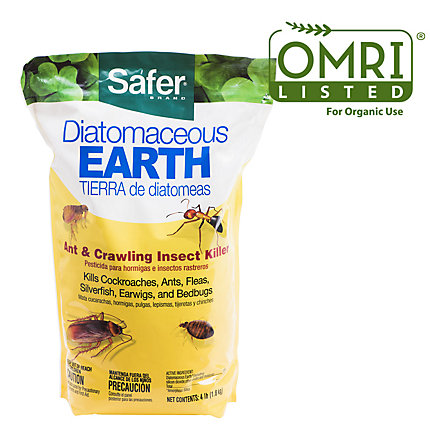
Safer® Brand


Discovered around 1836 by Peter Kasten in Germany, diatomaceous earth (DE) was originally used to make dynamite.
It now has dozens of uses including: metal polishes, toothpaste, pest control and water filters.
Diatomaceous Earth-1/2 Kilo - Hornsby Beekeeping SuppliesDE is made from Diatomites, which are rough, porous fossilized mineral deposits formed near dried up water.
The mineral is a result of dead single-celled algae called diatoms usually found in marine sediments.
Diatoms account for ¼ of all photosynthesis on Earth.
The size of each diatom is about the width of a human hair (0.5 mm).
While some diatoms float by themselves, many diatoms group together and form suspended chains near the surface of water or attach themselves to rocks or plants under water.
Diatoms have hard shells that resemble tiny pill-shaped glass houses made from silica.
Silica is one of the hardest solids on earth and can be found in glass and concrete. Silica makes up 26% of the earth’s crust by weight.
Diatomite deposits can be found all over the world, including notable extractions sites such as Neuohe.
TWO TYPES OF DE: POOL GRADE VS FOOD GRADE
The quality of DE depends mostly on two factors: 1) where it’s mined and
2) how it’s processed.
In the United States, according to the U.S. Geological Survey, DE is mined and processed in California, Nevada, Oregon and Washington.
However, diatomite deposits can be found all over the world.
At the processing plant, the diatomites are crushed, dried, and milled to create food grade diatomaceous earth.
Pool grade (also called filter grade) diatomaceous earth is treated with very high heat in a process called calcination, which changes the silicon dioxide into crystalline silica.
Pool grade DE is toxic and should only be used in filtration.
Food grade DE has less than 1% of crystalline silica and no more than 10mg/kg of arsenic or lead.
HOW DE WORKS TO KILL BUGS
One of the most common household uses for DE is pest control.
Safer® Brand Diatomaceous Earth is deadly to insects with an exoskeleton.
Woman working in a raised garden bedWhen a bug comes into contact with DE, it works under the insect’s shell and punctures the body with DE’s microscopic sharp edges, absorbs all the moisture, and causes the bug to die of dehydration.
Let’s take a look at how to use diatomaceous earth to kill bed bugs.
In the past few years, the U.S. has seen a rise in bed bug infestations because the bugs built up resistance to the toxic chemicals companies used to get rid of them.
Since diatomaceous earth kills bugs physically they can never become immune to it.
Homeowners can safely apply diatomaceous earth to their bed, couches, closets and whole house to eradicate bed bugs without harming their pets and kids.
Once bed bugs come into contact with DE it takes less than 48 hours to kill the insect.
Ways to use DE to Kill Bugs
Wear a dust mask when applying DE as it can irritate your nose and lungs.
Food Grade Diatomaceous Earth for Gardens and PlantsHowever, DE is safe once the dust has settled.
Diatomaceous earth must be dry in order to work. If using outside, reapply after it rains.
Leave bugs dead in the dust and feel good about using nature’s remedy.
Check out Safer® Brand’s diatomaceous earth products made from food grade diatomaceous earth.
Our products are OMRI Listed® and compliant for use in organic production.
Safer Diatomaceous Earth for Pest Control
When using desiccants (diatomaceous earth or boric acid) to control bed bugs it is critical to use those that are registered by EPA and labeled for bed bug control.
Desiccants that are intended for other uses, such as food-grade or for use in swimming pools, pose an increased inhalation risk to people.

All of Safer® Brand's products stem from our belief that the health of our soil impacts the health of our food, our bodies, and the planet. We want to go back to the time when soil was safe.
Because it's no secret that chemical pesticides deplete the nutritional value of our soil and the microorganisms essential for the health of plants. When plants are fed a chemically – altered diet, the yield suffers and our health is compromised.
IT'S ALL ABOUT CREATING CLEAN SOIL, A CLEAN HOME AND A CLEAN CONSCIENCE
Our commitment to organic living doesn't stop with a healthy garden. Safer® Brand's line of pest control products for organic gardening eliminates harmful invaders in order to create an optimal environment for plants to thrive, season after season. Gardening eliminates harmful invaders in order to create an optimal environment for plants to thrive, season after season.
WE SEE THE BEAUTY AND BOUNTY OF GOING ORGANIC.
Organic gardening creates goodness. Gardens soak up the soil's rich nutrients without taking in harmful chemicals. Homes are free from toxic sprays and insecticides. Parents worry less about their family's wellbeing.
And, most delicious of all, that backyard-grown meal is packed with richer flavors, more nutrients, and a peace of mind.
Diatomaceous Earth - Food Grade Benefits & Uses incl. Pest Control
10 Reasons To Use Diatomaceous Earth In The Garden
Garden Safe Brand Diatomaceous Earth - YouTubeDiatomaceous Earth For Cats - What Is It And What Can It Do?Diatomaceous Earth
Food Grade Diatomaceous Earth

Monday, November 25, 2019

DIATOMACEOUS EARTH - Diatomite, also known as diatomaceous earth, is the naturally occurring fossilized remains of diatoms. Diatoms are single-celled aquatic algae. The properties which make diatomite valuable include low density, high porosity, high surface area, abrasiveness, insulating properties, inertness, absorptive capacity, brightness, and high silica content. The most important use relative of high-quality diatomite is as a filtering media. The naturally occurring fossilized remains of diatoms have innate filtering characteristics due to their unique honeycomb structure. Their filtering qualities are used in beer and wine making, pharmaceutical manufacturing, motor oil processing, and to filter swimming pool water.

Image result for images diatomaceous earth
.............................................................................................................................................................
Image result for images diatomaceous earth
Diatomite

What is Diatomite?
The Industrial Minerals Association


Image result for images diatomaceous earth

Diatomite, also known as diatomaceous earth, is the naturally occurring fossilized remains of diatoms.
Diatoms are single-celled aquatic algae. They belong to the class of golden brown algae known as Bacillariophyceae.  
Diatomite is a near pure sedimentary deposit consisting almost entirely of silica.  
The Greeks first used diatomite over 2,000 years ago in pottery and brick.
There are many diatomite deposits throughout the world, but those of high-purity which are commercially viable are rare. 
The properties which make diatomite valuable include low density, high porosity, high surface area, abrasiveness, insulating properties, inertness, absorptive capacity, brightness, and high silica content.  
Diatomite has a wide variety of uses, and is a component in hundreds of products, or vital to the manufacturing process of thousands more.
Filter Aids:  The most important use relative of high-quality diatomite is as a filtering media.  
The naturally occurring fossilized remains of diatoms have innate filtering characteristics due to their unique honeycomb structure.  
Their filtering qualities are used in beer and wine making, pharmaceutical manufacturing, motor oil processing, and to filter swimming pool water.  
For almost 100 years diatomite has been the workhorse of food and beverage processing.  
Almost every shelf in the grocery store contains a product which has been filtered by diatomite. 
Functional Additives:  In paints, diatomite alters glass and sheen, extends primary pigments, adds bulk and strength, controls permeability and enhances coating adhesion.  
In plastics, diatomite serves as an antiblocking agent which helps in the separation of plastic parts in manufacturing, and in the separation of plastic bags by the consumer.
Absorbents:  Due to such characteristics as porosity and high surface area, diatomite is highly absorbent and is very useful in the clean-up of spills in the automotive, industrial, janitorial and waste remediation industries. 
Soil Amendments:  When diatomite is incorporated into soil, it serves to reduce compaction, and increase water and air permeation.  
It also increases plant available water, firms soggy soils, loosens hard to work soils, provides better drainage, aids in nutrient transfer, and improves root growth.
In such applications as golf courses, and other landscaped areas it helps absorb and hold water, reducing the amount of water used.
Natural Insecticide:  When insects come in contact with diatomaceous earth, it absorbs their protective wax coating and their shells are damaged by the glassy diatoms. This combination causes them to die by dehydration.
There is no survival and no built-up immunity as there is with chemical insecticides. Also, it does not break down as chemicals do. 
Other examples of the universe of products and uses which benefit from diatomite include dental fillings, seed coatings, roofing compounds, adhesives, sealants, matches, oil drilling compounds, specialty concretes, and paper.
The Industrial Minerals Association - North America (IMA-NA) is the representative voice of companies which extract and process a vital and beneficial group of raw materials known as industrial minerals. Industrial minerals are the ingredients for many of the products used in everyday life, and our companies and the people they employ are proud of their industry and the socially responsible methods they use to deliver these beneficial resources.
IMA-NA represents ball clay, barite, bentonite, borates, calcium carbonate, diatomite, feldspar, industrial sand, kaolin, magnesia, soda ash, talc and wollastonite.
Industrial minerals . . . Your world is made of them!
Image result for images diatomaceous earth
Image result for images diatomaceous earthImage result for images diatomaceous earth