Showing posts with label Water treatment systems. Show all posts

Sunday, December 20, 2020

WATER SOFTENERS AND THE ENVIRONMENT - ARE WATER SOFTENERS BAD FOR THE ENVIRONMENT? The perceived waste associated with water softeners occurs during what’s known as regeneration. Media used to soften water by removing the hard minerals calcium and magnesium eventually gets exhausted and needs to be recharged. During the regeneration process, sodium from the solution in the brine tank refreshes the media by knocking off the calcium and magnesium ions collected by the water softening media. This gives the media new life and allows it to continue removing hard minerals. What gets flushed out of your system also contains the calcium and magnesium that the media collected during softening. The EPA has said that softener discharge is not harmful to septic systems and may actually be beneficial to the soil. More of us are paying much closer attention to how the things we buy and use impact the environment. We’re doing what we can to reduce waste and our individual carbon footprints in many different ways. If you’ve purchased new appliances in the past few years, you’ve probably noticed the shift towards more energy efficient options, and you’re likely familiar with the government’s ENERGY STAR® program. It rates appliances such as dishwashers, washing machines, and water heaters based on their energy efficiency. But, you won’t find water softeners on that list. So are water softeners bad for the environment?

.................................................................................................................................................................................................................................................................................................................................................................................................................................

Water Softeners and the Environment

ARE WATER SOFTENERS BAD FOR THE ENVIRONMENT?

.

The perceived waste associated with water softeners occurs during what’s known as regeneration. Media used to soften water by removing the hard minerals calcium and magnesium eventually gets exhausted and needs to be recharged (aka. regenerated). During the regeneration process, sodium from the solution in the brine tank refreshes the media by knocking off the calcium and magnesium ions collected by the water softening media. This gives the media new life and allows it to continue removing hard minerals. What gets flushed out of your system also contains the calcium and magnesium that the media collected during softening. The EPA has said that softener discharge is not harmful to septic systems and may actually be beneficial to the soil.

Water-Right


More of us are paying much closer attention to how the things we buy and use impact the environment.

We’re doing what we can to reduce waste and our individual carbon footprints in many different ways.

In fact, a 2019 study found the vast majority of people remodeling (78%), buying new homes (87%), and building new homes (89%) called energy efficiency a priority.

A slightly higher percentage of people in all three groups also said they’re willing to pay more for an energy efficient home.

If you’ve purchased new appliances in the past few years, you’ve probably noticed the shift towards more energy efficient options, and you’re likely familiar with the government’s ENERGY STAR® program.

It rates appliances such as dishwashers, washing machines, and water heaters based on their energy efficiency.

But, you won’t find water softeners on that list. So, what’s the truth about water softeners? Are they bad for the environment?

Water Softener Efficiency and Environmental Impact

There are certainly people who criticize water softeners in regards to sustainability.

The biggest complaints are that these residential water treatment systems waste too much water and put chloride (from salts) into aquatic environments.

Water softeners, as well as other types of water treatment do come with a certain amount of what some may view as waste.

But, is it really “wasted” water if it serves a useful purpose that also promotes energy efficiency and sustainability in other areas?

If you’re using softened water for better bathing, housecleaning, and to avoid other common hard water problems, it isn’t being wasted.

The perceived waste associated with water softeners occurs during what’s known as regeneration.

Media used to soften water by removing the hard minerals calcium and magnesium eventually gets exhausted and needs to be recharged (aka. regenerated).

During the regeneration process, sodium from the solution in the brine tank refreshes the media by knocking off the calcium and magnesium ions collected by the water softening media.

This gives the media new life and allows it to continue removing hard minerals.

What gets flushed out of your system also contains the calcium and magnesium that the media collected during softening.

The EPA has said that softener discharge is not harmful to septic systems and may actually be beneficial to the soil.

“Soil structure in the soil absorption field is positively affected by the calcium and magnesium ions in water softener effluent.”

The EPA goes on to explain that a common misconception is that influent (what’s in the brine tank) is the same as the effluent (the wastewater discharged after regeneration).

The amount of sodium (not salt or sodium chloride) in softened water that goes down the drains in your home will depend on the hardness level of the water before softening.

Historically, it took a substantial amount of water to flush the system sending the unwanted hardness minerals to the drain and regenerate the media.

However, the residential water treatment industry has made great strides in sustainability over the past decade, and high-efficiency water softeners can make a significant difference.

Systems that are properly calibrated to use less salt put less back into waste water.

So, those who want soft water while minimizing potential environmental impact should consider upgrading their residential water treatment solutions.

The Benefits of Water Efficient Technology

Most of the industry’s efforts to make water softening equipment more efficient focused on salt.

At Water-Right, however, we realized it was even more important to consider how we could conserve the precious natural resource of water.wet technology logo

That’s why we introduced Water Efficient Technology or W.E.T.

This water treatment innovation has the ability to reduce both water and salt used in a home’s softening system by as much as 50%, which compares to about 18% savings over the average high-efficiency water softeners.

As our equipment learns your household water usage routine, W.E.T. adjust its settings to use the optimal amount of salt and water.

So, if your system is regenerating when the softening media is at 75% capacity, it only uses 75% of the brine solution (salt and water) and reduces the rinse cycle times to use less water compared to regenerating a system that has used 100% of its capacity.

If your family uses more water on Saturdays, because that’s laundry day and bath day for the kids, the softener knows you need more soft water and may adjust accordingly to regenerate on Friday night.

This may mean that the media has only been 50% used before it starts regenerating.

Much like not filling the kitchen sink up all of the way to wash just a handle full of dishes, W.E.T. adjusts to only use the minimum amount of resources necessary to keep your water softener running effectively, reducing waste.

Water Softeners and Environmentally-Friendly, Energy Efficient Homes

Water softeners play a very important role in helping many other appliances in your home operate efficiently, and they’re even part of the solution for keeping certain detergents from polluting our waterways.

Let’s take water-using appliances such as washing machines and dishwashers as an example.

Many dish and laundry detergents contained phosphates to bond to the minerals in hard water and prevent them from depositing into your clothing.

However, there were serious concerns about phosphates leading to nutrient pollution, starving fish of oxygen, and causing harmful algae blooms, especially in the Great Lakes region.

All 50 states have introduced bans on phosphates in laundry detergents.

In 2010, 17 states and Washington, D.C. expanded that ban to dishwashing detergent and other soaps.

Manufacturers of these products decided it was too difficult and expensive to have different formulas for different states. So, phosphates are no longer found in most detergents.

After the ban, people started noticing things weren’t getting nearly as clean as they expected.

NPR even reported that some consumers were adding their own phosphates to dish detergent.

Pouring Detergent into the wash machine

Phosphates were basically trying to do the same thing for dishes and laundry that water softeners do for an entire house.

Homeowners with water softeners could use phosphate-free detergent without noticing any difference because the problematic minerals were already being removed from their water.

From this perspective, water softeners enable consumers to use a more environmentally-friendly product and help keep phosphates out of our waterways.

But, that’s not where the story ends.

Not only does hard water make it difficult to get dishes and laundry clean, it can also cause appliances to wear out sooner than expected and work harder than necessary.

Hard water leaves behind limescale inside appliances.

For energy-efficient models, this can mean they fail to run according to the manufacturer’s specifications.

So, they aren’t operating as efficiently as intended, which means you aren’t saving as much on your utility bills or as much energy as you thought.

That’s especially true for water heaters.

As we explained in our infographic on water softener savings, the Department of Energy found water heater scaling reduces efficiency by 10%.

Could Your Water Softener be More Efficient and Environmentally-Friendly?

If you’re concerned with how water softening in your home impacts the environment, the first thing you should evaluate is the age of your equipment.

If it’s been 10 years or more since you updated your water treatment solutions, you should consider a new, high-efficiency water softener, such as those equipped with W.E.T.™ from Evolve® and WaterCare®dealers.

W.E.T.™ will actually show you how much water and salt you are saving over time, so you’ll know it is working.

Select units can also be equipped with Wripli® Wi-Fi technology, which has features including the ability to track your water usage and turn on Vacation Mode remotely with a smartphone.

That way you won’t waste water during regeneration when you’re away from home. Wripli® is available exclusively from our Evolve® and WaterCare® dealers.

What you should avoid is simply purchasing equipment and making water softener installation a DIY project.

An expert from Water-Right’s family of water treatment professionals can test your water to find out how to accurately calibrate your equipment for the best water quality and optimal efficiency.

Without their help, the unit could fail to adequately treat your water, or it could over-soften and result in wasted water and salt.

It is possible to have soft water in your home and still feel good about your efforts to support a cleaner planet.

In fact, there are ways in which the two go hand-in-hand. You just need a helpful local expert to point you in the right direction.

THE RIGHT WATER FOR LIFE

Constant innovation and no shortcuts. Water-Right is first and foremost a company built on integrity. Since 1963, we’ve done things the right way. Our value set has driven the development of the finest water treatment systems, making it easy for industry professionals to satisfy today’s demand for the highest quality water.

Keeping water clean and safe is an increasingly difficult challenge. That’s why we push to make good products better, create industry-leading technology, and offer a state-certified, independent lab specializing in water testing. It’s about making life better as well as providing “The Right Water for Life.”

Mission: Passionately provide and create innovative water treatment solutions with a splash of inspiration

Vision: Deliver innovative water solutions honestly, ethically, and enthusiastically through education, teamwork, and engaging customer support

https://www.water-rightgroup.com/blog/are-water-softeners-bad-for-the-environment/


You might also like:


Water Softener Regeneration

CLICK HERE . . . to view . . . 

https://puricare.blogspot.com/2019/09/water-softener-regeneration-water.html

.............................................................................................................................................................................................................................................................................................

Myths and truths about water softeners

CLICK HERE . . . to view . . . 

https://puricare.blogspot.com/2019/10/myths-and-truths-about-water-softeners.html

.............................................................................................................................................................................................................................................................................................

Fabric Softeners

CLICK HERE . . . to view . . . 

https://puricare.blogspot.com/2020/05/fabric-softeners-fabric-softeners.html

............................................................................................................................................................................................................................................................................................

Laundry And Hard Water

CLICK HERE . . . to view . . . 

https://puricare.blogspot.com/2019/11/laundry-and-hard-water-if-your-laundry.html

.............................................................................................................................................................................................................................................................................................

Survival Solutions

Water Storage & Purification

CLICK HERE . . . to view . . . 

https://puricarechronicles.blogspot.com/2020/01/image-result-for-images-survivalist.html

...........................................................................................................................................................................................................................................................................................

Abiogenesis: Water and Oxygen Problems

CLICK HERE . . . to view . . . 

https://puricarechronicles.blogspot.com/2019/05/abiogenesis-water-and-oxygen-problems.html

Tuesday, September 10, 2019

LARGE-SCALE WATER SUPPLY TREATMENT TECHNOLOGIES - As urban populations increase, there is a need to find new sources to meet the growing demand. If groundwater is available this can often be used with minimal treatment but any surface water source will need to be treated to make it safe. For towns and cities, the water supply is best provided by large mechanised water treatment plants that draw water from a large river or reservoir, using pumps. The size of the treatment plant required is determined by the volume of water needed, which is calculated from the number and type of users and other factors. There are often seven steps in large-scale water treatment for urban municipal water supply. The water utility will ensure by regular analysis of the water that it adheres to quality standards for safe water.

...................................................................................................................................................................
Large-scale Water Supply
Water Treatment Technologies for Large-scale Water Supply
The Open University


The need for large-scale water treatment
Water treatment is the process of removing all those substances, whether biological, chemical or physical, that are potentially harmful in water supply for human and domestic use.
This treatment helps to produce water that is safe, palatable, clear, colourless and odourless. Water also needs to be non-corrosive, meaning it will not cause damage to pipework.
In urban areas, many people live close together and they all need water. This creates a demand for large volumes of safe water to be supplied reliably and consistently, and this demand is growing.
As urban populations increase, there is a need to find new sources to meet the growing demand. If groundwater is available this can often be used with minimal treatment but any surface water source will need to be treated to make it safe.
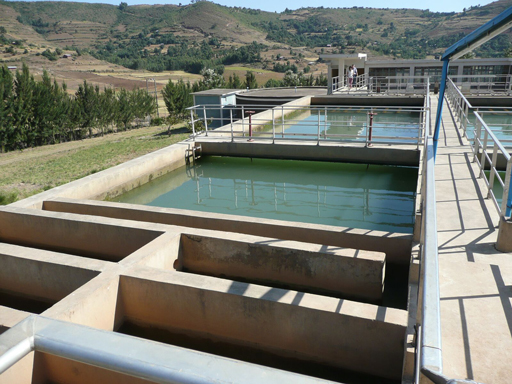
For towns and cities, the water supply is then best provided by large mechanised water treatment plants (Figure 5.1) that draw water from a large river or reservoir, using pumps.
(‘Mechanised’ means that machines, such as pumps and compressors, are used). The treated water is then distributed by pipeline.
The size of the treatment plant required is determined by the volume of water needed, which is calculated from the number and type of users and other factors.
Stages in large-scale water treatment
There are often seven steps (Figure 5.2) in large-scale water treatment for urban municipal water supply (Abayneh, 2004).
Each of the steps will be described in turn in this section. The water utility (the organisation that runs the treatment plants and water distribution system) will ensure by regular analysis of the water that it adheres to quality standards for safe water.
Figure 5.2  The seven steps often used in the large-scale treatment of water.
5.2.1  Screening
To protect the main units of a treatment plant and to aid in their efficient operation, it is necessary to use screens to remove any large floating and suspended solids that are present in the inflow.
These materials include leaves, twigs, paper, rags and other debris that could obstruct flow through the plant or damage equipment. There are coarse and fine screens.
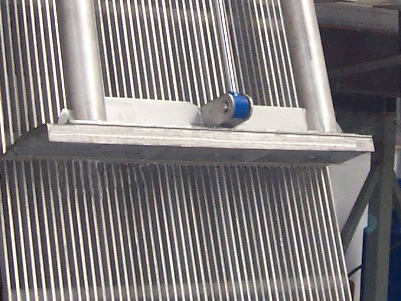
Coarse screens (Figure 5.3) are steel bars spaced 5–15 cm apart, which are employed to exclude large materials (such as logs and fish) from entering the treatment plant, as these can damage the mechanical equipment.
The screens are made of corrosion-resistant bars and positioned at an angle of 60º to facilitate removal of the collected material by mechanical raking.
Figure 5.3  A coarse screen.
Fine screens, which come after the coarse screens, keep out material that can block pipework at the plant. They consist of steel bars which are spaced 5–20 mm apart.
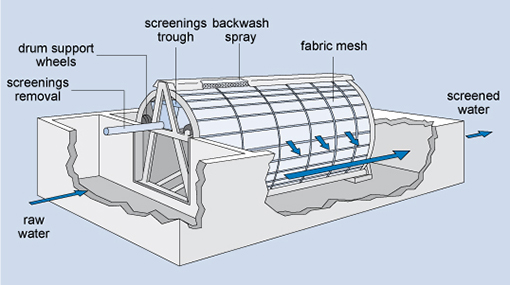
A variation of the fine screen is the microstrainer (Figure 5.4) which consists of a rotating drum of stainless steel mesh with a very small mesh size (ranging from 15 µm to 64 µm, i.e. 15–64 millionths of a metre).
Suspended matter as small as algae and plankton (microscopic organisms that float with the current in water) can be trapped.
The trapped solids are dislodged from the fabric by high-pressure water jets using clean water, and carried away for disposal.
Figure 5.4  Diagram of a microstrainer.
Aeration
After screening, the water is aerated (supplied with air) by passing it over a series of steps so that it takes in oxygen from the air.
This helps expel soluble gases such as carbon dioxide and hydrogen sulphide (both of which are acidic, so this process makes the water less corrosive) and also expels any gaseous organic compounds that might give an undesirable taste to the water.
Aeration also removes iron or manganese by oxidation of these substances to their insoluble form.
Iron and manganese can cause peculiar tastes and can stain clothing. Once in their insoluble forms, these substances can be removed by filtration.
In certain instances, excess algae in the raw water can result in algal growth blocking the sand filter further down the treatment process.
In such situations, chlorination is used in place of, or in addition to, aeration to kill the algae, and this is termed pre-chlorination.
This comes before the main stages in the treatment of the water. (There is a chlorination step at the end of the treatment process, which is normal in most water treatment plants).
The pre-chlorination also oxidises taste- and odour-causing compounds.
Coagulation and flocculation
After aeration, coagulation takes place, to remove the fine particles (less than 1 Âµm in size) that are suspended in the water.
In this process, a chemical called a coagulant (with a positive electrical charge) is added to the water, and this neutralises the negative electrical charge of the fine particles.
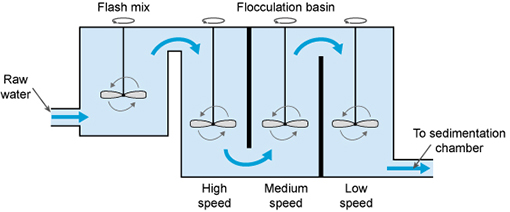
The addition of the coagulant takes place in a rapid mix tank where the coagulant is rapidly dispersed by a high-speed impeller (Figure 5.5).
Since their charges are now neutralised, the fine particles come together, forming soft, fluffy particles called ‘flocs’.
(Before the coagulation stage, the particles all have a similar electrical charge and repel each other, rather like the north or south poles of two magnets.)
Two coagulants commonly used in the treatment of water are aluminium sulphate and ferric chloride.
Figure 5.5  The coagulation–flocculation process.
The next step is flocculation. Here the water is gently stirred by paddles in a flocculation basin (Figure 5.5) and the flocs come into contact with each other to form larger flocs.
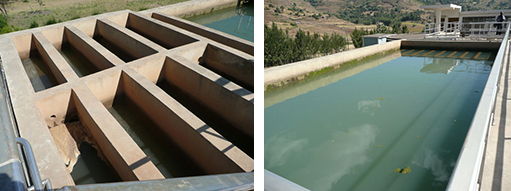
The flocculation basin often has a number of compartments with decreasing mixing speeds as the water advances through the basin (Figure 5.6(a)).
This compartmentalised chamber allows increasingly large flocs to form without being broken apart by the mixing blades.
Chemicals called flocculants can be added to enhance the process. Organic polymers called polyelectrolytes can be used as flocculants.
Sedimentation
Once large flocs are formed, they need to be settled out, and this takes place in a process called sedimentation (when the particles fall to the floor of a settling tank).
The water (after coagulation and flocculation) is kept in the tank (Figure 5.6(b)) for several hours for sedimentation to take place. The material accumulated at the bottom of the tank is called sludge; this is removed for disposal.
Figure 5.6  Flocculation chambers (a) and a sedimentation tank (b) at Gondar water treatment works.
Filtration
Filtration is the process where solids are separated from a liquid. In water treatment, the solids that are not separated out in the sedimentation tank are removed by passing the water through beds of sand and gravel.
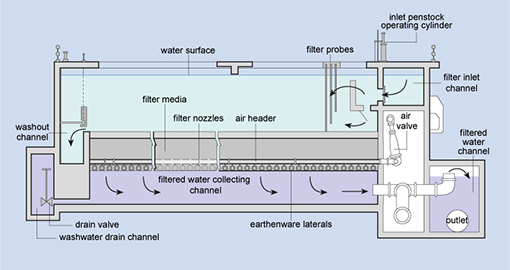
Rapid gravity filters (Figure 5.7), with a flow rate of 4–8 cubic metres per square metre of filter surface per hour (this is written as 4–8 m–3 m–2 h–1) are often used.
When the filters are full of trapped solids, they are backwashed.
In this process, clean water and air are pumped backwards up the filter to dislodge the trapped impurities, and the water carrying the dirt (referred to as backwash) is pumped into the sewerage system, if there is one.
Alternatively, it may be discharged back into the source river after a settlement stage in a sedimentation tank to remove solids.
Figure 5.7  Cross-sectional diagram of a rapid gravity sand filter.
Chlorination
After sedimentation, the water is disinfected to eliminate any remaining pathogenic micro-organisms.
The most commonly used disinfectant (the chemical used for disinfection) is chlorine, in the form of a liquid (such as sodium hypochlorite, NaOCl) or a gas. It is relatively cheap, and simple to use.
When chlorine is added to water it reacts with any pollutants present, including micro-organisms, over a given period of time, referred to as the contact time.
The amount of chlorine left after this is called residual chlorine. This stays in the water all the way through the distribution system, protecting it from any micro-organisms that might enter it, until the water reaches the consumers.
World Health Organization Guidelines (WHO, 2003) suggest a maximum residual chlorine of 5 mg l–1 of water.
The minimum residual chlorine level should be 0.5 mg l–1 of water after 30 minutes’ contact time (WHO, n.d.).
There are other ways of disinfecting water (e.g. by using the gas ozone, or ultraviolet radiation) but these do not protect it from microbial contamination after it has left the water treatment plant.
Following disinfection the treated water is pumped into the distribution system.
Supplementary treatment
Supplementary treatment may sometimes be needed for the benefit of the population. One such instance is the fluoridation of water, where fluoride is added to water.
It has been stated by the World Health Organization that ‘fluoridation of water supplies, where possible, is the most effective public health measure for the prevention of dental decay’ (WHO, 2001).
The optimum level of fluoride is said to be around 1 mg per litre of water (1 mg l–1).
The safe level for fluoride is 1.5 mg l–1.
In such high-fluoride areas, removal or reduction of fluoride (termed defluoridation) is essential.
The simplest way of doing this is to blend the high-fluoride water with water that has no (or very little) fluoride so that the final mixture is safe. If this is not possible, technical solutions may be applied.
Two of these, the Nakuru Method and the Nalgonda Technique, used in Ethiopia, are described below.
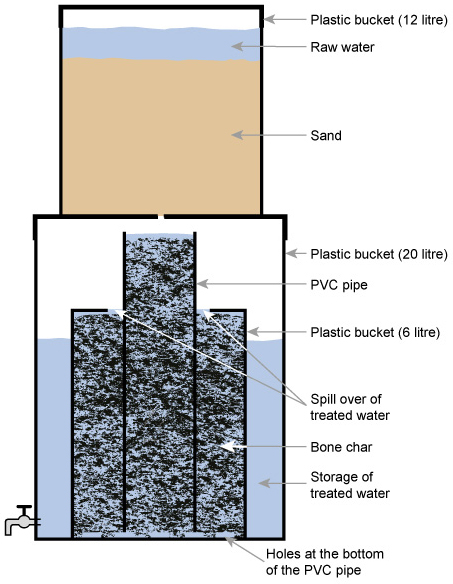
The Nakuru Method (Figure 5.8) involves a filter with bone char (charcoal produced from animal bone) and calcium phosphate to adsorb the fluoride (Kung, 2011).
There have been reservations on the use of bone char, and alternatives for defluoridation, such as activated alumina, are being tested in Addis Ababa (Alemseged, 2015).
Figure 5.8  The Nakuru method for defluoridation using plastic buckets and piping.
The Nalgonda technique for defluoridation (Suneetha et al., 2008) uses aluminium sulphate and calcium oxide to remove fluoride.
The two chemicals are added to and rapidly mixed with the fluoride-contaminated water and then the water is stirred gently.
Flocs of aluminium hydroxide form and these remove the fluoride by adsorption and ion exchange. The flocs are then removed by sedimentation.
Management of wastes from water treatment plants
Coarse screenings are usually sent to a landfill or other waste disposal site. Fine screenings (in the form of a slurry) may be discharged to a sewer, if there is one, or sent to a landfill.
The sludge from the sedimentation tank can be sent to landfill, or to a sewage treatment plant. In the latter it is added to the incoming sewage, where it can help settlement of solids.
The backwash from the sand filter is discharged into the sewer or returned to the river after settlement of solids.
Packaging waste such as chemical drums can be returned to the supplier for reuse. Wood and cardboard waste can be recycled.
Sustainability and resilience in water treatment
In Study Session 4 you read about some factors that can influence the sustainability of a water source. For example, reducing soil erosion by planting trees and retaining vegetation can reduce the amount of silt that accumulates in a reservoir and prolong its life.
For the water treatment process itself to be sustainable (meaning that it can be maintained at its best for a long time) it has to be simple to operate and maintain.
Complex systems should be avoided and wherever possible locally available materials should be used. For example, if a coagulant is required, the one that can be purchased in-country will be preferable to one that has to be imported.
Water treatment plants consume energy, and if this energy could be supplied through renewable sources (such as solar or wind) it will keep operating costs down and improve sustainability.
The plant and distribution system should be made of robust materials that will have a long operating life. It can be difficult to obtain spare parts, so there should be plans in place for procurement of replacements.
Another important factor in sustainability is an effective maintenance system, which needs planning and, importantly, requires well-trained and motivated staff.
Resilience, in the context of a water treatment system, is its ability to withstand stress or a natural hazard without interruption of performance or, if an interruption does occur, to restore operation rapidly.
With water treatment plants located very close to water sources, having too much water can be just as much a problem for operations as having too little.
Storms and floods, exacerbated by climate change, may overwhelm systems and interrupt operations, so appropriate flood defence measures must be in place.
The need to be resilient to these impacts is another reason why the equipment and construction of the plant should be of a high standard.
Basic calculations in water supply
A critical factor in the sustainability of a water supply system is ensuring that the volume of water provided is sufficient to meet current and future demand.
Table 5.1 shows the water supply requirements for towns of different sizes in Ethiopia according to the Growth and Transformation Plan II.
Table 5.1- Water supply requirements for urban areas in Ethiopia (note that for categories 1–4, the water should be available at the premises). (MoWIE, 2015)
Urban category
Population
Minimum water quantity (litres per person per day)
Maximum fetching distance (m)
1   Metropolitan
>1,000,000
100
2   Big city
100,000–1,000,000
80
3   Large town
50,000–100,000
60
4   Medium town
20,000–50,000
50
5   Small town
<20,000
40
250
The water needs of a town can be estimated from the size of the population and the water requirements of users such as schools, health facilities and other institutions within it.
The guidelines for the water supply requirement of different categories of towns, shown in Table 5.1, may be used to estimate the minimum quantity of water that should be supplied for a given population.
There will be institutions in the town with particular water requirements. Table 5.2 shows the requirements of some of these in Ethiopia.
Table 5.2  Water requirements for various types of institutions in Ethiopia. (Adapted from Kebeda and Gobena, 2004)
Institution
Water requirement (litres per person per day)
Health centre
135
Hospital
340
Day school
18.5
Boarding school
135
Office
45
Restaurant
70
Once the consumers’ total water requirement has been calculated, an allowance should be added for leakage losses, and for water use by the water utility itself (for washing of tanks, etc.). This allowance could, for example, be 15%.
The water will have to be stored in service reservoirs. Service reservoirs have to hold a minimum of 36 hours’ or 1.5 days’ water supply.
Water provision for a small town
Imagine a town with a population of 5000 people, and a health centre that treats 100 people a day.
The minimum water requirement per day for the population (using the guidelines in Table 5.1) will be 40 litres x 5000 = 200,000 litres, or 200 m3.
The water requirement for the health centre would be 135 litres x 100 = 13,500 litres, or 13.5 m3. The total water requirement each day would be 200 + 13.5 = 213.5 m3.
Allowing for 15% leakage and water usage by the water utility, each day the required volume of treated water supplied would be:
213.5 m3 x 1.15 = 245.5 m3. This could be rounded up to 246 m3.
The service reservoir would need to hold a minimum of 36 hours’ of supply (1.5 days). This means that the service reservoir size would be:
46 m3 x 1.5 = 369 m3. This could be rounded up to 370 m3.
The water requirement would therefore be 246 m3 per day, and the minimum service reservoir capacity required would be 370 m3.
This volume could be held in one service reservoir or shared between two, located in different parts of the town.
These simple calculations are included here to give you an idea of the approach that would be taken to planning a new water supply system.
In practice, the process would require many different engineering, economic and environmental considerations involving a team of experts.

The Open University is a world leader in the development of free Open Educational Resources (OER) as well as having already taught over 1.8 million people worldwide. The OU is also the largest academic institution in the UK with over 170,000 students currently enrolled on its formal qualifications. OpenLearn can help get you started but you might want to jump straight to The OU to see what qualifications you can start today!


Figure 5.8  The Nakuru method for defluoridation using plastic buckets and piping.


Figure 5.1  The water treatment plant at Gondar, Ethiopia


Figure 5.2  The seven steps often used in the large-scale treatment of water.

Figure 5.3  A coarse screen.


Figure 5.4  Diagram of a microstrainer.


Figure 5.5  The coagulation–flocculation process.


Figure 5.6  Flocculation chambers (a) and a sedimentation tank (b) at Gondar water treatment works.


Figure 5.7  Cross-sectional diagram of a rapid gravity sand filter.