Showing posts with label Aircraft landing. Show all posts

Monday, February 1, 2021

THE CONCAVE MIRROR AND THE CONVEX MIRROR - The concave mirror is a converging mirror so that it is used for many purposes. It is used as a torch to reflect the light. It is used in the aircraft landing at the airports to guide the aeroplanes. It is used in shaving to get an enlarged and erect image of the face. The concave mirror is used in front lights of cars to reflect the light. It is used in marine lighthouses that are found at the marine ports and at the airports to guide the ships and it is used in the solar ovens. The concave mirror is used in the solar ovens and the solar furnaces to collect a large amount of solar energy in the focus of the mirror for cooking food, heating water, recharging power backups, or melting metals respectively. Concave mirrors are used in satellite dishes. They are used in telescopes, dentists and ENT doctors use them to obtain a larger image than the original of the teeth, ear or skin, etc. Concave mirrors are used in the electron microscopes and magnifying glasses. They are used in the visual bomb detectors and they are used in the flashlight mirror of the camera. The real image is formed as a result of the intersection of the reflected light rays. It can be received on a screen and it is always inverted. The virtual image is formed as a result of the intersection of the reflected light rays extensions. It can not be received on a screen and it is always erect (upright). The focus of the concave mirror is produced due to the collection of the reflected rays emitted from a far object such as the sun.

.............................................................................................................................................................................................................................................................................................................................................................................................

The Concave Mirror And The Convex Mirror

Uses of the concave mirror and the convex mirror in our daily life

BY HEBA SOFFAR


Uses of the concave mirror

The concave mirror is a converging mirror so that it is used for many purposes.

It is used as a torch to reflect the light.

It is used in the aircraft landing at the airports to guide the aeroplanes,

It is used in shaving to get an enlarged and erect image of the face.

The concave mirror is used in front lights of cars to reflect the light.

It is used in marine lighthouses that are found at the marine ports and at the airports to guide the ships and it is used in the solar ovens.

The concave mirror is used in the solar ovens and the solar furnaces to collect a large amount of solar energy in the focus of the mirror for cooking food, heating water, recharging power backups, or melting metals respectively.

Concave mirrors are used in satellite dishes.

They are used in telescopes, dentists and ENT doctors use them to obtain a larger image than the original of the teeth, ear or skin, etc.

Concave mirrors are used in the electron microscopes and magnifying glasses.

They are used in the visual bomb detectors and they are used in the flashlight mirror of the camera.

Real image and Virtual image

The real image is formed as a result of the intersection of the reflected light rays.

It can be received on a screen and it is always inverted.

The virtual image is formed as a result of the intersection of the reflected light rays extensions.

It can not be received on a screen and it is always erect (upright).

The focus of the concave mirror

The focus of the concave mirror is produced due to the collection of the reflected rays emitted from a far object such as the sun.

The rays after being reflected collect in one lit point which is called the focus of the mirror that can be received on the screen.

The distance between the focus of the mirror and the pole of the mirror = ½ the radius of mirror curvature and it is called the focal length of the mirror.

When the incident light ray is parallel to the principal axis.

It reflects passing through the focus. When the incident light ray that passes through the focus, it reflects parallel to the principal axis.

When the incident light ray that passes through the center of curvature, It reflects back on itself.

Cases of formation of the images by the concave mirror

When the position of the object is very far, the position of the image is at the focus, the image is real and very tiny (dot).

The object is at a distance greater than the radius of curvature (after the center of curvature).

The image is at a distance greater than the focal length but less than the double of focal length (between the focus and the curvature).

The image is real, inverted and diminished (small).

When the object is at the center of curvature (at a distance equals the radius of curvature), the image will be at the curvature center.

The image will real, inverted, and equal to the object.

When the object is between the center of curvature and the focus (at a distance more than the focal length but less than the radius of curvature), the image is after the center of curvature (at a distance greater than the radius of curvature), the image is real, inverted and enlarged (magnified).

When the object is between the focus and the pole (at a distance less than the focal length, the image is behind the mirror, the image is virtual, upright (erect), and magnified.

When the object is at the focus, no image is formed, the image is at infinity where the rays penetrate as parallel.

Uses of the convex mirror

The convex mirror is used as side-view mirror on the passenger’s side of a car because it forms an erect and smaller image for the way behind the car.

The convex mirror is suitable for convenient shop and big supermarket and any other corner where need anti-thief, it is used in the turning off the road and parking.

Convex mirrors are used inside the buildings.

They are also used in making lenses of sunglasses.

They are used in the magnifying glass.

They are used in securities and they are used in telescopes.

They can be used as street light reflectors because they can spread the light over a bigger area.

They are put on the corners of roads so that you can see any cars coming to avoid the collisions and they are used as ceiling dome mirrors.

Properties of the formed image by the convex mirror         

Wherever the position of the object in front of the convex mirror, the image is smaller than the object, it is upright (erect), it is virtual (not received on a screen).

Name  : Heba Soffar
Job : Telecommunication Engineer
Faculty of Engineering
Alexandria University
Electrical Engineering Department
B.Sc.Project : Wave propagation in Random and Deterministic Media
Country : Egypt

https://www.online-sciences.com/technology/uses-of-the-concave-mirror-and-the-convex-mirror-in-our-daily-life/


You might also like:


Destroying Ships By Focusing Sunlight Through Mirrors

CLICK HERE . . . to view . . . 

https://puricare.blogspot.com/2020/02/destroying-ships-by-focusing-sunlight.html

..........................................................................................................................................................................................................................................................................................

Fiber Optics

CLICK HERE . . . to view . . . 

https://puricare.blogspot.com/2021/01/how-fiber-optics-work-fiber-optic-lines.html

.......................................................................................................................................................................................................

Beyond the Mirror

CLICK HERE . . . to view . . . 

https://puricarechronicles.blogspot.com/2020/10/beyond-mirror-when-you-look-in-mirror.html

..........................................................................................................................................................................................................................................................................................

The Sea Of Glass

CLICK HERE . . . to view . . . 

https://puricarechronicles.blogspot.com/2019/05/the-sea-of-glass-on-patmos-island-in.html

.......................................................................................................................................................................................................

Driving Tips

CLICK HERE . . . to view . . . 

https://puricare.blogspot.com/2019/10/some-tips-from-driving-professionals-no.html

..........................................................................................................................................................................................................................................................................................

Fortune Telling

CLICK HERE . . . to view . . . 

https://puricarechronicles.blogspot.com/2018/07/fortune-telling-or-divination-attempt.html

Saturday, September 12, 2020

HOW COULD A LASER POINTER TAKE DOWN A PLANE? A laser pointer beamed at a plane's cockpit could have serious consequences. The same laser pointer you've used in business presentations or to entertain your cat for hours on end could actually take down a plane. The beam of light from a handheld laser pointer aimed at an aircraft from the ground can travel more than a mile. Pilots who have experienced laser attacks from the cockpit compare the experience to having a camera flash go off in a pitch black car at night. Typical laser pointers like the kind used by amateur astronomers to point out constellations or by college professors during a lecture have an output of around 5 milliwatts, which hardly sounds like enough power to bring down a plane. But unlike an incandescent bulb the light from a laser pointer is concentrated into a narrow beam that spreads out very slowly. A standard 5-milliwatt green laser pointer is capable of causing retinal burns at distances of up to 50 feet and flash blindness from nearly a quarter mile away. At 2 miles, a 5-milliwatt laser pointer was able to interfere with a pilot's vision enough to cause an aborted landing. As of late 2013, no airplane accident has been attributed to a laser pointer, but the potential for harm is real nonetheless. Because laser flashes are most likely to occur during takeoff and landing when an aircraft is closest to the ground, even a minor distraction can be a hazard.

Man gets 14 years for pointing laser at helicopter
...........................................................................................................................................
A laser pointer beamed at a plane's cockpit could have serious consequences.
How could a laser pointer take down a plane?
.
FLYING BLIND: Laser strikes on planes increasing at alarming rateBecause laser flashes are most likely to occur during takeoff and landing when an aircraft is closest to the ground, even a minor distraction can be a hazard. Pilots in several laser strike incidents have suffered temporary blindness, and, in a few extreme cases, pilots have been hospitalized with retinal burns.
BY BETH BRINDLE


New checks introduced at ports to stop the import of dangerous high-powered  laser pensIt may sound like the stuff of urban legends, but it's true: The same laser pointer you've used in business presentations or to entertain your cat for hours on end could actually take down a plane.
How can this be?
According to the U.S. Federal Bureau of Investigation, the beam of light from a handheld laser pointer aimed at an aircraft from the ground can travel more than a mile.
Pilots who have experienced laser attacks from the cockpit compare the experience to having a camera flash go off in a pitch black car at night.
Silent, invisible, deadly: The weapon that could change warfareTypical laser pointers like the kind used by amateur astronomers to point out constellations or by college professors during a lecture have an output of around 5 milliwatts, which hardly sounds like enough power to bring down a plane.
But unlike an incandescent bulb designed to illuminate a large space, the light from a laser pointer is concentrated into a narrow beam that spreads out very slowly.
The Federal Aviation Administration found that a standard 5-milliwatt green laser pointer is capable of causing retinal burns at distances of up to 50 feet (15 meters) and flash blindness from nearly a quarter mile (350 meters) away.
At 2 miles (3 kilometers), a 5-milliwatt laser pointer was able to interfere with a pilot's vision enough to cause an aborted landing.
As of late 2013, no airplane accident has been attributed to a laser pointer, but the potential for harm is real nonetheless.
Because laser flashes are most likely to occur during takeoff and landing when an aircraft is closest to the ground, even a minor distraction can be a hazard.
Pilots protest as government shoots down laser pointer penalty bill | RNZ  NewsPilots in several laser strike incidents have suffered temporary blindness, and, in a few extreme cases, pilots have been hospitalized with retinal burns.
In the United States, it is a felony to knowingly point the beam of a laser at an aircraft, and convicted offenders can expect to receive jail time.
Since 2005, the FBI has worked with the FAA to track laser strikes, offering rewards of up to $10,000 for information leading to the arrest of anyone who intentionally aims a laser at an aircraft.

HowStuffWorks got its start in 1998 at a college professor's kitchen table. From there, we quickly grew into an award-winning source of unbiased, reliable, easy-to-understand answers and explanations of how the world actually works. Today, our writers, editors, podcasters and video hosts share all the things we're most excited to learn about with nearly 30 million visitors to the site each month. Learn more about our authors, and maybe even become one yourself. You can learn more about us in our FAQ.
https://electronics.howstuffworks.com/gadgets/other-gadgets/could-a-laser-pointer-take-down-a-plane.htm
Everything you need to know about lasers (because people are pointing them  at planes) - BBC Newsbeat
Know Your Laser Spectrum: Red vs Green vs Blue vs Yellow - Tested

Wednesday, February 26, 2020

APPROACH SPEED AND THRESHOLD CROSSING SPEED - The term "approach speed" can be slightly misleading. It's not the speed you'll fly all the way to the runway. Instead, think of your final approach as three stages of speed changes. Following this model will give you the best speed control for nailing your touchdown point: Final Approach Speed, Slowing To Threshold Crossing Speed, Slowing During Your Flare. Most aircraft flight manuals recommend a speed. However, if your manufacturer doesn't list a final speed in their flight manual, the FAA recommends that you fly 1.3 x Vso. As you turn final, set pitch and power for your final approach speed, and stabilize your descent to the runway. If you're constantly changing throttle settings to adjust altitude and airspeed, you might want to consider going around to try again. A good rule of thumb for light, single-engine piston airplanes is to check that you're flying a stable approach at least 200 feet above the ground. Are you flying the correct approach speed, configured, on centerline, with minimal power changes, and a normal sink rate?

threshold-crossing-speed
..........................................................................................................................................................
PrimaryApproach Speed And Threshold Crossing Speed
What's The Difference Between Approach Speed And Threshold Crossing Speed?
By Swayne Martin


If you don't fly the right speeds on final, you can miss your touchdown point by hundreds of feet, every time. Here's what you need to know...
Flying Your Approach
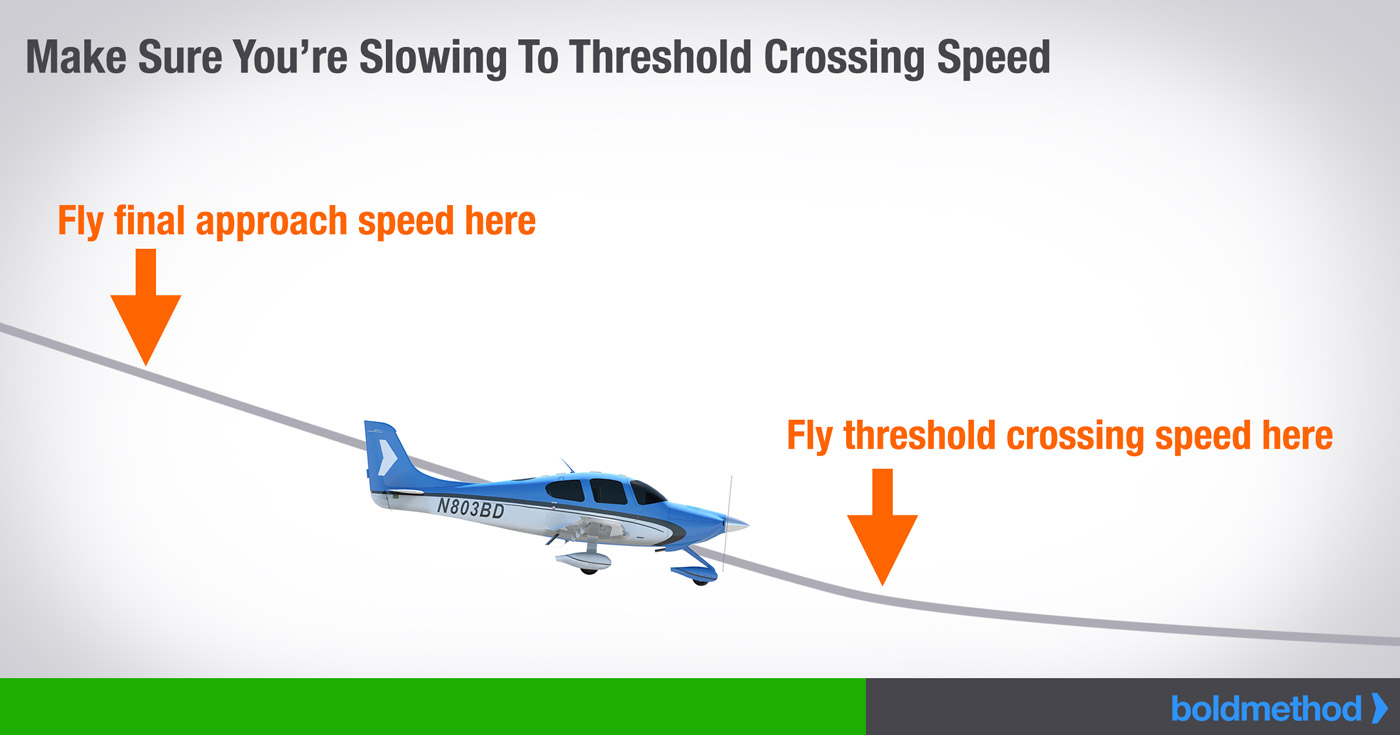
The term "approach speed" can be slightly misleading. It's not the speed you'll fly all the way to the runway.
Instead, think of your final approach as three stages of speed changes. Following this model will give you the best speed control for nailing your touchdown point:
Final Approach Speed
Slowing To Threshold Crossing Speed
Slowing During Your Flare
How Approach Speed Is Calculated
How fast should you fly on final? Most aircraft flight manuals recommend a speed.
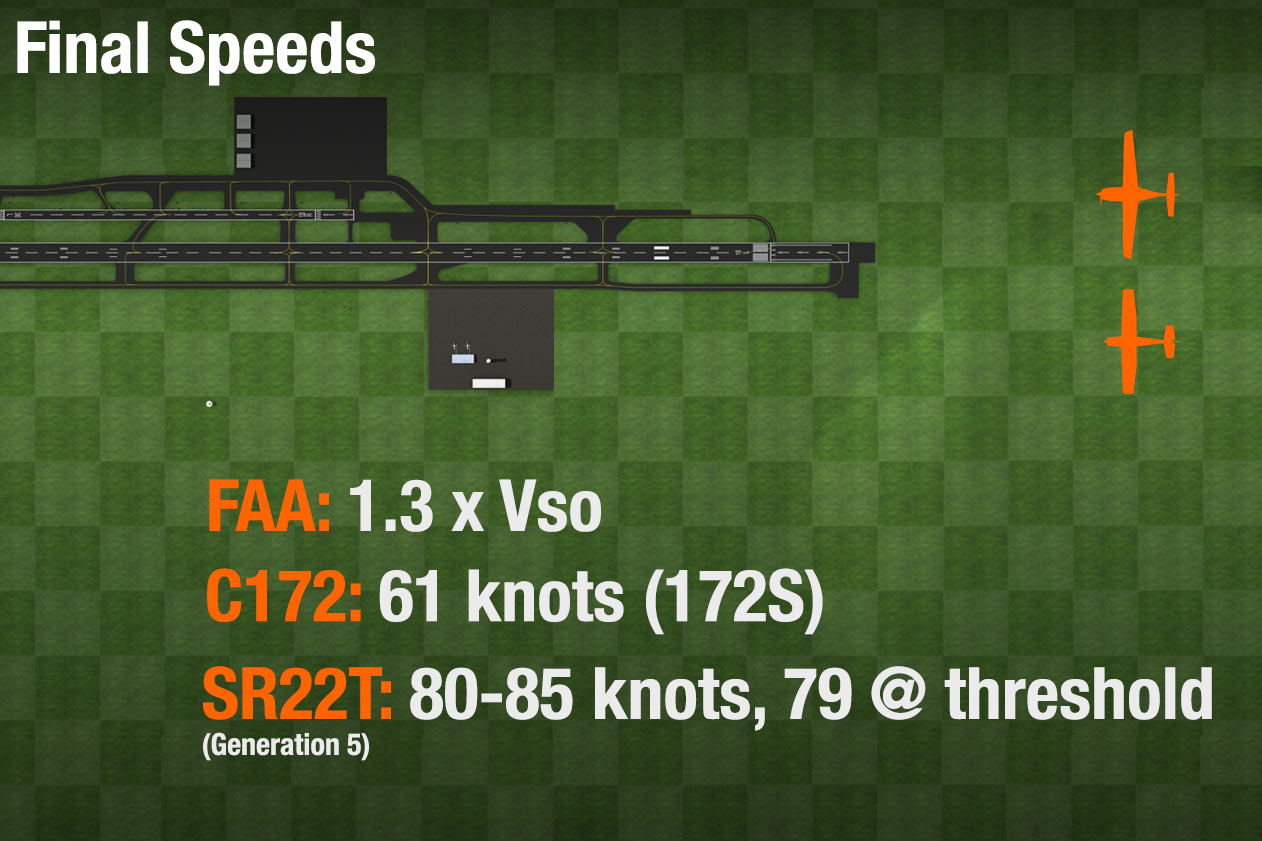
However, if your manufacturer doesn't list a final speed in their flight manual, the FAA recommends that you fly 1.3 x Vso (stall speed in a landing configuration).
For a couple examples, the C172S POH recommends 60-70 knots with full flaps for a final approach speed.
As for the Cirrus SR22T, they recommend 80-85 knots on final, and 79 knots crossing the threshold.
Stabilize Your Approach As Early As Possible
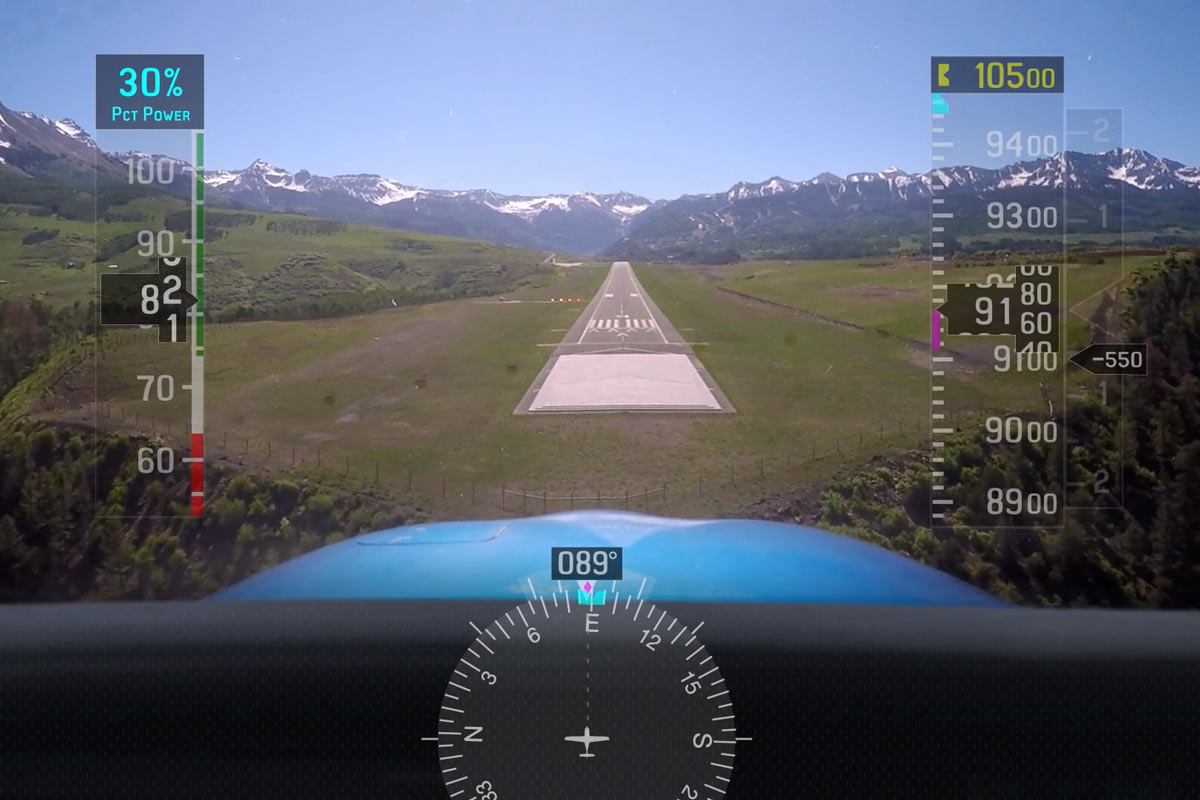
As you turn final, set pitch and power for your final approach speed, and stabilize your descent to the runway.
If you're constantly changing throttle settings to adjust altitude and airspeed, you might want to consider going around to try again.
A good rule of thumb for light, single-engine piston airplanes is to check that you're flying a stable approach at least 200 feet above the ground.
Are you flying the correct approach speed, configured, on centerline, with minimal power changes, and a normal sink rate?
Slowing To Threshold Crossing Speed
Now that you're stabilized on final approach speed and glidepath, you need to prepare for your next phase of the landing: threshold crossing speed.
Once you have no doubt that you'll make the runway, just before the threshold, slowly begin reducing the throttle.
Not all aircraft manufacturers have a recommend threshold crossing speed, but as a rule-of-thumb, it should usually be around 5 knots slower than your final approach speed in a light aircraft.
As you cross the threshold, keep reducing throttle, and start your transition to flare by slowly pitching up.
Technique for how and where to reduce power can change dramatically based upon each different type of airplane you fly.
The best way to hone your skills in your plane is to go out and practice!
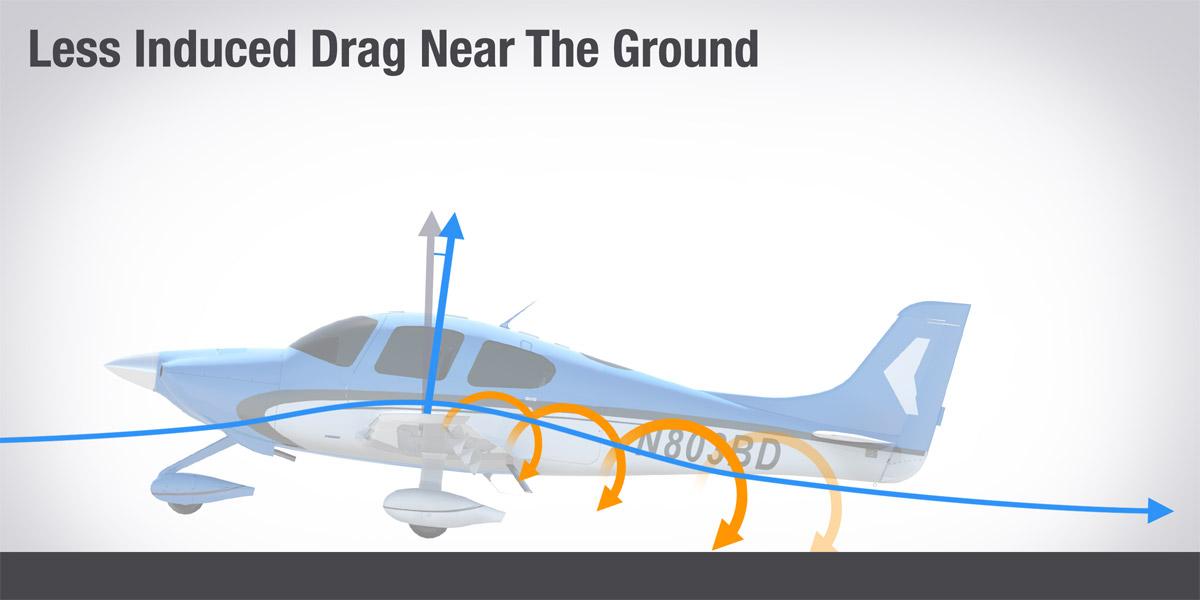
Continue Slowing In The Flare
As you reach the final stage of speed change during your flare, you should be continually slowing the aircraft.
In many single-engine piston airplanes, you'll be at idle power during the flare.
Your goal is to touch down just a few knots above stall speed.
With just a few knots of airspeed to lose, you'll give yourself the best shot at nailing your touchdown point by being on-speed in the flare.
If you continue descending to the runway close to approach speed, the extra knots of speed will be hard to bleed off during the flare because of ground effect.
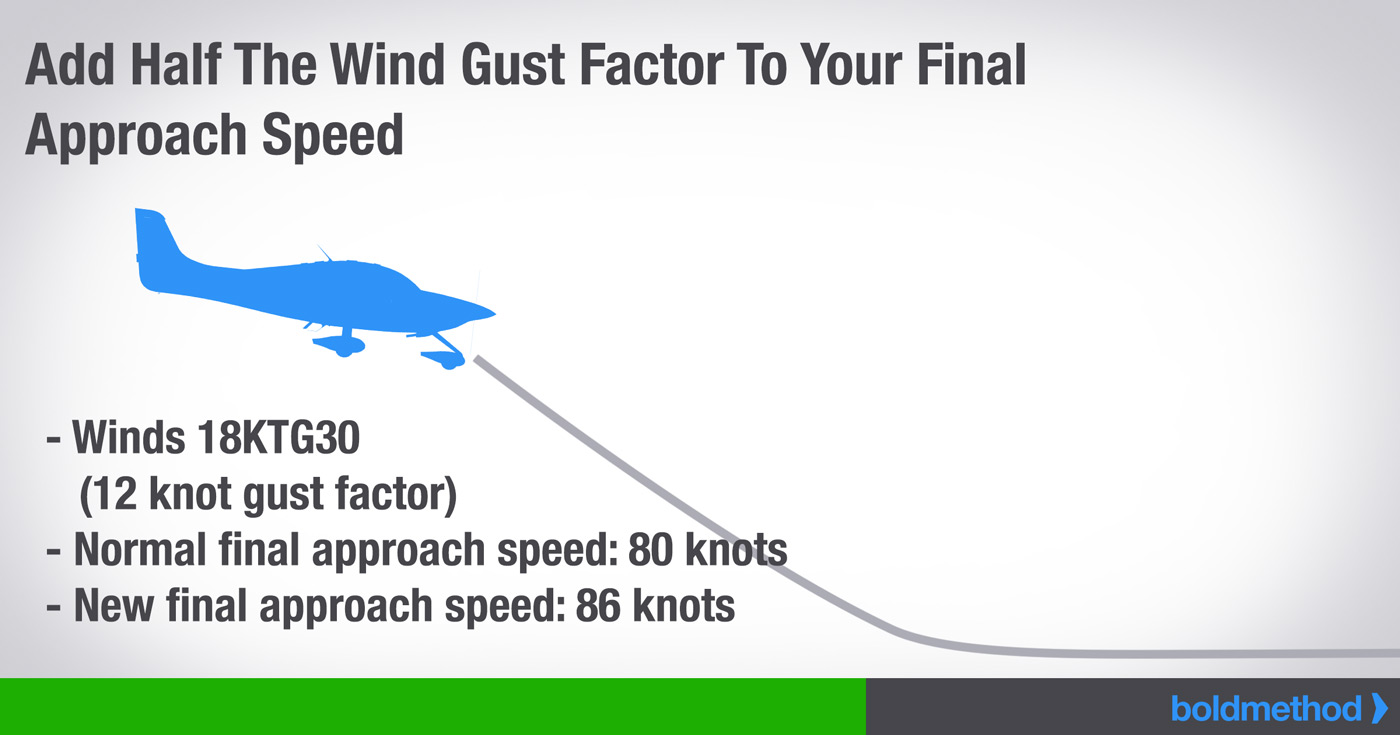
Exception: Gusty Winds
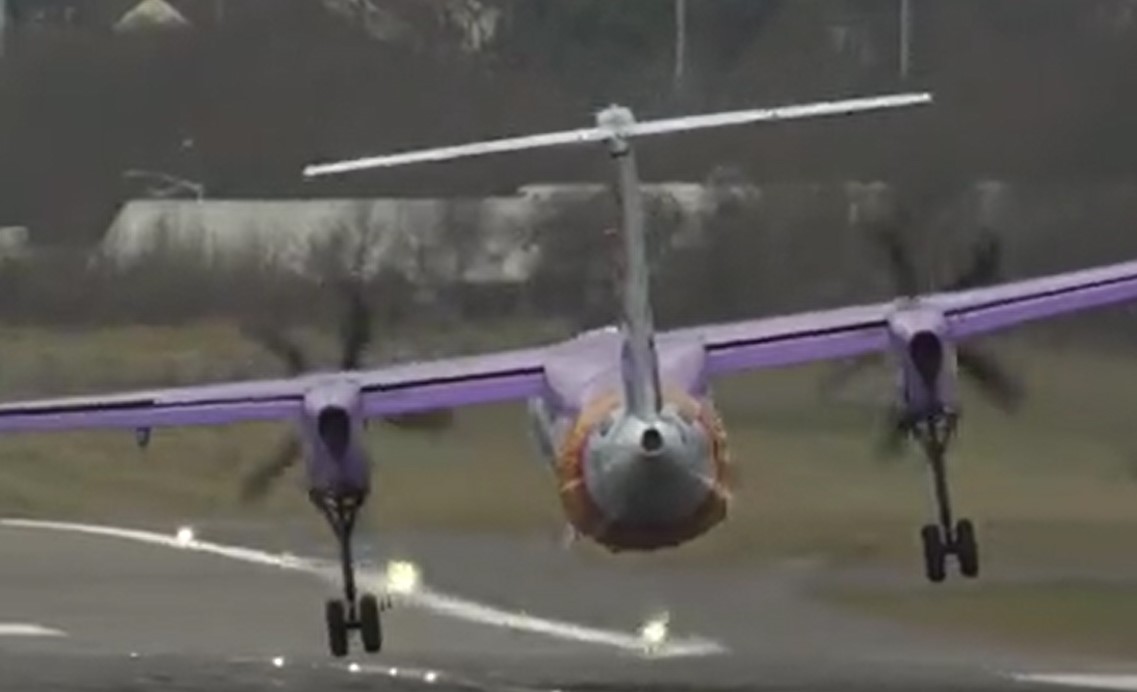
You'll fly a faster approach speed than recommended with strong, gusting winds.
Adding half of the gust factor to your final approach speed will ensure you're flying well above stall speed if you encounter wind shear. That's a good thing.
Because of this, you may also want to consider flying a faster threshold crossing speed and flare speed.
The extra knots of airspeed will give your flight controls more effectiveness, helping with crosswind control.
What do you think? How do you slow down on short final? Tell us in the comments below.
Take The Next Step...
Do you have a perfect takeoff and landing every time? Neither do we. That's why we built our Mastering Takeoffs and Landings online course.
You'll learn strategies, tactics and fundamental principles that you can use on your next flight, and just about any takeoff or landing scenario you could imagine.
Even better, the course is full of tools you can come back to throughout your flying career.

Become a better pilot.
Subscribe to the Boldmethod email and get real-world flying tips and information direct to your inbox, every week.

Swayne Martin
Swayne is an editor at Boldmethod, certified flight instructor, and an Embraer 145 First Officer for a regional airline. He graduated as an aviation major from the University of North Dakota in 2018, holds a PIC Type Rating for Cessna Citation Jets (CE-525), and is a former pilot for Mokulele Airlines. He's the author of articles, quizzes and lists on Boldmethod every week. You can reach Swayne at swayne@boldmethod.com, and follow his flying adventures on his YouTube Channel.
threshold-crossing-speedgust-factorground-less-induced-drag
finalPrimary

Saturday, January 18, 2020

HOW PILOTS CHOOSE AN EMERGENCY LANDING SPOT - Choosing a place to land in an emergency can be difficult, and pilots may have to take many factors into consideration, including automobile traffic on the ground, surrounding terrain and obstacles, wind direction and speed, the plane's altitude, and the glide distance of the aircraft (the distance the plane can travel without engines). The two best options are usually a field or a road, with other possibilities generally proving more hazardous to the plane's passengers and crew and to people on the ground. Engine failure due to fuel starvation is probably the most common reason, but an off-field landing can be the result of structural failure, an engine or cockpit fire, a bird strike, or any of a number of other emergency situations. A paved or a dirt road that's not in use is an obvious choice for an off-field landing. But pilots need to be on the lookout for obstacles like fence posts and power lines that may not be visible until they're very close.

People at Maho Beach Watching Landing Plane
..............................................................................................................................................................
Emergency Landing Spots
How Pilots Choose an Emergency Landing Spot in an Airplane
BY SARINA HOUSTON


During flight training, student pilots spend many hours practicing emergency or "off-field" landings so they'll be prepared in the event they have to perform one in real life.
There are several reasons why pilots might have to put an airplane down in a field, on a road, or somewhere else outside of an airport.
Engine failure due to fuel starvation is probably the most common reason, but an off-field landing can be the result of structural failure, an engine or cockpit fire, a bird strike, or any of a number of other emergency situations.
Choosing a place to land in an emergency can be difficult, and pilots may have to take many factors into consideration, including automobile traffic on the ground, surrounding terrain and obstacles, wind direction and speed, the plane's altitude, and the glide distance of the aircraft (the distance the plane can travel without engines).
The two best options are usually a field or a road, with other possibilities generally proving more hazardous to the plane's passengers and crew and to people on the ground.
Fields
Fields are usually very good options for forced landings. They're wide open, empty, and unpopulated.
They're often flat and free of obstacles and offer plenty of space for a long landing if the pilot overshoots.
But pilots must be cautious even in fields. They can have hidden obstacles like fence posts and irrigation lines.
And depending on what's growing, the pilot may be in for a bumpy landing. A cornfield, for example, might actually destroy an airplane, while a mowed hayfield might cushion the landing.
And a freshly tilled field might look inviting to a pilot, but if it's wet enough, it will probably cause the airplane to sink into the mud and then cartwheel.
Roads
Roads can be good landing sites, but only if there are no cars or pedestrians on them.
Pilots should always choose a field over a road if there are cars or the possibility of cars on the road because they're responsible for not becoming a hazard to people on the ground.
A paved or a dirt road that's not in use is an obvious choice for an off-field landing.
But as with any other landing site, pilots need to be on the lookout for obstacles like fence posts and power lines that may not be visible until they're very close.
Other Landing Areas
Besides a field or a road, there are a few other suitable landing areas that might help minimize the destruction of the plane and save lives.
Pilots might look for beaches, dried lake beds, shorelines, dirt patches, or any other type of flat terrain.
A beach is a fine option for pilots as long as there aren't any people around.
The sound of the waves could mask the noise of the engine — if it's working — and people might not see the plane coming.
Pilots should avoid hilly or rocky terrain if at all possible. A level surface is crucial for landing.
When There Is Nowhere to Go
If pilots have no good landing spots in sight, they shouldn't panic. Many pilots have landed aircraft on top of trees or in water and lived to talk about it.
If a pilot is over a forested area and a tree landing is inevitable, they should prepare the aircraft for an emergency landing and concentrate on making the approach as slow and as stable as possible.
A slow approach near stall speed with minimal descent rate and minimal forward speed will increase their chances of survival and minimize wreckage.
Ditching on water might be one of the most challenging of all of the potential emergency scenarios.
A water landing requires a bit more finesse in order to not cartwheel or flip over.
With too much speed or in an uncontrolled state, a water impact can be like hitting a wall.
But a nice controlled landing might mean passengers and crew will survive, as long as they can swim to shore or have a life vest and the water isn't too cold.
In all cases, the most important thing for pilots to do is to continue to fly the plane.
No matter where they are, a controlled approach and landing is better than a crash and subsequent fire.

The Balance Careers makes navigating your career easy. It is home to experts who provide clear, practical advice on job searching, resume writing, salary negotiations, and other career planning topics. Whether you're looking to find a new job, advance at your current position, or explore new paths, our 20-year-strong library of more than 10,000 pieces of content will help you take your career to the next level.
The Balance is part of The Balance family of sites, including The Balance and The Balance Small Business, covering personal finance, career, and small business topics. With more than 24 million monthly visitors, The Balance is among the top-10 largest finance properties as measured by comScore, a leading Internet measurement company. Our more than 50 expert writers have extensive qualifications and expertise in their topics, including MBAs, PhDs, CFPs, other advanced degrees and professional certifications.
The Balance family of sites have been honored by multiple awards in the last year, including The Telly AwardsThe Communicator Awards, and Eppy Awards.
People at Maho Beach Watching Landing Plane

Monday, October 29, 2018

AIRCRAFT MISSED APPROACH - With today’s advanced Category III or “Cat III” landing parameters, aircraft can be automatically guided all the way down to a safe landing on the runway in “zero-zero” conditions (no ceiling/no visibility) without the pilots ever seeing the ground.


......................
Aircraft Missed Approach
WHAT IS A “MISSED APPROACH?”
By Airline Ratings


In the past, if pilots could not see either the approach lights or runway after descending to a certain height called the MDA, or “Minimum Descent Altitude,” they had to execute a missed approach by adding power, climbing back to a higher altitude and trying the approach again, or diverting to an alternate airport.
With today’s advanced Category III or “Cat III” landing parameters, aircraft can be automatically guided all the way down to a safe landing on the runway in “zero-zero” conditions (no ceiling/no visibility) without the pilots ever seeing the ground.

https://www.airlineratings.com/did-you-know/what-is-a-missed-approach/


You mignt also like:

landing dangerous phase flight
Most Dangerous Part Of Any Flight 
CLICK HERE . . .

Thrust Reversers
CLICK HERE . . .
Rainbow Encircling An Airplane Shadow
CLICK HERE . . .

Sunday, October 21, 2018

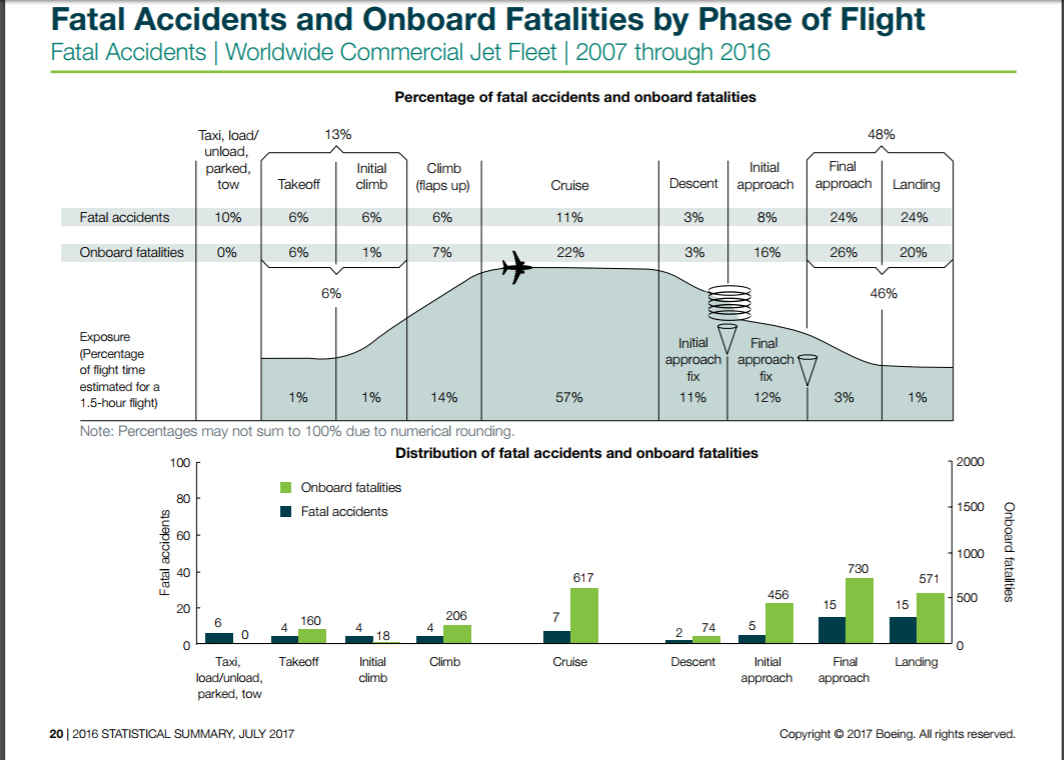
MOST DANGEROUS PART OF ANY FLIGHT - 24 percent of all fatal accidents occur on the final approach to land while another 24 percent are in the landing. The final approach and landing phases account for just 5 percent of the average flight according to the Boeing data. Just 11 percent of accidents occurred in the cruise portion of the flight, which accounts for 57 percent of the exposure based on the percentage of flight time estimated for a 1.5-hour-flight. The most dangerous part of any flight is the landing with nearly half of all fatal accidents occurring in the last fraction of a journey, according to US manufacturer Boeing. The annual Boeing Statistical Summary of Commercial Jet Airplane Accidents Worldwide Operations 1959 – 2016 finds that for the period 2007 through 2016, 24 percent of all fatal accidents occur on the final approach to land while another 24 percent are in the landing. The final approach and landing phases account for just 5 percent of the average flight according to the Boeing data. Graphic of fatalities of phases of flight showing landing. Just 11 percent of accidents occurred in the cruise portion of the flight, which accounts for 57 percent of the exposure based on the percentage of flight time estimated for a 1.5-hour-flight. The Boeing report does not include any jets built in Russia or former Soviet bloc countries nor turbo-prop or piston-powered aircraft of any make. Graphic of flight hours and departures In 2016, there were 64.4 million flight hours and 29 million departures conducted by western manufactured jets. Since 1959, the worldwide fleet of jets has flown 1,389 million flight hours (978 million on Boeing aircraft which includes McDonnell Douglas) and had 744 million departures (520 million on Boeing / McDonnell Douglas aircraft)

landing dangerous phase flight
........................
Most Dangerous Part Of Any Flight 

LANDING THE MOST DANGEROUS PHASE OF FLIGHT
By Geoffrey Thomas

The most dangerous part of any flight is the landing with nearly half of all fatal accidents occurring in the last fraction of a journey, according to US manufacturer Boeing.
The annual Boeing Statistical Summary of Commercial Jet Airplane Accidents Worldwide Operations 1959 – 2016 finds that for the period 2007 through 2016, 24 percent of all fatal accidents occur on the final approach to land while another 24 percent are in the landing.
The final approach and landing phases account for just 5 percent of the average flight according to the Boeing data.
Graphic of fatalities of phases of flight showing landing
Just 11 percent of accidents occurred in the cruise portion of the flight, which accounts for 57 percent of the exposure based on the percentage of flight time estimated for a 1.5-hour-flight.
The Boeing report does not include any jets built in Russia or former Soviet bloc countries nor turbo-prop or piston-powered aircraft of any make.
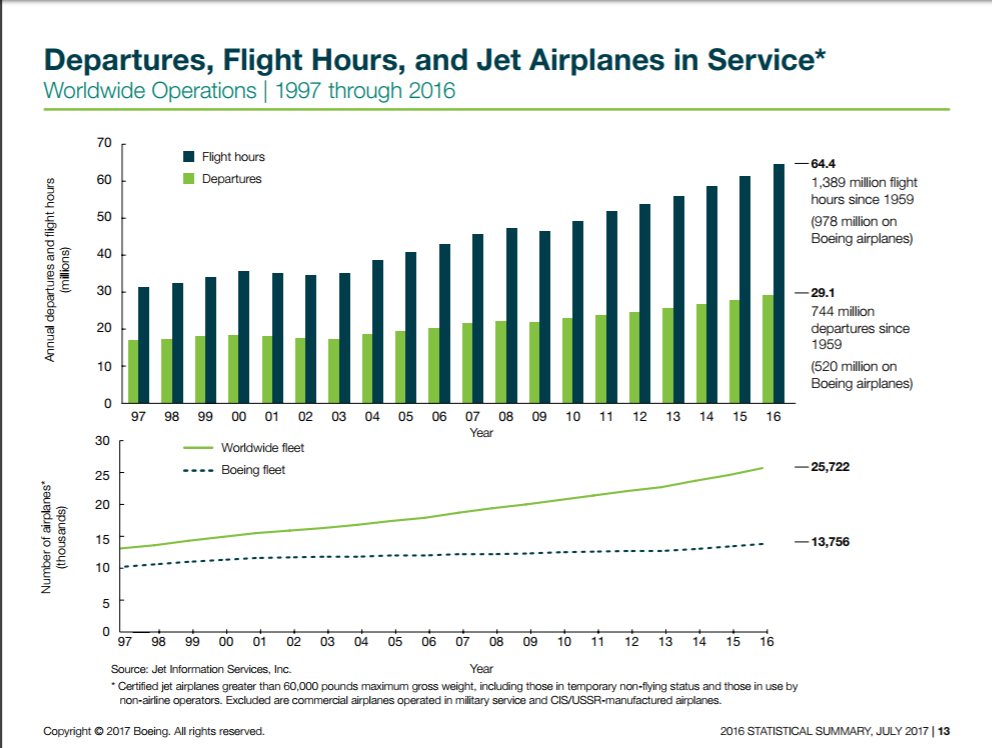
Graphic of flight hours and departures
In 2016, there were 64.4 million flight hours and 29 million departures conducted by western manufactured jets.
Since 1959, the worldwide fleet of jets has flown 1,389 million flight hours (978 million on Boeing aircraft which includes McDonnell Douglas) and had 744 million departures (520 million on Boeing / McDonnell Douglas aircraft)
As of Dec 31, 2016, the worldwide fleet of Western-built jets numbers 25,722 of which 13,756 are Boeing / McDonnell Douglas.

https://www.airlineratings.com/news/passenger-news/landing-dangerous-phase-flight/


You might also like:


Surviving A Plane Crash

CLICK HERE . . . to view . . . 

https://puricare.blogspot.com/2020/01/surviving-plane-crash-plane-crashes-are.html

........................................................................................................................................................................................................................................................................................

How A Plane Can Still Fly If An Engine Fails

CLICK HERE . . . to view . . . 

https://puricare.blogspot.com/2020/05/flying-plane-if-engine-fails-engine.html

........................................................................................................................................................................................................................................................................................

Aircraft Missed Approach

CLICK HERE . . . to view . . . 

https://puricare.blogspot.com/2018/10/aircraft-missed-approach-with-todays.html

........................................................................................................................................................................................................................................................................................

 Instrument Landing System

CLICK HERE . . . to view . . . 

https://puricare.blogspot.com/2019/01/instrument-landing-system-where.html

........................................................................................................................................................................................................................................................................................

Bird Strikes On Aircrafts

CLICK HERE . . . to view . . . 

https://puricare.blogspot.com/2019/07/bird-strikes-on-aircrafts-bird-strikes.html

........................................................................................................................................................................................................................................................................................

How Pilots Choose an Emergency Landing Spot

CLICK HERE . . . to view . . . 

https://puricare.blogspot.com/2020/01/how-pilots-choose-emergency-landing.html

landing dangerous phase flight