Showing posts with label Pandemics. Show all posts

Tuesday, January 26, 2021

THE NEXT PANDEMIC COULD EASILY COME FROM OUR FACTORY FARMS - As people point fingers at the dangers of “wet markets,” it’s easy to overlook the closer to home problem of factory farms. Our next zoonotic pandemic could easily come from a factory farm. As the new coronavirus escalated into a pandemic, it became important to pinpoint its origin. Headlines circulated at the beginning of the outbreak, pointing to “wet markets” in China as the potential source of the outbreak. While attention turned abroad, a more sinister disease incubator remains right here at home: factory farms. The conditions in China’s wholesale wet markets are very similar to those in factory farms here in the U.S. Factory farms, as the name implies, are essentially animal factories. These facilities cram thousands of animals into tightly packed spaces; these conditions cause elevated stress responses in animals. In the warehouse-like structures animals receive little, if any, sunlight or fresh air. Factory farms have also bred animals that are virtually genetically identical, making mass production possible of all the inputs from feed to barn construction. We raise animals for food on a modern day assembly line. But those conditions make them prime targets for the spread and incubation of disease. And when one animal in a factory farm gets sick, the pathogen can rapidly spread — killing hundreds or thousands of animals and potentially jumping to humans.

........................................................................................................................................................................................................................................................................................................................................................................................

The Next Pandemic Could Easily Come From Our Factory Farms

.
As people point fingers at the dangers of “wet markets,” it’s easy to overlook the closer to home problem of factory farms. Our next zoonotic pandemic could easily come from a factory farm.

By Mackenzie Aime


As the new coronavirus escalated into a pandemic, it became important to pinpoint its origin.

Headlines circulated at the beginning of the outbreak, pointing to “wet markets” in China as the potential source of the outbreak.

While attention turned abroad, a more sinister disease incubator remains right here at home: factory farms. 

The Similarities Between Wet Markets And Factory Farms

The conditions in China’s wholesale wet markets are very similar to those in factory farms here in the U.S.

Factory farms, as the name implies, are essentially animal factories.

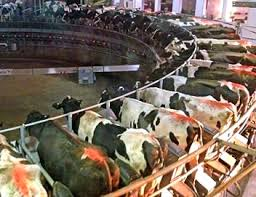
These facilities cram thousands of animals into tightly packed spaces; these conditions cause elevated stress responses in animals.

In the warehouse-like structures animals receive little, if any, sunlight or fresh air.

Factory farms have also bred animals that are virtually genetically identical, making mass production possible of all the inputs from feed to barn construction.

We raise animals for food on a modern day assembly line.  But those conditions make them prime targets for the spread and incubation of disease.

And when one animal in a factory farm gets sick, the pathogen can rapidly spread — killing hundreds or thousands of animals and potentially jumping to humans.

This is exactly what it means when a disease is “zoonotic.”

Viral Pandemics Have Sprung From Factory Farms In The Past

This isn’t a “what if” scenario. It’s happened before — several pandemics have been incubated in factory farms.

In the late 1990s, the H1N1 flu virus originated in factory farms in North Carolina.

mutated form of this North Carolina virus later popped up in a factory farm in Mexico where it spread around the world, leading to the 2009 H1N1 flu pandemic.

During its first year of circulation, the 2009 H1N1 flu killed between 151,700 - 575,400 people worldwide.

And, in 2006 an outbreak of bird flu turned into a full-scale pandemic after originating in factory farms in China.

In early April as the coronavirus was raging, a South Carolina poultry factory farm operation was forced to cull tens of thousands of birds after discovering an outbreak of bird flu.

While thankfully contained to this single farm, this outbreak could have had equally dire consequences.

These are just a few examples; there are plenty more. The fact that these previous outbreaks did not force us into home isolation was only a stroke of dumb luck. 

The factory farm industry is acutely aware that it is playing with fire.

Antibiotics, meant for the treatment of bacterial infections, are routinely used on factory farms to prevent the spread of disease.

In fact, 70 percent of the total volume of medically important antibiotics in the US are sold for animal agriculture.

This overuse of antibiotics has led to antibiotic resistance, where infections that were once curable develop a resistance to drugs that had previously been used to treat them — yet another pandemic in the making.

The rise of drug-resistant superbugs, MRSA for example, puts our collective public health at risk and could have dire consequences in future pandemics, especially those that have bacterial complications like pneumonia.

Our public health and ability to treat diseases should not be sold for corporate gain.

Family Farms Would Be A Saving Grace In A Pandemic, But Are Stomped Out By Factory Farms

The current coronavirus pandemic is demonstrating how fragile our highly consolidated food system is and how ill-equipped it is to handle emergency situations.

Every day more and more meatpacking plants become ground zero for new outbreaks of coronavirus, and thousands of people are putting their lives on the line to keep these facilities functioning.

Produce is being plowed under and meat is piling up in cold storage — even as unprecedented lines at food banks demonstrate the massive need for food as unemployment rates skyrocket.

Corporate agriculture has created this broken system, which constantly puts us at risk of another pandemic, and yet corporate agriculture has shown that it is wholly unable to meet our needs during a pandemic.

Where are our public institutions in this time of crisis?

Our food system is being held hostage by a few corporations that control everything — from piglets to politicians.

With this power, the factory farm industry has mercilessly lobbied against measures that would keep us and our food safe.

Demanding faster line speeds at meatpacking plants and unnecessarily increasing risks for slaughterhouse workers, opposing restrictions on antibiotic use, and even refusing to provide workers with necessary protective equipment — this is just a tiny fraction of examples of how Big Ag puts profits before the lives of everyday people. 

Supporting The Farm System Reform Act Will Greatly Reduce Our Risk Of New Zoonotic Pandemics

This crisis has illustrated just how broken our food system truly is.

People are angry that wet markets are already reopening, but we cannot ignore that the way we raise animals in the U.S. also places us at risk for future pandemics.

As the COVID-19 outbreak forces us to significantly alter our daily lives and as the disease continues to spread, will we finally muster the political will to overhaul our food system — including banning factory farms — to decrease the likelihood of the next pandemic?

Our lives depend on it. Ask your legislators to support the Farm System Reform Act today!

Mackenzie Aime is an Iowa Organizer for Food & Water Watch. She works to build support for a moratorium against factory farming so that Iowa has a future for its strong communities, independent family farmers, and environmental resources. Prior to joining Food & Water Watch, Mackenzie served as an Emerson Hunger Fellow striving to eradicate poverty by working on housing policy at RESULTS and by creating a comprehensive food system plan in rural West Virginia with Reconnecting McDowell. She received her Bachelors in Interdisciplinary Studies with a focus on food justice from Emory University.

She can be reached at meaime[at]fwwatch.org.

https://www.foodandwaterwatch.org/news/next-pandemic-could-easily-come-our-factory-farms


You might also like:


Factory Farming

CLICK HERE . . . to view . . . 

https://puricare.blogspot.com/2020/05/factory-farming-factory-farming-is.html

...........................................................................................................................................................................................................................................................................................

Vertical Farming

CLICK HERE . . . to view . . . 

https://puricare.blogspot.com/2020/06/vertical-farming-vertical-farming.html

..........................................................................................................................................................................................................................................................................................

Tunnel ventilation

CLICK HERE . . . to view . . . 

https://puricare.blogspot.com/2016/09/commercial-meat-chicken-farms-are.html

........................................................................................................................................................................................................................................................................................... 

Tuesday, July 21, 2020

SCHISTOSOMIASIS AND PESTICIDES - Pesticides speed the spread of deadly waterborne pathogens - Widespread use of pesticides and other agrochemicals can speed the transmission of the debilitating disease schistosomiasis, while also upsetting the ecological balances in aquatic environments that prevent infections, finds a new study led by researchers at the University of California, Berkeley. Schistosomiasis, also known as snail fever, is caused by parasitic worms that develop and multiply inside freshwater snails and is transmitted through contact with contaminated water. The infection, which can trigger lifelong liver and kidney damage, affects hundreds of millions of people every year and is second only to malaria among parasitic diseases, in terms of its global impact on human health. The study, published in the journal Lancet Planetary Health, found that agrochemicals can increase the transmission of the schistosome worm in myriad ways: by directly affecting the survival of the waterborne parasite itself, by decimating aquatic predators that feed on the snails that carry the parasite and by altering the composition of algae in the water, which is a major food source for snails. The findings come as the connections between environment and infectious disease have been laid bare by the COVID-19 pandemic, which is caused by an emerging pathogen thought to be linked to wildlife.

Snail genome provides clues to controlling devastating disease ...
.................................................................................................................................................
Schistosomiasis And Pesticides
What is schistosomiasis? - Outbreak News TodayPesticides speed the spread of deadly waterborne pathogens
by University of California - Berkeley


Pesticides speed the spread of deadly waterborne pathogens
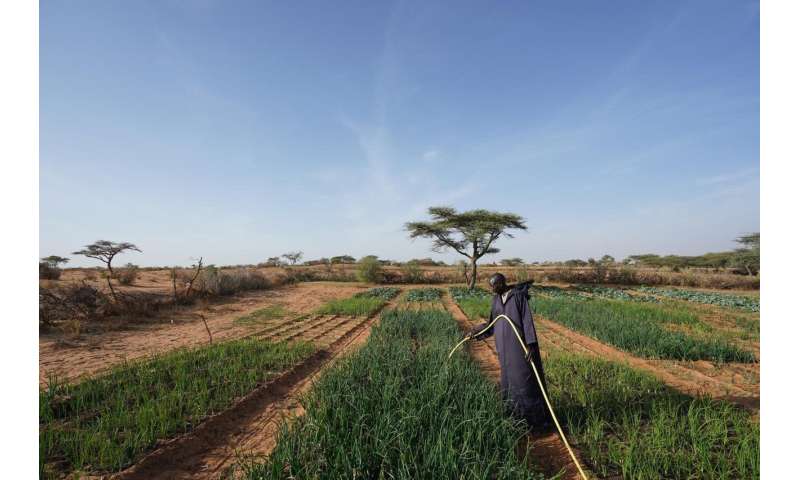
A man waters his crops near Lampsar, a community about 12 miles  from the city of Saint Louis
 in the lower Senegal River Basin in West Africa. A new study led by researchers at the
University of California, Berkeley finds that use of some agricultural pesticides can speed
 the transmission of the debilitating disease schistosomiasis, while also upsetting the
ecological balances in aquatic environments that prevent infections.
Widespread use of pesticides and other agrochemicals can speed the transmission of the debilitating disease schistosomiasis, while also upsetting the ecological balances in aquatic environments that prevent infections, finds a new study led by researchers at the University of California, Berkeley.
Schistosomiasis, also known as snail fever, is caused by parasitic worms that develop and multiply inside freshwater snails and is transmitted through contact with contaminated water.
The infection, which can trigger lifelong liver and kidney damage, affects hundreds of millions of people every year and is second only to malaria among parasitic diseases, in terms of its global impact on human health.
The study, published in the journal Lancet Planetary Health, found that agrochemicals can increase the transmission of the schistosome worm in myriad ways: by directly affecting the survival of the waterborne parasite itself, by decimating aquatic predators that feed on the snails that carry the parasite and by altering the composition of algae in the water, which provides a major food source for snails.
Agrochemicals increase the transmission of Schistosomiasis | Earth ..."We know that dam construction and irrigation expansion increase schistosomiasis transmission in low-income settings by disrupting freshwater ecosystems," said UC Berkeley's Christopher Hoover, a doctoral student in environmental health sciences and lead author of the study.
"We were shocked by the strength of evidence we found also linking agrochemical pollution to the amplification of schistosomiasis transmission."
The findings come as the connections between environment and infectious disease have been laid bare by the COVID-19 pandemic, which is caused by an emerging pathogen thought to be linked to wildlife.
"Environmental pollutants can increase our exposure and susceptibility to infectious diseases," said Justin Remais, chair of the Division of Environmental Health Sciences at the UC Berkeley School of Public Health and senior author of the study.
"From dioxins decreasing resistance to influenza virus, to air pollutants increasing COVID-19 mortality, to arsenic impacting lower respiratory tract and enteric infections — research has shown that reducing pollution is an important way to protect populations from infectious diseases."
After combing through nearly 1,000 studies gathered in a systematic literature review, the research team identified 144 experiments that provided data connecting agrochemical concentrations to components of the schistosome life cycle.
They then incorporated these data into a mathematical model that captures the transmission dynamics of the parasite.
The model simulates concentrations of common agrochemicals following their application to agricultural fields and estimates the resulting impacts on infections in the nearby human population.
The researchers found that even low concentrations of common pesticides — including atrazine, glyphosate and chlorpyrifos — can increase rates of transmission and interfere with efforts to control schistosomiasis.
Pesticides Increase Transmission of Snail Fever - Sustainable PulseAgrochemical amplification of parasite transmission was not inconsequential.
In the study communities in the Senegal River Basin in West Africa, the excess burden of disease attributable to agrochemical pollution was on par with disease caused by lead exposure, high sodium diets and low physical activity.
"We need to develop policies that protect public health by limiting the amplification of schistosomiasis transmission by agrochemical pollution," Hoover said.
"More than 90% of schistosomiasis cases occur in areas of sub-Saharan Africa, where agrochemical use is expanding. If we can devise ways to maintain the agricultural benefits of these chemicals, while limiting their overuse in schistosomiasis-endemic areas, we could prevent additional harm to public health within communities that already experience a high and unacceptable burden of disease."

The University of California at Berkeley (UC-Berkeley) is the flagship of the University of California system. Berkeley was established in 1868 as the first of the public universities of the eventual 10 campuses. UC Berkeley has an acclaimed physics department. It is the manager of the Los Alamos National Laboratory, the Lawrence Livermore National Laboratory. Nearly 25,000 undergraduate and graduate students undertake UC Berkeley's 200 programs and individual post graduate degree programs. UC Berkeley has a solid $2 billion endowment with the ability to attract grants from the National Science Foundation and other foundations. UC Berkeley has numerous Nobel Laureates with ties to its university and Medal of Science recipients.world.https://medicalxpress.com/news/2020-07-pesticides-deadly-waterborne-pathogens.html
Overview - SENTINEL - Linking Freshwater Pollution and the Risk of ...