Showing posts with label Respiratory System. Show all posts

Tuesday, January 19, 2021

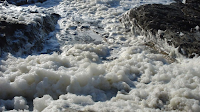
SEA FOAM - Sea foam is created by the agitation of seawater containing high concentrations of dissolved organic matter, which can come from the natural environment in the form of algal blooms or from man-made sources. As the waves crash onto the shore or lap at the beach, depending on where you are, there's usually some leftover frothy bits that cling to the sand. On windy days, this foamy stuff can even be lifted off the ground and blown around. What is it? And is it dangerous to touch it or let the dog run around in it? It's sea foam, and it is not nearly as green as the color we call sea foam. It's usually whitish, though it's probably a little dingy rather than being sparkling white. Sometimes it's more of a reddish-brown, though, and that's the sea foam to watch out for. Sea water is 96.5 percent water and 2.5 percent salt. That only adds up to 99 percent, so what's the other 1 percent? A lot of things - it's "proteins, fats, dead algae, detergents and other pollutants," plus other bits of organic and inorganic matter. When these particles get agitated by wind and waves, they froth. You can create the same effect by putting some sea water in a bottle and shaking it. The bubbles happen because of molecules called surfactants. These surfactants can come from natural sources, like algae and seaweed, or from human pollution, like fertilizers, detergents and sewage. One end of the molecule is hydrophobic – it repels water. The other end is hydrophilic – it attracts water.

.......................................................................................................................................................................................................................................................................................................................................................................................................

What Exactly Is Sea Foam?

BY KRISTEN HALL-GEISLER


Sea foam is created by the agitation of seawater containing high concentrations of dissolved organic matter, which can come from the natural environment in the form of algal blooms or from man-made sources. 

As the waves crash onto the shore or lap at the beach, depending on where you are, there's usually some leftover frothy bits that cling to the sand.

On windy days, this foamy stuff can even be lifted off the ground and blown around.

What is it? And is it dangerous to touch it or let the dog run around in it?

It's sea foam, and it is not nearly as green as the color we call sea foam. It's usually whitish, though it's probably a little dingy rather than being sparkling white.

Sometimes it's more of a reddish-brown, though, and that's the sea foam to watch out for.

Sea water is 96.5 percent water and 2.5 percent salt. That only adds up to 99 percent, so what's the other 1 percent?

A lot of things. According to the National Oceanic and Atmospheric Administration (NOAA), it's "proteins, fats, dead algae, detergents and other pollutants," plus other bits of organic and inorganic matter.

When these particles get agitated by wind and waves, they froth. You can create the same effect by putting some sea water in a bottle and shaking it.

The bubbles happen because of molecules called surfactants, which Popular Science explains are "sticky molecules that cling to the surface between water and air."

These surfactants can come from natural sources, like algae and seaweed, or from human pollution, like fertilizers, detergents and sewage.

One end of the molecule is hydrophobic – it repels water. The other end is hydrophilic – it attracts water.

The easiest shape for these molecules to form is a sphere, with the hydrophobic ends on the inside and the hydrophilic ends pointing outward.

Spheres (even if they aren't perfect) make bubbles. And a lot of bubbles make sea foam!

Now, about that reddish-brown sea foam. That's often due to phytoplankton, also known as algae blooms, which is a natural phenomenon.

These tiny organisms release toxins that aren't good for you, your dog, the birds, or anything, really. The toxins can irritate eyes and ears, and even the respiratory system.

The white foam may not be toxic, but that doesn't mean it's harmless.

When weather gets completely out of control, the churning of the water creates a lot of sea foam.

Like, a lot. In the winter of 2020, a king tide in Washington state with 25-foot (nearly 8-meter) waves created a "blender effect" that churned up sea foam as high as a man's chest.

Later that spring and halfway around the world, so much sea foam appeared in the Netherlands that it killed five very experienced surfers.

NOW THAT'S COLOR

In 2001, Crayola introduced a minty-green crayon called "seafoam."

According to Canva, it's a soft blue-green that is not the same as mint green. These two colors have different hex codes used by designers.

Seafoam is a mix of green, blue and a little gray, and it looks nothing like the sea foam found in the actual sea.

Kristen Hall-Geisler

CONTRIBUTING WRITER

Kristen Hall-Geisler is a freelance writer and book editor living in Oregon. As an automotive journalist since 2006, she's honed her research and interviewing skills with HowStuffWorks, The New York Times, TechCrunch, Popular Science, US News & World Report and more. She loves falling down the rabbit hole of research and emerging with a book or article that others find useful and — she hopes — entertaining while still being based on solid sources. She is the author of the historical novel "Skull and Sidecar" as well as the nonfiction books "Take the Wheel: A Woman’s Guide to Buying a Car Her Own Damn Self" and "Lightning in a Throttle: Three Early Electric Vehicle Victories."

https://science.howstuffworks.com/environmental/earth/oceanography/sea-foam.htm?utm_medium=recirc&utm_source=taboola&utm_campaign=feed


You might also like:


Algae Blooms 

(Red Tides)

CLICK HERE . . . to view . . . 

https://puricare.blogspot.com/2017/07/algae-blooms-red-tides-algae-blooms-are.html

...........................................................................................................................................................................................................................................................................................

Detergents And Water Pollution

CLICK HERE . . . to view . . . 

https://puricare.blogspot.com/2017/07/detergents-and-water-pollution-many-of.html

...........................................................................................................................................................................................................................................................................................

A dangerous guide to beachcombing

CLICK HERE . . . to view . . . 

https://puricarechronicles.blogspot.com/2017/12/beachcombing-if-you-see-something-that.html

...........................................................................................................................................................................................................................................................................................

Water Contaminants 

CLICK HERE . . . to view . . . 

https://puricare.blogspot.com/2016/10/water-contaminants-health-effects-epas.html

...........................................................................................................................................................................................................................................................................................

Foam Definition in Chemistry

CLICK HERE . . . to view . . . 

https://puricare.blogspot.com/2019/10/foam-definition-foam-is-substance-made.html

...........................................................................................................................................................................................................................................................................................

The Dead Sea & Bible Prophecy

CLICK HERE . . . to view . . . 

https://puricarechronicles.blogspot.com/2020/05/the-dead-sea-bible-prophecy-ezekiels.html

...........................................................................................................................................................................................................................................................................................

Worsening Algal Blooms

CLICK HERE . . . to view . . . 

https://puricare.blogspot.com/2020/05/worsening-algal-blooms-toxic-algae.html

Thursday, July 23, 2020

ALCOHOL VAPORIZERS - If you drink too much alcohol, your system will start rejecting the alcohol, which will exit your body in the form of vomit. No one likes to throw up, but it can be a very good thing if it saves you from alcohol poisoning. Because the alcohol hits your blood quickly, it can also give you alcohol poisoning quickly -- especially when the digestive system is taken out of the equation. Unlike when you drink, it can be hard to tell exactly how much alcohol you're inhaling - calories are digested in the bloodstream, and inhaled alcohol gets into your bloodstream fast - Alcohol vaporizers are now taking their turn in the spotlight as the latest questionable device du jour. Alcohol vaporizers take hard liquor and - typically through pressurization, heat or contact with dry ice - turn it into mist that you can inhale. Vaporizer manufacturers tout their products' ability to get you buzzed fast: Inhaled alcohol goes into your bloodstream full-strength, directly from your lungs, allowing you to feel its effects more powerfully and quickly. No waiting around for that pesky digestive system to do its job - you get an almost instant high, with little to none of the side effects that can plague people who actually drink alcohol the old-fashioned way. It's also calorie- and hangover-free, or so goes the sales pitch. Alcohol bypasses your digestive system. This is publicized as a plus by vaporizer companies, but the digestive system is a natural defense against toxicity.

WHISKY VAPORIZER - Holo
................................................................................................................................................
Vaping Alcohol: Is It Safe, and How Does It Affect the Body?
Alcohol Vaporizers

What's an alcohol vaporizer?
.
Smoking Alcohol: The Dangerous Way People Are Getting Drunk | TIME.comIf you drink too much alcohol, your system will start rejecting the alcohol, which will exit your body in the form of vomit. No one likes to throw up, but it can be a very good thing if it saves you from alcohol poisoning. Because the alcohol hits your blood quickly, it can also give you alcohol poisoning quickly -- especially when the digestive system is taken out of the equation. Unlike when you drink, it can be hard to tell exactly how much alcohol you're inhaling - calories are digested in the bloodstream, and inhaled alcohol gets into your bloodstream fast
BY ALISON COOPER


Inhaling vapor from an alcoholic drink is entirely different from sipping a cocktail, and devices called vaporizers can help you to do it.
Inhaling vapor from an alcoholic drink is entirely different from sipping
 a cocktail, and devices called vaporizers can help you to do it.
It's no secret that people (some of them, anyway) will go to great lengths to get a buzz.
Humans have turned to all sorts of substances and contraptions in the name of getting high, and there seems to be a never-ending stream of newfangled methods available.
Alcohol vaporizers are now taking their turn in the spotlight as the latest questionable device du jour.
Alcohol vaporizers take hard liquor and -- typically through pressurization, heat or contact with dry ice -- turn it into mist that you can inhale.
Vaporizer manufacturers tout their products' ability to get you buzzed fast: Inhaled alcohol goes into your bloodstream full-strength, directly from your lungs, allowing you to feel its effects more powerfully and quickly.
No waiting around for that pesky digestive system to do its job -- you get an almost instant high, with little to none of the side effects that can plague people who actually drink alcohol the old-fashioned way.
Inhaling Alcohol Is DangerousIt's also calorie- and hangover-free, or so goes the sales pitch.
One major red flag is the fact that inhaled alcohol bypasses your digestive system. This is publicized as a plus by vaporizer companies, but the digestive system is a natural defense against toxicity.
If you drink too much alcohol, your system will start rejecting the alcohol, which will exit your body in the form of vomit.
No one likes to throw up, but it can be a very good thing if it saves you from alcohol poisoning.
When you inhale too much alcohol, there's nothing your lungs, brain and blood can do about it.
Because the alcohol hits your blood quickly, it can also give you alcohol poisoning quickly -- especially when the digestive system is taken out of the equation.
Unlike when you drink, it can be hard to tell exactly how much alcohol you're inhaling.
And it can be extra hard to keep track when you're getting drunk much faster than you're used to.
The no-calories claim is also a dubious one.
How to Vape Weed and Get the Most Out Of itBecause the digestive system isn't involved when you inhale alcohol, it's tempting to believe that all those empty calories aren't being digested -- they're vanishing into thin air, so to speak.
But calories are digested in the bloodstream, and we know that inhaled alcohol gets into your bloodstream fast.
The mist might contain fewer alcohol molecules than liquid does, but it still gets metabolized and releases calories at the same rate per gram.
There haven't been any human studies on the effects of alcohol vaporizers, so there's no hard evidence about the veracity of the no-hangover claim.
And we haven't even mentioned the havoc that inhaled alcohol doubtless wreaks on your lungs and respiratory system.
Just in case you haven't come up with enough reasons to decline an alcohol vaporizer if you ever encounter one.

HowStuffWorks got its start in 1998 at a college professor's kitchen table. From there, we quickly grew into an award-winning source of unbiased, reliable, easy-to-understand answers and explanations of how the world actually works. Today, our writers, editors, podcasters and video hosts share all the things we're most excited to learn about with nearly 30 million visitors to the site each month. Learn more about our authors, and maybe even become one yourself. You can learn more about us in our FAQ.
This Is What It's Like to Inhale Your Favorite Liquor - Reviewed ...
 How Do You Turn on a SMOK Vape? | VaporFi
5 Things Parents Should Know About Marijuana E-Cigarettes
How to use the Vapor Sphere to Vaporize / Smoke Alcohol - YouTubeFacebook and Instagram to restrict content related to alcohol ...Vaporizers vs Bongs: the Difference? - Florida Independent.......