Showing posts with label Ultraviolet Light UV. Show all posts

Thursday, August 13, 2020

HOW MODERN WASTEWATER TREATMENT CHANGED OUR WORLD - Without wastewater treatment, diseases and infections would ravage our society. Wastewater treatment is often an overlooked necessity of civilization. Without proper sewer systems, wastewater treatment plants, and overall regulation, our cities would be ripe with disease and human waste everywhere. When you flush a toilet, your waste flows through the sewers to a wastewater treatment plant that treats it. Sewer systems are a topic all their own, so we'll mainly focus on how your wastewater goes from one of the dirtiest substances on the planet back into water that's safe for the environment. Some wastewater plants known as full-cycle reuse plants will even take wastewater and treat it all the way back to drinking water, which will then be pumped to city inhabitants. Today's level of engineering and chemistry allow full-cycle reuse plants to output drinking water chemically identical to what's in your tap right now. When wastewater arrives at a treatment facility, it first gets all the large chunks filtered out through a screen, a rather large one. These screens are generally called bar screens, and their main job is to make the sewage more homogenous so it can flow through pumps and pipes in the plant. The waste removed from bar screens is sent off to the landfill, and the slightly less chunky sewage heads to the next step, the grit chamber.

How Modern Wastewater Treatment Changed our World
...............................................................................................................................................................
How Modern Wastewater Treatment Changed our World
How Modern Wastewater Treatment Changed our WorldWithout wastewater treatment, diseases and infections would ravage our society
By Trevor English


Wastewater treatment is often an overlooked necessity of civilization.
Without proper sewer systems, wastewater treatment plants, and overall regulation, our cities would be ripe with disease and human waste everywhere.
Believe it or not, much of the modern wastewater management technology we consider standard in any 21st century home, things like toilets and sewer pipes, are actually relatively new in the grand scheme of history.
The history of wastewater treatment
That's not to say that sewer systems haven't been around for ages.
After all, the ancient Romans had a complex system of sewers at the peak of their empire.
How Modern Wastewater Treatment Changed our World
Roman sewer in Cologne
Rather, the knowledge of how poorly managed wastewater can drastically impact the health of society is relatively new.
The Romans had a centralized sewage management system, although it was fairly rudimentary by today's standards.
Open and closed ditches and pipes would carry away excrement and trash, primarily using rainwater runoff.
The contaminated water would then flow into large concrete tanks that let the sewage settle out before the water was allowed to flow into the nearby rivers.
There was indoor plumbing, and public latrines were also built over the sewers.
In medieval Europe, closed sewers, stone conduits, or ditches were used to drain sewage away from residential areas, often in conjunction with septic tanks, but chamber pots were often dumped directly onto the streets.
Between 1858 and 1859 the Thames in London was chock full of untreated wastewater, which combined with very hot weather to cause what became known as "the Great Stink".
The 17th and 18th centuries saw a rapid expansion in waterworks and pumping systems, but the Industrial Revolution led to even more rapid growth of cities and pollution, which acted as a constant source for the outbreak of deadly diseases like cholera and typhoid.
As cities grew in the 19th century, increasing public health concerns led to the development of municipal sanitation programs and the construction of sewer systems in many cities.
These systems often discharged sewage directly into rivers without treatment, but by the late 19th century, chemical treatments and sedimentation systems were in use in many cities.
The construction of centralized sewage treatment plants began between the late 19th and early 20th centuries.
These systems passed sewage through a combination of physical, biological, and chemical processes to remove pollutants.
Also beginning in the 1900s, new sewage-collection systems were designed to separate storm-water from domestic wastewater, to prevent treatment plants from becoming overloaded during heavy rains.
In the 1910s and 20s, engineers developed more sophisticated systems to treat drinking water before it was supplied to residents in cities.
Stepping back for a moment and examining the timeline here, we can begin to understand just how recent effective wastewater treatment on a grand scale appeared.
Roughly 150 years ago was the first few centralized instances of water treatment for cities. It would take decades for more rigid practices to emerge.
In 1972, the Clean Water Act was passed in the United States. Up until this point, sewage treatment for some cities still relied on chemical treatment and filtration, and the treated sewage was often dumped into rivers and streams.
There was little in the way of pretreatment of industrial wastewater to prevent toxic chemicals from interfering with the biological processes used at sewage treatment plants.
After the passage of the Clean Water Act, cities started a process known as secondary treatment, which removes all the pollutant organic materials from the effluent.
Wastewater with high concentrations of organic materials and nutrients being dumped into rivers was causing algal blooms and the bacteria growth, which created dead zones in rivers.
The secondary treatment essentially eradicates the effluent of microorganisms and organics so that when it's discharged, it has little effect on the surrounding environment.
To think, just 50 years ago many communities in the world were dumping mostly untreated sewage into rivers.
Wastewater treatment processes have really experienced their most rapid growth in the last 30 or so years, now with every planned municipality in the world having some form of a centralized wastewater management system.
It's all at a hefty cost too - on the scale of billions and billions of dollars.
Now, however, we can flush our toilets and shower without really having to worry about what's happening to all that dirty water.
It gets handled by trusty wastewater treatment plant operators before being discharged into local rivers and lakes.
"Oh, and what happens to all the solids from wastewater?" you might wonder.
Well in some cases, wastewater treatment plants will let it dry, package it up and sell it as fertilizer to help supplement the hefty costs of running a treatment plant.
In other cases, some plants will use the sludge to produce methane, which they will then burn for power or sell.
Wastewater treatment today uses science and engineering, though it is still a little bit smelly. We suppose it comes with the territory.
Now that we understand just how recently our knowledge of sanitation when it comes to human waste has emerged, let's take a closer look at exactly how wastewater treatment plants work. 
How modern wastewater treatment works
When you flush a toilet, your waste flows through the sewers to a wastewater treatment plant that treats it.
Sewer systems are a topic all their own, so we'll mainly focus on how your wastewater goes from one of the dirtiest substances on the planet back into water that's safe for the environment, and in theory, safe enough to drink.
Some wastewater plants known as full-cycle reuse plants will even take wastewater and treat it all the way back to drinking water, which will then be pumped to city inhabitants.
This may sound gross, but today's level of engineering and chemistry allow full-cycle reuse plants to output drinking water chemically identical to what's in your tap right now.
Before we dive into the specific process of wastewater treatment, let's put things into a scale.
New York City has an array of 14 wastewater treatment plants that handle 1.3 billion gallons of wastewater per day (4.9 billion liters).
That is enough wastewater to fill the dead sea with sewage in 8 years, just from one large city.
So, society produces a lot of waste. Let's see what happens first when it arrives at a wastewater treatment plant.
How Modern Wastewater Treatment Changed our World
Pre & Primary Treatment
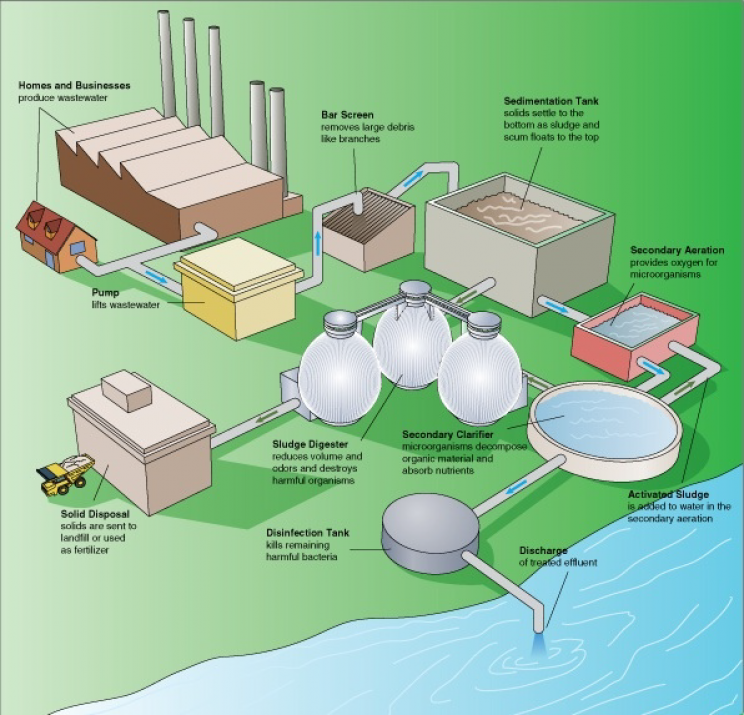
How Modern Wastewater Treatment Changed our WorldWhen wastewater arrives at a treatment facility, it first gets all the large chunks filtered out through a screen, a rather large one.
These screens are generally called bar screens, and their main job is to make the sewage more homogenous so it can flow through pumps and pipes in the plant.
The waste removed from bar screens is sent off to the landfill, and the slightly less chunky sewage heads to the next step, the grit chamber.
Grit chambers are essentially just big pools that you definitely don't want to swim in, they allow the larger particles in the sewage to settle out to the bottom.
These larger particles, things like dirt, sand, and large food particles, are called grit. Again, this process aids in making the sewage more homogenous than when it came in. The grit is also trucked off to landfills.
After the sewage gets pretty homogenized in these first few processes, it moves onto the primary clarifiers.
Primary clarifiers function as giant settling basins that allow particles larger than 10 μm (0.01 mm), referred to as suspended solids, to settle out to the bottom of the basin.
A giant skimming arm also scrapes away fat and grease that rise along the surface of the water.
These primary clarifiers are based on a principle called settling velocity, essentially just the speed at which particles settle.
Engineers make sure that the inflow of the water to the primary clarifier isn't more than the settling velocity of the particles, which ensures that particles still settle out and the sewage keeps on flowing.
Upon leaving the primary clarifiers, the sewage is free of solids bigger than 10 μm and at this point, is mostly contaminated with organic matter.
The sewage then moves on to aeration basins, beginning the secondary treatment processes.
Secondary wastewater treatment
Aeration basins are essentially bubbly hot tubs for sewage.
They bubble up air through the bottom of the sewage, which invigorates the sewage with dissolved oxygen.
How Modern Wastewater Treatment Changed our World
A view of 3 clarifiers
Engineers also pump in activated sludge into aeration basins, which is essentially bacteria and waste from the next round of clarifiers.
This activated sludge raises the oxygen content of the water and the bacteria go on a feeding frenzy, eating up all of the organic matter.
After the aeration basins, the sewage is going to look a lot clearer and it will head onto the secondary clarifiers.
This is the final filtering process, where all the remaining particles settle out.
The stuff that settles out is that activated sludge just mentioned, and a part of it is reused to make the aeration basins run smoothly.
What isn't used is left to dry out before it's disposed of or used as fertilizer.
How Modern Wastewater Treatment Changed our World
By the time the sewage leaves the secondary clarifiers, 85 percent of all organic matter has been removed and it will look fairly clear.
It might also be safe to drink too, but you're probably not going to want to. The final process before discharge is disinfection.
This process kills off all the bacteria still left in the water and makes sure there aren't any diseases being discharged into rivers.
This is typically done through chlorine, ozone, or ultraviolet disinfection (or a combination of these).
Ozone disinfection involves discharging electricity into the water to cause oxygen gas molecules to turn into ozone molecules, which oxidizes the bacteria, causing their cell walls to break, and kills them.
Chlorine treatment kills the bacteria in a similar manner but is a liquid chemical added to the water, and the treatment plant operators will generally remove the chlorine before releasing the effluent so the chlorine doesn't damage the environment.
Lastly, engineers can also use ultraviolet light to scramble the DNA of the bacteria, making it impossible for them to reproduce.
All three of these processes have different pros and cons and are used fairly interchangeably across the world.
In most cases, after disinfection, the water is released into rivers and streams.
In regions where water is scarce, sometimes the treated wastewater will head back for another round of treatment to be made into drinking water.
Chemically, this is very safe and could probably be used in many more places around the world if it wasn't for the stigma surrounding the closed-loop process of turning wastewater back into drinking water.
The entire process takes around 24 to 36 hours for a molecule of water to make it through the treatment plant.
And that's the magic of wastewater treatment. It's an essential process that allows us to live our lives without having to think about our own waste.
Be sure to thank all the wastewater treatment plant operators around you, because they have to deal with what you don't want to, 24/7.

Trevor English
Author
Trevor is a civil engineer (B.S.) by trade and an accomplished writer with a passion for inspiring everyone with new and exciting technologies. He is also a published children’s book author and the producer for the YouTube channel Concerning Reality.

Founded on the core mission of connecting likeminded engineers around the globe, Interesting Engineering is now a leading community with more than 15 million+ minds. Every day we share a new idea, a new thought, an upcoming technology OR an engineering breakthrough that will change the way you think about technology and engineering in today’s world and in the near future. Whether it’s a device that can charge your mobile in seconds or it’s the latest model of Boeing that has launched moments ago, we will bring everything up on your screen to view, to share and to grant you the power to comment. We believe that sharing information is the only way that can enrich and empower humans on this earth and we follow this as our core mission and responsibility. If you have got something that could entice the world, then Interesting Engineering is a perfect platform to show off your work to the outside world.
How Modern Wastewater Treatment Changed our World

Saturday, July 11, 2020

COMMON CARCINOGENS YOU SHOULD KNOW - A carcinogen is something that can cause you to have cancer. It may be a substance in the air, a product you use, or a chemical in foods and drinks. Your chance of getting sick depends on many things. How much you've been exposed to it is part of it. Your genes also play a role. It doesn't matter whether you're a smoker or breathing in someone else's smoke. At least 70 chemicals in tobacco are known to cause cancer by damaging your DNA. Radon gas occurs in small amounts in nature, where it's harmless. But if it builds up indoors and you breathe it in, radon breaks down the lining of your lungs. The tough, tiny fibers in asbestos help strengthen products like roof shingles, ceiling tiles, and car parts. Yet if these fibers break free and you breathe them in, they get lodged inside your lungs. When some vegetables, like potatoes, are heated to high temps, they give off a chemical called acrylamide. From plywood to some fabrics, formaldehyde is used in many household products. Most skin cancer cases are due to Ultraviolet rays. The more booze you drink, the greater your odds of getting certain kinds of cancers. Bacon, salami, pepperoni, sausage -- any meat that's been preserved or flavored raises your chances of getting colon cancer. Trucks, buses, trains, and even some cars run on diesel fuel. The gas and soot in diesel engine exhaust are believed to cause lung cancer and other types of cancer. Aside from exhaust, polluted outdoor air contains dust and traces of metals and solvents that can lead to cancer.

Lab notes: 'Light' cigarettes are causing the most common type of ...
............................................................................................................................................
The 116 things that can give you cancer – the full list | Society ...Common Carcinogens You Should Know
WebMD Medical Reference
Reviewed by Laura J. Martin, MD


You've probably heard the word "carcinogen" pop up in news stories and wondered what that means for your everyday life.
A carcinogen is something that can cause you to have cancer. It may be a substance in the air, a product you use, or a chemical in foods and drinks.
8 Common Carcinogens You Can AvoidJust because you had contact with a carcinogen doesn't mean that you'll get cancer.
Your chance of getting sick depends on many things. How much you've been exposed to it is part of it. Your genes also play a role.
Researchers use different methods to decide whether something should be called a carcinogen.
Large doses of a substance can be given to lab animals to see if they get cancer. Scientists also study the results of many studies.
Tobacco
Cancer-Causing Substances in the Environment | Carcinogen ListIt doesn't matter whether you're a smoker or breathing in someone else's smoke. At least 70 chemicals in tobacco are known to cause cancer by damaging your DNA.
Smokeless tobacco may seem safer, but it can lead to cancer, too. Even light smoking raises your risk, so talk to your doctor about ways to quit.
Radon
This gas occurs in small amounts in nature, where it's harmless. But if it builds up indoors and you breathe it in, radon breaks down the lining of your lungs.
It's the No. 1 cause of lung cancer in nonsmokers. You can't see or smell radon, but a special test can check the levels in your home. Some state radon offices offer kits for free.
Asbestos
Exposure Limits for Laboratory Chemicals and Carcinogens ...
The tough, tiny fibers in asbestos help strengthen products like roof shingles, ceiling tiles, and car parts. Yet if these fibers break free and you breathe them in, they get lodged inside your lungs.
Studies of people and animals have shown that asbestos is a carcinogen.
If you come into contact with it at your job, wear protective gear. If it's in your home and needs to be removed, hire an expert.
Crispy, Brown Foods
An A-Z of common carcinogensWhen some vegetables, like potatoes, are heated to high temps, they give off a chemical called acrylamide.
Studies show that rats who took in acrylamide in their drinking water got cancer, so researchers think humans do, too.
You can cut the amount you eat by baking, roasting, frying, and toasting foods until they're a tan color instead of golden or deep brown.
Formaldehyde
From plywood to some fabrics, this chemical is used in many household products. Studies on lab rats and people who are around formaldehyde at their jobs show it can cause cancer.
Before buying any wood products or furniture for your home, find out if they contain formaldehyde. Air out your house every day and keep humidity levels low with an air conditioner or dehumidifier.
Ultraviolet Rays
Studies show that ultraviolet (UV) rays, whether from the sun or a tanning bed, get absorbed into your skin and damage the cells there.
Most skin cancer cases are due to UV rays.
Pollution and climate change make these rays stronger. To stay safe, protect your skin with sunscreen, wear a hat and sunglasses, and avoid tanning salons.
Alcohol
The more booze you drink, the greater your odds of getting certain kinds of cancers, such as:
·                     Head and neck
·                     Esophageal
·                     Breast
·                     Liver
·                     Colorectal
One reason for this may be carcinogenic chemicals produced when beer, wine, and hard liquor are made.
Experts suggest women have no more than one drink each day and men no more than two.
Processed Meat
8 Common Carcinogens You Can AvoidBacon, salami, pepperoni, sausage -- any meat that's been preserved or flavored raises your chances of getting colon cancer.
Experts reached that view by looking at more than 800 studies.
Eating a hot dog every once in a while is fine, but limit how much processed meat you have as much as you can.
Engine Exhaust
Trucks, buses, trains, and even some cars run on diesel fuel. The gas and soot in diesel engine exhaust are believed to cause lung cancer and other types of cancer.
When you can, avoid idling in traffic or spending time next to diesel-run vehicles. If it's part of your job, follow workplace safety guidelines to protect your health.
Pollution
Chemicals, Cancer, and YouAside from exhaust, polluted outdoor air contains dust and traces of metals and solvents that can lead to cancer. Experts know this from looking at data from over 1.2 million people across the U.S.
You can't avoid pollution, but you can do your part to avoid contributing to it by walking or biking instead of driving.
Follow local public health warnings and stay indoors on days when air quality is bad.

WebMD Medical Reference Reviewed by Laura J. Martin, MD on July 21, 2018
Laura J. Martin, MD, MPH, is a former medical editor for WebMD who was responsible for reviewing WebMD news and feature stories to ensure their medical accuracy. She has many years of experience in the practice of both inpatient and outpatient internal medicine. She has served as a medical educator in the fields of general internal medicine, palliative care, and medical ethics.
She obtained her master's degree in public health at Tulane University, followed by her medical degree at Louisiana State University Medical School in New Orleans. Martin completed her residency in internal medicine at Emory University School of Medicine in Atlanta. She practiced general internal medicine in a private practice setting in Fort Walton Beach, Fla., for several years before returning to Atlanta, where she practiced academic medicine at Emory University for more than 10 years.
WebMD has created an organization that we believe fulfills the promise of health information on the Internet. We provide credible information, supportive communities, and in-depth reference material about health subjects that matter to you. We are a source for original and timely health information as well as material from well known content providers.
The WebMD content staff blends award-winning expertise in journalism, content creation, community services, expert commentary, and medical review to give our users a variety of ways to find what they are looking for.

10 facts about occupational carcinogens
Chemicals that cause cancer - ECHAThe 20 Most Carcinogenic FoodsWhat foods and drinks are linked to cancer? | CTCA

Wednesday, May 6, 2020

WASTEWATER - Our Essential Guide To Wastewater Treatment, Management & Solutions - Wastewater treatment, collection and discharge are essential to protect human health, the environment and surrounding water quality. Today, wastewater is being seen a valuable resource to generate: energy, nutrients and water for irrigation, industrial and even drinking purposes. Around 80% of all wastewater is discharged into the world's waterways where it creates health, environmental and climate-related hazards. Estimates suggest wastewater treatment capacity is currently 70% of the generated wastewater in high-income countries, and only 8% in low-income countries. Furthermore, urbanisation further exacerbates this challenge with increasing wastewater generation, while at the same time using more of Earth's dwindling resources, according to the IWA. The discharge of untreated effluent in water bodies does not only lead to eutrophication and human health risks, it also contributes significantly to Greenhouse Gas (GHG) emissions in the form of nitrous oxide and methane. Emissions from untreated sewage represents three times the emissions of conventional wastewater treatment. The emissions from untreated sewage can represent a significant percentage of cities' global emissions, even when treatment coverage is still poor as in many emerging cities.

Wastewater: Our essential guide to wastewater treatment, management & solutions
...................................................................................................................................................................
Wastewater
Our Essential Guide To Wastewater Treatment, Management & Solutions
Aquatech


Wastewater treatment, collection and discharge are essential to protect human health, the environment and surrounding water quality.
Before it can be treated, wastewater needs to be collected from sewer networks servicing homes, municipal, commercial and industrial premises, including rainwater run-off from roads and other impermeable surfaces.
Wastewater treatment and industrial wastewater treatment are evolving.
Historically it was designed to clean up wastewater before a cleaned-up effluent could be discharged safely into the surround area.
Today, wastewater is being seen a valuable resource to generate: energy, nutrients and water for irrigation, industrial and even drinking purposes.
This article provides everything you need to know about the different treatment stages and technologies involved in wastewater treatment.
Wastewater: creating sustainable value
Why is wastewater treatment important?
Today, around 80% of all wastewater is discharged into the world's waterways where it creates health, environmental and climate-related hazards, according to the IWA.
Estimates suggest wastewater treatment capacity is currently 70% of the generated wastewater in high-income countries, and only 8% in low-income countries.
Furthermore, urbanisation further exacerbates this challenge with increasing wastewater generation, while at the same time using more of Earth's dwindling resources, according to the IWA.
The discharge of untreated effluent in water bodies does not only lead to eutrophication and human health risks, it also contributes significantly to Greenhouse Gas (GHG) emissions in the form of nitrous oxide and methane.
Emissions from untreated sewage represents three times the emissions of conventional wastewater treatment.
The emissions from untreated sewage can represent a significant percentage of cities' global emissions, even when treatment coverage is still poor as in many emerging cities.
Wastewater management and adequate sewer systems play important roles in sanitation and disease prevention.
It is vital to develop a system to manage community wastewater and sewage.
Otherwise, wastewater can contaminate the local environment and drinking water supply, thereby increasing the risk of disease transmission.
Global access to safe water, adequate sanitation, and proper hygiene education can reduce illness and death from disease, leading to improved health, poverty reduction, and socio-economic development.
However, in many countries, proper wastewater management is not practiced due to lack of resources, investment, infrastructure, available technology, and space.
Many countries are challenged to provide these basic necessities to their populations, leaving people at risk for water, sanitation, and hygiene (WASH)-related diseases.
In the 2030 Agenda for Sustainable Development, Goal 6 aims to guarantee sustainable management of, and access to, water and sanitation for all by 2030.
However, in 2015, three in ten people (2.1 billion) did not have access to safe drinking water and 4.5 billion people, or six in ten, had no safely managed sanitation facilities.
As well as safeguarding human health and environmental protection, modern wastewater treatment is helping to identify ways to create value from the materials, energy and water that is embedded in wastewater streams.
What is wastewater treatment?
Wastewater treatment involves the collection of wastewater often by thousands of kilometres of sewer pipes.
The size of collection systems varies depending on the region and country they serve. For example, the largest collection systems in the UK are linked to around 9000 wastewater treatment plants.
In some countries and areas, rainwater from roofs, roads and pavements is collected in a separate system, called a surface water sewer, which goes straight into river.
Alternatively, wastewater and surface water are mixed together in combined sewers before wastewater treatment.
A recent development in the UK using fibre sensing cables is evaluating the measurement of flow, depth, temperature and structural integrity every five metres along a sewer pipe.
Once wastewater reaches treatment plants, four stages are involved, including:
·      Preliminary treatment (pre treatment) – to remove grit and gravel and screening of large solids.
·      Primary treatment – to settle larger suspended, generally organic, matter.
·      Secondary treatment – to biologically break down and reduce residual organic matter.
·      Tertiary treatment – to address different pollutants using different treatment processes.
During wastewater treatment, a mixture of solids and water is generated, known as sludge.
According to the IWA, the volume of sludge produced in a WWTP is only about 1% (dewatered sludge is 0.5%) of the volume of influent wastewater to be treated.
To manage WWTPs effectively and efficiently, it is absolutely necessary to extract waste sludge, including inert solids and excess biomass, in order to prevent their accumulation within the system.
In a WWTP the types of sludge produced are:
·      primary sludge – produced by settleable solids removed from raw wastewater in primary settling; characterised by high putrescibility and good dewaterability when compared to biological sludge; Total solids content in primary sludge is in the range 2-5%.
·      secondary sludge (also called biological sludge) – produced by biological processes such as activated sludge or biofilm systems; contains microorganisms grown on biodegradable matter (either soluble or particulate), endogenous residue and inert solids not removed in the primary settling (where a primary settler is present) or entering with the raw wastewater (where no primary settler is present); TS content in secondary sludge is in the range 0.5-1.5%.
·      chemical sludge – produced by precipitation of specific substances (i.e. phosphorus) or suspended solids.
Wastewater pre treatment (preliminary treatment)
Pre-treatment is necessary to remove anything that might interfere with subsequent treatment.
It can protect raw water lifting systems and pipelines against blockages, as well as other treatment equipment against abrasion and to generally remove anything that might interfere with subsequent treatment.
They can also help to reduce abrasion of mechanical parts and extend the life of the sanitation infrastructure.
The following constitute pre-treatment operations, although wastewater treatment plants can comprise one of more of the options, depending on raw water quality: bar screening; straining; comminution; grit removal; grease removal, frequently combined with grit removal; oil removal; by-product treatment: grit and grease; combined treatment of mains cleaning waste and of plant grit.
Advantages of pre-treatment include relatively low capital costs and low to moderate operating costs.
This is coupled with the reduced risk of impairing subsequent conveyance and/or treatment technologies. Meanwhile, the major disadvantage is frequent maintenance required.
Often the first unit operation used at wastewater treatment plants, screening is used to remove objects to prevent damage and clogging of downstream equipment and piping.
Both coarse screens and fine screens can be used in some modern wastewater treatment plants.
Coarse screens remove large solids, rags, and debris from wastewater, and typically have openings of 6 mm (0.25 in) or larger.
Types of coarse screens include mechanically and manually cleaned bar screens, including trash racks.
Fine screens are typically used to remove material that may create operation and maintenance problems in downstream processes, particularly in systems that lack primary treatment.
Typical opening sizes for fine screens are 1.5 to 6 mm (0.06 to 0.25 in). Very fine screens with openings of 0.2 to 1.5 mm (0.01 to 0.06 in) placed after coarse or fine screens can reduce suspended solids to levels near those achieved by primary clarification.
Three stages to wastewater treatment process
1) Primary treatment
The objective of primary treatment is the removal of settleable organic and inorganic solids by sedimentation, and the removal of materials that will float (scum) by skimming.
Approximately 25% to 35% of the incoming biochemical oxygen demand (BOD), 50 to 70% of the total suspended solids (SS), and 65% of the oil and grease are removed during primary treatment.
Some organic nitrogen, organic phosphorus, and heavy metals associated with solids are also removed during primary sedimentation but colloidal and dissolved constituents are not affected.
2) Secondary treatment
The objective of secondary treatment is to remove the residual organics and suspended solids.
In most cases, secondary treatment follows primary treatment and involves the removal of biodegradable dissolved and colloidal organic matter using aerobic biological treatment processes.
Aerobic biological treatment is performed in the presence of oxygen by aerobic microorganisms (principally bacteria) that metabolize the organic matter in the wastewater, thereby producing more microorganisms and inorganic end-products.
Several aerobic biological processes are used for secondary treatment.
These differ primarily in the manner in which oxygen is supplied to the microorganisms and in the rate at which organisms metabolize the organic matter.
Common high-rate processes include the activated sludge processes, trickling filters or biofilters, oxidation ditches, and rotating biological contactors.
In the activated sludge process, the dispersed-growth reactor is an aeration tank or basin containing a suspension of the wastewater and microorganisms, the mixed liquor.
The contents of the aeration tank are mixed vigorously by aeration devices which also supply oxygen to the biological suspension.
Aeration devices commonly used include submerged diffusers that release compressed air and mechanical surface aerators that introduce air by agitating the liquid surface.
Hydraulic retention time in the aeration tanks usually ranges from three to eight hours but can be higher with high BOD wastewaters.
Following the aeration step, the microorganisms are separated from the liquid by sedimentation and the clarified liquid is secondary effluent.
A portion of the biological sludge is recycled to the aeration basin as return activated sludge (RAS) to maintain a high mixed-liquor suspended solids (MLSS) level.
The remainder is removed as surplus activated sludge (SAS) or otherwise known as waste activated sludge (WAS) from the process and sent to sludge processing to maintain a relatively constant concentration of microorganisms in the system.
3) Tertiary treatment
Tertiary and/or advanced wastewater treatment is used to remove specific wastewater constituents which cannot be removed by secondary treatment.
Nitrogen, phosphorus, additional suspended solids, refractory organics, heavy metals and dissolved solids can be removed using individual treatment processes.
However, advanced treatment processes are sometimes combined with primary or secondary treatment (e.g., chemical addition to primary clarifiers or aeration basins to remove phosphorus) or used in place of secondary treatment (e.g., overland flow treatment of primary effluent).
4 advanced waste water solutions
Multiple advanced treatment solutions are available, driven by the need for improved operational cost (OPEX), smaller plant footprints and more stringent regulations governing discharge.
Below we have highlighted four key waste water solutions.
1) Moving Bed Biofilm Reaction (MBBR) Technology
MBBR technology employs thousands of polyethylene biofilm carriers operating in mixed motion within an aerated wastewater treatment basin.
Each individual biocarrier increases productivity through providing protected surface area to support the growth of heterotrophic and autotrophic bacteria within its cells.
It is this high-density population of bacteria that achieves high-rate biodegradation within the system.
MBBR processes can self-maintain an optimum level of productive biofilm which, when attached to the mobile biocarriers within the system automatically responds to load fluctuations, according to Headworks International.
2) Membrane Bioreactors (MBR)
Membrane bioreactor’ (MBR) is generally a term used to define wastewater treatment processes where a perm-selective membrane, e.g. microfiltration or ultrafiltration, is integrated with a biological process − specifically a suspended growth bioreactor, according the MBR site.
MBRs differ from ‘polishing’ processes where the membrane is employed as a discrete tertiary treatment step with no return of the active biomass to the biological process.
Almost all commercial MBR processes available today use the membrane as a filter, rejecting the solid materials which are developed by the biological process, resulting in a clarified and disinfected product effluent.
3) Membrane aerated biofilm reactor (MABR)
MABR systems passively circulate oxygen through a spirally wound membrane at atmospheric pressure.
MABR’s self-respiring membrane allows bacteria to consume oxygen more readily for a 90% reduction in energy used for aeration.
The membrane surface accumulates a biofilm of bacteria that establishes a simultaneous nitrification-denitrification (SND) process to produce a high-quality, low-nitrogen effluent suitable for reuse in irrigation.
4) Ultraviolet (UV)
For advanced wastewater treatment plants, ultraviolet (UV) technology has been included in the tertiary treatment process.
This can allow the wastewater treatment plant to meet even more stringent requirement, in some cases for indirect and direct potable reuse and water reclamation.
The wavelengths of UV light range between 200 and 300 nanometers (billionths of a meter).
Special low-pressure mercury vapor lamps produce ultraviolet radiation at 254 nm, the optimal wavelength for disinfection and ozone destruction.
Categorised as germicidal, this means they are capable of inactivating microorganisms, such as bacteria, viruses and protozoa.
The UV lamp never contacts the water; it is either housed in a quartz glass sleeve inside the water chamber or mounted external to the water which flows through UV transparent Teflon tubes.
One notable development to UV systems is the scaling up of light-emitting diode technology, known as UV-LED, with 2018 witnessing a tipping point on power density and purchasing price.
Waste water recovery
Water reuse is a form of wastewater recovery whereby water can be extracted for purposes such as agricultural and golf course irrigation, rather than being discharged to the environment.
This ties in with a growing trend to see wastewater treatment plants instead as resource recovery centres.
Recovering the water, energy, nutrients and other precious materials embedded in wastewater is a key opportunity, according to the IWA.
Used water is one of the most under-exploited resources available.
Water from industrial or domestic use contains energy, water, organics, phosphates, nitrogen, cellulose, rare earths, and other resources.
The IWA said technologies are increasingly making resource recovery from wastewater commercially feasible, including bio-gas, fertiliser, paper, metals, plastics and, perhaps most importantly, it is a source of ‘new’ water.
Industrial Wastewater Treatment
Most water reuse applications prior to the last decade were producing secondary quality water for industrial or agricultural purposes.
These will still provide major uses for lower grade reused wastewater. However, for potable and some industrial purposes, a high level of treatment is required.
When addressing the question of why reuse wastewater, one answer is because you've already paid for the treatment so why not make the most of this resource.
Techniques for potable water reuse can involve membrane-based techniques such as ultrafiltration (UF) and reverse osmosis (RO), and using ultraviolet (UV) light or ozone for disinfection.
Lately, these are finding other applications in industry.
Other techniques such as electrodialysis, ceramic membranes and advanced oxidation are also being used in novel ways to enable wastewater reuse.
For potable purposes, the industry has split wastewater reuse into indirect (IPR) and direct (DPR) reuse, the latter requiring much more stringent standards and approvals than the former.
The city-state of Singapore has long been the pathfinder in reusing wastewater for potable purposes - NEWater, as the government terms it.
Yet the small cities of Big Spring and Wichita Falls in Texas and the much larger city of San Diego in California will probably be better remembered as ushering in DPR across the world.
The US already hosts a world-leading example of IPR in the Orange County Groundwater Replenishment System in California.
Meanwhile, Australia boasts an equally large project, the 232,000 m3/day Western Corridor Recycled Water Project in Queensland.
This has three advanced wastewater treatment plants, which contribute reused water to industry and agriculture.

Aquatech is the platform for professionals in the world of water technology. On this platform we offer you: Aquatech events with information on the leading worldwide water technology tradeshows. Products & Services: The online catalogue where you meet your manufacturers, suppliers and distributors. News and press releases: The latest ‘need to know’ in the water industry.
Wastewater: Our essential guide to wastewater treatment, management & solutions