Showing posts with label Pyrite. Show all posts

Thursday, September 10, 2020

DIFFERENCE BETWEEN PYRITE AND GOLD - Real gold is a chemical element, a substance no ordinary chemical process — like electrolysis or heating — can break down. Gold's chemical symbol is "Au" (derived from the element's Latin-language name, "aurum"). A fun way to remember this is to say to yourself, "A! U! Give me back my gold!" For maximum entertainment value, use a Brooklyn accent. Pyrite is different. Unlike gold, it's a compound made up of two different elements: iron and sulfur. That's why it's often referred to by the name "iron sulfide." Scientists write out pyrite's chemical formula as "FeS2." You see, iron and sulfur's chemical symbols are, "Fe" and "S," respectively. And each pyrite molecule contains one iron atom along with two sulfur atoms. On the Mohs' scale, which rates the hardness of gems and minerals, gold has a ranking of 2.5 to 3. As elements go, it's rather soft so a gold nugget can easily be scratched with a pocket knife. Pyrite has the advantage here; it's a bit harder and comes in at 6 to 6.5 on the Mohs' scale. Forget knives; you'd need a high-quality metal file to scratch this stuff. Steel hammers are another tool that can give the game away. Hit some pyrite with one of these beauties and it'll send sparks flying. If you're persistent enough, the pyrite will shatter and eventually get reduced to a powder. None of that happens when you strike gold with a hammer: No sparks, no powder.

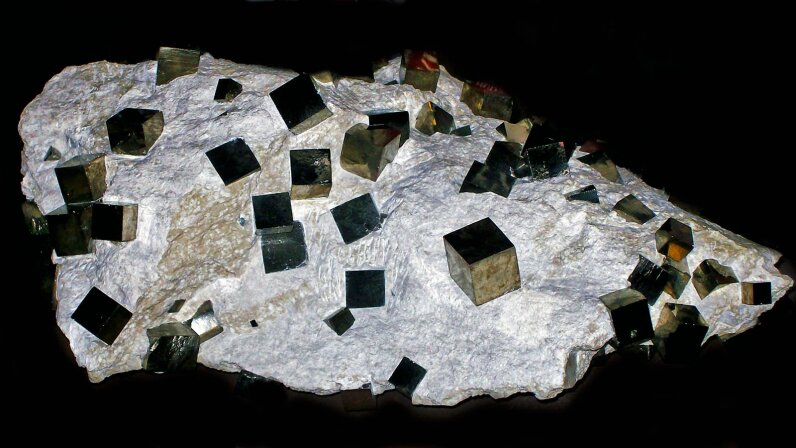
Cubic Pyrite.............................................................................................................................................
gold veinDifference Between Pyrite and Gold
What's the Difference Between Pyrite and Gold?
BY MARK MANCINI


Martin Frobisher thought he'd hit the jackpot.
The year 1576 found this English explorer and legal pirate — he was sanctioned by the crown to plunder enemy treasure ships — seeking the Northwest Passage, the undiscovered Arctic sea route that links the Atlantic and Pacific oceans.
He found something else instead — Labrador, Canada, and what is now Frobisher Bay.
But weeks later he sailed west and reached icy Baffin Island, where he gathered a mineral sample that seemed to be flaked with gold. But it wasn't.
Not according to the Royal Assayer who identified the shiny bits as pyrite, also known as "fool's gold."
Undeterred, Queen Elizabeth's merchants sent Frobisher back to Baffin, where he gathered and shipped 1,400 tons (1,270 metric tons) of ore.
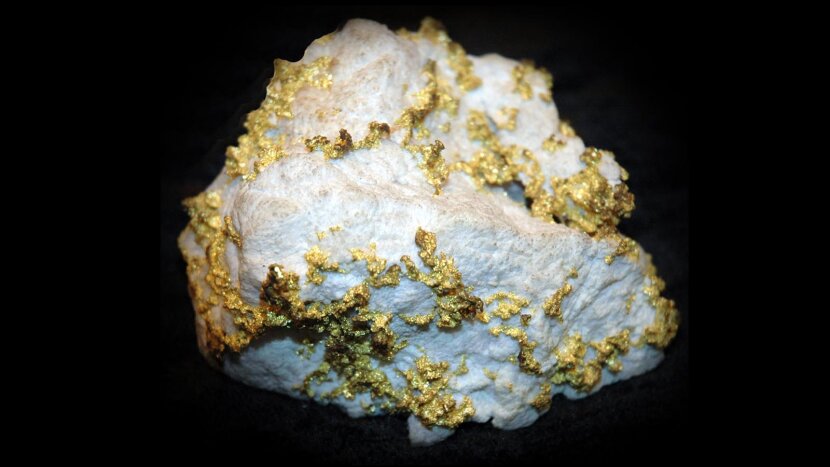
gold vein
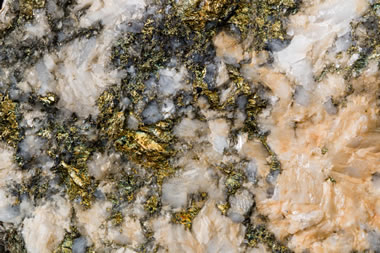
A vein of gold is seen here in a hydrothermal sample of quartz taken from an unspecified mine
 at or near Grass Valley in northeast-central California.
You can see how different the gold vein is from the pyrite above.
Most of it was worthless; in a few tested samples, the gold content was only five to 14 parts per billion.
Though he longed to abandon Baffin and go exploring again, Frobisher spent years fruitlessly hunting Arctic treasure. And it was all because of that pyrite.
Elements and Compounds
Captain Christopher Newport could likely sympathize.
As the leader of Jamestown, England's first permanent settlement in North America, he was constantly getting tricked by New World "gold" that turned out to be — you guessed it — pyrite.
So, let's say you're a prospector, or maybe just a bright-eyed field geologist. How do you avoid pyrite's trickery?
Before we get into that, it might be a good idea to explain what pyrite actually is in the first place.
Real gold is a chemical element, a substance no ordinary chemical process — like electrolysis or heating — can break down.
If you've got a classroom periodic table handy, look for gold between platinum and mercury.
Gold's chemical symbol is "Au" (derived from the element's Latin-language name, "aurum").
A fun way to remember this is to say to yourself, "A! U! Give me back my gold!" 
For maximum entertainment value, use a Brooklyn accent.
Pyrite is different. Unlike gold, it's a compound made up of two different elements: iron and sulfur.
That's why it's often referred to by the name "iron sulfide."
Scientists write out pyrite's chemical formula as "FeS2."
You see, iron and sulfur's chemical symbols are, "Fe" and "S," respectively. And each pyrite molecule contains one iron atom along with two sulfur atoms.
Playing Rough
Telling gold and pyrite apart really isn't that difficult if you know what you're doing.
Ever watch the Olympics? Then you'll probably know those world-class athletes love to bite their gold medals in front of the cameras. (Seriously, it happens a lot.)
The practice comes from the old belief that one can bite gold coins to see if they're counterfeit.
Supposedly, nibbling on any coin with a high gold content leaves bite marks behind.
The truth's more complicated, though, but the custom has a basis in fact.
On the Mohs' scale, which rates the hardness of gems and minerals, gold has a ranking of 2.5 to 3. As elements go, it's rather soft so a gold nugget can easily be scratched with a pocket knife.
Pyrite has the advantage here; it's a bit harder and comes in at 6 to 6.5 on the Mohs' scale. Forget knives; you'd need a high-quality metal file to scratch this stuff.
Steel hammers are another tool that can give the game away. Hit some pyrite with one of these beauties and it'll send sparks flying.
If you're persistent enough, the pyrite will shatter and eventually get reduced to a powder.
None of that happens when you strike gold with a hammer: No sparks, no powder.
Instead, you might just end up expanding or flattening the sample. Not only is gold soft, it's malleable to boot.
See How I Glitter
Visually, both materials are yellowish, but gold is less brassy in hue. It also doesn't form cube-shaped crystals, as pyrite often does.
On the contrary, most of the gold encountered in the field takes the form of either flakes or lumpy nuggets.
Gold also will leave a yellow streak behind if it's rubbed against a bit of porcelain or white ceramic tile.
Repeat this same experiment with pyrite and it will leave a darker, greenish-black line.
If you're still in doubt, the nose knows. Although gold is pretty much odorless, pyrite has a faint smell — and it smells like rotten eggs. (Again, it's loaded with sulfur.)
But where things can get confusing is gold and pyrite sometimes turn up in the same deposits.
Remember, Frobisher's ore did contain some genuine gold — albeit a teeny, tiny amount.
If "real" gold keeps eluding you, don't despair.
Fool's gold isn't completely useless. Like we already mentioned, it can be used to produce sparks, and thereby start fires.
That made pyrite a valuable commodity in ancient and prehistoric societies. Indeed, the word "pyrite" itself came from a Greek term for "firestone."
Tomorrow may bring a new appreciation for iron sulfide.
In 2020, scientists at the University of Minnesota used electric voltage and an ionic solution to successfully turn pyrite into a magnetic material.
This breakthrough could lead to low-cost, sulfur-based solar cells down the road — giving fool's gold a bright future in the green energy industry.
NOW THAT'S INTERESTING
He never found the Northwest Passage, but Martin Frobisher was knighted in 1588 for fighting the Spanish Armada

Mark Mancini is a freelance writer currently based in New Jersey. Over the years, he’s covered every subject from classic horror movies to Abe Lincoln's favorite jokes. He is particularly fond of paleontology and has been reporting on new developments in this field since 2013. When Mark's not at his writing desk, you can usually find him on stage somewhere because he loves to get involved with community theater. And if you ever feel like trading puns for a few hours, he's your guy.
Cubic Pyrite

Friday, November 1, 2019

ACID MINE DRAINAGE - Acid mine drainage mostly occurs where mining is done to extract coal or metals from sulfur-bearing rocks. Silver, gold, copper, zinc, and lead are commonly found in association with metal sulfates, so their extraction can cause acid mine drainage. Rainwater or streams become acidified after they run through the mine’s tailings. In hilly terrain, older coal mines were sometimes built so that gravity would drain out water from inside the mine. Long after those mines are closed, acid mine drainage continues to come out and contaminate waters downstream. In some circumstances, sulfur-bearing rock can be exposed to water in non-mining operations. Drinking water becomes contaminated. Groundwater can be affected, impacting local water wells.

New Idria Mercury Mine in California releases acid mine drainage
.....................................................................................................................................................
Acid Mine Drainage
What Is Acid Mine Drainage?
by Frederic Beaudry 


In a nutshell, acid mine drainage is a form of water pollution that happens when rain, runoff, or streams come in contact with rock that is rich in sulfur.
As a result, the water becomes very acidic and damages downstream aquatic ecosystems.
In some regions, it is the most common form of stream and river pollution.
Sulfur-bearing rock, especially one type of mineral called pyrite, is routinely fractured or crushed during coal or metal mining operations, and accumulated in piles of mine tailings.
Pyrite contains iron sulfide which, when in contact with water, dissociates into sulfuric acid and iron.
The sulfuric acid dramatically lowers the pH, and the iron can precipitate and form an orange or red deposit of iron oxide that smothers the bottom of the stream.
Other harmful elements like lead, copper, arsenic, or mercury may also be stripped from the rocks by the acidic water, further contaminating the stream.
Where Does Acid Mine Drainage Happen?
It mostly occurs where mining is done to extract coal or metals from sulfur-bearing rocks.
Silver, gold, copper, zinc, and lead are commonly found in association with metal sulfates, so their extraction can cause acid mine drainage.
Rainwater or streams become acidified after they run through the mine’s tailings.
In hilly terrain, older coal mines were sometimes built so that gravity would drain out water from inside the mine.
Long after those mines are closed, acid mine drainage continues to come out and contaminate waters downstream.
In the coal mining regions of the eastern United States, over 4,000 miles of stream have been impacted by acid mine drainage.
These streams are mostly located in Pennsylvania, West Virginia, and Ohio. In the western U.S., on Forest Service land alone there are over 5,000 miles of affected streams. 
In some circumstances, sulfur-bearing rock can be exposed to water in non-mining operations. For example, when construction equipment cuts a path through bedrock to build a road, pyrite can be broken up and exposed to air and water.
Many geologists thus prefer the term acid rock drainage, since mining is not always involved.
Environmental Effects
·      Drinking water becomes contaminated. Groundwater can be affected, impacting local water wells.
·      Waters with a very low pH can support only severely reduced animal and plant diversity. Fish species are some of the first to disappear. In the most acidic streams, only some specialized bacteria survive.
·      Because of how corrosive it is, acidic stream water damages infrastructure such as culverts, bridges, and stormwater pipes.
·     Any recreational potential (e.g., fishing, swimming) and scenic value for streams or rivers affected by acid mine drainage are greatly reduced. 
Solutions
·     Passive treatment of acidic streams can be conducted by routing the water into a purpose-built wetland designed to buffer the low pH.
Yet, these systems require complex engineering, regular maintenance, and are applicable only when certain conditions are present.
·     Active treatment options include isolating or treating the waste rock to avoid contact of water with sulfates.
Once water has been contaminated, options include pushing it through a permeable reactive barrier that neutralizes the acid or routing it through a specialized wastewater treatment plant.

Frederic Beaudry
Introduction
Associate professor of environmental science at Alfred University in New York
Ph.D. in wildlife ecology from the University of Maine
Experience
Dr. Frederic Beaudry is a former writer for ThoughtCo who contributed articles on pollution, global warming, and climate science for three years. He is an associate professor of environmental science at Alfred University in New York. Prior to teaching, he worked as a wildlife biologist, focusing on the ecology and conservation of birds and turtles. Beaudry has authored several scientific papers on land use and conservation and has conducted research examining land use changes and their effects on bird and amphibian communities.
Education
Beaudry has a B.S. in biology from Université du Québec à Rimouski and an M.A. in natural resources from Humboldt State University. He earned a Ph.D. in wildlife ecology at the University of Maine. Beaudry completed postdoctoral research at the University of Wisconsin-Madison.
ThoughtCo and Dotdash
ThoughtCo is a premier reference site focusing on expert-created education content. We are one of the top-10 information sites in the world as rated by comScore, a leading Internet measurement company. Every month, more than 13 million readers seek answers to their questions on ThoughtCo.
For more than 20 years, Dotdash brands have been helping people find answers, solve problems, and get inspired. We are one of the top-20 largest content publishers on the Internet according to comScore, and reach more than 30% of the U.S. population monthly. Our brands collectively have won more than 20 industry awards in the last year alone, and recently Dotdash was named Publisher of the Year by Digiday, a leading industry publication.
New Idria Mercury Mine in California releases acid mine drainage

Wednesday, September 25, 2019

FOOL'S GOLD – Pyrite received the nickname "Fool's gold" because it is worth virtually nothing, but has an appearance that "fools" people into believing that it is gold. The nickname "fool's gold" has long been used by gold buyers and prospectors, who were amused by excited people who thought they had found gold. These people did not know how to tell the difference between pyrite and gold, and their ignorance caused them to look foolish. Chalcopyrite and small pieces of biotite mica can fool you. Chalcopyrite (a copper iron sulfide) has very similar properties to pyrite.

Gold streak
.............................................................................................................................................
Fool's Gold
Pyrite with Striations
Don't be fooled: These quick tests separate pyrite from real gold
Article by: Hobart M. King, Ph.D., RPG


What Is Fool's Gold?
"Fool's gold" is a common nickname for pyrite.
Pyrite received that nickname because it is worth virtually nothing, but has an appearance that "fools" people into believing that it is gold.
With a little practice, there are many easy tests that anyone can use to quickly tell the difference between pyrite and gold.
The nickname "fool's gold" has long been used by gold buyers and prospectors, who were amused by excited people who thought they had found gold.
These people did not know how to tell the difference between pyrite and gold, and their ignorance caused them to look foolish.
Separating Fool's Gold from Gold
Here are a few simple tests that almost anyone can use to tell the difference between pyrite and gold. They can usually be done successfully by inexperienced people.
However, wise people obtain a couple small pieces of pyrite and a couple small pieces of gold and use them to gain valuable experience.
CAUTION: All pieces of gold are valuable. However, any piece of gold with a nice crystal habit will have a premium value - often worth several times the value of its contained gold. That premium value can be ruined by some of the tests explained below. So, we have separated the tests into "destructive tests" and "non-destructive tests". Be careful if you think that you might have a valuable gold specimen.
Non-Destructive Tests
A) Tarnish: Most specimens of pyrite, found in nature, will have at least some tarnish on their surface. Nuggets or small flakes of gold are usually bright and untarnished.
B) Color: Pyrite has a brassy color. Gold has a golden to yellow color. Most native gold is alloyed with silver, and if the silver content is high enough, the specimen will have a whitish yellow color.
C) Shape: Pyrite is usually found as angular pieces, and many of them exhibit the faces of a cube, octahedron or pyritohedron. Most gold particles found in streams have slightly rounded edges, but be careful - some crystalline gold specimens can display a crystal habit that is similar to pyrite.
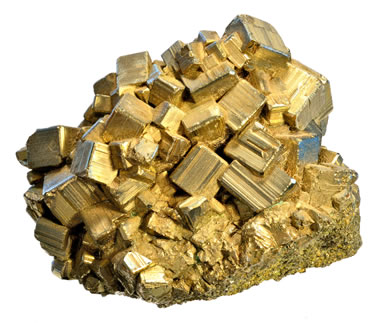
D) Striations: Many crystals of pyrite have fine parallel lines on their faces. Gold crystals do not have striations.
E) Specific Gravity: Gold has a specific gravity of about 19.3. The specific gravity of pyrite is about 5. (All gold found in nature is always alloyed with other metals. These metals have a specific gravity which will reduce the specific gravity of the specimen, but never enough that it approaches the specific gravity of pyrite. Specimens containing a significant amount of gold will always have at least two to three times the specific gravity of pyrite.)
Destructive Tests
A) Streak: Gold has a yellow streak. Pyrite has a greenish black streak. Learn how to do the streak test here.
B) Hardness: Gold has a Mohs hardness of 2.5, while pyrite has a Mohs hardness of 6 to 6.5. Gold will not scratch a copper surface (Mohs hardness of 3), but pyrite will easily scratch copper. Gold can be scratched by a sharp piece of copper, but copper will scratch very few other materials. Learn about the Mohs hardness test here.
C) Ductility: Gold is very ductile, and a tiny piece of gold will bend or dent with pressure from a pin or a pointed piece of wood. Tiny pieces of pyrite will break or resist the pressure.
D) Sectility: Small particles of gold can be cut with a sharp pocket knife. Small particles of pyrite cannot be cut.
Other Minerals That Can Fool You!
Chalcopyrite and small pieces of biotite mica can fool you. Chalcopyrite (a copper iron sulfide) has very similar properties to pyrite.
It has a lower hardness than pyrite (3.5 to 4) and a lower specific gravity than pyrite (4.1 to 4.3), but the same tests can separate chalcopyrite from gold. Chalcopyrite also has a greenish black streak.
Many people are surprised that biotite mica can fool people into thinking that it is gold. This most often occurs when an inexperienced person is panning for gold and sees a bright flash in their gold pan.
After chasing the tiny, highly lustrous flake, they think that it might be gold. However, slight pressure with a pin can break the flake of mica, but a tiny flake of gold will bend around the pin.

Hobart M. King is the owner and publisher of Geology.com. He is a geologist with over 40 years of experience, has a Ph.D. in geology, and is a GIA graduate gemologist. Much of his work has focused on coal geology, industrial minerals, gemology, geologic hazards, and geoscience education.
He has authored many of the internet’s most popular articles about rocks, minerals and gems. He writes most of the content published on Geology.com and compiles its daily news. His writing is read by over a million people each month, making him one of the world’s most widely read geologists.
Dr. King earned a Ph.D. and an M.S. in geology from West Virginia University; a B.S. in geology from California University of Pennsylvania; and, a Graduate Gemologist Diploma from the Gemological Institute of America. He is a registered professional geologist in the Commonwealth of Pennsylvania.
He has worked as a geologist in a variety of settings since 1975.
Chalcopyrite in Dolomite and Quartz
Chalcopyrite in Dolomite and Quartz: Gold-colored minerals can be tested even if they are embedded in a rock. The gold-colored mineral in this rock is chalcopyrite, and a person could determine that it is not gold by poking the gold-colored material with a pin and observing if it dents or breaks. This photograph is by Scott Horvath of the United States Geological Survey. 


Gold streak
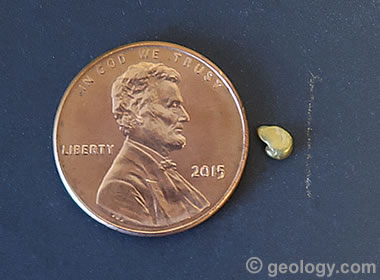
Gold's Streak: A copper penny and a tiny gold nugget on a black streak plate, with a small streak made by the nugget. The copper penny is in the photo to serve as a scale. The tiny nugget weighs 0.0035 troy ounce, and at a gold price of $1200/ozt the nugget, if it were pure gold, would have a gold value of $4.20. The tiny mark left by the streak plate removed about $0.06 worth of gold from the nugget.


Testing Specific Gravity
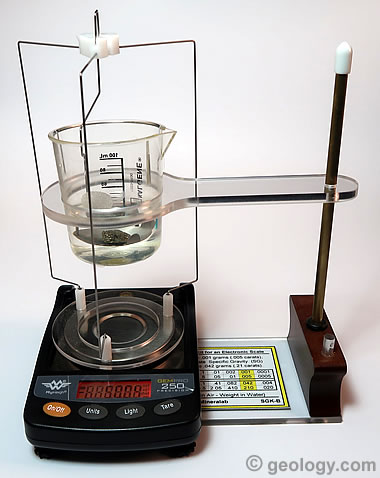
Testing Specific Gravity: Specific Gravity is the ratio between the weight of a material in air and the weight of an equal volume of water. The device in the photo above is a scale that is used to weigh the material in air, and a weighing pan that enables the material to be weighed under water. The weight under water can be subtracted from the weight in air to obtain the weight of the volume of water displaced by the material. Specific gravity is then calculated by the formula: Wa / (Wa - Wu) where Wa is the weight of the material in air and Wu is the weight of the material under water.


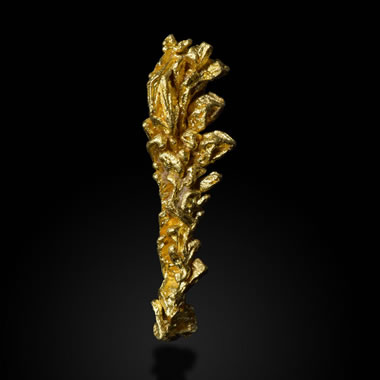
Crystalline Gold
Crystalline Gold: A specimen of native gold from Pontes e Lacerda, Mato Grosso, Brazil, approximately 3.5 centimeters tall. This specimen is visually appealing and displays the crystalline habit of gold. The value of this specimen to collectors of crystalline gold would be many times the value of its contained gold. Destructive tests should not be done on specimens of gold that display a crystalline habit or specimens of no trivial size that have an attractive appearance. 


Pyrite with Striations
Pyrite with Striations: A cluster of cubic pyrite crystals exhibiting prominent striations.