Saturday, December 9, 2017

CHROME AND STAINLESS STEEL - Solid chrome (chrome as the only element) is not used to construct objects. Instead, it is applied as a thin layer on the objects which are made from steel and sometimes aluminum, brass, copper, plastic, or stainless steel. Stainless steel is used in kitchen appliances and civil engineering to produce window fittings, street furniture, structural sections, reinforcement bar, lighting columns, lintels and masonry supports.

Chrome and Stainless Steel
Difference Between Chrome and Stainless Steel
by Abey S.D.

Key Difference – Chrome vs Stainless Steel

Chrome and stainless steel are two of the most extensively used metallic materials in the production of metal appliances or fixtures.
Although these two materials look very similar and have similar properties, they are quite different.
The differences in their properties and applications arise since these two materials are very different in their composition. 
Stainless steel is an alloy which mainly contains iron, carbon and chromium whereas, chrome is a chromium plated material, and cannot be considered as an alloy. 
This is the key difference between Chrome and Stainless Steel.

What is Chrome?

Chrome is the shortened form of chromium, and it usually refers to chromium plating. 
Chromium plating is the application of a chromium layer onto the surface of a plastic or metal object by electroplating.
This technique is used for both decorative and industrial purposes.
In decorative applications, it strengthens the object in addition to its aesthetic properties.
One of the most common examples is chromium plating on the side of a motorcycle.
Piston rods is an example for the industrial application of chromium plating.
Chromium is well known for its luster and corrosion resistance.

What is Stainless Steel?

Stainless steel is an alloy made of steel and chromium; the minimum quantity of chromium is about 10.5% by mass.
Stainless steel has some essential and versatile properties such as relatively low cost, high strength, higher resistant to staining, corrosion and rusting as well as its flashier luster.
There are three types of industrial grade stainless steel varieties based on their composition; austenitic, martensitic and ferritic.
Austenitic is a chromium-nickel-iron alloy (Cr  -16% -26% , Ni - 6% - 22% and a low carbon content).
Martensitic is a chromium-iron alloy (Cr - 10.5% - 17% with some carbon content).
And Ferritic is a chromium-iron alloy (Cr -17% - 27% and a low carbon content).
Many cooking utensils are made from ferritic type of stainless steel.

What is the difference between Chrome and Stainless Steel?

Composition:

Chrome: Chrome only contains chromium; it is not an alloy.
Stainless steel: Stainless steel is an alloy which contains at least 10.5% of chromium in addition to iron and carbon. It may or may not contain nickel. The use of nickel is very limited since it is one of the most expensive alloying elements.

Properties:

Chrome: The high luster of Chrome makes it more aesthetically pleasing.  However, chrome materials are more susceptible to dirt and grime. It is comparatively less expensive than stainless steel, but the durability is low.
Stainless steel: The durability of stainless steel is relatively higher than chrome since it is an alloy. In addition, it is little resistant to corrosion and scratches; therefore, it does not tarnish and is very easy to keep clean. However, it is very expensive and less shiny compared to chrome.

Uses:

Chrome: Solid chrome (chrome as the only element) is not used to construct objects. Instead, it is applied as a thin layer on the objects which are made from steel and sometimes aluminum, brass, copper, plastic, or stainless steel.
Stainless steel: Stainless steel is used in kitchen appliances such as cutlery, sinks, saucepans, washing machine drums, microwave oven liners, razor blades.
It is also used in civil engineering to produce window fittings, street furniture, structural sections, reinforcement bar, lighting columns, lintels and masonry supports.
In addition, it is used in transportation to manufacture exhaust systems, car trim/grilles, road tankers, ship containers and chemical tankers in ships.
Stainless steel is also used in several other areas like oil and gas production equipment, surgical instruments, catering equipment, brewing, distilling, food processing,
and water and sewage treatment.
You may also like:


CLICK HERE:


CLICK HERE:


CLICK HERE:


CLICK HERE:


CLICK HERE:
.
Multi-Media Filter, Highly-Activated Carbon Filter,
Zeolite-Process Water Softener With Brine Tank,
Fiberglass Ballast-Type Pressure Tank
(fully automatic backwash & regeneration)
PURICARE 
INDUSTRIAL 
ENTERPRISES 
Water 
Treatment 
Systems
.
.
...
Aganan, Pavia, Iloilo, Philippines
...

CLICK HERE . . . to view company profile . . .


BEACHCOMBING - If you see something that you think might be dangerous, keep clear and inform the local authorities. If you are collecting items, make sure you take suitable precautions. Amber hunters should collect and store their samples in a steel bucket filled with water or sand, which will prevent the sample from igniting.

Beachcombing
A dangerous guide to beachcombing
BY GEORGE WINTER  
What not to touch at the seaside
The mid-19th century rise of oceanography as a scientific discipline is partly attributable to the Victorian craze for beachcombing – a trend that continues to this day.
But the flotsam and jetsam that washed up on Victorian beaches were not freighted with the same chemical hazards that await today’s treasure hunters.
Why the concern?
In August this year, a 41-year-old woman picked up an object from a beach on the banks of the Elbe, near Hamburg, Germany, mistaking it for amber.
She put it in her jacket pocket, laid the jacket down… and her pocket combusted.
The object was white phosphorus from a second world war incendiary bomb.
What is white phosphorus?
White phosphorus is an allotrope of phosphorus in a tetrahedral structure with size single P–P bonds.
It’s a translucent, waxy solid that becomes yellow when exposed to light – which is why the beachcomber misidentified it.
It’s nasty stuff, which self-ignites on contact with air, is highly corrosive, burns intensely and reacts with water (it needs to be extinguished with sand).
Phosphorus oxidises at any temperature above 30°C, forming phosphorus pentoxide – as the video below demonstrates.
Today its use is banned as an incendiary weapon, although it is still widely used to create smoke screens.
Is this the first time someone had made this mistake?
No. There have been at least four cases of white phosphorus burns on beachcombers around the Baltic sea. 
All had confused white phosphorus ammunition residues with amber while walking on beaches at the Baltic Sea coast, sustaining serious burns after placing clots of phosphorus in their trouser pockets.
The problem isn’t only limited to the Baltic. A 40-year-old woman sustained full-thickness burns from white phosphorus picked up on a Tel Aviv beach in Israel.  
Has phosphorus ever been found in the UK?
Yes. In 1995 more than 4500 incendiary bombs – made of phosphorus, benzene and cellulose – washed up on beaches around Scotland’s west coast. 
They were part of an estimated million tons of munitions dumped between 1945 and 1976 by the Ministry of Defence in Beaufort’s Dyke, an underwater trench between Northern Ireland and Scotland.
It was speculated that the munitions were disturbed by work on an undersea gas link between the two countries.
What other hazards are on UK beaches?
The inaugural issue of the Chemical Hazard and Poisons Report by the Health Protection Agency described an incident which began on 20 January 2003, when beaches in the vicinity of Bridport, Dorset, yielded ‘large numbers of vials marked “Anthrax vaccine” [and] about 100 vials of brown liquid labelled Dimercaptopropanol [sic].’
The Chemical Incident Response Service advised that whereas the vaccine (expiry date 1999) would be harmless following skin contact, the 2,3-dimercaptopropanol (C3H8OS2) would be an irritant.
What is 2,3-dimercaptopropanol?
Also known as British Anti-Lewisite (BAL), it was developed in Britain during the second world war as an antidote for an arsenic-based chemical warfare agent, lewisite.
However, although BAL is mainly used today as a chelating agent to treat metal poisoning – for example, arsenic, mercury, lead, antimony.
Anything else?
The HPA report, in a retrospective survey of major incidents involving packaged goods being lost overboard in British waters, noted that in February 1990 the freighter Fathulkhair lost six canisters of potassium cyanide (KCN), which washed ashore on Kent and Sussex beaches.
KCN appears as white amorphous lumps or a crystalline mass; smells faintly of bitter almonds; and is toxic by skin absorption through open wounds or by ingestion.
Another problem is the rise of fatbergs.
What are fatbergs?
According to a report in the Marine Pollution Bulletin, the 15 hazardous and noxious substances most often transported in bulk through European waters include palm and other vegetable oils, animal fat, methanol, benzene and its mixtures, sodium hydroxide solution, ammonia and sulphuric acid.
Palm oil comes from the plant Elaeis guineensis, and the world’s largest producer is Malaysia.
Palm oil is semi-solid at room temperature and has a balanced ratio of unsaturated and fatty acids, containing 40% oleic acid (C18H34O2 monounsaturated fatty acid), 10% linoleic acid (C18H32O2polyunsaturated fatty acid), 45% palmitic acid (C16H32O2) and 5% stearic acid (C18H36O2 saturated fatty acid).
Palm oil residues may be washed from ships’ cargo tanks.
Unfortunately, fats are hydrophobic, so tend to form together and wash up on beaches.
While not as dangerous as old munitions, they can be fatal if ingested by animals – making them a hazard for dog walkers.
How can I stay safe at the beach?
Don’t go around picking up strange objects.
If you see something that you think might be dangerous, keep clear and inform the local authorities – usually the council or coastguard.
If you are collecting items, make sure you take suitable precautions.
For example, amber hunters should collect and store their samples in a steel bucket filled with water or sand, which will prevent the sample from igniting.
Multi-Media Filter, Highly-Activated Carbon Filter,
Zeolite-Process Water Softener With Brine Tank,
Fiberglass Ballast-Type Pressure Tank
(fully automatic backwash & regeneration)
.
PURICARE 
INDUSTRIAL 
ENTERPRISES 
Water 
Treatment 
Systems
.
...
Aganan, Pavia, Iloilo, Philippines
...

CLICK HERE . . . to view company profile . . .
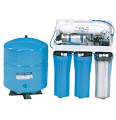
Reverse Osmosis with Steel Tank 
& Cartridge Pre-Filters

Submersible Pumps

Tachmina Solenoid-Driven
Chemical Metering Pump
- ensures regulated dosing
of chlorine into water system
without human intervention


Monday, December 4, 2017

CREATING PATTERNS OF SUCCESS - Successful people are only special because they are doers and follow through. They are not smarter than others; in fact, it is entirely possible you are smarter on paper than they are. You just don’t follow through. People who achieve are doers. If you want to get something done, schedule it no matter how silly it might seem to you. Learn from other people’s mistakes and realize that you can gain valuable information from what others are already doing. Never Stop Learning

Patterns of Success
................................................................................
Patterns Of Success
How to Create a Pattern of Success
By Mike Krutza


Once you experience success you will be able to look back and realize that you achieve all success pretty much the same way – a pattern of success.

You set a goal, follow through on the tasks needed to be done for achieving results, keep an open mind, learn from others, track your successes and learn from failure.
It’s the same thing, over and over again. And it works.
If you want to create a pattern of success in your life, you can start now by learning the secret that successful people know.
Successful people are only special because they are doers and follow through.
They are not smarter than others; in fact, it is entirely possible you are smarter on paper than they are. You just don’t follow through.

Become a Goal Setting Expert

Start at the top and learn how to craft the best goals for yourself.
Know that the goal is something that can be accomplished and know that the goal is measurable before you finish writing it. Most of all, make sure it’s a goal that you really want to achieve.

Schedule Everything

People who achieve are doers. If you want to get something done, schedule it no matter how silly it might seem to you.
If you put it in a schedule at a particular time, and not just on a generic “to do” list, it will be more likely that you get it done.
You can also use goal setting tools to help you achieve more.
For instance, if you have set a goal to write a 80,000-word novel by a certain date, then you should know how many pages you need to get done each week and which days you can work on it, which times, hours, and how long it takes you to write a page.
Successful writers write; they don’t wait for inspiration to strike. They schedule it and do it.
The same can be said for anything you want to achieve. You don’t wait until you want to do it; you do it on schedule.

Automate the Mundane

There are a lot of things that need to be done but that can escalate easily into “busy work” which doesn’t get you closer to a goal.
Bookkeeping, for instance, is something that can be accomplished today, with the right software, almost automatically.
You can schedule payments to happen automatically; you can also use software that enters everything for you in the ledger.
Freeing up your time to focus on scheduled activities that must be done to achieve the goal is a more productive use of time.

Get Outside Expert Help

To be a success doesn’t mean you have to do everything yourself. You’re not on your own.
The best scientists, professors, doctors, lawyers, and CEOs have assistants who help them look great.
You too can hire outside help and contractors to help you do the tasks needed to reach your goals.
Other than doing exercise for you and thing you must do physically for yourself, there isn’t much you can’t outsource today.

Stop Reinventing the Wheel

In most cases, someone has already done it before you. Someone has already worked out the kinks and devised a plan of action that will work for you too with hardly any tweaks.
Learn from other people’s mistakes and realize that you can gain valuable information from what others are already doing.

Never Stop Learning

They say it takes ten thousand hours of reading about a topic to become an expert on any subject. Keep this in mind as you look toward your future and set your goals.
If you want to be an expert, you’ll need to start today building up those ten thousand hours. Even if you know nothing about a topic today, you can be an expert in just ten thousand hours.

Know Your Core Values

As you set goals to create a pattern of success, it’s imperative that you know what your core values are in terms of family, personal, financial and your physical life.
Everyone has different areas they need to work on more than others – you need to know what your areas are to set realistic goals that you want to meet.

Track, Assess, Repeat

Nothing is ever done without the paperwork, as they say. Well, that includes creating a pattern of success.
Only by setting goals, then tracking and assessing the results of the goals, and then repeating what works will you create a pattern of success.
Creating a pattern of success requires knowledge of goal setting, and goal achieving, and in-depth knowledge of yourself.
Starting today you can gain that knowledge and create a real pattern of success in your life.

Mike Krutza helps individuals and teams find their own 'elegant courage' in handling tough leadership challenges. His extraordinary sense of vision and common sense amazes clients. As a past CEO of a financial company, he understands both the bottom line and human side of making a company successful.
Patterns of Success