Friday, February 28, 2020

MOISTURE IN CONCRETE FLOOR - Factors that lead to moisture accumulation in concrete and subsequent related problems include fast track construction schedule which does not allow free water to evaporate naturally, inadequate moisture protection, and wet construction site. Moisture prevention techniques are available for slabs that is already constructed and experienced moisture and newly constructed slabs. There are different techniques used for stopping moisture in concrete floors. A Low-permeance vapor Barrier or retarder can effectively keep below-slab moisture from reaching the flooring system. Sometimes, providing adequate time for natural drying of concrete slab would solve the problem. In this case the concrete slab shall be tested prior to the installation of tiles, coatings, or paints. Keep below grade excavations free of water to prevent potential reservoirs of moisture that can migrate upward through slabs. Excessive moisture below concrete slabs can cause structural degradation of soil bearing strengths, and swelling and shrinkage of soil.

Image result for images Moisture in Concrete Floor
..............................................................................................................................................................
Image result for images Moisture in Concrete FloorMoisture in Concrete Floor
How to Stop Moisture in Concrete Floor?
Madeh Izat Hamakareem


Image result for images Moisture in Concrete FloorCommonly, concrete floors are vulnerable to moisture and suffer from different detrimental influence of moisture such as lifting tile off the floor, rotting hardwood, damping carpet, coating delamination and many more.
These problems are not only disrupting functions of the building due to maintenance operations but also costly. Therefore, it is recommended to implement necessary measures to stop moisture in concrete floors.
Several techniques are available which can be applied based on the condition under consideration.
By and large, every problem can be tackled provided that the source of the problem is identified.
On this base, suitable prevention method or combination of methods are specified to cut the anticipated source of moisture in given concrete floor.
Free water in concrete and rising moisture from below concrete are the source of moisture.
Factors that lead to moisture accumulation in concrete and subsequent related problems include fast track construction schedule which does not allow free water to evaporate naturally, inadequate moisture protection, and wet construction site.
Moisture prevention techniques are available for slabs that is already constructed and experienced moisture and newly constructed slabs.
Sources of Moisture in Concrete Floors
1.        Free water in concrete
2.        Moisture rising from below the slab
Causes of Moisture in Concrete Floors
1.        Wet Building Sites
2.        Fast-Track Construction Schedules
3.        Inaccurate, Insufficient or Misinterpreted Moisture Tests
4.        Inadequate Sub-Slab Moisture Protection
5.        Changing materials
Methods Used to Stop Moisture in Concrete Floors
There are different techniques used for stopping moisture in concrete floors. These techniques are classified into two groups include those which are used before slabs construction and methods used for existing slabs:
Before Slab Construction
1. Low-permeance Vapor Barrier or Retarder
A Low-permeance vapor Barrier or retarder can effectively keep below-slab moisture from reaching the flooring system.
In this technique, a layer of sand with certain thickness is placed, after that, a strong and highly durable plastic such as polyethylene is laid, then another layer of sand is installed above the plastic sheet.
After that, the construction of concrete floor can be carried out.  
Any material used below slab to prevent the movement of moisture from ground into slab fall in this category of moisture prevention method.
2. Allow Natural Drying of Concrete Slab
Sometimes, providing adequate time for natural drying of concrete slab would solve the problem. In this case the concrete slab shall be tested prior to the installation of tiles, coatings, or paints.
3. Keep Excavation Free of Water
Keep below grade excavations free of water to prevent potential reservoirs of moisture that can migrate upward through slabs.
Excessive moisture below concrete slabs can cause structural degradation of soil bearing strengths, and swelling and shrinkage of soil.
These can adversely affect a concrete slab on grade.
After Slab Construction
Image result for images Moisture in Concrete FloorApply Damping Agent for Existing Concrete Floor
In this method, damping agent (such as liquid epoxy damp proof membrane) is applied for an existing concrete floor system.
It is used for slabs that suffered moisture problems due to lack of moisture prevention means or failure of moisture prevention system.
The damping agent creates an impermeable layer and hence keep moisture in concrete slab. Not only does it provide visually good surface finish to the floor but also it can be applied without any concern regarding drying the concrete slab.
Moisture Prevention Agent for Floor Surface
Application procedure involves clean concrete surface from dirt and then apply the damping agent using roller and brush.
It may be required to apply multiple layer, but each layer shall be allowed to be set before applying the next layer. The number of layers is based on the amount of moisture in concrete.

Madeh is a Structural Engineer who works as Assistant Lecturer in Koya University. He is the author, editor and partner at theconstructor.org.
 Image result for images Moisture in Concrete Floor
Image result for images Moisture in Concrete Floor

Thursday, February 27, 2020

ANTIBIOTICS - Antibiotics fight bacterial infections either by killing bacteria or slowing and suspending its growth. They do this by: attacking the wall or coating surrounding bacteria, interfering with bacteria reproduction and blocking protein production in bacteria. Antibiotics are also called antibacterials. Most antibiotics are only available with a prescription from your doctor. Some antibiotic creams and ointments are available over the counter. Antibiotics begin to work right after you start taking them. However, you might not feel better for two to three days. How quickly you get better after antibiotic treatment varies. It also depends on the type of infection you’re treating. Most antibiotics should be taken for 7 to 14 days. In some cases, shorter treatments work just as well. Your doctor will decide the best length of treatment and correct antibiotic type for you. Even though you might feel better after a few days of treatment, it’s best to finish the entire antibiotic regimen in order to fully resolve your infection. This can also help prevent antibiotic resistance. Don’t stop your antibiotic early without first talking with your healthcare provider.

Image result for images What’s an antibiotic
Image result for images woman taking antibiotic
................................................................................................................................................................
Image result for images woman taking antibioticAntibiotics
How Do Antibiotics Work?
Healthline's Medical Network


Image result for images What’s an antibioticWhat’s an antibiotic?
Antibiotics are medications used to fight infections caused by bacteria.
They’re also called antibacterials. They treat infections by killing or decreasing the growth of bacteria.
The first modern-day antibiotic was used in 1936.
Before antibiotics, 30 percent of all deaths were caused by bacterial infections. Thanks to antibiotics, previously fatal infections are curable.
Today, antibiotics are still powerful, life-saving medications for people with certain serious infections. They can also prevent less-serious infections from becoming serious.
There are many classes of antibiotics. Certain types of antibiotics work best for specific types of bacterial infections.
Antibiotics come in many forms, including:
·               tablets
·               capsules
·               liquids
·               creams
·               ointments
Most antibiotics are only available with a prescription from your doctor. Some antibiotic creams and ointments are available over the counter.
Antibiotics fight bacterial infections either by killing bacteria or slowing and suspending its growth.
They do this by:
·               attacking the wall or coating surrounding bacteria
·               interfering with bacteria reproduction
·               blocking protein production in bacteria
Antibiotics begin to work right after you start taking them. However, you might not feel better for two to three days.
How quickly you get better after antibiotic treatment varies. It also depends on the type of infection you’re treating.
Most antibiotics should be taken for 7 to 14 days. In some cases, shorter treatments work just as well. Your doctor will decide the best length of treatment and correct antibiotic type for you.
Even though you might feel better after a few days of treatment, it’s best to finish the entire antibiotic regimen in order to fully resolve your infection.
This can also help prevent antibiotic resistance. Don’t stop your antibiotic early without first talking with your healthcare provider.
The first beta-lactam antibiotic, penicillin, was discovered by accident. It was growing from a blob of mold on a petri dish.
Scientists found that a certain type of fungus naturally produced penicillin. Eventually, penicillin was produced in large quantities in a laboratory through fermentation using the fungus.
Some other early antibiotics were produced by bacteria found in ground soil.
Today, all antibiotic medications are produced in a lab. Some are made through a series of chemical reactions that produce the substance used in the medication.
Other antibiotics are at least partially made through a natural but controlled process.
This process is often enhanced with certain chemical reactions that can alter the original substance to create a different medication.
Image result for images What’s an antibioticAntibiotics are powerful medications that work very well for certain types of illnesses.
However, some antibiotics are now less useful than they once were due to an increase in antibiotic resistance.
Antibiotic resistance occurs when bacteria can no longer be controlled or killed by certain antibiotics.
In some cases, this can mean there are no effective treatments for certain conditions.
Each year, 2 million people are infected with bacteria that are resistant to antibiotics, resulting in at least 23,000 deaths.
When you take an antibiotic, the sensitive bacteria are eliminated.
The bacteria that survive during antibiotic treatment are often resistant to that antibiotic. These bacteria often have unique characteristics that prevent antibiotics from working on them.
Some serious antibiotic-resistant infections include:
Clostridium difficile (C. diff)
The overgrowth of this type of bacteria causes infection in both your small and large intestines. This often occurs after someone’s treated with antibiotics for a different bacterial infection. C. diff is naturally resistant to many antibiotics.
Vancomycin-resistant enterococcus (VRE)
These bacteria often infect your bloodstream, urinary tract, or surgical wounds. This infection typically occurs in people who are hospitalized. Enterococci infections may be treated with the antibiotic vancomycin, but VRE is resistant to this treatment.
Methicillin-resistant Staphylococcus aureus (MRSA)
This type of infection is resistant to traditional staph infection antibiotics. MRSA infections typically occur on your skin. It’s most common in people in hospitals and those with weakened immune systems.
Carbapenem-resistant Enterobacteriaceae (CRE)
This class of bacteria are resistant to a lot of other antibiotics. CRE infections typically occur in people in hospitals and who are on a mechanical ventilator or have indwelling catheters.
The most important cause of antibiotic resistance is inappropriate use or overuse of antibiotics.
As much as 30 percent of antibiotic use is thought to be unnecessary. This is because antibiotics are often prescribed when they aren’t needed.
Several important steps can be taken to decrease inappropriate antibiotic use:
·          Take antibiotics only for bacterial infections. Don’t use antibiotics for conditions caused by viruses such as the common cold, flu, cough, or sore throat.
·          Take antibiotics as directed by your healthcare provider. Using the wrong dose, skipping doses, or taking it longer or shorter than directed might contribute to bacteria resistance. Even if you feel better after a few days, talk with your healthcare provider before discontinuing an antibiotic.
·         Take the right antibiotic. Using the wrong antibiotic for an infection might lead to resistance. Don’t take antibiotics prescribed for someone else. Also, don’t take antibiotics left over from a previous treatment. Your healthcare provider will be able to select the most appropriate antibiotic for your specific type of infection.
Have medical questions? Connect with a board-certified, experienced doctor online or by phone. Pediatricians and other specialists available 24/7.
Antibiotics are used for treating infections caused by bacteria. Sometimes it’s difficult to determine if your infection is caused by bacteria or a virus because the symptoms are often very similar.
Your healthcare provider will evaluate your symptoms and conduct a physical exam to determine the cause of your infection.
In some cases, they may request a blood or urine test to confirm the cause of infection.
Some common bacterial infections include:
·               urinary tract infections
·               sinus and ear infections
·               strep throat
Antibiotics aren’t effective against viruses, such as the common cold or flu. They also don’t work on infections caused by fungi, such as:
·               yeast infections
·               athlete’s foot
·               fungal toenail infections
·               ringworm
These are treated with a different group of medications called antifungals.
Most antibiotics have similar side effects. Perhaps the most common side effect is gastrointestinal (GI) upset, including:
·               diarrhea
·               nausea
·               vomiting
·               cramps
In some cases, these side effects can be reduced if you take the antibiotic with food. However, some antibiotics must be taken on an empty stomach.
Ask your doctor or pharmacist about the best way to take your antibiotic.
GI upset usually goes away after you stop treatment. If it doesn’t, you should call your doctor. Also, call your doctor if you develop:
·               severe diarrhea
·               stomach pain and cramping
·               blood in your stool
·               fever
Antibiotics are most effective when used appropriately. This starts with ensuring that you really need the antibiotic.
Only use antibiotics prescribed by your doctor for a bacterial infection.
Talk with your doctor or pharmacist about the best way to take your antibiotic. Some should be taken with food to reduce side effects but others need to be taken on an empty stomach.
Antibiotics should also be taken in the prescribed amount and for the directed length of treatment.
You might feel better within a few days after starting the antibiotic but you should talk with your healthcare provider before stopping your treatment early.

Medically reviewed by Stacy Sampson, DO on May 4, 2018 — Written by Healthline's Medical Network
 Image result for images woman taking antibiotic

Wednesday, February 26, 2020

APPROACH SPEED AND THRESHOLD CROSSING SPEED - The term "approach speed" can be slightly misleading. It's not the speed you'll fly all the way to the runway. Instead, think of your final approach as three stages of speed changes. Following this model will give you the best speed control for nailing your touchdown point: Final Approach Speed, Slowing To Threshold Crossing Speed, Slowing During Your Flare. Most aircraft flight manuals recommend a speed. However, if your manufacturer doesn't list a final speed in their flight manual, the FAA recommends that you fly 1.3 x Vso. As you turn final, set pitch and power for your final approach speed, and stabilize your descent to the runway. If you're constantly changing throttle settings to adjust altitude and airspeed, you might want to consider going around to try again. A good rule of thumb for light, single-engine piston airplanes is to check that you're flying a stable approach at least 200 feet above the ground. Are you flying the correct approach speed, configured, on centerline, with minimal power changes, and a normal sink rate?

threshold-crossing-speed
..........................................................................................................................................................
PrimaryApproach Speed And Threshold Crossing Speed
What's The Difference Between Approach Speed And Threshold Crossing Speed?
By Swayne Martin


If you don't fly the right speeds on final, you can miss your touchdown point by hundreds of feet, every time. Here's what you need to know...
Flying Your Approach
The term "approach speed" can be slightly misleading. It's not the speed you'll fly all the way to the runway.
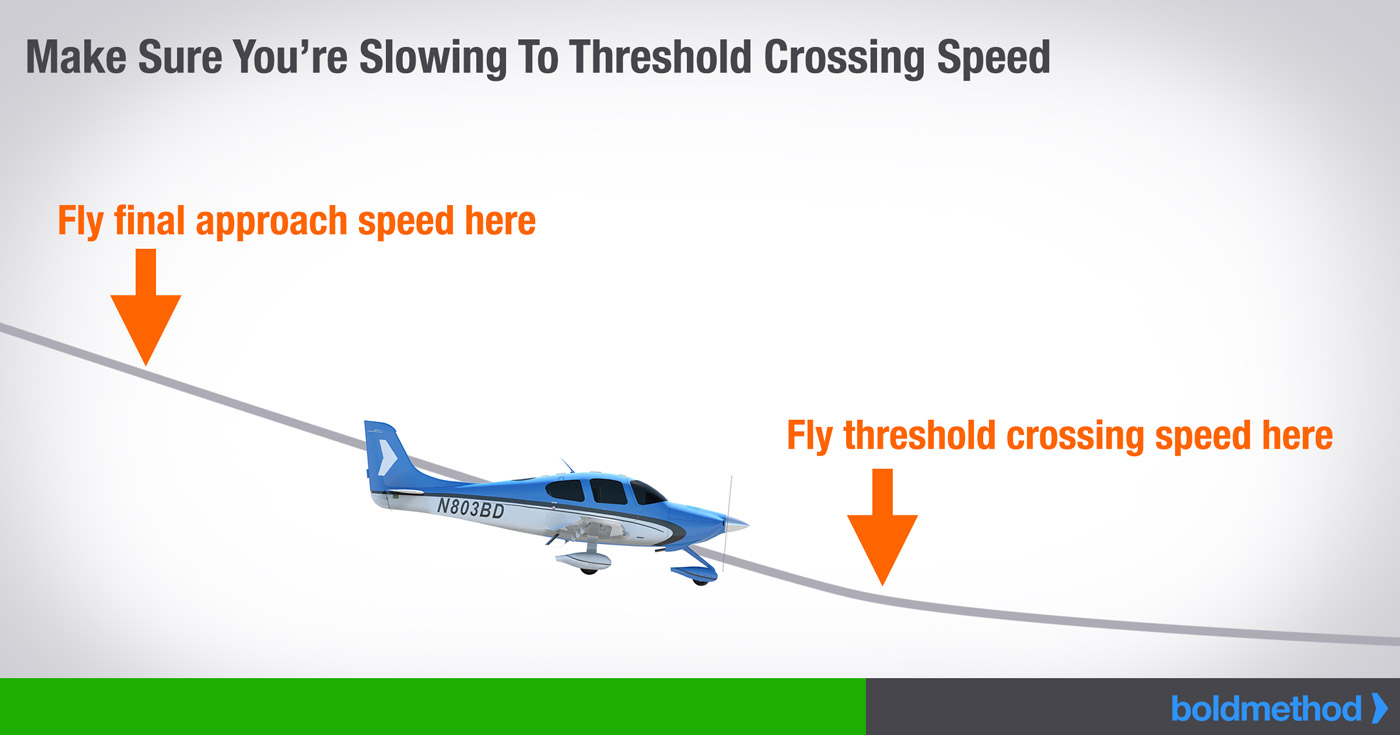
Instead, think of your final approach as three stages of speed changes. Following this model will give you the best speed control for nailing your touchdown point:
Final Approach Speed
Slowing To Threshold Crossing Speed
Slowing During Your Flare
How Approach Speed Is Calculated
How fast should you fly on final? Most aircraft flight manuals recommend a speed.
However, if your manufacturer doesn't list a final speed in their flight manual, the FAA recommends that you fly 1.3 x Vso (stall speed in a landing configuration).
For a couple examples, the C172S POH recommends 60-70 knots with full flaps for a final approach speed.
As for the Cirrus SR22T, they recommend 80-85 knots on final, and 79 knots crossing the threshold.
Stabilize Your Approach As Early As Possible
As you turn final, set pitch and power for your final approach speed, and stabilize your descent to the runway.
If you're constantly changing throttle settings to adjust altitude and airspeed, you might want to consider going around to try again.
A good rule of thumb for light, single-engine piston airplanes is to check that you're flying a stable approach at least 200 feet above the ground.
Are you flying the correct approach speed, configured, on centerline, with minimal power changes, and a normal sink rate?
Slowing To Threshold Crossing Speed
Now that you're stabilized on final approach speed and glidepath, you need to prepare for your next phase of the landing: threshold crossing speed.
Once you have no doubt that you'll make the runway, just before the threshold, slowly begin reducing the throttle.
Not all aircraft manufacturers have a recommend threshold crossing speed, but as a rule-of-thumb, it should usually be around 5 knots slower than your final approach speed in a light aircraft.
As you cross the threshold, keep reducing throttle, and start your transition to flare by slowly pitching up.
Technique for how and where to reduce power can change dramatically based upon each different type of airplane you fly.
The best way to hone your skills in your plane is to go out and practice!
Continue Slowing In The Flare
As you reach the final stage of speed change during your flare, you should be continually slowing the aircraft.
In many single-engine piston airplanes, you'll be at idle power during the flare.
Your goal is to touch down just a few knots above stall speed.
With just a few knots of airspeed to lose, you'll give yourself the best shot at nailing your touchdown point by being on-speed in the flare.
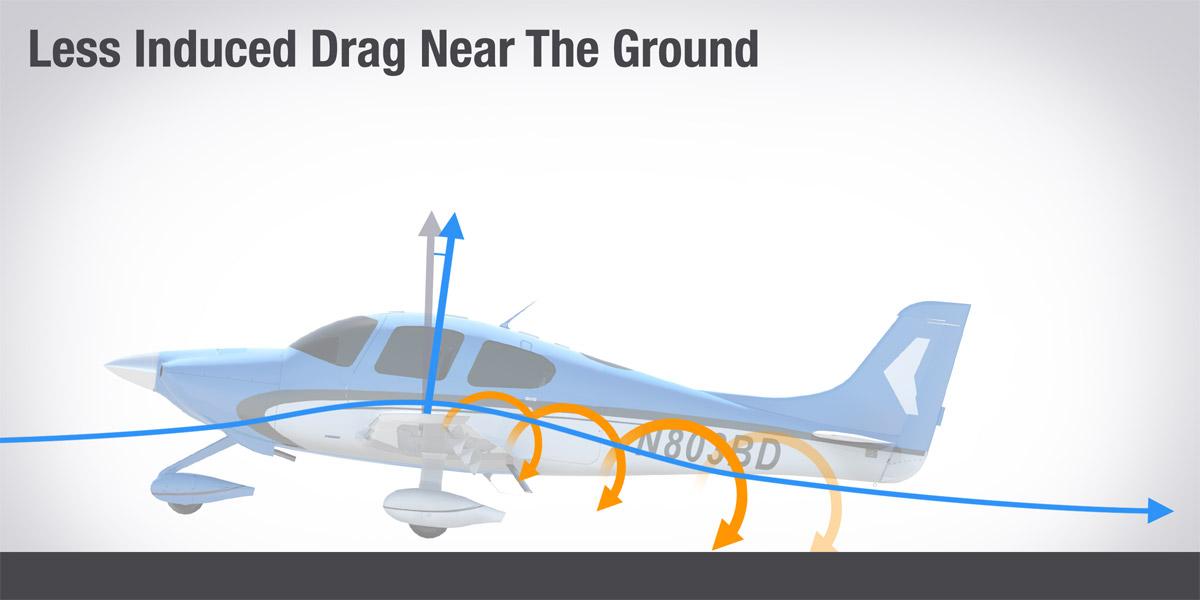
If you continue descending to the runway close to approach speed, the extra knots of speed will be hard to bleed off during the flare because of ground effect.
Exception: Gusty Winds
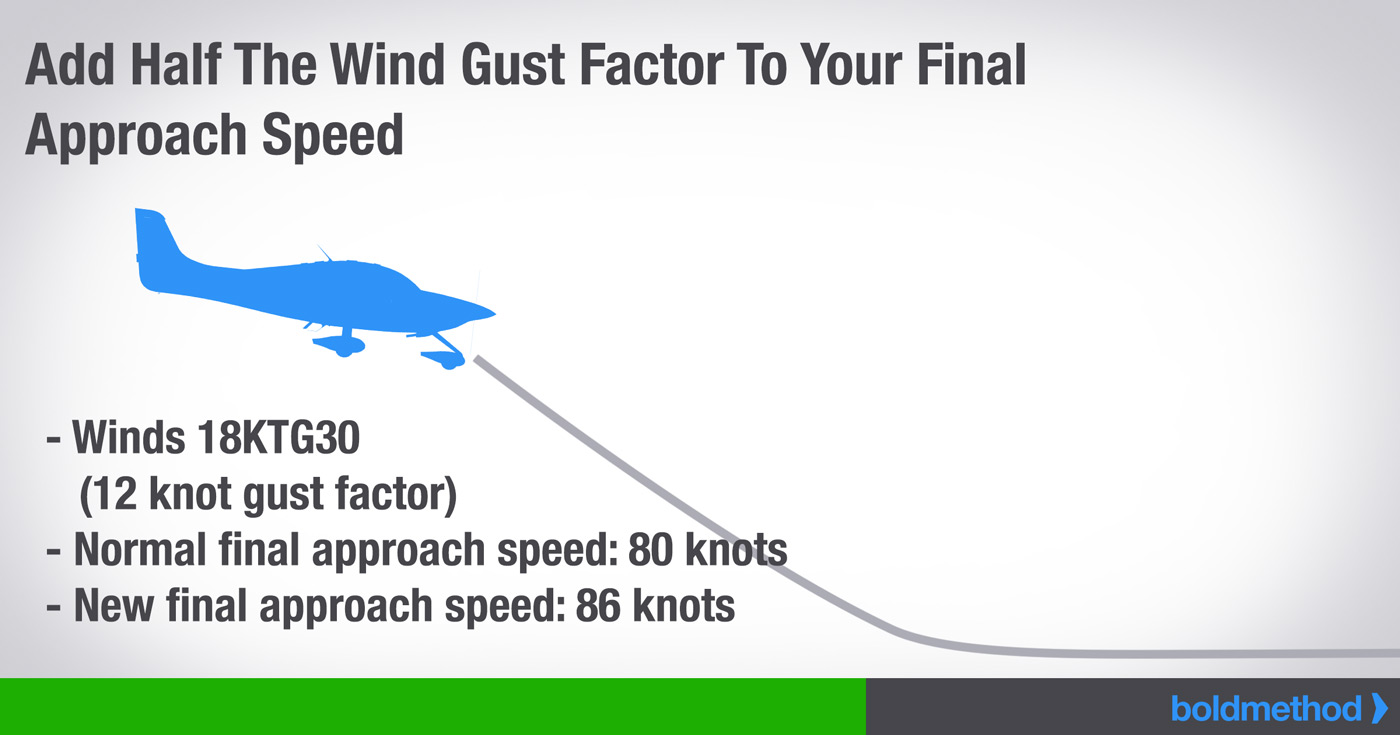
You'll fly a faster approach speed than recommended with strong, gusting winds.
Adding half of the gust factor to your final approach speed will ensure you're flying well above stall speed if you encounter wind shear. That's a good thing.
Because of this, you may also want to consider flying a faster threshold crossing speed and flare speed.
The extra knots of airspeed will give your flight controls more effectiveness, helping with crosswind control.
What do you think? How do you slow down on short final? Tell us in the comments below.
Take The Next Step...
Do you have a perfect takeoff and landing every time? Neither do we. That's why we built our Mastering Takeoffs and Landings online course.
You'll learn strategies, tactics and fundamental principles that you can use on your next flight, and just about any takeoff or landing scenario you could imagine.
Even better, the course is full of tools you can come back to throughout your flying career.

Become a better pilot.
Subscribe to the Boldmethod email and get real-world flying tips and information direct to your inbox, every week.

Swayne Martin
Swayne is an editor at Boldmethod, certified flight instructor, and an Embraer 145 First Officer for a regional airline. He graduated as an aviation major from the University of North Dakota in 2018, holds a PIC Type Rating for Cessna Citation Jets (CE-525), and is a former pilot for Mokulele Airlines. He's the author of articles, quizzes and lists on Boldmethod every week. You can reach Swayne at swayne@boldmethod.com, and follow his flying adventures on his YouTube Channel.
threshold-crossing-speedgust-factorground-less-induced-drag
finalPrimary