Tuesday, March 3, 2020

RIPPLES IN WATER - Even on a day when you don’t feel any wind, there will always be some movement in the air, and at the surface of a water body, that movement causes small ripples to form. Wind energy is being transferred to the minuscule water molecules, which begin to move up and down, gently rising and falling, pulling along with the molecules beside them. However, the surface tension of water is quite strong, due to the polar nature of water molecules, and this tension will stop the ripples from perpetuating very far or for very long. The energy transferred into the water is quickly used up in moving those molecules up and down, so the ripples fade. This is what gives the ripples on a lake their transient, sparkling appearance, as they briefly rise and catch the light before settling back into stillness. When you throw a rock into a body of water, the rock will push water out of its way as it enters, causing ripples to move away from its point of entry in a circle or ring shape. Water will then rush back in to fill the empty space, which can often cause a splash, resulting in more ripples forming.

i think we can officially call this one wave
...............................................................................................................................................................
ripples are like sunsets memeRipples In Water
What Causes Ripples In Water?
John Staughton 


Ripples in water are more formally known as capillary waves, and are caused by the subtle interaction of wind and water, or the physical interaction of the water with another object. 
Have you ever stood at the edge of a lake on a hot summer day and stared out across the water?
Even if there isn’t a whisper of wind against your face, you will likely still see faint lines and irregularities in the water.
The light will reflect off movement at the surface, and small ripples will be seen in patches, sometimes appearing to move in different directions.
Imagine picking up a stone and chucking it into the lake, where it lands with a satisfying splash, and an expanding ring of ripples will appear.
These patterns and shapes that we see or create in water bodies are commonly referred to as ripples, but why do they form and what affects how long they last?
What is a Ripple?
Even on a day when you don’t feel any wind, there will always be some movement in the air, and at the surface of a water body, that movement causes small ripples to form.
Wind energy is being transferred to the minuscule water molecules, which begin to move up and down, gently rising and falling, pulling along with the molecules beside them.
However, the surface tension of water is quite strong, due to the polar nature of water molecules, and this tension will stop the ripples from perpetuating very far or for very long.
The energy transferred into the water is quickly used up in moving those molecules up and down, so the ripples fade.
This is what gives the ripples on a lake their transient, sparkling appearance, as they briefly rise and catch the light before settling back into stillness.
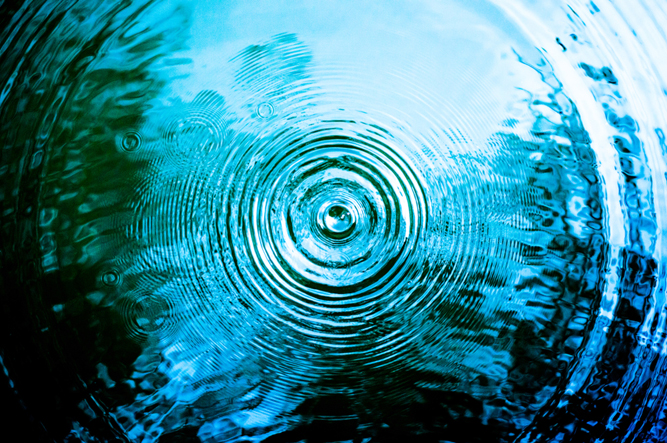
When you throw a rock into a body of water, the rock will push water out of its way as it enters, causing ripples to move away from its point of entry in a circle or ring shape.
Water will then rush back in to fill the empty space, which can often cause a splash, resulting in more ripples forming.
You can try this yourself by dropping a marble straight down into a bowl of water. Watch the resultant splash rise straight up and then fall back in, sending out a second ring of ripples.
The larger the rock, the greater the effect and the stronger the ripple, meaning that it will last longer before disappearing.
The reason that these ripples don’t behave like waves on a beach is because they aren’t strong enough; they lack the energy to persist in the face of water’s strong surface tension.
These types of ripples may also form when water is moving in a certain direction and encounters an obstacle, such as a fishing boat, a breakwall, or even your feet as they dangle off a dock!
Water molecules will encounter an object and move upwards against it, before being pulled back down by the neighboring molecules.
This interaction causes a ripple to form that moves in the opposite direction of the water’s initial motion.
Now, while a ripple is a type of wave motion — a capillary wave, to be precise — when we are talking about water bodies, there is a clear difference between a ripple and a wave.
Ripples vs Waves vs Swells
As mentioned above, a ripple is a transient, short-lived phenomena that quickly disappears once its input energy is used up.
However, if wind continually moves over a body of water, creating a steady stream of ripples, they can begin to accrue more energy, and will turn into waves, like those you might see crashing on a beach.
While ripples are unable to overcome the force of surface tension, waves can build up enough energy to do so if the wind blows steadily over a large enough patch of water.
Such waves will always flow in the same direction as the wind, and will shift direction if the wind changes.
When waves move into shallower water, the bottom part of the wave will decrease in speed, and the top part of the wave will overtake it, causing the wave to break.
This can also be seen in the ocean open, particularly during a storm or when the seas are choppy, i.e., when different weather systems are interacting, or when the wind is rapidly changing direction.
If the wind is persistent and strong, it can begin to generate the most persistent type of movement — a swell.
While waves always move in the same direction as the wind, a swell forms when those waves move out of the area they were initially made.
The water of a swell has gathered enough energy and momentum that it can actually move against the wind, sometimes traveling vast distances, across entire oceans, without losing its energy.
A swell is typically difficult to see against the horizon, as it is often longer, more even and slower-moving than normal waves.
Also, the distance between the troughs and peaks of a swell is usually much greater than that distance in waves formed by the wind.
A Final Word
Clearly, water is able to store and harness a lot of wind energy under the right conditions, but ripples are simply too transient, too small and have too little energy to persist and travel for long distances.
However, if you get a large enough rock and drop it from a high enough height, you may be able to create a ripple that travels out from the middle of the lake to the shoreline!

John Staughton is a traveling writer, editor, publisher and photographer who earned his English and Integrative Biology degrees from the University of Illinois. He is the co-founder of a literary journal, Sheriff Nottingham, and the Content Director for Stain’d Arts, an arts nonprofit based in Denver. On a perpetual journey towards the idea of home, he uses words to educate, inspire, uplift and evolve.
 Top view Closeup blue water rings(YJ (1)

Monday, March 2, 2020

MALARIA - Malaria is transmitted by the bite of an infected Anopheles female mosquito, which passes on the Plasmodium parasite to people. Anopheles mosquitoes thrive in areas with warm temperatures, humid conditions and high rainfall. When the malaria parasite enters a person's body, it travels to the liver, where it multiplies and matures. Parasites are then released into the bloodstream, where they invade and infect red blood cells. The parasites continue multiplying and infecting other red blood cells, and these cells eventually rupture and release toxins, causing a person to experience flu-like symptoms. As the disease progresses, the liver and spleen (which filters and stores blood) can enlarge. With severe malaria, the blood inside the body sludges, or piles up and sticks to blood vessel walls, so it doesn't flow normally. A person may die of the disease because the sludging blocks blood vessels to organs, such as the lungs, brain or kidneys, causing damage, he said.

Image result for images Malaria Causes, Symptoms & Treatment
...........................................................................................................................................................
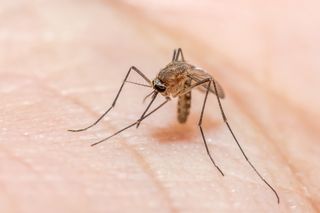
Close up of an Anopheles species of mosquito biting human skin.Malaria
Causes, Symptoms & Treatment
By Cari Nierenberg - Live Science Contributor


Malaria is a disease caused by a parasite that gets passed into the bloodstream of humans by the bite of an infected mosquito.
Image result for images Malaria Causes, Symptoms & TreatmentOnly the Anopheles species of mosquito can transmit malaria, and mosquitoes pick up the parasite from biting a person already infected with the illness. 
People with malaria typically get very sick and experience a high fever, teeth-rattling chills and muscle aches. If caught early and treated, severe illness and death can usually be prevented. 
Malaria is very rare in the United States, where about 1,700 cases and five deaths occur each year, mostly in immigrants and travelers returning from countries where the disease is common, according to the Centers for Disease Control and Prevention (CDC). 
However, in many developing countries, malaria is a leading cause of death and disease, where children under age 5 and pregnant women are the hardest hit groups.
In 2017, there were 219 million cases of malaria worldwide and about 435,000 deaths, according to the World Health Organization (WHO). The majority of cases were in tropical and subtropical countries. 
Common malaria regions include large areas of Africa south of the Sahara desert, Southeast Asia, Central and South America, Haiti and the Dominican Republic, Eastern Europe and the South Pacific, according to the American Academy of Family Physicians.
It's difficult to control malaria worldwide because parasites tend to stay in our bodies, and the immune system is not very effective at clearing them, said Dr. Edward Ryan, director of global infectious diseases at Massachusetts General Hospital in Boston.
In addition, some species of Anopheles mosquitoes are hard to wipe out, he said. 
By 1949, the U.S. eliminated malaria, according to the CDC. The country implemented a coordinated public health effort in southern states that involved spraying insecticides and removing mosquito breeding sites, Ryan said.
The growing, widespread use of air conditioning and screens on doors and windows also helped keep mosquitoes outside of homes, he said. 
How do you get malaria? 
Malaria is transmitted by the bite of an infected Anopheles female mosquito, which passes on the Plasmodium parasite to people. 
Anopheles mosquitoes thrive in areas with warm temperatures, humid conditions and high rainfall, according to the University Corporation for Atmospheric Research in Boulder, Colorado. 
Five species of Plasmodium parasites can infect people with malaria, but some species cause more serious problems than others.
The Plasmodium falciparum parasite is the one most likely to cause severe, life-threatening illness if the infection is not promptly treated. 
When the malaria parasite enters a person's body, it travels to the liver, where it multiplies and matures. Parasites are then released into the bloodstream, where they invade and infect red blood cells. 
The parasites continue multiplying and infecting other red blood cells, and these cells eventually rupture and release toxins, causing a person to experience flu-like symptoms. As the disease progresses, the liver and spleen (which filters and stores blood) can enlarge.
With severe malaria, the blood inside the body sludges, or piles up and sticks to blood vessel walls, so it doesn't flow normally, Ryan told Live Science.
A person may die of the disease because the sludging blocks blood vessels to organs, such as the lungs, brain or kidneys, causing damage, he said. 
Malaria is not spread from person to person. But in very rare instances, it can be transmitted by a blood transfusion containing the parasite, by the sharing of drug needles or from an infected mother to her baby during pregnancy or delivery.
Two groups most vulnerable to malaria are young children, who have not yet developed immunity to the disease; and pregnant women, whose immunity has decreased because they are expecting, according to the CDC. 
Other high-risk groups are visitors from countries with no malaria and therefore, no immunity, as well as travelers who grew up in malaria regions, but moved away for long periods of time and lost their partial immunity to the parasite. 
Symptoms
Symptoms of malaria may develop a week or two after a person is bitten by an infected mosquito, or they may show up several months or more after exposure, according to the National Organization for Rare Diseases.
Early symptoms may resemble the flu, such as fever, chills, headache and muscle aches, Ryan said.
Other early signs include tiredness, nausea and vomiting. Then, a person may experience a high fever and teeth-rattling chills, followed by heavy sweating and exhaustion when the fever breaks. 
Malaria can rapidly become a serious, life-threatening disease. According to the CDC, some complications of severe malaria, which is more common with P. falciparum infections, may include:
·      Liver and kidney failure
·      Mental confusion, convulsions and coma 
·      Severe anemia from destruction of red blood cells
·      Jaundice (yellowing skin and eyes) from a loss of red blood cells
·      Death
Diagnosis and treatment
A simple blood test is used to detect the malaria parasite under a microscope, Ryan said. The blood test confirms malaria parasites are present and identifies the species causing illness. 
If the illness is diagnosed early and treated, it's totally curable and all malaria parasites can be cleared from the body, he said. Both intravenous and oral medicines are available to treat malaria and remove the parasite from the blood. 
The majority of people with malaria in the U.S. are hospitalized, but the length of stay depends on which species of the parasite an individual has been infected with and how healthy someone was to start, Ryan said.
A patient will receive anti-malarial medications to fight the parasite and will be monitored to ensure the level of infection is falling. 
Some malaria drugs may not be effective because parasites have become increasingly resistant to them, making it difficult to control the disease worldwide, the CDC reports. 
Prevention
When visiting malaria-zone countries, travelers need to consider the time they will spend in each destination, the type of travel (air-conditioned hotels versus rural villages) and the season (some locations have year-round malaria risk, while others have high and low periods), Ryan said. 
Minimize risk by taking the following precautions: 
·      Take appropriate anti-malarial medications — before, during and after the visit — which are highly effective at preventing the disease, Ryan said. 
·      Apply insect repellent. Choose products containing DEET when applying the repellent on exposed skin. Spray pyrethrin, an insecticide, on clothing. 
·      Limit outdoor activities between dusk and dawn — the peak feeding times for Anopheles mosquitoes. Wear long-sleeved shirts and pants to cover skin. 
·      Use bed netting. If visiting rural villages, sleep under insecticide-treated bed netting and spray insecticides indoors to keep mosquitoes away. 

For the science geek in everyone, Live Science breaks down the stories behind the most interesting news and photos on the Internet, while also digging up fascinating discoveries that hit on a broad range of fields, from dinosaurs and archaeology to wacky physics and astronomy to health and human behavior. If you want to learn something interesting every day, Live Science is the place for you.
Image result for images Malaria Causes, Symptoms & Treatment

ADENOSINE TRIPHOSPHATE - Adenosine triphosphate or ATP is often called the energy currency of the cell because this molecule plays a key role in metabolism, particularly in energy transfer within cells. The molecule acts to couple the energy of exergonic and endergonic processes, making energetically unfavorable chemical reactions able to proceed. Adenosine triphosphate is used to transport chemical energy in many important processes. In addition to metabolic functions, ATP is involved in signal transduction. It is believed to be the neurotransmitter responsible for the sensation of taste. The human central and peripheral nervous system, in particular, relies on ATP signaling. ATP is also added to nucleic acids during transcription. ATP is continuously recycled, rather than expended. It's converted back into precursor molecules, so it can be used again and again. Another way to look at it is that a single molecule of ATP gets recycled 500-700 times every day. At any moment in time, the amount of ATP plus ADP is fairly constant.

ATP is important for metabolism because it provides energy coupling between endergonic and exergonic biochemical reactions.
...................................................................................................................................................................
Adenosine Triphosphate
What You Need To Know About Adenosine Triphosphate or ATP
By Anne Marie Helmenstine, Ph.D.


Adenosine triphosphate or ATP is often called the energy currency of the cell because this molecule plays a key role in metabolism, particularly in energy transfer within cells.
The molecule acts to couple the energy of exergonic and endergonic processes, making energetically unfavorable chemical reactions able to proceed.
Metabolic Reactions Involving ATP
Adenosine triphosphate is used to transport chemical energy in many important processes, including:
·          aerobic respiration (glycolysis and the citric acid cycle)
·         fermentation
·         cellular division
·         photophosphorylation
·          motility (e.g., shortening of myosin and actin filament cross-bridges as well ​as cytoskeleton construction)
·         exocytosis and endocytosis
·         photosynthesis
·         protein synthesis
In addition to metabolic functions, ATP is involved in signal transduction. It is believed to be the neurotransmitter responsible for the sensation of taste.
The human central and peripheral nervous system, in particular, relies on ATP signaling. ATP is also added to nucleic acids during transcription.
ATP is continuously recycled, rather than expended. It's converted back into precursor molecules, so it can be used again and again.
In human beings, for example, the amount of ATP recycled daily is about the same as body weight, even though the average human being only has about 250 grams of ATP.
Another way to look at it is that a single molecule of ATP gets recycled 500-700 times every day.
At any moment in time, the amount of ATP plus ADP is fairly constant. This is important since ATP is not a molecule that can be stored for later use.​
ATP may be produced from simple and complex sugars as well as from lipids via redox reactions. For this to occur, the carbohydrates must first be broken down into simple sugars, while the lipids must be broken ​into fatty acids and glycerol.
However, ATP production is highly regulated. Its production is controlled via substrate concentration, feedback mechanisms, and allosteric hindrance.
ATP Structure
As indicated by the molecular name, adenosine triphosphate consists of three phosphate groups (tri- prefix before phosphate) connected to adenosine.
Adenosine is made by attaching the 9' nitrogen atom of the purine base adenine to the 1' carbon of the pentose sugar ribose.
The phosphate groups are attached connecting and oxygen from a phosphate to the 5' carbon of the ribose.
Starting with the group closest to the ribose sugar, the phosphate groups are named alpha (α), beta (β), and gamma (γ).
Removing a phosphate group results in adenosine diphosphate (ADP) and removing two groups produces adenosine monophosphate (AMP).
How ATP Produces Energy
The key to energy production lies ​with the phosphate groups. Breaking the phosphate bond is an exothermic reaction. 
So, when ATP loses one or two phosphate groups, energy is released. More energy is released breaking the first phosphate bond than the second.
ATP + H2O → ADP + Pi + Energy (Δ G = -30.5 kJ.mol-1)
ATP + H2O 
→ AMP + PPi + Energy (Δ G = -45.6 kJ.mol-1)
The energy that is released is coupled to an endothermic (thermodynamically unfavorable) reaction in order to give it ​the activation energy needed to proceed.
ATP Facts
ATP was discovered in 1929 by two independent sets of researchers: Karl Lohmann and also Cyrus Fiske/Yellapragada Subbarow.
Alexander Todd first synthesized the molecule in 1948.
Empirical Formula
C10H16N5O13P3
Chemical Formula
C10H8N4O2NH2(OH2)(PO3H)3H
Molecular Mass
507.18 g.mol-1
What Is ATP an Important Molecule in Metabolism?
There are essentially two reasons ATP is so important:
1.    It's the only chemical in the body that can be directly used as energy.
2.    Other forms of chemical energy need to be converted into ATP before they can be used.
Another important point is that ATP is recyclable. If the molecule was used up after each reaction, it wouldn't be practical for metabolism.
ATP Trivia
·          Want to impress your friends? Learn the IUPAC name for adenosine triphosphate. It's [(2''R'',3''S'',4''R'',5''R'')-5-(6-aminopurin-9-yl)-3,4-dihydroxyoxolan-2-yl]methyl(hydroxyphosphonooxyphosphoryl)hydrogen phosphate.
·         While most students study ATP as it relates to animal metabolism, the molecule is also the key form of chemical energy in plants.
·         The density of pure ATP is comparable to that of water. It's 1.04 grams per cubic centimeter.
·         The melting point of pure ATP is 368.6°F (187°C).

Anne Marie Helmenstine, Ph.D.
Chemistry Expert
Education
Ph.D., Biomedical Sciences, University of Tennessee at Knoxville
B.A., Physics and Mathematics, Hastings College
Introduction
Ph.D. in biomedical sciences from the University of Tennessee at Knoxville - Oak Ridge National Laboratory.
Science educator with experience teaching chemistry, biology, astronomy, and physics at the high school, college, and graduate levels.
ThoughtCo and About Education chemistry expert since 2001.
Widely-published graphic artist, responsible for printable periodic tables and other illustrations used in science.
Experience
Anne Helmenstine, Ph.D. has covered chemistry for ThoughtCo and About Education since 2001, and other sciences since 2013. She taught chemistry, biology, astronomy, and physics at the high school, college, and graduate levels. She has worked as a research scientist and also abstracting and indexing diverse scientific literature for the Department of Energy.
In addition to her work as a science writer, Dr. Helmenstine currently serves as a scientific consultant, specializing in problems requiring an interdisciplinary approach. Previously, she worked as a research scientist and college professor. 
Education
Dr. Helmenstine holds a Ph.D. in biomedical sciences from the University of Tennessee at Knoxville and a B.A. in physics and mathematics with a minor in chemistry from Hastings College. In her doctoral work, Dr. Helmenstine developed ultra-sensitive chemical detection and medical diagnostic tests.
ThoughtCo and Dotdash
ThoughtCo is a premier reference site focusing on expert-created education content. We are one of the top-10 information sites in the world as rated by comScore, a leading Internet measurement company. Every month, more than 13 million readers seek answers to their questions on ThoughtCo.
For more than 20 years, Dotdash brands have been helping people find answers, solve problems, and get inspired. We are one of the top-20 largest content publishers on the Internet according to comScore, and reach more than 30% of the U.S. population monthly. Our brands collectively have won more than 20 industry awards in the last year alone, and recently Dotdash was named Publisher of the Year by Digiday, a leading industry publication.

ATP is important for metabolism because it provides energy coupling between endergonic and exergonic biochemical reactions.