Sunday, September 2, 2018

DENSITIES OF COMMON SUBSTANCES - Density is a measure of the amount of mass contained in a unit of volume. Most gases are less dense than liquids, which are in turn less dense than solids, but there are numerous exceptions. The density of pure water is defined to be 1 gram per cubic centimeter (or, g/ml). Unlike most substances, water is denser as a liquid than as a solid. A consequence is that ice floats on water. Also, pure water is less dense than seawater, so fresh water can float on top of salt water, mixing at the interface.

Iceberg

Densities Of Common Substances
Table of Densities of Common Substances
Compare the Densities of Solids, Liquids, and Gases
By Anne Marie Helmenstine, Ph.D.
Here's a table of densities of common substances, including several gases, liquids, and solids.
Density is a measure of the amount of mass contained in a unit of volume.
The general trend is that most gases are less dense than liquids, which are in turn less dense than solids, but there are numerous exceptions.
For this reason, the table lists density from lowest to highest and includes the state of matter.
Note that the density of pure water is defined to be 1 gram per cubic centimeter (or, g/ml).
Unlike most substances, water is denser as a liquid than as a solid.
A consequence is that ice floats on water.
Also, pure water is less dense than seawater, so fresh water can float on top of salt water, mixing at the interface.
The Factors That Affect Density
Density depends on temperature and pressure.
For solids, it's also affected by the way atoms and molecules stack together.
A pure substance can take many forms, which don't have the same properties. For example, carbon can take the form of graphite or diamond.
Both are chemically identical, but they do not share an identical density value.
To convert these density values into kilograms per cubic meter, multiply any of the numbers by 1000.
Densities of Common Substances
Material
Density (g/cm3)
State of Matter
hydrogen (at STP)
0.00009
gas
helium (at STP)
0.000178
gas
carbon monoxide (at STP)
0.00125
gas
nitrogen (at STP)
0.001251
gas
air (at STP)
0.001293
gas
carbon dioxide (at STP)
0.001977
gas
lithium
0.534
solid
ethanol (grain alcohol)
0.810
liquid
benzene
0.900
liquid
ice
0.920
solid
water at 20°C
0.998
liquid
water at 4°C
1.000
liquid
seawater
1.03
liquid
milk
1.03
liquid
coal
1.1-1.4
solid
blood
1.600
liquid
magnesium
1.7
solid
granite
2.6-2.7
solid
aluminum
2.7
solid
steel
7.8
solid
iron
7.8
solid
copper
8.3-9.0
solid
lead
11.3
solid
mercury
13.6
liquid
uranium
18.7
solid
gold
19.3
solid
platinum
21.4
solid
osmium
22.6
solid
iridium
22.6
solid
white dwarf star
107
solid


Anne Marie Helmenstine, Ph.D.
Ph.D. in biomedical sciences from the University of Tennessee at Knoxville - Oak Ridge National Laboratory.
Science educator with experience teaching chemistry, biology, astronomy, and physics at the high school, college, and graduate levels.
ThoughtCo and About Education chemistry expert since 2001.
Widely-published graphic artist, responsible for printable periodic tables and other illustrations used in science.
Experience
Anne Helmenstine, Ph.D. has covered chemistry for ThoughtCo and About Education since 2001, and other sciences since 2013. She taught chemistry, biology, astronomy, and physics at the high school, college, and graduate levels. She has worked as a research scientist and also abstracting and indexing diverse scientific literature for the Department of Energy.
In addition to her work as a science writer, Dr. Helmenstine currently serves as a scientific consultant, specializing in problems requiring an interdisciplinary approach. Previously, she worked as a research scientist and college professor. 
Education
Dr. Helmenstine holds a Ph.D. in biomedical sciences from the University of Tennessee at Knoxville and a B.A. in physics and mathematics with a minor in chemistry from Hastings College. In her doctoral work, Dr. Helmenstine developed ultra-sensitive chemical detection and medical diagnostic tests.
ThoughtCo and Dotdash
ThoughtCo is a premier reference site focusing on expert-created education content. We are one of the top-10 information sites in the world as rated by comScore, a leading Internet measurement company. Every month, more than 13 million readers seek answers to their questions on ThoughtCo.
For more than 20 years, Dotdash brands have been helping people find answers, solve problems, and get inspired. We are one of the top-20 largest content publishers on the Internet according to comScore, and reach more than 30% of the U.S. population monthly. Our brands collectively have won more than 20 industry awards in the last year alone, and recently Dotdash was named Publisher of the Year by Digiday, a leading industry publication.
Iceberg


STEERING AN AIRLINER - Although pilots of smaller aircraft use rudder pedals for steering the nose wheel, airliners have a ground steering system that is quite a bit more unique. Located on the console directly to the left of the captain’s seat is a small wheel or triangular-shaped device called the “tiller” used exclusively for steering when the airplane on the ground. Normally, pilots follow yellow centerline stripes painted on ramps and taxiways, but very large airliners require special techniques to maintain correct position on these stripes while turning, since their nose wheels can be located well behind and far below the cockpit.

air serbia
......................
Steering An Airliner
HOW DO PILOTS STEER AN AIRLINER ON THE GROUND?
By Airline Ratings 
We’ve all seen pictures of airline pilots in the cockpit holding either a large yoke or side-stick controller that enables them to fly their aircraft safely and with great accuracy.
However, when on the ground, how does the pilot steer the nose wheel to accurately guide the aircraft while navigating the maze of taxiways leading to and from the runway?
Although pilots of smaller aircraft use rudder pedals for steering the nose wheel, airliners have a ground steering system that is quite a bit more unique.
Located on the console directly to the left of the captain’s seat is a small wheel or triangular-shaped device called the “tiller” used exclusively for steering when the airplane on the ground.
Normally, pilots follow yellow centerline stripes painted on ramps and taxiways, but very large airliners require special techniques to maintain correct position on these stripes while turning, since their nose wheels can be located well behind and far below the cockpit.
On takeoff, ground steering is used until the airliner’s aerodynamic controls become effective at speeds of about 60-to-80 mph, while the reverse procedure is used during landing.

air serbia

LAB-GROWN DIAMONDS - Lab-grown diamonds have been produced since the 1950s. Nearly all of the earliest lab-grown diamonds were put to industrial uses such as making abrasive granules for cutting, drilling, and polishing tools. One of the main incentives for developing methods of producing man-made diamonds was the fact that abrasive tool industries were starting to consume more diamond than could easily be supplied by mining. Just like the natural diamonds that form deep within the Earth, lab-grown diamonds are a crystalline form of carbon with a cubic (isometric) crystal structure. Today, several companies are creating commercial quantities of beautiful lab-grown diamonds with spectacular clarity and color. Now, several percent of the diamonds entering the gem and jewelry marketplace are laboratory-grown.

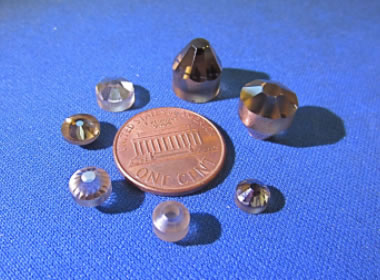
synthetic diamond anvils
Diamond Anvils manufactured from synthetic diamond are used in high-pressure testing and experiments. These anvils were manufactured from CVD diamond. Their bases measure between 5 and 10 millimeters in diameter and their culets between 1.5 and 3 millimeters.
...............................................................................................................................................................
Lab-Grown Diamonds
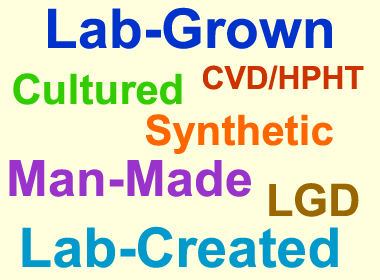
Names for lab-grown diamonds
Names for Lab-Grown Diamonds: These are some of the names
that people use to refer to lab-grown diamonds: Cultured, CVD/HPHT
(Chemical Vapor Deposition / High-Pressure High-Temperature), 
Synthetic, Man-Made, LGD (Lab-Grown Diamond), 
and Lab-Created, among others.

Also known as lab-created diamonds, man-made diamonds, synthetic diamonds
Author: Hobart M. King, Ph.D., GIA Graduate Gemologist


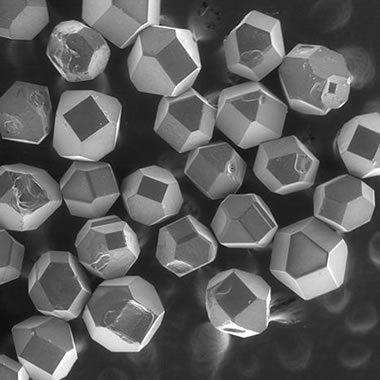
synthetic diamonds
Synthetic Diamonds grown in the High-Temperature Materials Laboratory 
of the Moscow Steel and Alloys Institute.

What Are Lab-Grown Diamonds?
Lab-grown diamonds are diamonds that have been made by people.
Just like the natural diamonds that form deep within the Earth, lab-grown diamonds are a crystalline form of carbon with a cubic (isometric) crystal structure.
Lab-grown diamonds have chemical, physical, and gemological properties that are the same as natural diamonds.
However, the manufacturing processes used to produce lab-grown diamonds give them subtle features that trained gemologists and specialized instruments can use to separate lab-grown diamonds from natural diamonds.
An ability to distinguish natural diamonds from lab-grown diamonds is very important.
In the gem and jewelry industry, many people have a strong preference for natural diamonds. They prefer them because they are made by nature and also because of their rarity.
As a result, natural diamonds sell for a higher price than lab-grown diamonds. However, many people will gladly buy a lab-grown diamond because they can be purchased at a significant cost savings.
A Brief History of Lab-Grown Diamonds
Lab-grown diamonds have been produced since the 1950s. Nearly all of the earliest lab-grown diamonds were put to industrial uses such as making abrasive granules for cutting, drilling, and polishing tools.
One of the main incentives for developing methods of producing man-made diamonds was the fact that abrasive tool industries were starting to consume more diamond than could easily be supplied by mining.
The young diamond-growing industry had the potential to produce an unlimited and reliable supply of diamond abrasives if the cost of production was contained.
This challenge was quickly achieved. Today diamond abrasive granules are produced in hundreds of factories in many parts of the world at a cost of under $1 per carat.
Within a few decades, lab-grown diamonds were being made pure enough and large enough that they could be used in a variety of high-tech applications.
Lab-grown diamonds were being used as heat sinks in advanced computers; wear-resistant coatings on tools and bearings; high-durability windows; tiny anvils for high pressure experiments; specialized lenses; speaker domes; and much more.
During the 1990s a small number of gem-quality diamonds were being produced in laboratories, but very few entered the marketplace.
These diamonds were costly to produce, and manufacturers needed to reduce costs and improve quality to be competitive in the diamond jewelry market.
By 2010, the quality of lab-grown diamonds had improved significantly. A small but increasing number of lab-grown diamonds began entering the gem and jewelry market.
Today, several companies are creating commercial quantities of beautiful lab-grown diamonds with spectacular clarity and color.
Now, several percent of the diamonds entering the gem and jewelry marketplace are laboratory-grown.
Separating Natural and Lab-Grown from Imitation
An ability to positively identify natural diamonds, lab-grown diamonds, and the many imitation materials is essential today for several reasons.
First, significant price differences exist between these materials.
Second, diamond customers are cautious and want to know exactly what they are buying.
And, third, the reputation of every business that sells diamonds is at risk.
Diamond merchants who do not monitor and confirm the identity of inventory coming into their business expose themselves to the risk of financial loss, civil liability and a loss of reputation.
Misidentified merchandise and fraud can enter the supply chain at any level.
Fortunately, both lab-grown and natural diamonds are distinctly different from the many diamond imitations such as cubic zirconia and synthetic moissanite.
These imitations differ from lab-grown diamonds and natural diamonds in many ways. They have a completely different chemical composition and a variety of different physical properties.
Competent gemologists can easily recognize the imitations.
Most jewelry professionals, with training and practice, can separate imitations from natural and synthetic diamonds with a simple testing device that can be purchased for less than $200.
Differences Between Lab-Grown and Natural
Contrary to some marketing messages, lab-grown diamonds and natural diamonds are not identical in every way.
Lab-grown diamonds are produced at Earth’s surface by two different processes: HPHT (high pressure high temperature) and CVD (chemical vapor deposition).
Diamond crystals grown in these manufacturing processes inherit characteristics of the manufacturing process that can be used to tell them apart. These characteristics can also be used to separate them from natural diamonds.
Some lab-grown diamonds can be separated from natural diamonds by a trained gemologist using standard tools.
Using a gemological microscope, the gemologist can sometimes identify inclusions or other features that are unique to HPHT-grown diamonds, CVD diamonds or natural diamonds.
Using a microscope that enables observations using ultraviolet light can reveal growth patterns unique to these different types of diamonds, but most gemologists do not have this equipment.
Even if the gemologist had that equipment, and the necessary training, many diamonds would not be identified with certainty. Thus, more sophisticated tools are needed.
Fortunately, several companies have invented portable screening devices that can separate natural diamonds from lab-grown diamonds.
These devices correctly identify about 98% of natural diamonds and refer all other stones (lab-created diamonds, imitation materials, and the remaining 2% of natural diamonds) for additional testing.
The cost of these screening devices starts at about $4000.
More sophisticated devices that successfully separate natural, lab-grown, and imitation stones from one another can be purchased, but the cost for these starts at about $20,000, which is quite costly for many small businesses.
To buy and sell with safety and confidence, a business must invest in the knowledge of its staff and obtain the necessary equipment.
Appropriate Names for Diamonds
A wide variety of names have been used for diamonds that have been made by people.
In the early days, the names "synthetic diamonds" and "man-made diamonds" were most often used.
Synthetic diamonds was the more scientific name and the name used among technical people. Man-made diamonds was a name used by the general public.
Up until recently the name "lab created" was used much more often than "lab grown".
In December of 2013 the number of people using the name "lab created diamonds" as a Google search query was rivaling the use of "man made diamonds", which was the dominant search query for these materials at that time.
In February of 2017 "lab created diamonds" became the clearly dominant query. (You can see this history for yourself in the graphic above.)
Then a major shift hit the language of Google search queries. In June of 2018, "lab grown diamonds" shot up to the leading position.
This date is coincident with the first appearance of heavy online advertising for the Lightbox diamond brand of De Beers.
Their ads and their website clearly used the name "lab-grown diamonds." Their product launch most likely changed the language being used by people searching Google.
It also caused a major increase in the number of people who queried Google for information about diamonds made by people.

Hobart M. King is the owner and publisher of Geology.com. He is a geologist with over 40 years of experience, has a Ph.D. in geology, and is a GIA graduate gemologist. Much of his work has focused on coal geology, industrial minerals, gemology, geologic hazards, and geoscience education.
He has authored many of the internet’s most popular articles about rocksminerals and gems. He writes most of the content published on Geology.com and compiles its daily news. His writing is read by over a million people each month, making him one of the world’s most widely read geologists.
Hobart M. King, Ph.D., GIA GG
Dr. King earned a Ph.D. and an M.S. in geology from West Virginia University; a B.S. in geology from California University of Pennsylvania; and, a Graduate Gemologist Diploma from the Gemological Institute of America. He is a registered professional geologist in the Commonwealth of Pennsylvania.
He has worked as a geologist in a variety of settings since 1975.
https://geology.com/diamond/lab-grown-diamonds/
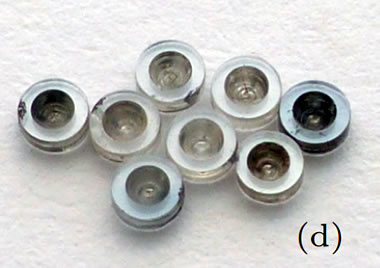
diamond lenses
Diamond Lenses: A photograph of concave parabolic diamond x-ray lenses. Diamond lenses for focusing x-ray beams have been in use since the late 1990s. The lenses in this photo are about 1 millimeter across. 

Saturday, September 1, 2018

ELEMENTS AND COMPOUNDS IN THE HUMAN BODY - Oxygen is the most abundant element in the human body accounting for approximately 65% of a person's mass. Carbon is contained in all organic compounds, which is why carbon is the second most abundant element in the body, accounting for about 18% of body mass. Hydrogen atoms are the most numerous type of atom in a human, but because they are so light, they only make up around 10% of the mass. Hydrogen is in water, plus it's an important electron carrier.

Most of the human body consists of water, which is made from hydrogen and oxygen.
.
Elements and Compounds In The Human Body
Chemical Composition of the Human Body
Human Body Composition as Elements and Compounds
By Anne Marie Helmenstine, Ph.D.
Many of the elements found throughout nature are also found within the body.
This is the chemical composition of the average adult human body in terms of elements and also compounds.
Major Classes of Compounds in the Human Body
Most of the elements are found within compounds.
Water and minerals are inorganic compounds.
Organic compounds include fat, protein, carbohydrates, and nucleic acids.
·  Water: Water is the most abundant chemical compound in living human cells, accounting for 65 percent to 90 percent of each cell. It's also present between cells. For example, blood and cerebrospinal fluid are mostly water.
·  Fat: The percentage of fat varies from person to person, but even an obese person has more water than fat.
·  Protein: In a lean male, the percentages of protein and water are comparable. It's about 16 percent by mass. Muscles, including the heart, contain a lot of muscle. Hair and fingernails are protein. Skin contains a large amount of protein, too.
·  Minerals: Minerals account for about 6 percent of the body. They include salts and metals. Common minerals include sodium, chlorine, calcium, potassium, and iron.
·  Carbohydrates: Although humans use the sugar glucose as an energy source, there isn't that much of it free in the bloodstream at any given time. Sugar and other carbohydrates only account for about 1% of body mass.
.
Elements in the Human Body
Six elements account for 99% of the mass of the human body.
The acronym CHNOPS may be used to help remember the six key chemical elements that are used in biological molecules.
C is carbon, H is hydrogen, N is nitrogen, O is oxygen, P is phosphorus, and S is sulfur.
While the acronym is a good way to remember the identities of the elements, it doesn't reflect their abundance.
·  Oxygen is the most abundant element in the human body accounting for approximately 65% of a person's mass. Each water molecule consists of two hydrogen atoms bonded to one oxygen atom, but the mass of each oxygen atom is much higher than the combined mass of the hydrogen. In addition to being a component of water, oxygen is essential for cellular respiration.
·  Carbon is contained in all organic compounds, which is why carbon is the second most abundant element in the body, accounting for about 18% of body mass. Carbon is found in proteins, carbohydrates, lipids, and nucleic acids. It's also found in carbon dioxide.
·  Hydrogen atoms are the most numerous type of atom in a human, but because they are so light, they only make up around 10% of the mass. Hydrogen is in water, plus it's an important electron carrier.
·  Nitrogen is about 3.3% of body mass. It's found in proteins and nucleic acids.
·  Calcium accounts for 1.5% of body mass. It's used to build bones and teeth, plus it's important for muscle contraction.
·  Phosphorus is about 1% of body mass. This element is found in nucleic acids. Breaking bonds connecting phosphate molecules is a major component of energy transfer.
·  Potassium is around 0.2-0.4% of the mass of a person. It's used in nerve conduction. Potassium is a key cation or positively-charged ion in the body.
·  Sulfur is found in some amino acids and proteins. It's about 0.2-0.3% of body mass.
·  Sodium, like potassium, is a positively-charged ion. It's about 0.1-0.2% of body mass. Sodium helps regulate the electrolyte balance in the body and maintain homeostasis with respect to the volume of water in the blood and cells.
·  Although aluminum and silicon are abundant in the earth's crust, they are found in trace amounts in the human body.
·  Other trace elements include metals, which are often cofactors for enzymes. Trace elements include iron, cobalt, zinc, iodine, selenium, and flourine.
Element
Percent by Mass
Oxygen
65
Carbon
18
Hydrogen
10
Nitrogen
3
Calcium
1.5
Phosphorus
1.2
Potassium
0.2
Sulfur
0.2
Chlorine
0.2
Sodium
0.1
Magnesium
0.05
Iron, Cobalt, Copper, Zinc, Iodine
trace
Selenium, Fluorine
minute amounts
Reference: Chang, Raymond (2007). Chemistry, Ninth Edition. McGraw-Hill. pp. 52.

Anne Marie Helmenstine, Ph.D.

Ph.D. in biomedical sciences from the University of Tennessee at Knoxville - Oak Ridge National Laboratory.
Science educator with experience teaching chemistry, biology, astronomy, and physics at the high school, college, and graduate levels.
ThoughtCo and About Education chemistry expert since 2001.
Widely-published graphic artist, responsible for printable periodic tables and other illustrations used in science.
Experience
Anne Helmenstine, Ph.D. has covered chemistry for ThoughtCo and About Education since 2001, and other sciences since 2013. She taught chemistry, biology, astronomy, and physics at the high school, college, and graduate levels. She has worked as a research scientist and also abstracting and indexing diverse scientific literature for the Department of Energy.
In addition to her work as a science writer, Dr. Helmenstine currently serves as a scientific consultant, specializing in problems requiring an interdisciplinary approach. Previously, she worked as a research scientist and college professor. 
Education
Dr. Helmenstine holds a Ph.D. in biomedical sciences from the University of Tennessee at Knoxville and a B.A. in physics and mathematics with a minor in chemistry from Hastings College. In her doctoral work, Dr. Helmenstine developed ultra-sensitive chemical detection and medical diagnostic tests.
ThoughtCo and Dotdash
ThoughtCo is a premier reference site focusing on expert-created education content. We are one of the top-10 information sites in the world as rated by comScore, a leading Internet measurement company. Every month, more than 13 million readers seek answers to their questions on ThoughtCo.
For more than 20 years, Dotdash brands have been helping people find answers, solve problems, and get inspired. We are one of the top-20 largest content publishers on the Internet according to comScore, and reach more than 30% of the U.S. population monthly. Our brands collectively have won more than 20 industry awards in the last year alone, and recently Dotdash was named Publisher of the Year by Digiday, a leading industry publication.

Most of the human body consists of water, which is made from hydrogen and oxygen.