Showing posts with label Physics. Show all posts

Friday, February 5, 2021

HOW A THERMOMETER MEASURES AIR TEMPERATURE - A thermometer -- an instrument used to measure air temperature—easily tells us this, but how it tells us is another question entirely. To understand how a thermometer works, we need to keep one thing in mind from physics: that a liquid expands in volume (the amount of space it takes up) when its temperature warms and decreases in volume when its temperature cools. When a thermometer is exposed to the atmosphere, the surrounding air's temperature will permeate it, eventually balancing the thermometer's temperature with its own — a process whose fancy scientific name is "thermodynamic equilibrium." If the thermometer and it's inside liquid must warm to reach this equilibrium, the liquid (which will take up more space when warmed) will rise because it is trapped inside of a narrow tube and has nowhere to go but up. Likewise, if the thermometer's liquid must cool to reach the air's temperature, the liquid will shrink in volume and lower down the tube. Once the thermometer's temperature balances that of the surrounding air, its liquid will stop moving. The physical rise and fall of the liquid inside of a thermometer is only part of what makes it work. Yes, this action tells you that a temperature change is occurring, but without a numerical scale to quantify it, you'd be unable to measure just what the temperature change is.

...............................................................................................................................................................................................................................................................................................................................................................

How Does a Thermometer Measure Air Temperature?

By Tiffany Means


How warm is it outside?

How cold will it be tonight?

A thermometer -- an instrument used to measure air temperature—easily tells us this, but how it tells us is another question entirely.

To understand how a thermometer works, we need to keep one thing in mind from physics: that a liquid expands in volume (the amount of space it takes up) when its temperature warms and decreases in volume when its temperature cools.

When a thermometer is exposed to the atmosphere, the surrounding air's temperature will permeate it, eventually balancing the thermometer's temperature with its own — a process whose fancy scientific name is "thermodynamic equilibrium."

If the thermometer and it's inside liquid must warm to reach this equilibrium, the liquid (which will take up more space when warmed) will rise because it is trapped inside of a narrow tube and has nowhere to go but up.

Likewise, if the thermometer's liquid must cool to reach the air's temperature, the liquid will shrink in volume and lower down the tube.

Once the thermometer's temperature balances that of the surrounding air, its liquid will stop moving.

The physical rise and fall of the liquid inside of a thermometer is only part of what makes it work.

Yes, this action tells you that a temperature change is occurring, but without a numerical scale to quantify it, you'd be unable to measure just what the temperature change is.

In this way, the temperatures attached to a thermometer's glass play a key (albeit passive) role.

Who invented it: Fahrenheit or Galileo?

When it comes to the question of who invented the thermometer, the list of names is endless.

That's because the thermometer developed from a compilation of ideas through the 16th to 18th centuries, starting in the late 1500s when Galileo Galilei developed a device using a water-filled glass tube with weighted glass buoys that would float high in the tube or sink depending on the hotness or coldness of air outside of it (sort of like a lava lamp). His invention was the world's first "thermoscope."

In the early 1600s, Venetian scientist and friend to Galileo, Santorio, added a scale to Galileo's thermoscope so that the value of temperature change could be interpreted.

In doing so, he invented the world's first primitive thermometer.

The thermometer didn't take on the shape we use today until Ferdinando I de' Medici redesigned it as a sealed tube having a bulb and stem (and filled with alcohol) in the mid-1600s.

Finally, in the 1720s, Fahrenheit took this design and "bettered it" when he began using mercury (instead of alcohol or water) and fastened his own temperature scale to it.

By using mercury (which has a lower freezing point, and whose expansion and contraction is more visible than water's or alcohol's), Fahrenheit's thermometer allowed temperatures below freezing to be observed and more precise measurements to be observed.

And so, Fahrenheit's model was accepted as the best.

What kind of weather thermometer do you use?

Including Fahrenheit's glass thermometer, there are 4 main types of thermometers used to take air temperatures:

Liquid-in-glass. Also called bulb thermometers, these basic thermometers are still used in Stevenson Screen weather stations nationwide by National Weather Service Cooperative Weather Observers when taking the daily maximum and minimum temperature observations.

They're made of a glass tube (the "stem") with a round chamber (the "bulb") at one end that houses the liquid used to measure the temperature.

As the temperature changes, the volume of liquid either expands, causing it to climb up into the stem; or contracts, forcing it to shrink back down out of the stem toward the bulb.

Hate how fragile these old-fashioned thermometers are?

Their glass is actually made very thin on purpose. The thinner the glass, the less material there is for the heat or cold to pass through, and the quicker the liquid responds to that heat or cold — that is, there's less lag.

Bi-metallic or spring. The dial thermometer mounted on your house, barn, or in your backyard is a type of bi-metal thermometer. (Your oven and refrigerator thermometers and furnace thermostat are other examples, too.)

It uses a strip of two different metals (usually steel and copper) which expand at different rates to sense temperatures.

The metals' two different expansion rates force the strip to bend one way if heated above its initial temperature, and in the opposite direction if cooled below it.

The temperature can be determined by how much the strip/coil has bent.

Thermoelectric. Thermoelectric thermometers are digital devices that use an electronic sensor (called a "thermistor") to generate an electric voltage.

As the electric current travels along a wire, its electrical resistance will change as temperature changes.

By measuring this change in resistance the temperature can be calculated. 

Unlike their glass and bi-metallic cousins, thermoelectric thermometers are rugged, respond fast, and don't need to be read by human eyes, which makes them perfect for automated use.

That's why they're the thermometer of choice for automated airport weather stations. (The National Weather Service uses data from these AWOS and ASOS stations to bring you your current local temperatures.)

Wireless personal weather stations also use the thermoelectric technique.

Infrared. Infrared thermometers are able to measure the temperature at a distance by detecting how much heat energy (in the invisible infrared wavelength of the light spectrum) an object gives off and calculating a temperature from it.

Infrared (IR) satellite imagery — which shows the highest and coldest clouds as a bright white, and low, warm clouds as gray — can be thought of as a kind of cloud thermometer.

Now that you know how a thermometer works, watch it closely at these times each day to see what your highest and lowest air temperatures will be.

Tiffany Means

Meteorology Expert

Education

B.S., Atmospheric Sciences and Meteorology, University of North Carolina

Introduction

Studied atmospheric sciences and meteorology at the University of North Carolina

Former administrative assistant for the National Oceanic and Atmospheric Administration

Member of the American Meteorological Society

Experience

Tiffany Means is a former writer for ThoughtCo who contributed articles about weather for five years. She has interned with the domestic and international weather departments at CNN, written monthly climate reports for NOAA’s National Centers for Environmental Prediction, and participated in a number of science outreach events, including the Science Olympiad Competition. Means has personally experienced such weather greats as the Blizzard of 1993 and the floods of Hurricane Francis (2004) and Ivan (2004).

Education

Bachelor's degree in atmospheric sciences and meteorology from the University of North Carolina at Asheville

ThoughtCo and Dotdash

ThoughtCo is a premier reference site focusing on expert-created education content. We are one of the top-10 information sites in the world as rated by comScore, a leading Internet measurement company. Every month, more than 13 million readers seek answers to their questions on ThoughtCo.

For more than 20 years, Dotdash brands have been helping people find answers, solve problems, and get inspired. We are one of the top-20 largest content publishers on the Internet according to comScore, and reach more than 30% of the U.S. population monthly. Our brands collectively have won more than 20 industry awards in the last year alone, and recently Dotdash was named Publisher of the Year by Digiday, a leading industry publication.

https://www.thoughtco.com/how-does-a-thermometer-work-3444248


You might also like:


Infrared Thermometers

CLICK HERE . . . to view . . . 

https://puricare.blogspot.com/2020/11/infrared-thermometers-infrared.html

..........................................................................................................................................................................................................................................................................................

How Does Temperature Gun Work

CLICK HERE . . . to view . . . 

https://puricare.blogspot.com/2020/10/temperature-guns-infrared-thermometer.html

..........................................................................................................................................................................................................................................................................................

Air Temperature

CLICK HERE . . . to view . . . 

https://puricare.blogspot.com/2021/01/air-temperature-what-is-air-temperature.html

..........................................................................................................................................................................................................................................................................................

Broken Thermometer

CLICK HERE . . . to view . . . 

https://puricare.blogspot.com/2020/07/broken-thermometer-broken-mercury.html

..........................................................................................................................................................................................................................................................................................

Converting Celcius To Fahrenheit

CLICK HERE . . . to view . . . 

https://puricare.blogspot.com/2019/01/converting-celsius-to-fahrenheit.html

..........................................................................................................................................................................................................................................................................................

History of the Thermometer

CLICK HERE . . . to view . . . 

https://puricare.blogspot.com/2017/09/the-thermometer-history-of-thermometer.html

..........................................................................................................................................................................................................................................................................................

Water Vapour Saturation

CLICK HERE . . . to view . . . 

https://puricarechronicles.blogspot.com/2019/10/water-vapor-saturation-air-in-our.html

..........................................................................................................................................................................................................................................................................................

Ambient Air Temperature

CLICK HERE . . . to view . . . 

https://puricare.blogspot.com/2017/10/ambient-air-temperature-it-simply-tells.html

Thursday, January 7, 2021

SPEED VS VELOCITY - What makes velocity different from speed? - Velocity is the rate of change of motion in a specific direction. The definition seems very simple, yet this vector quantity is complex in more ways than one. We say high velocity when the time required to cross a distance is low. Likewise, low velocity is a result of more time required to make a displacement. You might have noticed that we use the term displacement with velocity rather than distance. There is a reason why we chose to do so! Distance is a scalar quantity and is a measure of the magnitude of distance covered. It is just a number that specifies how much an object has traveled from point A to point B. Now imagine two points, separated by a distance. There are infinite ways to connect them. The shortest distance would be a single line connecting these two points. You can also connect two points using curved lines. But the distance will be different for every type of line you choose to connect the two points. We cannot say the same for displacement because it is the measure of how far the second point is from the reference point. Therefore, displacement has both magnitude and direction, making it a vector quality. When defining velocity, you are defining not just the rate of motion, but also its direction. This is another comparison that leaves many scratching their heads. People often use the term velocity and speed interchangeably, but they both have very distinct qualities.

................................................................................................................................................................................................................................................................................................................................................................................................................

Speed Vs Velocity

Understanding the Difference

What makes velocity different from speed?

By Kashyap Vyas


Velocity is the rate of change of motion in a specific direction. The definition seems very simple, yet this vector quantity is complex in more ways than one.

The equation of average velocity is as follows: 


Where,

Δx = position or displacement

Δt = Time interval

The line or sometimes an arrow over ν signifies that this value is a vector.

According to the equation, the value of velocity increases as the time required for displacement decreases.

So, we say high velocity when the time required to cross a distance is low.

Likewise, low velocity is a result of more time required to make a displacement.

Displacement or distance

You might have noticed that we use the term displacement with velocity rather than distance.

There is a reason why we chose to do so!

Distance is a scalar quantity and is a measure of the magnitude of distance covered. It is just a number that specifies how much an object has traveled from point A to point B.

Now imagine two points, separated by a distance. There are infinite ways to connect them.

The shortest distance would be a single line connecting these two points.

However, you can also connect two points using curved lines. But the distance will be different for every type of line you choose to connect the two points.

We cannot say the same for displacement because it is the measure of how far the second point is from the reference point.

Therefore, displacement has both magnitude and direction, making it a vector quality.

When defining velocity, you are defining not just the rate of motion, but also its direction.

Speed vs Velocity

This is another comparison that leaves many scratching their heads.

People often use the term velocity and speed interchangeably, but they both have very distinct qualities.

Let us examine the equation of speed.

There’s a striking similarity between the equation of speed and velocity. The equation tells us that speed is the rate of distance covered in a specific time frame.

But here, we are concerned only about the distance.

Hence, speed is a scalar quantity that gives us the rate of motion without any information about the direction.

However, when we re-examine velocity, we can see that distance is replaced by displacement. This gives us an idea about the direction of the object.

Therefore, the velocity and speed of an object are both defined differently.

For example, let us imagine that a car travels at 20 kmph. If you ask a physicist, he/she would say that the speed of the car is 20 kmph but the velocity is unknown.

But if you know that the car is traveling at 20 kmph to the North, then the physicist would say that the speed of the car is 20 kmph and its velocity is 20 kmph in the North direction.

Can the speed and velocity of an object be different?

There is always a comparison drawn between speed and velocity regarding the motion of an object.

These two entities are constantly pitted against each other to see which is superior.

But there is no point comparing vector and scalar quantities because they are distinct in their ways.

To give a rough idea, consider an object traveling in a perfect circle at 20 kmph.

Since this is a perfect circle and we have defined a constant rate of motion for it, speed and velocity should be the same, right?

Wrong! In this case, the speed of the object is constant, but the velocity is always changing.

This is because we consider direction when defining velocity. So when an object travels in a circle, we find that its direction is always in a state of change.

If we find out the direction of that object at any given point, it will be tangential to the outline edge of that circle.

Instantaneous Velocity and Instantaneous Speed

When we talk about the standard equation, almost always, we are talking about average speed and average velocity.

However, sometimes it is necessary to know the velocity or speed at an instant.

The velocity of an object at a specific point in time is known as instantaneous velocity. The general equation for instantaneous velocity is:

 The speed of an object at a specific point in time is known as instantaneous speed. The general equation for instantaneous speed is:

Where,

x = Displacement

s = Distance

The most common example of the measurement of instantaneous speed is a speedometer.

Speedometers show the speed of an object in a particular instant, not its average value.

Why is velocity important?

Why bother having two equations for the rate of motion with respect to the time when you can simply use speed, which has a simpler equation?

The reason why velocity is of high importance is that, in physics, the direction of an object carries great importance.

Consider an airplane en route to its destination. To get detailed information on the airplane, air control terminals use velocity instead of the speed.

Vectors also play a very important role in helping us determine how the velocity of one object may influence another object.

For example, if two objects collide in a nonlinear fashion, understanding their velocity before impact will help us understand their behavior (direction and speed) after impact.

This is not possible if you are using only the speed of the two objects. There are many more examples that you can draw when it comes to the importance of velocity in physics.

Conclusion

Velocity often gets overlooked because it doesn’t serve major roles outside of physics.

However, within the realm of physics, it takes the center stage while speed is regarded with a lesser importance.

Irrespective of how important both these quantities are, understanding the differences between velocity and speed gives us great insight into the different aspects of science and its applications.

Kashyap Vyas is an entrepreneur, marketer and writer. He holds a Master’s degree in Thermal Engineering with several research papers to his credit. Kashyap primarily authors in-depth content in the science & technology space. You can find more about him on LinkedIn.

Founded on the core mission of connecting likeminded engineers around the globe, Interesting Engineering is now a leading community with more than 15 million+ minds. Every day we share a new idea, a new thought, an upcoming technology OR an engineering breakthrough that will change the way you think about technology and engineering in today’s world and in the near future. Whether it’s a device that can charge your mobile in seconds or it’s the latest model of Boeing that has launched moments ago, we will bring everything up on your screen to view, to share and to grant you the power to comment. We believe that sharing information is the only way that can enrich and empower humans on this earth and we follow this as our core mission and responsibility. If you have got something that could entice the world, then Interesting Engineering is a perfect platform to show off your work to the outside world.

https://interestingengineering.com/speed-vs-velocity-understanding-the-difference


You might also like:


Escape Velocity

CLICK HERE . . . to view . . . 

https://puricare.blogspot.com/2019/09/escape-velocity-earths-escape-velocity.html

...........................................................................................................................................................................................................................................................................................

Airspeed Vs. Ground Speed 

CLICK HERE . . . to view . . . 

https://puricare.blogspot.com/2019/09/airspeed-vs-ground-speed-ground-speed.html

...........................................................................................................................................................................................................................................................................................

Warp Drive

CLICK HERE . . . to view . . . 

https://puricare.blogspot.com/2019/12/warp-drive-warp-drive-is-what-allows.html

...........................................................................................................................................................................................................................................................................................

The True Speed of Light 

CLICK HERE . . . to view . . . 

https://puricare.blogspot.com/2019/12/the-true-speed-of-light-it-is-often.html

...........................................................................................................................................................................................................................................................................................

Einstein's Theory of Relativity

CLICK HERE . . . to view . . . 

https://puricare.blogspot.com/2019/10/einsteins-theory-of-relativity.html

.........................................................................................................................................................................................................................................................................................

Faster Than The Speed of Light 

CLICK HERE . . . to view . . . 

https://puricarechronicles.blogspot.com/2020/07/faster-than-speed-of-light-if-we-can.html

...........................................................................................................................................................................................................................................................................................

What Is Light?

CLICK HERE . . . to view . . . 

https://puricarechronicles.blogspot.com/2020/10/what-is-light-physics-and-bible.html

............................................................................................................................................................................................................................................................................................

How fast is too fast?

CLICK HERE . . . to view . . . 

https://puricare.blogspot.com/2020/12/how-fast-is-too-fast-heres-how-to-tell.html

Tuesday, December 22, 2020

HYDRAULICS - Challenge your friends to hold down the plunger of the large (10ml) syringe while you push down on the plunger of the small 2.5ml syringe. Strange that a small piston can generate so much force. Multiplying the force. Using a 10 ml and a 2.5 ml syringe lift a 10kg brick with as little effort as possible. Which set up would you use? 2.5ml syringe is used to push the 10ml syringe. The 10ml syringe is used to push the 2.5ml syringe. This system can hardly budge the brick. The hydraulic system above can lift the brick with little effort. The effort is magnified by this system The system on the left can hardly budge the brick. Even though the brick may be lifted higher, this hydraulic system cannot generate the force required. Explain how the hydraulic system above can multiply the effort to lift the brick. Click for extra, vital information. Multiplying the force or distance activity. Construct the hydraulic system on the right. Challenge your friends to hold down the plunger of the large (10ml) syringe while you push down on the plunger of the small 2.5ml syringe. Strange that a small piston can generate so much force. Connect a 2.5ml syringe to a 10ml syringe as shown. Design a hydraulic system to lift a small mass, maximum distance off the ground with as little movement from the controlling syringe as possible. Hydraulic Pressure. Pressure produced by the effort piston passes through the fluid (water) to the load's piston.


.....................................................................................................................................................................................................................................................................................................................................................................................................

Hydraulics

Challenge your friends to hold down the plunger of the large (10ml) syringe while you push down on the plunger of the small 2.5ml syringe. Strange that a small piston can generate so much force.

dynamicscience.com


Multiplying the force

Using a 10 ml and a 2.5 ml syringe lift a 10kg brick with as little effort as possible.

Which set up would you use?

2.5ml syringe is used to push the 10ml syringe.

The 10ml syringe is used to push the 2.5ml syringe. This system can hardly budge the  brick.

The hydraulic system above can lift the brick with little effort. The effort is magnified by this system

The system on the left can hardly budge the brick.

Even though the brick may be lifted higher, this hydraulic system cannot generate the force required.

Click to see a 120kb movie of the hydraulic system capable of lifting 10kg brick.

Explain how the hydraulic system above can multiply the effort to lift the brick. Click for extra, vital information.

Multiplying the force or distance activity.

Construct the hydraulic system on the right.

Challenge your friends to hold down the plunger of the large (10ml) syringe while you push down on the plunger of the small 2.5ml syringe.

Strange that a small piston can generate so much force. Click for further information

Connect a 2.5ml syringe to a 10ml syringe as shown.

Design a hydraulic system to lift a small mass, maximum distance off the ground with as little movement from the controlling syringe as possible.

Click to see a 120kb movie.

Hydraulic Pressure

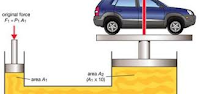
Pressure produced by the effort piston passes through the fluid (water) to the load's piston.

This piston has a larger area and so the pressure from the smaller piston presses on a larger area.

This produces a larger force, in this case 5 times the force.

http://www.dynamicscience.com.au/tester/solutions1/hydraulicus/hydraulics.htm


You might also like:

.

Pascal's Principle and Hydraulics

CLICK HERE . . . to view . . . 

https://puricare.blogspot.com/2020/10/blog-post_92.html

...........................................................................................................................................................................................................................................................................................

Hydraulics And Pneumatics

CLICK HERE . . . to view . . . 

https://puricare.blogspot.com/2019/04/hydraulics-and-pneumatics-both-systems.html

...........................................................................................................................................................................................................................................................................................

Fluid Dynamics

CLICK HERE . . . to view . . . 

https://puricarechronicles.blogspot.com/2017/12/fluid-dynamics-fluid-dynamics-is-one-of.html

...........................................................................................................................................................................................................................................................................................

 Hydraulic Hammers 

CLICK HERE . . . to view . . . 

https://puricare.blogspot.com/2020/08/hydraulic-hammers-hydraulic-hammer-is.html

...........................................................................................................................................................................................................................................................................................

Hydrology 

CLICK HERE . . . to view . . .  

https://puricare.blogspot.com/2018/12/hydrology-hydrologists-are-large-and.html

...........................................................................................................................................................................................................................................................................................

Weird & Wonderful 

Water Facts

CLICK HERE . . . to view . . . 

https://puricarechronicles.blogspot.com/2017/12/weird-wonderful-water-facts-we-need.html

...........................................................................................................................................................................................................................................................................................

God’s Flawless Design of Water 

CLICK HERE . . . to view . . . 

https://puricarechronicles.blogspot.com/2020/11/gods-flawless-design-of-water-makes.html