Showing posts with label Road safety. Show all posts

Wednesday, July 3, 2019

BLACK TIRES - The main reason for black tyres on cars today is the chemical compound ‘carbon black.’ It is used as a stabilizing chemical, which is combined with other polymers to create the tread compound of a tyre. Once added to the rubber, carbon black increases the strength and durability of the tyres, which is understandably seen as a desirable trait for tyre manufacturers and car drivers. One way carbon black expands the lifespan of tyres is by conducting heat away from parts of the tyre that tend to get particularly hot when driving, such as the tread and belt areas. Carbon maintains the quality of tyres by protecting them from UV light and ozone, which are known to deteriorate tyres.

tyres
........................................................................................................................................
Black Tires
tyres
Why Most Tyres Black Not Any Other Colour? 

Benefits Of Black Tyres


While the very first tyres were created from bands of the iron placed on wooden wheels of carts and wagons, the first rubber car tyres which were invented in 1895, were in fact, white.
So why are these white tyres not around today?
Although the natural colour of rubber is a milky white, the black colour we see was originally caused by soot.
The soot was thought to increase the durability of the tyre along with cotton threads, which were inserted in order to reduce heat and increase stability.
Natural rubber is off-white in color, and in fact the first rubber tires were white.  
Pure vulcanized rubber is soft and wears out very quickly, however, and tends to heat up and deform under load. 
So you want to mix something in with the rubber that adds temperature stability and hardness — originally this was typically zinc oxide which made the tires bright white in color.
However, the main reason for black tyres on cars today is the chemical compound ‘carbon black.’
It is used as a stabilizing chemical, which is combined with other polymers to create the tread compound of a tyre.
Once added to the rubber, carbon black increases the strength and durability of the tyres, which is understandably seen as a desirable trait for tyre manufacturers and car drivers.
One way carbon black expands the lifespan of tyres is by conducting heat away from parts of the tyre that tend to get particularly hot when driving, such as the tread and belt areas.
tyresCarbon maintains the quality of tyres by protecting them from UV light and ozone, which are known to deteriorate tyres.
The above are specialty tires from Double Star Tyre, a Chinese manufacturer, and are mostly intended for show use (these likely use standard plastic pigments along with silica filler — similar compounds are used for sneaker soles — this provides good traction but much poorer wear characteristics than carbon black).
tyresA somewhat more mainstream variant is the Scorcher tuner-car tire from BF Goodrich, which has embedded colored bands:
So it’s possible to make useful tires with pigmentation other than carbon black. 
However, no other readily-available filler has been found with the combination of beneficial properties seen in carbon black.
Other Benefits Of Black Tyres
Not only do the black tyres increase strength and durability, they also largely affect the safety of your driving.
Having stronger, long-lasting tyres means you will have a more reliable drive.
Tyres could be considered the most important part of your vehicle as they affect almost every performance factor from handling and acceleration to braking and ride comfort.
It, therefore, comes as no surprise that black tyres are the most popular manufactured today.
When it comes to looks, although black may be considered boring, they are definitely easier to clean. 
They are therefore more practical than the white wall tires or fully white tires which are sometimes seen to be more luxurious, particularly on classic cars.
While some novelty cars with colorful tyres might exist, they aren’t considered suitable for daily driving.
The plain black tyres, though they may seem dull, are chosen for a very important reason; tyre durability and road safety.
The black colour is a good absorber of heat and can absorb the sun rays better when a vehicle is out in open under the sun, the wear and tear will be very minimal as compared to any other colour.
During the run of the vehicle, the tyres tend to get hot and the speciality of the black colour is that it does absorb heat fast and can return it back to the roads as well, so the temperature though hot but still remains balanced.
There are also practical considerations; colored tires would be harder to keep clean and might tend to clash with the color and style of the car itself — even if multiple colors were made and stocked (itself a logistical challenge that would increase prices) there would be many color shade combinations that clashed, while “black goes with everything.”
tyres

Friday, December 29, 2017

BASIC ROAD MARKINGS IN PH - Reading road markings is an important skill for new drivers, yet it's one that even veteran drivers seem to lack. Perhaps it's because our road signage and markings seem to be in a perpetual state of flux, and even the authorities painting them often seem puzzled by where they should actually go.

.
Basic Road Markings
Must-know: All the basic road markings in PH and what each one means
Niky Tamayo


Reading road markings is an important skill for new drivers, yet it's one that even veteran drivers seem to lack.
Perhaps it's because our road signage and markings seem to be in a perpetual state of flux, and even the authorities painting them often seem puzzled by where they should actually go.
When you find lane markings directing you into a telephone pole planted in the middle of the road, it's probably best to use your better judgment instead.
Even so, it can't hurt to familiarize yourself with these basic lane markings, because they might save your life.
1. Solid white shoulder line. This denotes the edge of the roadway. Any asphalt or concrete surface beyond this line should not be used during the normal operation of your vehicle. 
2. Diagonal white lines. An area filled with diagonal white lines and bordered by solid white lines is not considered part of the roadway, and vehicles are expected to stay off unless there is an emergency. These areas are often used to ease the flow of traffic where roads diverge or intersect.
3. Broken white center line or lane divider. This denotes the center of a two-lane road, or marks the division between lanes on multi-lane roads. It is a reminder to stay in your lane. Straddling the line is illegal and punishable under the law. As the line is “broken,” however, this means it is legal to cross it when overtaking or changing lanes. Bear in mind that vehicles continuing in a straight line within their lane automatically have right of way, so wait for your turn.
4. Solid white center line. This is often used to divide traffic on a two-way multi-lane road. As this is a solid line, you are discouraged from overtaking over it unless the way is absolutely clear.
5. Solid white double center line. You are forbidden from overtaking over this line, but you may make left turns over it, provided the way is clear. Remember, however, that oncoming traffic still automatically has right of way.
6. Solid yellow double center line. As we noted a while back, this line indicates that it is unsafe to overtake at any time. It is often found around blind curves or in areas where fast-moving two-way traffic meets on an undivided road.
7. Mixed center line/solid yellow with broken yellow or white line. This indicates that only one side can overtake--the side with the broken line. This is often found entering curves where the view is obstructed coming from one direction, but is clear from the opposite side.
8. Solid white lane divider. These are often found near intersections, and are reminders to stay in lane. As a practice, if you're turning at an intersection, it's best to get into the turning lane 50m before the intersection, while the lane divider is still broken.
9. Directional arrows. When combined with solid white lane dividers, they indicate which directions you are allowed to go within a lane. If the arrow points forward only, you cannot make a turn from that lane. If it points forward and to the side, you can either go straight or turn. If it points only to the side, you must turn within that lane. Ignoring these arrows might just get you a ticket, or worse, get you into an accident.
10. Broken blue lane divider. This indicates the motorbike lane along major thoroughfares. The broken line indicates that you can move into and out of it, but the lane is preferentially for motorbikes.
11. Solid yellow lane divider. This indicates the bus lane on EDSA, but can also be used to indicate bicycle lanes in some areas. Bicycle lanes may also be indicated by solid white lines on the side of the road.
12. Broken yellow lane divider. This indicates areas where you can merge into the bus lane in preparation for turning off EDSA.
13. Mixed double lane divider/solid yellow with broken yellow or white line. This indicates that traffic on the solid yellow side cannot cross lanes, while traffic on the other side may do so if the way is clear. This is often used where smaller arteries merge into main roads or where feeder roads merge onto the highway.
14. Rumble strips. These tightly spaced horizontal white lines not only give your car's suspension a bit of a workout, they also indicate hazards ahead, such as dangerous curves or merging traffic. 
15. Solid white horizontal line. This indicates where you must stop at a stoplight or stop sign. 
16. Zebra crossing. This indicates a pedestrian crossing zone. Stopping over this at a red light is a traffic violation, so make sure to pay attention to those light timers!
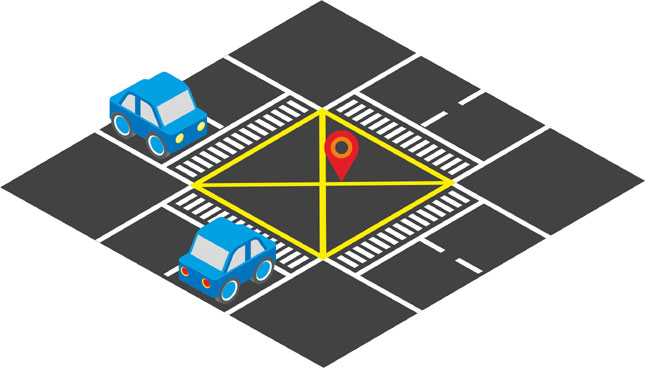
17. The yellow box. This box indicates the part of the intersection that must--by law--be kept open at all times. Even if you have a green light, if the traffic is stopped on the other side ahead, it's best to wait until there's enough space for you to clear the yellow box. Even in the absence of a light, the yellow box must be kept clear.
Memorize these road markings and you will be more law-abiding than 90% of drivers on Philippine roads, guaranteed.
And hopefully safer as well.

Niky Tamayo
Writer
Niky's first automotive article was a 5,000-word essay on Life, the Universe and the Suzuki Alto. The published version was slightly more readable. Niky joined Top Gear Philippines on the promise of someday getting to braid James May's hair. He's still waiting.
.
Multi-Media Filter, Highly-Activated Carbon Filter,
Zeolite-Process Water Softener With Brine Tank,
Fiberglass Ballast-Type Pressure Tank
(fully automatic backwash & regeneration)
PURICARE 
INDUSTRIAL 
ENTERPRISES 
Water 
Treatment 
Systems
.
.
...
Aganan, Pavia, Iloilo, Philippines
...

CLICK HERE . . . to view company profile . . .


Friday, June 9, 2017

HORIZONTAL LINES ON THE ROAD - They are called rumble strips. Believe it or not, they’re not meant to give you a speed boost, nor to engage you to a time travel of some sort. These lines are a road safety feature that was first used back in 1952. There are 4 types of rumble strips: continuous shoulder, centerline, continuous lane, and the most common here in the Philippines, the transverse.

Horizontal Lines On The Road
What are those horizontal lines you see on the road for?
Jacob Oliva


It’s more likely that you’ve already seen (or experienced) multiple horizontal lines that look like parallel pedestrian lanes on the highway.
They make a pretty annoying sound and vibration when you pass through them, right?
They are called rumble strips. Believe it or not, they’re not meant to give you a speed boost, nor to engage you to a time travel of some sort.
These lines are a road safety feature that was first used back in 1952.
There are 4 types of rumble strips: continuous shoulder, centerline, continuous lane, and the most common here in the Philippines, the transverse.
Basically, the first 3 are designed to warn you that you’re not in the correct lane anymore.
Transverse rumble strips (TRS), on the other hand, tell you that you need to slow down because of an upcoming intersection, stopping point, construction zone, or toll plaza.
You usually see them on expressways and multiple lane avenues where cars are faster. In our country, TRSs are also placed in the middle of long, boring highways—like the Tarlac-Pangasinan-La Union Expressway (TPLEX)—to keep you awake.
Its effectivity has been proven over time. In fact, U.S. Federal Highway Administration Research and Technology conducted a research and concluded that TRSs that TRSs can be effective in reducing severe injury crashes.
Next time someone asks you what those lines are, you know what to answer them.

Jacob Oliva is a poet, a singer/musician, and an enthusiast of anything with wheels. He has a passion about cars and writing, which sprung from his ability to create music and poetry. A bit of a stretch, yes, but it plays out for him as AutoDeal's Associate Content Editor.

https://www.autodeal.com.ph/blog/what-are-those-horizontal-lines-you-see-road
RELATED POSTS:

How Your GP
Works
CLICK HERE . . .
Leave No Trace
CLICK HERE . . .
Octane Rating
What does octane mean? 
CLICK HERE . . .
Lightning 
Strikes
Lightning Warning Signs You Shouldn't Ignore
CLICK HERE . . .
Israeli Technology Turns Air Into Drinking Water For Troops
CLICK HERE . . .

Multi-Media Filter, Highly-Activated Carbon Filter,
Zeolite-Process Water Softener With Brine Tank,
Fiberglass Ballast-Type Pressure Tank
(fully automatic backwash & regeneration)
PURICARE 
INDUSTRIAL 
ENTERPRISES 
Water 
Treatment 
Systems
.
...
...
Aganan, Pavia, Iloilo, Philippines
...

CLICK HERE . . . to view company profile . . .